
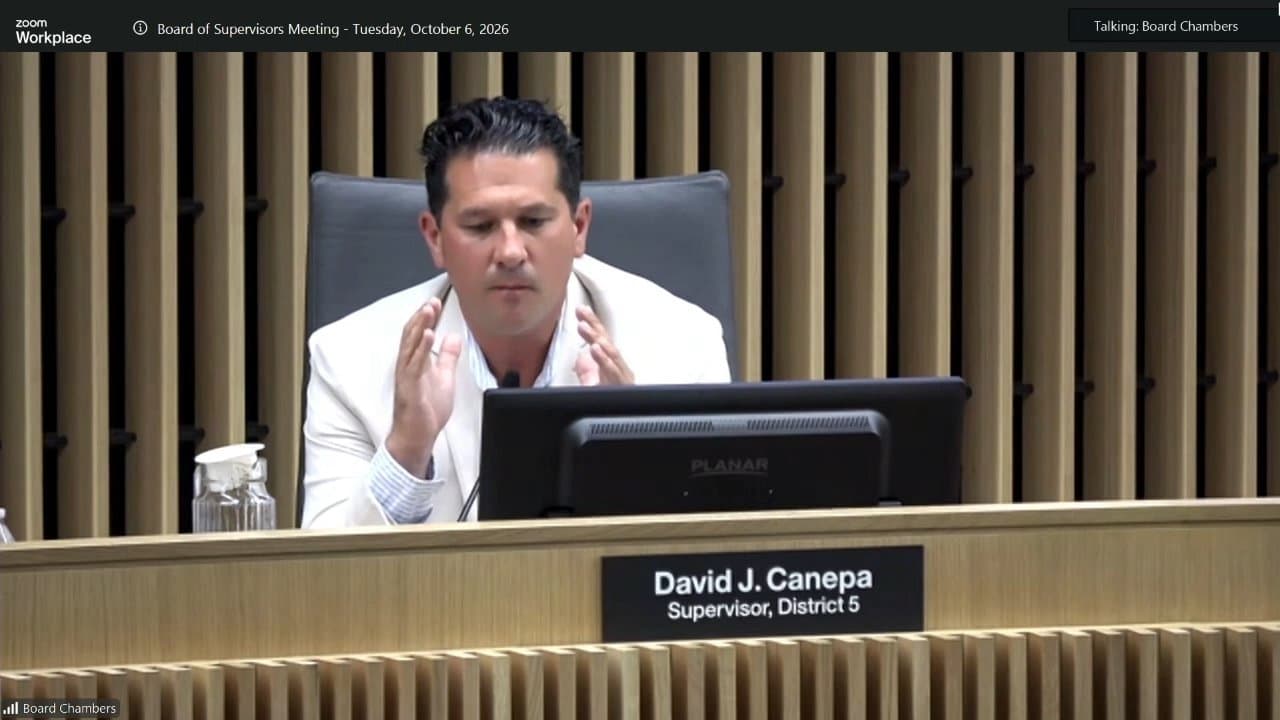
Divided Supervisors Oppose Prop 43 as Housing, Census Moves Pass Unanimously
Board of Supervisors • San Mateo CountyOctober 6, 2026
Locunity is an independent informational service and is not an official government page for this commission. All information is sourced from public footage and an analysis of official agendas with the aid of responsible, fact-checked AI. to report an error or omission.
San Mateo County supervisors split 3-2 on Oct. 6, 2026, to oppose Proposition 43, a statewide measure that would make citizen-initiated local special taxes harder to pass. The vote exposed a widening board rift over taxes as the county weighs a $1.4 billion vehicle license fee problem. On housing, the census and farmworker water safety, the board acted unanimously.
Board opposes Prop 43, 3-2, after Speier and Mueller accuse wealthy interests of exploiting citizen initiatives
Rezoned North County districts must build lower-income units on site, ordinance adopted 5-0
County will formally oppose the federal 2030 Census rule and enlist regional bodies before the Nov. 2 deadline
HR confirms union talks on more office time and possible monitoring of remote workers
Farmworker water monitoring ordinances introduced 5-0 after widespread E. coli findings
Environmental groups deliver 1,486-signature petition to end county pesticide use
Prop 43 Splits the Board
The basics: Under the Upland decision, a court ruling, citizen-initiated special taxes can pass by simple majority. Prop 43 would raise that threshold to two-thirds.
Why it matters: The vote signals a narrow majority that wants to keep easier paths to local tax measures open, while two supervisors argue the citizen-initiative route has been captured by organized interests.
Where things stand: Staff recommended opposition, but Supervisor Jackie Speier (District 1) pulled the item from consent. Legislative officer Connie Juarez-Dirollo traced Prop 43 to a Howard Jarvis Taxpayers Association proposal. She said CSAC, the League of Cities and the California Special Districts Association oppose it, and that the county's legislative program already supports lowering tax thresholds.
Board President Noelia Corzo listed measures in Los Angeles, San Francisco, San Diego and Alameda that she said would have failed under Prop 43, including a $143 million-a-year firefighting measure passed after the Palisades fires.
“Under Prop 43, if voters try to pass this measure to make corporations pay their fair share, corporations would only need 1/3 of the vote to block such initiatives,” said Corzo.
Supervisor David Canepa (District 5), who moved the resolution, cited opposition from firefighters and SEIU. “This county has a huge issue to deal with, and this issue is called VLF, which many are familiar with. It's $1.4 billion,” he said, referring to the vehicle license fee.
The other side: Speier argued the regional transportation measure's qualifying campaign was funded by wealthy interests, producing a sales tax that burdens the poor.
“The citizens' initiative that qualified the regional transportation measure on the ballot spent $7 million. Those weren't citizens,” said Speier. She added: “I want to be registered as a no vote on this resolution because I support Proposition 43.”
Vice President Ray Mueller (District 3) called it a fiscal-architecture question for voters. “I don't think the county should be endorsing in this race, in this election,” said Mueller.
Tempers flared: After a dissenting supervisor cited polling that 71% of California voters believe they are overtaxed, Corzo replied, “Okay, sure, but when it's someone's pet project, it's okay though, right?” The remark, aimed at a colleague's past interest in a county sales tax, drew an objection that no county sales tax was ever placed on the ballot.
Decisions and stakeholder impacts: The resolution passed (For: 3, Corzo, Canepa, Supervisor Lisa Gauthier (District 4); Against: 2, Speier, Mueller; Absent: 0). The clerk announced the result as 3-0, so the official minutes should confirm the tally. Explaining their votes, Mueller said, “I will not support this board raising the sales tax to supplement any VLF shortfall, and my vote is no.” Canepa said, “Yes, and I will support a tax that supports our cities and counties.” Unions and local government associations gain an official county ally. Taxpayer advocates and fixed-income residents who spoke earlier in public comment did not.
North County Rezoning Gets Stricter Affordability Rules
Why it matters: The fix protects the county's state-certified housing element. Staff conceded, however, that it could make small parcels unbuildable.
The basics: In April 2026, the board created three higher-density districts (R3-MD, PC-HD and TS-MU) in the Colma, Broadmoor and Harbor Industrial areas to meet its RHNA, or Regional Housing Needs Allocation. The countywide inclusionary ordinance requires 20% below-market-rate (BMR) units in projects of five or more units. It also allows moderate-income units and, at county discretion, in-lieu fees, off-site transfers, land dedication or rehabilitation.
Where things stand: “The state law requires that in any areas rezoned to implement an adopted housing element, 20% of the units built in that rezoning area must be affordable to lower-income households,” said Bharat Singh, Planning Services Manager. He said the state Department of Housing and Community Development (HCD) raised the conflict only at the very end of certification.
The new ordinance requires on-site BMR units affordable only to lower-income households in those three districts. Moderate-income units and other alternatives are no longer allowed there. Singh said the rest of the county is unaffected.
The other side: Corzo asked, “If we see an unintended consequence like less housing being built because of this amendment to our ordinance, could we re-amend it and still be in compliance with a future housing element?” Singh answered, “There is a potential for that to happen where really small parcels may not be feasible to be built.” He said the county would offer incentives but could not predict HCD's stance.
Decisions and stakeholder impacts: The ordinance was adopted 5-0 on Canepa's motion, following a Sept. 9 Planning Commission recommendation. Developers in the districts lose fee and moderate-income options. Lower-income renters gain guaranteed on-site units. Canepa, who thanked Planning Director Steve Monowitz, said, “I always look at sort of unincorporated area as what could potentially be the Redwood City of the North.”
County Joins Fight Against 2030 Census Rule
Why it matters: Dr. Megan Gall of Blockwell Consulting, who is preparing the county's demographic report, warned the rule could undercount children and immigrants. She said it would also erode data that guided $2.8 trillion in federal funds.
Where things stand: Gall said the Sept. 10 proposed rule would limit apportionment to citizens and lawful permanent residents, ban race, ethnicity and sexual orientation questions, and add a legal-status question. It would also redefine residence using tax records. “It covers at most 77% of the population, which leaves roughly 1 in 4 people with no tax record to back up where they live,” Gall said. She noted the 2020 count undercounted children under 5 by 5.4%. “And if you can't see discrimination, you can't fix it,” she added.
Co-sponsor Corzo argued the rule violates the 14th Amendment and would weaken California's congressional voice. “These rules are designed to specifically hurt urban and Democratic-leaning communities like ours,” she said. She also announced a new county contract with the Bay Area Habeas Network.
Canepa tied the stakes to the county's public hospital. “I think we need to send it to the governor of California,” he said.
Decisions and stakeholder impacts: The resolution was adopted 5-0 on Corzo's motion. Her amendment directs the county to notify regional bodies it belongs to and invite them to comment. Immigrant households and safety-net services have the most at stake.
What's next: The extended federal comment deadline is Nov. 2, 2026.
Remote Work Fight Moves to Bargaining Table
Why it matters: Telework and monitoring decisions affect recruitment and retention. Only 56% of county employees live in San Mateo County, according to Human Resources Director Michelle Kuka.
Where things stand: During department performance reviews, Speier asked every department to report in-office schedules. “How many work 4? How many work 3? How many work exclusively remotely?” she asked. She said she had heard 75% of Public Works administrative staff work remotely. Public Works Director Tory Newman responded, “All DPW staff work minimum of 3 days a week in the office, including admin staff.”
Kuka said the county is “currently in the meet and confer process with our unions on an increased in-office presence.” Meet and confer is the legally required negotiation process with labor unions. When Mueller asked whether the county is weighing surveillance tools for remote employees, Kuka said, “There are discussions in a meet and confer process about that.”
The other side: Canepa noted a fundamental difference with colleagues on remote work, citing productivity tools and affordability. “To afford a home in San Mateo County, you need to make combined income $500,000,” he said.
What's next: “So I'm officially requesting that we agendize it here in this space so that we can dig into the housing needs of our employees,” said Corzo, referring to an employee housing survey. Speier also pressed Newman on a recently dedicated park that ran 30% over its $11.6 million estimate. County Executive Officer Mike Callagy cited a landslide, and Newman cited field-designed ADA paths. Landslide costs will be reported back.
Coastside Health: Water Rules and Pesticide Petition
Water: “A majority of tested farm labor housing sites' water systems not under a regulatory program were found to have positive results of E. coli,” said Charles Ice, Environmental Health Services Director. Owners fixed those systems, but the rewrites of Chapters 4.68 (wells) and 4.64 (domestic water systems) create ongoing monitoring and reference state standards.
Karen Curtis of Red Dot Ranch and the PMAC Housing Task Force backed the intent and asked for a commitment to amend the rules if they cause problems on the South Coast. “My request today is that there is an opportunity for our community and local stakeholders to review the ordinances with more time and help provide input to fine-tune them,” said Rita Mancera, Executive Director of Puente. Sid Young of Montero Water and Sanitary District asked whether the rules cover all coastside wells, but the question went unanswered. Mueller said he had referred stakeholders to Deputy County Executive Calderon. Both ordinances were introduced 5-0 on Mueller's motions.
Pesticides: In an organized push, El Granada Advocates, Protect Our Watersheds San Mateo County and Nontoxic Neighborhoods made four asks. They want a moratorium on harmful products, independent community oversight, written approval before pesticides are used as a "last resort," and a ban on pesticide rewards programs. “Today we submit our petition of 1,486 signatures asking San Mateo County to transition to nontoxic land management,” said Melinda McNaughton of El Granada Advocates. “Your own records show 626 acres were treated with herbicides in 2024, up from 444 acres in 2023,” said Kim Conte of Nontoxic Neighborhoods. The groups credited Mueller for a 2024 pesticide report and a contractor rebate ban. The petition was not on the agenda, so the board took no action.
Minor Items
Measure K: The board approved a $36,250 upfront payment on a $145,000 grant for the Center for Age-Friendly Excellence after Speier questioned departing from reimbursement-only funding. Five ayes were recorded, though the clerk announced 4-0.
Proclamations: All passed unanimously, honoring Dr. Harvey Kaplan, Disabilities Awareness Month, Indigenous Peoples' Day, Fire Prevention Week and National Coming Out Day. The last drew one objector.
Ballot and emergency: On consent, the board endorsed the $11.25 billion Prop 1 housing and veterans bond and extended the Pacifica Pier emergency.
Contract increases: The Minuteman Press printing contract rose from $1M to $3M. The Tunitas Creek Beach change order added $926,646.71, bringing the total to $15,179,727.71.
Other consent contracts: The board approved $2M in sewer inspection contracts, a $579,447 public health lab grant, a $616,000 Stanford e-consult contract, and jail programs worth $405,625 and $535,236.
Looking ahead: Census comments are due Nov. 2, 2026. Corzo's employee housing item awaits scheduling, and the South Coast Traffic Advisory Panel will be honored at the board's next meeting.