
Board of Supervisors - Apr 21, 2026 - Meeting
Board of Supervisors • San Mateo CountyApril 21, 2026
Locunity is a independent informational service and is not an official government page for this commission.We use AI-assisted analysis and human editorial review to publish information.
Board Adopts Largest Housing Upzoning in County History Near Colma BART
The San Mateo County Board of Supervisors cleared a major housing milestone on April 21, adopting an amended Housing Element on a 4-1 vote and creating three new high-density zoning districts that Supervisor Canepa called the largest housing upzoning the county has ever approved. The marathon session also saw the introduction of a first-in-Bay-Area ban on kratom products, alarming data on youth suicide, and $6 million in federal funds directed toward affordable housing and homelessness services.
Board adopts amended Housing Element 4-1, creates three new zoning districts near Colma BART enabling up to 150 units per acre
First-in-Bay-Area ordinance introduced banning kratom and synthetic 7-OH products; chronic pain patients urge regulation over prohibition
988 crisis contacts in San Mateo County up 160% in 18 months; school data show two students per classroom have attempted suicide
$6M+ in federal housing funds approved for affordable housing, childcare, homelessness services, and community development
Supervisors push for eviction tracking ordinance as displacement pressures mount countywide
Historic Housing Upzoning Clears Path for State Certification
The Board took its most consequential land use actions in years, adopting an amended 2023-2031 Housing Element and immediately implementing phase one of a rezoning program that creates hundreds of new housing sites near transit.
Why it matters: Without a certified Housing Element, San Mateo County has been locked out of state housing grants worth tens of millions of dollars and exposed to "builder's remedy" — a state law provision that lets developers bypass local zoning when a jurisdiction lacks a compliant plan. The votes end that vulnerability.
Where things stand: Housing planner William Gibson presented a revised strategy that separates the timeline: the Board could immediately adopt Bayside rezoning while continuing to work on El Granada coastal sites over the next six to eight months. The amendment raises maximum density from 120 to 150 units per acre for Bayside sites, adds a parcel in unincorporated Colma, and nearly doubles the county's housing surplus to 1,011 units. HCD confirmed the amendments remain compliant with state law, and the Planning Commission recommended adoption on April 8.
Gibson explained the stakes of inaction:
"It allows developers to in some sense ignore our regulations regarding height, regarding size of a project, regarding the location of a project. Residential development can happen in areas that are not zoned for residential development."
Three new zoning chapters were created: PC-HD (Planned Colma High Density), R3-MU (Residential Mixed Use), and TS-MU (Transit Supportive Mixed Use). Standards include 75-foot height limits, one parking space per unit (0.5 for TS-MU near transit), and objective design standards.
Supervisor David Canepa strongly supported the Colma upzoning, pointing to the underdeveloped Mission Street corridor and its proximity to Colma BART.
"We're making history today. We're making history because I think what we've done is we've approved by density the largest housing upzoning," he said.
Canepa pressed staff on the full range of consequences including loss of grants, builder's remedy exposure, state notice of violation, and potential loss of land use authority.
The other side: Supervisor Ray Mueller voted no on the Housing Element amendment, stating plainly:
"I can't support the amount of density that's within this currently at the El Granada sites."
However, Mueller voted yes on the Bayside-only rezoning ordinance after being assured it did not include El Granada. Coast-side resident Dan Haggerty argued the housing projections are based on population numbers that did not pass the state Department of Finance audit and urged neighborhood-compatible housing. Jeremy Levine of the Housing Leadership Council supported certification, noting the organization had been advocating since November 2022.
County Executive Mike Callagy criticized the state process itself:
"Where it's mostly broken is receiving timely feedback, consistent feedback that would allow us to move forward with this."
Board President Noelia Corzo raised fair housing concerns, emphasizing the need for equitable distribution of upzoning:
"We can't just expect certain communities to bear that burden. Everyone has to shift just a little bit, and we have to make sure that it's equitable."
Decisions: The Housing Element amendment passed 5-0.
What's next: Staff will continue working on El Granada coastal site planning over the next six to eight months. The rezoning positions Colma BART-adjacent parcels, Broadmoor, and Harbor Industrial sites for transit-oriented development at up to 150 units per acre.
First-in-Bay-Area Kratom Ban Sparks Debate Over Natural vs. Synthetic
Supervisor Ray Mueller introduced an ordinance banning the sale and distribution of kratom and 7-hydroxymitragynine (7-OH) products, making San Mateo County the first of nine Bay Area counties to take such action.
The basics: Kratom is a plant-derived substance increasingly sold at gas stations and smoke shops. The FDA warns that 7-OH, a synthetic derivative, is 13 times more potent than morphine. Mueller described discovering a smoke shop in West Menlo Park marketing kratom alongside youth apparel and whippets.
Why it matters: Mueller framed the products as the next stage of the opioid epidemic:
"Kratom and 7-OH really have become known as what's referred to in this SF Gate article as gas station heroin. It is destroying lives up and down the state."
The ordinance uses the county's police power to prohibit sale, declares violations a public nuisance and misdemeanor, and allows revocation of tobacco retailer permits. Public Health Officer Dr. Kismet Baldwin-Santana endorsed the measure.
The other side: Nine public commenters spoke, with the overwhelming majority urging the Board to distinguish between synthetic 7-OH — which all supported banning — and natural leaf kratom, which they described as a life-changing pain management tool. Shannon Lee, a healthcare worker, credited natural leaf kratom with managing her chronic back pain. Other commenters included chronic pain patients and a retired nurse practitioner who noted neither the FDA nor HHS has moved to ban natural kratom.
Mueller acknowledged the difficulty of distinguishing natural and synthetic products from packaging alone and said the state legislature should determine any future regulatory carve-outs.
Decisions: The introduction passed 5-0. Supervisors Speier, Gauthier, and Canepa all praised Mueller's leadership.
What's next: A second reading and final adoption vote is required before enforcement begins.
988 Crisis Contacts Surge 160% as Youth Data Sound Alarm
The Board proclaimed May 2026 as Mental Health Month, but the data presented by behavioral health staff turned the ceremony into a sobering policy discussion.
Why it matters: A representative from the Peninsula Suicide Prevention / Felton Institute reported that 988 crisis line contacts in San Mateo County have risen 160% in 18 months, with recurring themes of loneliness, resource navigation struggles, and the need for preventative outreach. Older adults and LGBTQ residents are at especially high risk.
Walter Ng, also of Peninsula Suicide Prevention, shared data from school presentations that stopped the room:
"In a classroom of 30, there will be six students in that class who have engaged in or thought about self-harm, four who have thought about suicide, and two that would have made attempts."
Supervisor David Canepa proposed a practical solution for awareness:
"I was just thinking about people's property tax bills or some sort of effort that doesn't require a lot of resources."
Supervisor Jackie Speier pushed for broader 988 promotion beyond May, suggesting utility bills as another vehicle. Supervisor Ray Mueller requested reports on emerging stressors identified through 988 data. Board President Noelia Corzo shared plans for a "friendship bench" at Coyote Point park and described her own End the Silence training at Aragon High School.
Decisions: Passed 5-0. Supervisor Gauthier seconded the motion co-sponsored with Canepa.
$6M in Federal Housing Funds Approved; Eviction Concerns Rise
Why it matters: The Board adopted the FY 2026-27 Annual Action Plan covering CDBG, HOME, and ESG allocations totaling $3.77 million from HUD, supplemented by program income and state ESG for a total of just over $6 million. Federal allocations have been slowly decreasing, making every dollar more consequential.
Where things stand: Director of San Mateo County's Department of Housing Ray Hodges and Housing Supervisor Karen Coppock of the Department of Housing presented the plan. Key investments include the Mercy Middlefield Junction Childcare Center, the Ridge and Masonic 63-unit affordable housing project in Belmont, minor home repair programs, and public service grants for legal aid and food programs.
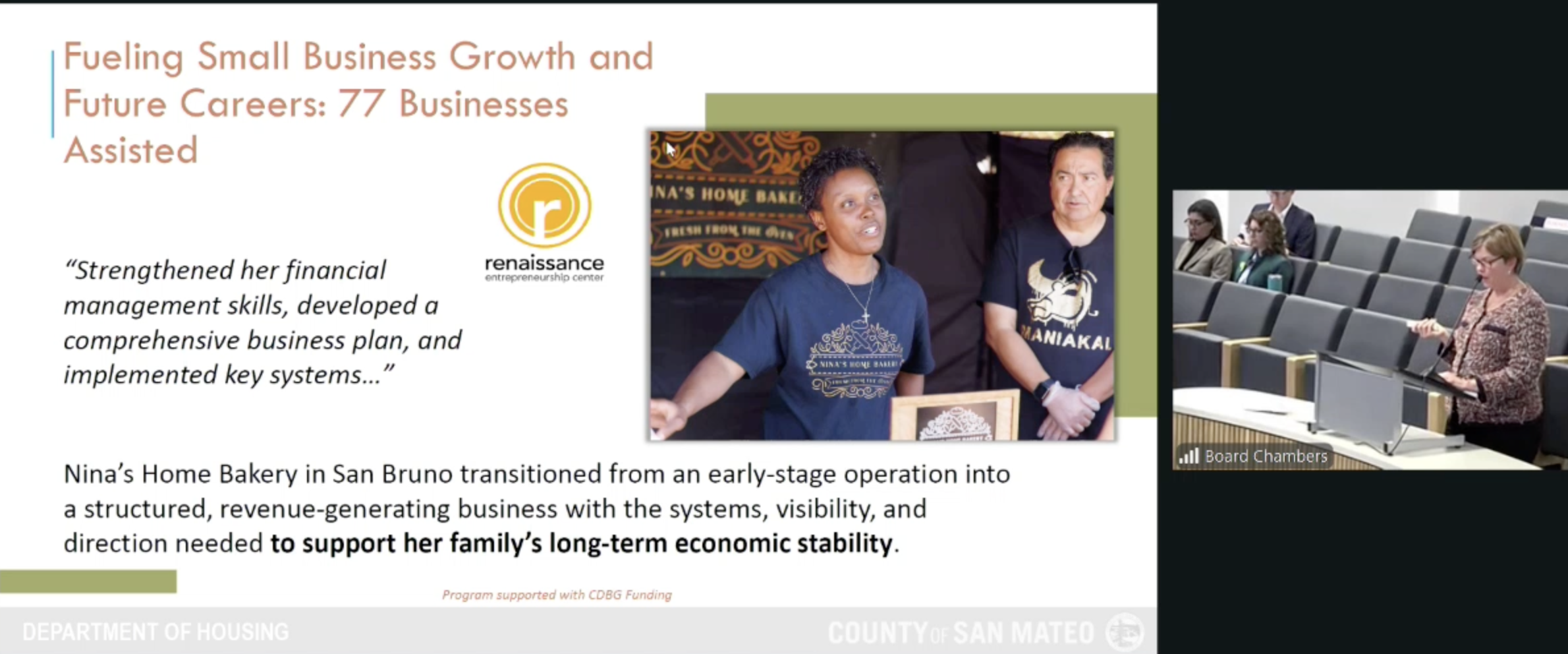
Coppock shared case studies that illustrated the human impact: a San Bruno resident whose grab bars prevented further falls, a Burlingame resident who achieved 290 days of sobriety through Cal Primrose services, a Belmont family protected from landlord harassment by Project Sentinel, and Nina's Home Bakery in San Bruno launched with support from the Renaissance Center.
Supervisor Jackie Speier raised the urgency of rental assistance, citing the book Evicted and its lessons on displacement prevention:
"If we can keep people in their rental housing, maybe provide some wraparound services, they are still there five years later."
She also asked about an additional $250,000 and where childcare investment gaps exist in the northern and coastal parts of the county.
President Noelia Corzo referenced an existing draft tenant protection ordinance from 2023 and highlighted interest from SAMCAR at Progress Seminar. Supervisor Lisa Gauthier asked about tracking indicators before evictions happen. The county executive advocated for an eviction reporting ordinance.
Decisions: Passed 5-0.
What's next: The eviction tracking ordinance and rental assistance program modifications are likely to surface in upcoming policy discussions.
County Launches Climate Action Dashboard, Reports Fleet Progress
Supervisor Lisa Gauthier and President Noelia Corzo co-sponsored the Earth Day proclamation, which was paired with a substantive presentation from the Sustainability Department.
Director Jasneet Sharma reported progress across three pillars: transforming systems, catalyzing regional solutions, and empowering communities. Key accomplishments include the Edible Food Recovery Program providing over half a million meals monthly, transitioning 10 low-income homes to all-electric appliances through a Peninsula Clean Energy grant, training 150 local contractors, achieving a 32% zero-emission county fleet, and launching a public Climate Action Dashboard that went live the day of the meeting.
Supervisor Jackie Speier honored the late Congressman Pete McCloskey as co-chair of the first Earth Day in 1970, connecting it to the Clean Air Act, Clean Water Act, and Endangered Species Act. Corzo highlighted communities facing disproportionate environmental impacts:
"We do have areas in our county that face significant air pollution, urban heat impacts, and often flooding risk — more so than other communities. Those communities are North Central San Mateo, East Palo Alto, Redwood City, and San Bruno."
A coast-side resident pointed out the lack of bike infrastructure connecting Moss Beach to Half Moon Bay.
Decisions: Passed 5-0.
Minor Items
American Muslim Appreciation Month: The Board unanimously proclaimed April 2026 as American Muslim Appreciation and Awareness Month. Maya Falaha of the Yasine Foundation accepted, highlighting Muslim Americans' roles as business owners, educators, healthcare professionals, and first responders, and partnerships with Second Harvest Food Bank. Supervisor Canepa publicly distanced himself from President Corzo's remarks about international affairs, saying they were outside the scope of the agenda item.
Measure K grants ($100,000 total): Supervisor Gauthier secured five District 4 grants: $35,000 to Community Initiatives/BACHAC for youth behavioral health leadership; $12,000 to CityTrees for approximately 100 trees in Redwood City; $28,000 to All Five for early childhood mental health therapists in classrooms; $15,000 to PAL Center for Friendly Acres neighborhood organizing; and $10,000 to Ravenswood Family Health Network for an advanced lensometer. All approved unanimously.
Study session calendar: The Board discussed upcoming study sessions covering juvenile justice and probation (June), Article 34 (June or August), senior housing (August), shared prosperity (September), and AI policy (date TBD). Supervisor Speier warned that Meta's planned 8,000 layoffs create urgency for the AI and workforce session: "We're going to have a lot of people out of work in San Mateo County." No formal vote taken.
Consent agenda: Approved unanimously, including $23 million for Pescadero Fire Station construction, $30 million in Pacifica School District bonds, $21.4 million in IT procurement, and multiple other resolutions.
Closed session: The Board entered closed session on anticipated and existing litigation matters. No reportable action.