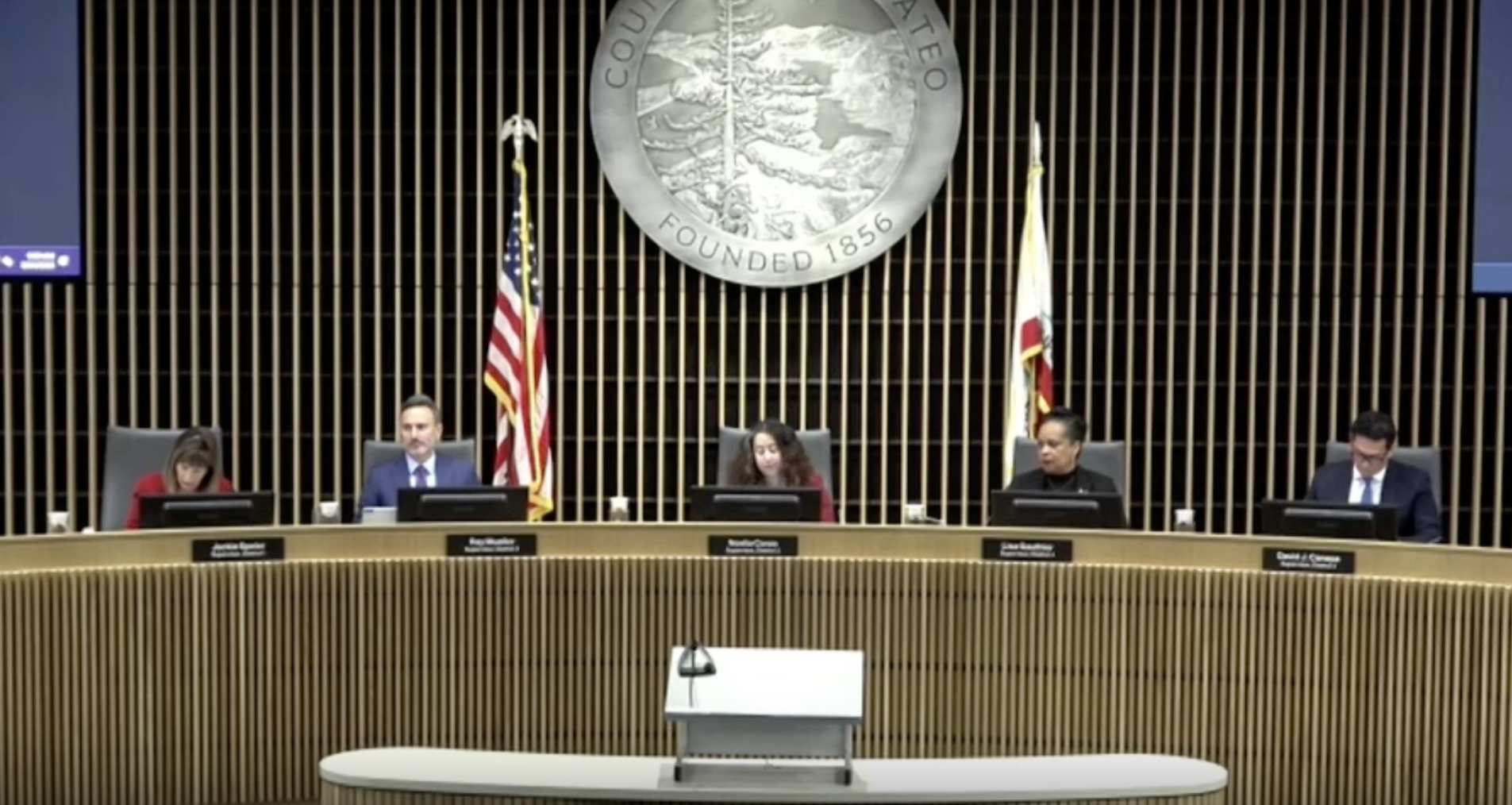
Board of Supervisors - Feb 24, 2026 - Meeting

Board of Supervisors - Feb 24, 2026 - Meeting

Board of SupervisorsSan Mateo CountyFebruary 24, 2026

Sources:

Locunity is a independent informational service and is not an official government page for this commission.We use AI-assisted analysis and human editorial review to publish information.

County Faces $119M State Funding Crisis as Board Debates Labor Standards, Spending Priorities

San Mateo County supervisors confronted one of the biggest fiscal threats in the county's history — a $119 million annual shortfall from a broken state funding mechanism — then spent much of their Feb. 24 meeting navigating labor disputes over a courthouse renovation, philosophical divides over how to spend sales tax dollars, and a political dust-up over the assessor's office. The board also joined a legal challenge to President Trump's effort to eliminate birthright citizenship.

  • $119M annual state funding gap threatens public safety, mental health, and homelessness services countywide; governor's budget includes zero reimbursement

  • Carpenters unions challenge lowest bidder on $7.5M Hall of Justice renovation; board postpones, then approves after confirming 12 of 13 subcontractors are union

  • Five climate advocates push board to back the state Climate Superfund Act making fossil fuel companies pay for damages

  • Supervisor Jackie Speier dissents on three Measure K grants, arguing sales tax revenue should fund countywide priorities, not district projects

  • Board joins birthright citizenship legal fight, authorizing an amicus brief in Trump v. Barbara

  • Assessor's office staffing sparks conflict-of-interest clash after SEIU reports 30% vacancies and a three-year backlog


A Broken Funding Formula Could Cost the County $1 Billion Over Next 10 Years

The basics: The in-lieu vehicle license fee (VLF) is a funding mechanism created during a 2004 state budget deal that replaced direct VLF payments to counties with a substitute tied to non-basic aid school districts. San Mateo County now has only four of 23 such districts remaining, which means the payment mechanism has essentially collapsed. The current shortfall is $119 million countywide — roughly $80 million for the county and the remainder for its 20 cities.

Why it matters: The gap exceeds the county's combined spending on homelessness, affordable housing, literacy, and foster youth programs. The state covered the shortfall through annual appropriations from fiscal year 2019-20 through 2022-23, but in fiscal year 2023-24 reimbursed only $76 million of a $114 million gap. Gov. Gavin Newsom's proposed 2026-27 budget includes zero reimbursement.

Where things stand: The county has filed a breach-of-contract lawsuit against the state. County Budget Official Justin Mates explained the core problem:

"This is not a disappearing revenue source for the state. The money is still in the state budget. Just the mechanism to pull it down to our county doesn't work on a technicality."

Supervisor Jackie Speier warned the damage compounds quickly:

"Over the course of 10 years, it will be a billion dollars of lost revenue to San Mateo County. The number only grows in terms of its impact. And it's truly theft when you think about it."

Supervisor Lisa Gauthier directed her frustration at the governor:

"He doesn't care about San Mateo County. He doesn't care about the people of San Mateo County. As he's preparing to move on to the higher office, you would think he would want to stop and recognize that the people of California have supported him."

Supervisor David Canepa pressed staff on the stakes:

"The cuts are catastrophic. Public safety and emergency response, healthcare, mental health services and programs for seniors and youth, local libraries and parks, homelessness prevention service and affordable housing, wildfire prevention, climate change and sea level initiatives."

Board President Noelia Corzo underscored the compounding pressure from potential federal cuts: "Maybe we could do it for one year, but reserves do run out. And we have a responsibility to our residents to make sure we can continue to serve them."

What's next: Staff said a comprehensive advocacy plan — including building coalitions with Alpine and Mono counties, which face the same broken mechanism, and engaging gubernatorial candidates — would be ready within two weeks. The board also discussed exploring alternative revenue sources, including a gross receipts tax.


Hall of Justice Renovation Approved After Carpenters Unions Force a Pause

Why it matters: A $7.5 million contract to build two new courtrooms and renovate 25,000 square feet in the Hall of Justice became a test case for the board's labor values — and exposed a timing gap between its recently adopted Project Labor Agreement policy (effective July 1, 2026) and current bidding rules.

Where things stand: Nels Delander of Carpenters Local 217 urged the board to pause the award to SBA Construction Inc., citing a $969,000 change order on a Santa Clara County project and reports that the company provides no employee benefits. Harvey McKeon of the North Coast States Carpenters Union echoed the concerns, asking the board to clarify whether SBA employees rely on public safety net programs.

The board voted unanimously to postpone the item to the end of the agenda so staff could investigate.

Supervisor David Canepa expressed the sharpest discomfort:

"We're comparing apples to oranges. We're comparing someone who may not have the extra costs outside of salary. We're not talking about the salary cost. We're talking about the other benefits."

Supervisor Ray Mueller pressed on the gap between board policy and bidding reality:

"When it comes back, I want to know what the difference between what's required in the PLA is and what currently was in the RFP. Because the PLA was something that the board said it wanted to move forward with. And so I want to understand the difference...between the two bids."

Supervisor Jackie Speier acknowledged the cautioned that the RFP was put out before the PLA came into effect, stating, "You can't superimpose a PLA during a time when it hasn't come into effect yet."

County Attorney John Nibbelin confirmed that under the Public Contract Code, the board must accept the lowest responsible bidder or reject all bids — and the PLA does not apply to projects bid before its July 1 effective date.

Decisions: When the item returned later in the meeting, Director of Public Works Ann Stillman reported that 12 of 13 subcontractors are union signatory, workers receive competitive medical benefits and 401(k) plans, and the Santa Clara change orders were owner-initiated scope changes on a hospital project subject to Office of Statewide Health Planning and Development (OSHPD) review — not contractor-caused overruns. The board approved the contract 4-0 (Supervisor Mueller absent for a family matter).

What's next: The PLA takes effect July 1, 2026. Future capital projects above the threshold will be subject to its requirements, but the Hall of Justice debate previewed the tensions the board will navigate during the transition.


Climate Superfund Push: Five Speakers Urge Board to Make Polluters Pay

Why it matters: A coordinated group of five advocates used general public comment to press the board to adopt a resolution supporting the state Climate Superfund Act — legislation modeled after laws in New York and Vermont that would make fossil fuel companies pay for climate damages.

Where things stand: Nancy Tierney of the Climate Superfund Coalition in Pacifica said over 130 elected officials statewide have signed on, and neighboring San Francisco and Santa Clara counties plus more than two dozen other jurisdictions have already passed resolutions. John McKenna of Menlo Park asked the county to also adopt reach codes (local ordinances that exceed state minimums) for heat pump and electric readiness. Brian Schmidt, Executive Director of Menlo Spark, called it "a low-risk, high-reward effort" given other states will bear primary litigation costs. Carlos Davidson, an economist from Pacifica, argued the legislation would not raise gas prices because prices are driven by global crude oil markets and competition prevents pass-through. Arlene Rosenberg of Hillsborough said the bill would raise "hundreds of billions" for climate solutions.

Decisions: No board action was taken during public comment, but the volume and coordination of the speakers signal growing local momentum for the legislation.


Measure K Grants Expose Philosophical Divide Over Spending Priorities

Why it matters: Four Measure K sales tax grants — totaling more than $75,000 — passed the board, but not before Supervisor Jackie Speier drew a line on principle, voting no on three items she characterized as district-specific rather than countywide.

Where things stand: Speier laid out her position clearly:

"I don't believe that Measure K funds should be spent on specific district projects. They should be countywide in nature. I think that's what the public voted on."

The grants and their outcomes:

  • $50,000 for the Middleton Community Road Corporation to replace a 60-year-old wooden bridge serving 35 families in rural La Honda. Bruce Ives of the Middleton community spoke in support. Supervisor Ray Mueller cited emergency access and wildfire evacuation needs. Approved 3-0 (Corzo abstained; Canepa absent). Speier supported this one, citing public safety.

  • $25,000 for wayfinding signs on Highway 92. Krystlyn Giedt, CEO of the Half Moon Bay Coastside Chamber of Commerce, noted that over half of coast visitors don't know a downtown exists, and the signs are part of a $500,000 multi-organization economic development effort. The vote was initially 3-2 with Speier and Canepa voting no; Supervisor Canepa later changed his vote to yes, producing a final tally of 4-1.

  • Funding for a San Carlos School District crossing guard near Tierra Linda Middle School. Speier voted no and urged the Transportation Authority to fund a comprehensive countywide school safety review rather than piecemeal grants. Approved 4-1.

  • Funding for the Union Community Alliance Trades Introduction Program. President Corzo noted declining interest in trades careers nationally and stressed the importance of valuing trades alongside college pathways. Approved 5-0.


Assessor's Office Staffing Becomes a Political Flashpoint

Why it matters: What started as a routine tax roll correction became the meeting's most politically charged moment, laying bare both genuine staffing concerns and the awkward overlay of an upcoming election.

Where things stand: During public comment, Mercedes Segura, SEIU Local 521 chapter chair, sounded an alarm about chronic problems in the assessor's office — 30% vacancies, a three-year backlog on exemption processing, 10,000 unprocessed deeds, and low morale. She called it a leadership problem, not a workforce problem.

Later, Supervisor David Canepa pulled the routine tax roll corrections item from the consent agenda to question Assistant Assessor Jim Irizarry about vacancy rates and a Thornton Beach deed fraud case involving a convicted felon. The exchange grew contentious.

Both Canepa and Irizarry are running for the assessor-clerk-recorder position.

President Corzo attempted to stop the questioning:

"My discomfort is really about the power imbalance in this situation. You are not an elected official at the moment, Mr. Irizarry, and I don't think it's appropriate for our board to have a member questioning you in this way."

Canepa protested:

"I'm putting that on the record, I do feel, as you are a president, you shutting me down, I think, is totally, totally unprofessional," noting that Corzo has endorsed Irizarry in the assessor-clerk-recorder race.

Irizarry responded during the questioning that the assessment roll has been submitted on time for the last 10-15 years, that 10 positions are currently being filled, and that the office has received 26 awards for technology and election programs.

Decisions: The tax roll corrections were approved 4-0 (Mueller absent).


Board Adopts Agenda Planning Tool, but Scheduling Tensions Surface

Why it matters: President Noelia Corzo introduced a public-facing tool to map anticipated board agenda items across the year, aiming to improve transparency and reduce overcrowded meetings.

The other side: Supervisor Jackie Speier pushed back, noting that study sessions on e-bike safety — requested after deaths in the county — and juvenile hall conditions had not been scheduled despite board consensus. Supervisor David Canepa supported the concept but advocated for returning to a subcommittee model rather than study sessions, citing efficiency.

Decisions: Adopted 4-0 (Mueller absent) with a commitment to add a "date agendized" tracking column for pending study session requests.


County Joins Birthright Citizenship Legal Challenge

County Attorney John Nibbelin reported two closed session actions, both on unanimous 5-0 votes: authorization to sign the county onto an amicus curiae brief in Trump v. Barbara, challenging President Trump's executive order eliminating birthright citizenship; and authorization to initiate new litigation, the details of which will be disclosed when the county files.


Black History Month: Board Honors MLK's Speechwriter, NASA Astronaut

Supervisor Lisa Gauthier led an extended Black History Month celebration marking the observance's 100th anniversary. Dr. Clarence B. Jones, 95, Martin Luther King Jr.'s personal counsel and a draft speechwriter for the "I Have a Dream" speech, joined via Zoom. In person, Dr. Yvonne Cagle — a retired NASA astronaut, retired U.S. Army colonel, and California State Guard brigadier general — described the view from space. President Noelia Corzo noted that Gauthier herself is the first Black person directly elected to the San Mateo County Board of Supervisors.


County Proclaims First Eating Disorders Awareness Week

Supervisor Ray Mueller led the proclamation, crediting interns Bethany Zhao and Danica Gonzalez Johnson. Gonzalez Johnson delivered personal testimony about being diagnosed with anorexia nervosa at age 14, multiple hospitalizations, and her recovery. She called for breaking stigma:

"Many people with eating disorders suffer in silence."

Staff reported expanded provider training and higher-level care contracts since a post-pandemic surge in youth diagnoses. Eating disorders affect 10% of the population and carry the highest mortality rate of any psychiatric disorder. Approved 5-0.


Minor Items

  • 2025 California Building Standards and fire codes adopted 5-0, including new Wildland Urban Interface Code and increased EV charging requirements for unincorporated areas; fire district codes ratified for Coastside, County Fire, Menlo Park, Woodside, and Redwood City districts.

  • STAR Awards recognized four county programs: IHSS achieved a 98% reassessment rate for high-need cases; the Elysian foster youth program raised satisfaction from 2.9 to 4.2 out of 5 stars; Public Works created fleet electrification plans for 19 departments; VRS Home culinary training served 220 clients with a 95% completion rate.

  • Civil Grand Jury Recognition Month proclaimed; applications for the 2026-27 term are open through March 30.

  • Board retreat scheduled for March 3 at Curiosity; draft governance handbook previewed.

  • Supervisor Canepa previewed a $13.5 million Daly City early learning center expected to come before the board in the next few months seeking $4 million in county support.

  • League of Women Voters observer Marcia Cohen announced that the organization's Volunteer Observer Corps will attend future board meetings to enhance accountability.

County Faces $119M State Funding Crisis as Board Debates Labor Standards, Spending Priorities | Board of Supervisors | Locunity