
Board of Supervisors - Jun 23, 2026 - Meeting

Board of Supervisors - Jun 23, 2026 - Meeting

Board of SupervisorsSan Mateo CountyJune 23, 2026

Sources:

Locunity is a independent informational service and is not an official government page for this commission.We use AI-assisted analysis and human editorial review to publish information.

San Mateo County Approves $45M+ in Contracts, Declares Pier Emergency

The San Mateo County Board of Supervisors moved aggressively on immigration, food security, juvenile justice, and zoning reform at its June 23 meeting — a sprawling session that also saw the county declare an emergency over its crumbling Pacifica pier and pull a controversial $29M property deal after a Foster City council member objected.

  • $14.4M in juvenile justice contracts approved for 12 community organizations serving 5,000+ youth, entirely state-funded
  • Design review ordinance overhauled, replacing months-long subjective hearings with staff-level checklists and adding bird-safe glass and dark-sky lighting standards
  • $5.9M in Measure K immigration legal services approved for Legal Aid Society amid 20,000+ hotline calls and 153 county detentions in 2025
  • Emergency declared for the Pacifica Municipal Pier, irreparably damaged June 4, with removal costs estimated at $5-8M and replacement at $45-50M
  • Second Harvest food bank agreement boosted by $2M to $6M as HR1 threatens CalFresh benefits
  • $29M Foster City property purchase pulled after council member raises siting concerns
  • County's first Immigrant Heritage Month proclaimed, honoring 280,000+ foreign-born residents

$14.4M Juvenile Justice Investment: Record Proposals, Persistent Oversight Questions

The Board approved $14.4M in three-year contracts with 12 community-based organizations to provide juvenile justice prevention, intervention, and reentry services — the largest single-item dollar amount on the agenda and one that drew pointed questions about process.

Why it matters: The contracts represent a maturing shift from incarceration to community-based treatment. A record 29 proposals were submitted this cycle, and the programs have served more than 5,000 individuals over the past five years, with 3,900 receiving trauma-informed care in the community rather than detention.

Where things stand: Chief Keen, Probation Department, walked the Board through the portfolio. "Ironically, over the last five-year period, we've served over 5,000 people — not simply just the 30 to 40 youth that may be detained at a given time," he said, emphasizing the breadth of community reach. The largest contract goes to Fresh Lifelines for Youth, whose reentry and LAW program Keen called "one of the strongest programs we have in our entire county." Other key organizations include CORA for domestic violence services, Beyond Measure for mental health assessments, and The Beat Within for creative expression through a magazine format. All funding comes from stable state streams — JJCPA, JPAF, YOBG, and JJRBG — not county general funds. Contracts are guided by the Local Action Plan developed through the Juvenile Justice Coordinating Council with community input, and will receive independent evaluation by the county's Applied Survey Research unit.

The other side: Johanna Rasmussen, Chair of the Juvenile Justice and Delinquency Prevention Commission, pushed back on process. She expressed disappointment that a planned study session was postponed before the vote and argued that a $14.4M investment warrants more in-depth public discussion. She also called for making the RFP process more inclusive for smaller organizations that may lack the capacity to navigate complex applications.

Board President Noelia Corzo acknowledged the feedback but expressed support for the contracts as moving in the right direction. Supervisor Corzo also flagged a desire for greater engagement with the Commission going forward.

Decisions: Approved 3-0 (For: Supervisor Lisa Gauthier, Supervisor David Canepa, Board President Noelia Corzo; Absent: Supervisor Jackie Speier, Supervisor Ray Mueller).

What's next: Independent program evaluation by ASR will track outcomes over the three-year contract term.


Design Review Gets a Total Makeover: Bird-Safe Glass, Dark Skies, and No More Committee Hearings

The Board adopted a sweeping overhaul of its design review ordinance, replacing vague, subjective standards with objective numerical criteria — and, for the first time, requiring bird-friendly glass and dark-sky-compliant lighting countywide.

The basics: Chapter 8.256 governs design review in both bayside and coastal unincorporated areas. Under the old rules, terms like "minimize" and "complementing" gave the volunteer Bayside Design Review Committee broad discretion, adding months and thousands of dollars to routine building permits.

Why it matters: The shift from discretionary to ministerial review aligns the county with state housing mandates like SB 9, SB 35, and ADU laws, which require objective standards. For homeowners, it means a new construction permit drops from a 4-to-8-month committee process costing $5,000-$8,000 to a staff-level checklist with fees of $861 for new construction or $646 for additions.

Where things stand: Assistant Director Sophie Mintier, Planning and Building Department, explained that the old process "adds substantial cost, often in the neighborhood of five to $8,000 and time four to eight months or longer to the permitting process." The new ordinance eliminates the Bayside Design Review Committee entirely. The coast side retains its Design Review Committee but with objective standards; the exemption threshold rises from 150 to 500 square feet, and story poles are required for projects of 800 square feet or more.

Environmental standards are the ordinance's breakout feature: a maximum 2200K color temperature for all exterior lighting (dark-sky compliant), bird-friendly glass treatment on 90% of windows for specified project types, and 100% coverage for glass railings, transparent corners, and surfaces above green roofs.

Four public commenters spoke in support. Alice Kaufman, Policy Director, Green Foothills, noted that the bird-friendly standards "align with San Francisco, San Jose, Mountain View, Cupertino, and Palo Alto" and urged adoption as drafted. Davina Gentry, a public commenter, testified about bird collision risks in suburban environments, noting that "it's not the skyscrapers that are the only risk — it's the suburban building that's even more deadly." Dan Haggerty, a public commenter, supported the ordinance but criticized the lighting provisions as having only long-term effect, urging the Board to pursue a standalone comprehensive lighting ordinance with phased enforcement.

Decisions: Adopted 3-0 (For: Gauthier, Canepa, Corzo; Absent: Speier, Mueller). The coastal zone portion requires California Coastal Commission certification before taking effect.


$5.9M for Immigration Legal Aid as Hotline Hits 20,000 Calls

The Board approved three Measure K-funded contracts with Legal Aid Society of San Mateo County totaling $5.9M over two years, with a third-year extension option, covering affirmative immigration relief, a 24/7 rapid response hotline, and removal defense.

Why it matters: In 2025, the rapid response hotline fielded more than 20,000 calls, with 153 county residents detained and 134 emergency attorney activations. Research cited during the hearing showed that 62% of immigrants without a lawyer were ordered removed, compared to 27% with legal representation.

Where things stand: Blanca Tapia, Community Affairs Office, presented three programs: affirmative immigration relief including SIJS applications for abused youth and U visas for domestic violence survivors; the multilingual rapid response hotline operating 24/7/365; and removal defense for residents in deportation proceedings. Five proposals were received across three RFPs.

Stacey Hawver, Executive Director, Legal Aid Society of San Mateo County, testified that immigrants make up more than a third of the county and that "fear is being deliberately stoked through threats of mass deportation." She noted that all nine Bay Area counties provide similar legal services.

Decisions: Approved 3-0 (For: Gauthier, Canepa, Corzo; Absent: Speier, Mueller).


County Declares Emergency for Pacifica's Broken Pier

The Board ratified and extended a local emergency declaration for the Pacifica Municipal Pier, a 1973 structure that suffered irreparable damage discovered June 4.

Why it matters: Removal alone could cost $5-8M and full replacement $45-50M. The pier is a regional fishing and tourism asset, and the county needs a state emergency declaration from the governor to unlock state and federal disaster funds.

Where things stand: County Executive Mike Callagy presented the item on behalf of absent Supervisor Mueller. The Pacifica city manager proclaimed a local emergency June 5, ratified by the Pacifica City Council June 8. Callagy issued a county proclamation June 18 to support a request for the governor's action. Vice Mayor Wright, City of Pacifica, thanked the county for rapid coordination, calling the pier "a regional asset, not just a Pacifica asset."

During public comment, Stegnik, a public commenter, stated the pier's spine is broken and that delay only increases costs.

The other side: Board President Corzo raised a concern about competition with other counties for the same pot of disaster funding, noting from her experience on CSAC that "there is sometimes some tension there amongst counties."

Decisions: Approved 3-0 (For: Gauthier, Canepa, Corzo; Absent: Speier, Mueller).

What's next: County will pursue the governor's emergency declaration and coordinate with state OES on federal funding eligibility.


Loneliness Report: 45% of Residents Isolated, Bus Service Half the State Average

The Board accepted a Measure K-funded Community Enrichment Report from Aging and Disability Services finding that 45% of county residents reported some degree of loneliness in 2023.

The basics: The report, prepared with RDA Consulting, found that 21% of residents are over 65 or have a disability; 30% of seniors live at or below 300% of the federal poverty level. By 2030, 30% of the county will be over 60.

Why it matters: The Board declared loneliness a public health issue in 2024. The report offers 16 recommendations across policy, collaboration, and one-time funding — with five immediate priorities including promoting community models, improving transportation coordination, workforce development for older adults and people with disabilities, accessibility audits of county buildings, and public awareness campaigns.

Where things stand: Lee Pullen, Aging and Disability Services, and Dr. Adidi Das, RDA Consulting, presented key barriers: county bus frequency is 2.4 trips per hour versus the 6.2 state average, and underserved communities on the north, south, and coast sides lack accessible programming. Board President Corzo highlighted the transit gap: "Bus frequency for our county as compared to the California average is 2.4 an hour versus 6.2 an hour."

Supervisor Canepa shared a story from a Meals on Wheels delivery about encountering an isolated senior: "I remember vividly she had said, 'Well, I only see Mario once a week.'" He likened the health impact of loneliness to smoking a pack of cigarettes a day. Board members also asked staff to explore how the county can help vulnerable populations maintain health care and CalFresh accounts, combat senior loneliness, and increase voter turnout. Canepa suggested the Youth Commission examine housing issues through a youth lens.

Decisions: Accepted 3-0. The project has spent $175,000 of its $1.5M Measure K allocation, with $500,000 budgeted for next year.


County's First Immigrant Heritage Month Proclaimed

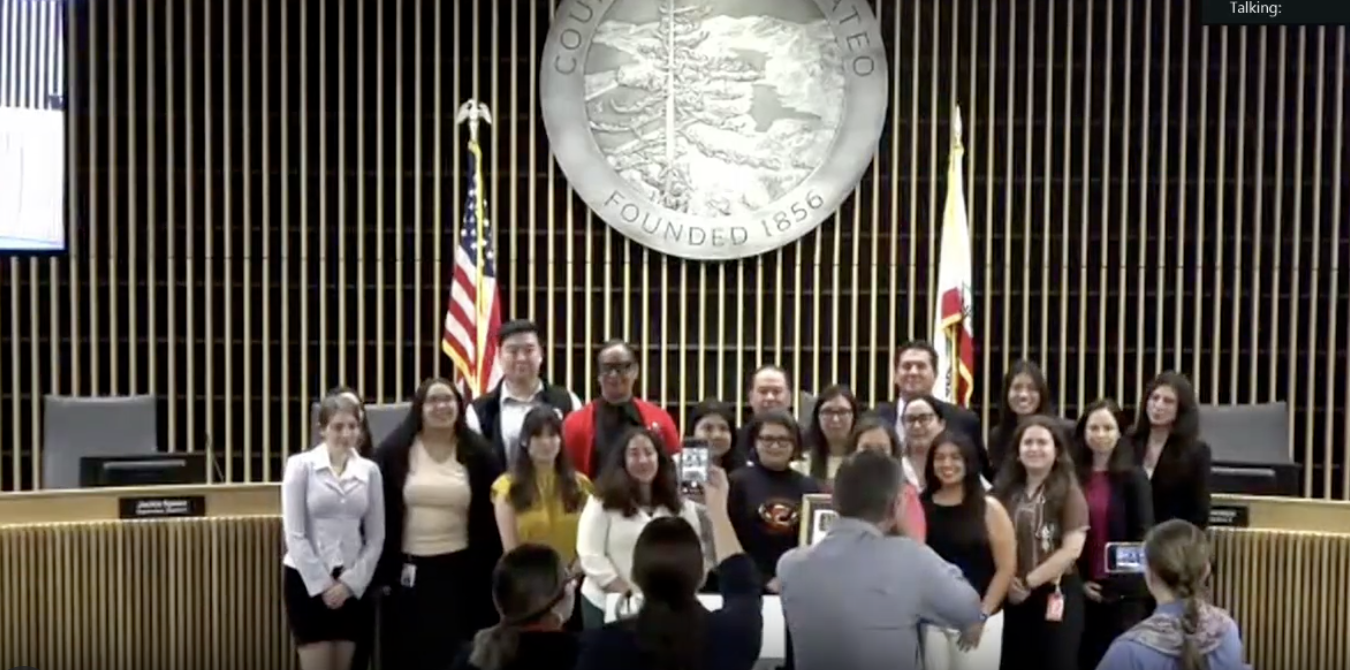
Board President Corzo, the daughter of Guatemalan immigrants, introduced the county's first-ever Immigrant Heritage Month proclamation, designating June 2026.

Dr. Ana Avendano, El Concilio, accepted the proclamation, noting that San Mateo County is home to more than 280,000 immigrants from over 100 countries. She described the current climate as a public health crisis driven by federal enforcement fears and restricted access to care.

Board President Corzo said, "Immigrant communities, just like so many other communities in this county, deserve to have a voice in every single decision that's made."

Decisions: Approved 3-0.


Horizon Treatment Center: Public Pushes Board to Act Before July 8 Deadline

Three speakers used public comment to press the Board on the Horizon Services treatment center, which was not a formal agenda item but looms large over the county's behavioral health infrastructure.

A Behavioral Health Continuum Infrastructure Grant is at stake, with a July 8 deadline for confirming a final site with the state. Jamie Campos, CEO of Horizon Services, expressed commitment to finding a solution. Carol Eldridge, One San Mateo, urged the Board to ensure the center gets built regardless of location. Alvaro, a public commenter, said, "The time of ruling based on fear and ignorance has to come to an end."

Board President Corzo acknowledged guests from the center and stated the Board intends to hold a special meeting in late June or early July to fully approve the relocation site.


$7M Shores Landing Grant Closeout: A Model for Senior Housing

The Board closed out over $7M in CDBG-CV federal funding for Shores Landing, a 95-unit permanent supportive housing site in Redwood Shores converted from a former Marriott hotel.

Director Ray Hodges, Department of Housing, explained that CDBG-CV funding grew from $4.7M to over $7M and paid for a community room, case manager offices, outdoor seating, landscaping, and a dog run, all completed before the March 31 deadline. Midpen Housing operates the site with wraparound services.

Supervisor Gauthier compared the project to social housing in Vienna: "This is very similar to what social housing looks like in Vienna, where residents can come together and just check on each other." Board President Corzo noted growing senior homelessness: "We have more people unhoused that are seniors in our county than we ever had before. And this is the kind of housing that they deserve."

Hodges announced a similar conversion is already under construction: "We are in construction now on the conversion of what was a Ramada Inn in South San Francisco for this same use. It'll be 45 units for homeless seniors."

Decisions: Approved 3-0.


Minor Items

  • $12.575M ARPA reallocation to housing approved 3-0; shifts unexpended federal pandemic funds to housing projects already in flight before the year-end deadline, with general funds backfilling originally obligated programs.
  • Moss Beach land purchase ($500,000) for the Connect the Coast transit project right-of-way, adjacent to a 71-unit affordable housing development. Approved 3-0.
  • Redwood City crisis facility ($2.1M) at 248 Redwood Avenue, securing continued operation of a crisis restoration facility for clients with severe behavioral health issues. Approved 3-0.
  • Second Harvest of Silicon Valley agreement increased by $2M to $6M in Measure K funds through June 2027 to offset anticipated CalFresh cuts from HR1. County Executive Mike Callagy warned, "Food security in this county is in jeopardy because of HR1 and the underlying impacts that will remove people from CalFresh." Approved 3-0.
  • Four Measure K discretionary grants totaling $75,000 approved for District 4: $20,000 to Renaissance Entrepreneurship Center for street vendor compliance, $20,000 to Bay Area Urban Eagles for aviation career pathways, $25,000 to One Step Beyond for inclusive arts for people with developmental disabilities, and $10,000 to Healthy Cities Tutoring for after-school programs.
  • ICAC appointments — one new member and four reappointments to the Sheriff's Office civilian oversight commission; one alternate position still pending interviews.
  • Item 8 (homeschool extracurricular access) pulled by Supervisor Canepa for Youth Commission review before Board action.
  • Item 11 ($29M Foster City property purchase) pulled by Board President Corzo after Foster City Council Member Susie Niederhofer opposed the deal, arguing the site across from Foster City's civic center is better suited for housing than a county warehouse use.
  • Consent agenda (Items 20-27) approved 3-0, including ratification of the California Nurses Association labor contract through 2028 and a five-year extension of Sheriff law enforcement services for the transit district at $9.6M per year.
  • Youth Commission annual report accepted — highlights included 500+ voter education pamphlets in three languages, a first-ever civic cafe with 70+ attendees featuring Congressman Licardo and Assemblyman Berman, a nature bus program for 35 children, and research into SB 1383 organic waste compliance gaps.
San Mateo County Approves $45M+ in Contracts, Declares Pier Emergency | Board of Supervisors | Locunity