
Board of Supervisors - Aug 11, 2026 - Meeting
Board of Supervisors • San Mateo CountyAugust 11, 2026
Locunity is a independent informational service and is not an official government page for this commission.We use AI-assisted analysis and human editorial review to publish information.
Board Blocks ICE Detention, Introduces E-Bike Law After Child's Death
San Mateo County's Board of Supervisors moved first in the Bay Area to shut the door on immigration detention facilities, introduced a landmark e-bike safety ordinance inspired by the death of a 4-year-old, and confronted a $226 million budget crisis — all in a single meeting that opened with an hour of community fury over conditions at the county's juvenile hall.
Board unanimously directs urgency ordinance to block ICE detention facilities, becoming the first Bay Area jurisdiction to use land use authority against federal immigration enforcement
E-bike safety ordinance introduced unanimously, setting 5 mph sidewalk speed limits and fines up to $500 — to be named after Aiden Fong, killed in a chain-reaction e-bike crash
15+ speakers demand action on juvenile hall conditions, forcing the Board to schedule an Aug. 25 study session after repeated postponements
$226 million vehicle license fee shortfall threatens every city budget in the county; emergency study session set for Thursday
Humanoid robot permitting resolution approved, putting the county at the forefront of local AI governance
Appeal denied 4-1 for Emerald Lake Hills residence; Speier dissents over tree screening
Bay Area's First Stand Against ICE Detention
Why it matters: With the federal government pursuing a mass immigration detention facility in nearby Gilroy and another proposed in Dublin, San Mateo County became the first Bay Area jurisdiction to deploy land use authority to preemptively block such facilities — and moved to make the barrier immediate.
Where things stand: Supervisor Ray Mueller and Board President Noelia Corzo co-sponsored the resolution directing staff to draft a permanent ordinance prohibiting, restricting, or regulating detention facilities in unincorporated San Mateo County. Congressman Sam Liccardo appeared in person to urge the Board to act, citing the state Department of Justice's 2026 report documenting overcrowding, inadequate medical care, unsanitary conditions, and six deaths at California ICE facilities in half a year.
"I come to you in a spirit of partnership to ask the county San Mateo to consider becoming the first jurisdiction in the region to deploy its land use authority to impose conditions and reasonable restrictions that will prohibit unsafe ICE detention facilities," said Congressman Liccardo.
He specifically requested the Board enact a Government Code Section 65858 urgency ordinance — a temporary moratorium lasting 45 days to a year — to cover the gap while the permanent ordinance is drafted. Mueller amended the motion accordingly, directing staff to bring the urgency ordinance to the next board meeting.
The other side: Every supervisor voiced support. Supervisor Jackie Speier praised Liccardo for finding a productive role under a hostile federal administration. "You have taken your role as Congressman to find a way to serve your district and your counties that will provide the protection necessary, at least slow down their efforts to try and trample once again on all of these rights," she said. Supervisor David Canepa pushed the conversation further, asking about preventing detention centers nationally, not just locally.
Decisions: Passed 5-0 (For: Corzo, Mueller, Speier, Gauthier, Canepa). The urgency moratorium will come before the Board at its next meeting.
What's next: Staff will bring the urgency ordinance to the next Board meeting and begin developing the permanent ordinance regulating detention facility siting in unincorporated areas.
A Father's Lego Tower, a County's New Law
The basics: The Board unanimously introduced an ordinance amending Chapter 7.80 of county code to regulate electric micromobility devices — closing gaps in state law that have left local jurisdictions without tools to address a surge in dangerous e-bike and illegal electric motorcycle use.
Why it matters: E-bike crashes in California rose 750-fold between 2018 and 2024, according to research cited by Dr. John Ma, a surgeon who told the Board that children under 14 are at greatest risk and e-bikes are 2.5 times more likely to involve pedestrians due to their silent motors. The ordinance creates a regulatory framework other Bay Area cities are expected to adopt.
Where things stand: Co-sponsored by Supervisors Speier and Mueller, the ordinance defines "illegal motorcycles" (e-bikes that don't meet vehicle code requirements), prohibits unsafe operation including stunts and phone use, sets a 5 mph sidewalk speed limit with a requirement to dismount when overtaking pedestrians, bans removal of serial numbers, and establishes fines from $50 to $500. Minors receive diversion to an education program for first offenses. The effective date is Jan. 1, 2027, to allow for outreach.
Deputy Chris Larson of the Sheriff's Office traffic unit described stopping 12- and 13-year-olds going 35 to 40 mph on a freeway overpass. Sheriff Kenneth Binder testified in support. County Attorney John Niblin walked through the legal mechanics.
The most powerful testimony came from Ming Fong, father of 4-year-old Aiden Fong, who died in a chain-reaction e-bike crash in Burlingame in August 2025. Fong brought his son's Lego tower spelling "protect our city." "An 11 year old should not be operating a motor vehicle that can go up to 20 miles an hour. They do not understand the traffic rules to the thoroughness as well we all do," he told the Board.
Public commenter Mike Swire noted that 80% of bikes on school campuses are illegal electric motorcycles and read aloud the names of eight recent pedestrian and cyclist deaths in the county.
Decisions: Introduced unanimously, 5-0 (For: Corzo, Mueller, Speier, Gauthier, Canepa). First reading. Effective Jan. 1, 2027. The Board directed that the ordinance be named after Aiden Fong at second reading.
An Hour of Outrage Over Juvenile Hall
Why it matters: A repeatedly postponed study session on conditions at Hillcrest Juvenile Hall has become a flashpoint for community trust. At least 15 speakers — including JJDPC commissioners, ACLU representatives, pastors, physicians, formerly incarcerated individuals, and members of the advocacy group In Our Care San Mateo — used public comment to demand the Board stop delaying.
Where things stand: Speakers raised a cascade of concerns: inedible food prepared at the adult jail and reheated the next day, causing chronic hunger; lack of independent PREA (Prison Rape Elimination Act) reporting mechanisms for youth to report sexual abuse; harsh prison-like conditions including metal beds, concrete floors, and no personal storage; absence of timely healthcare, dental, and vision services; lack of language support for Spanish-speaking youth; and the need for a public accountability dashboard.
"I will tell you that as someone that cares deeply about young people, I have seen staff, and I myself have felt like I am being interrogated by commissioners and disparaged at times," said Board President Noelia Corzo, describing difficult interactions with the JJDPC commission. She pushed back on some public assertions, calling portions of the testimony misinformation — noting that the probation department website has complaint mechanisms, that Chief Keene installed video and audio recording in all juvenile hall spaces, and that she personally tried the food and found it regulated by a dietitian.
Chief of Probation John Keene was more blunt. "I want to be clear that a large percentage of what's been said is either flat out untrue or have been misrepresented in such a way that the general public who do not work in our space, who have the opportunity to come and see what we do, are being misled," he said.
Supervisor Mueller explained the postponement was driven by the $226 million vehicle license fee crisis requiring an emergency study session the same week.
What's next: The Board scheduled the juvenile justice study session for Aug. 25. Both the Board and advocacy groups will have the opportunity to present evidence publicly.
$226 Million Budget Hole Could Push Every City Into the Red
Why it matters: The state budget funded only $77 million of more than $200 million owed to San Mateo County and its cities in vehicle license fees — a gap that could devastate local budgets and social services with only weeks left in the legislative session to find a fix.
Where things stand: Chief Legislative Officer Connie Driscoll Juarez reported that the state appropriated $80 million (of which $77 million goes to San Mateo County and its cities) against $119 million owed for fiscal year 2024-25, plus approximately $80 million from prior years. The projected fiscal year 2025-26 VLF shortfall is approximately $226 million, of which $134 million is the county's share.
"About three weeks ago, we received the calculation that our vehicle license fee shortfall for next year is going to be close to a quarter of a billion dollars, $230 million potentially unfunded by the state, which has devastating consequences for county services and for all of our cities," said Supervisor Mueller.
The legislative report also flagged $197 million for Medi-Cal HR1 implementation, the potential transition of 40,000 UIS enrollees to fee-for-service (risking $3.6 million in losses to the county medical center), and $34 million for elections security (with $521,000 to San Mateo County).
What's next: A VLF study session and press conference were scheduled for Thursday. The Aug. 31 state legislative deadline makes the timeline urgent.
Decisions: Report accepted 4-0 (Mueller absent for this vote).
Emerald Lake Hills Home Approved Despite Neighbor's Objections
Why it matters: The public hearing tested whether privacy and drainage concerns can override a fully code-compliant project — and the Board's answer was a firm no for four of five supervisors.
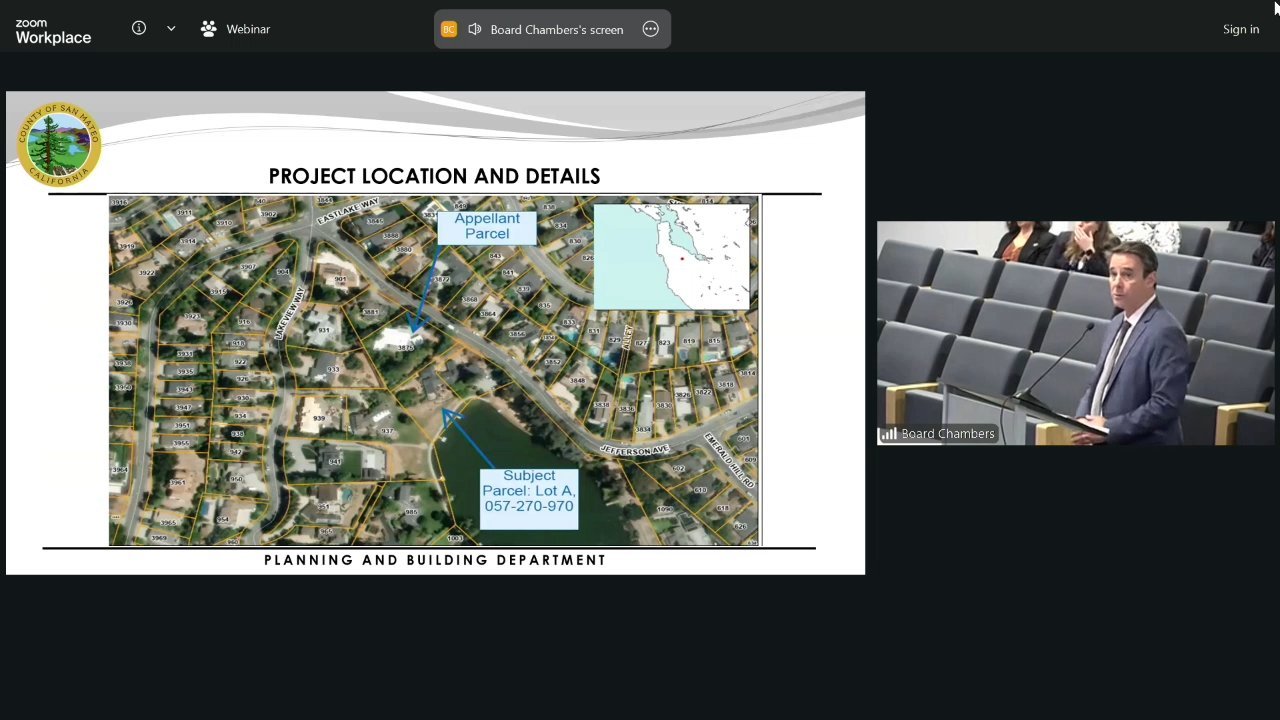
Where things stand: The Board heard an appeal of the Planning Commission's denial of an appeal of staff approval of a design review and grading permit for a new two-story, 5,935-square-foot single-family residence on Jefferson Avenue in Emerald Lake Hills. Director Manowitz presented that the project complies with all setback, height, floor area ratio, and site coverage requirements. The appellant's primary concerns were privacy from a second-story bedroom window — which sits at the same elevation as the appellant's first floor due to steep topography — and drainage.
Architect Steve Simpson testified the second floor was made one room wide specifically to minimize exposure to the adjacent lake. An HOA board member testified that the appellant had clear-cut trees from her own yard that had previously provided screening.
Supervisor Mueller noted the Planning Commission approved the project 3-0 and is "pretty tight" on oversight. Board President Corzo said property owners don't control their neighbors' properties.
The other side: Supervisor Speier dissented, wanting the applicant and appellant to negotiate on tree screening requirements before proceeding.
Decisions: Appeal denied 4-1 (For: Corzo, Mueller, Gauthier, Canepa; Against: Speier). Construction may proceed.
Economic Mobility Gets a County Playbook
Supervisors Corzo and Gauthier sponsored a resolution directing staff to develop a county-specific action plan for economic mobility based on a national framework from the Gates Foundation and the Urban Institute. Chief Equity Officer Shereen Malik Ivzali Tahedi presented alongside Ariana Perez of the Silicon Valley Community Foundation.
The Shared Prosperity Coordinating Council — comprising PPIC, Samcita, Samaritan House, JobTrain, and other partners — has met monthly for three years and produced a community data dashboard and an Economic Mobility Action Plan built around five pillars: economic success, power and autonomy, and being valued. Ten recommendations span career opportunities, housing stability, diverse leadership, and community resource navigation.
Supervisor Speier suggested creating a county corps pipeline for young people.
Decisions: Passed 5-0. A deeper study session is planned for Sept. 15.
Minor Items
Humanoid robot permitting resolution approved on consent, directing development of a comprehensive permitting process for commercial humanoid robots. Rich Seguin of Local 2400 Firefighters noted that lithium-ion battery fires from robots burn hotter and more toxic; Julie Lind of the San Mateo Labor Council emphasized workforce protections including retraining and redeployment.
$145,000 Measure K grant approved for the Center for Age-Friendly Excellence to develop an age-friendly action plan for San Bruno — moving San Mateo County closer to being only the second county in California where all cities have AARP age-friendly certification. The county has funded all 14 certifications so far, totaling approximately $1.4 million. Passed 5-0.
$50,000 Measure K grant approved for San Mateo County Health Foundation's Caring Hands in Health program.
Consent agenda of 36 items approved, including a NARA facility closure resolution, HUD cooperation agreements, a $3.9 million cybersecurity contract increase, and multiple commission appointments.
International Youth Day proclamation adopted, with youth commissioners highlighting policy wins from nitrous oxide sales bans to immigrant scholarships.
Purple Heart Day proclamation approved on consent.
Poet Laureate Antonio López delivered the quarterly poetry reading, sharing personal wedding vows as poetry.
Closed session held on five litigation matters; nothing to report.
Homeless union members described weekly attacks on RV dwellers in safe parking programs — paintballs, BB guns, flaming oil — and alleged that police ticketed an RV the same night a dweller reported vandalism.
Street safety advocates called for engineering fixes on Skyline Boulevard and lower speed limits near schools after cyclist Jacob Solovsky, 34, was killed by a speeding driver at Four Corners.
A public commenter requested that Cypress Point affordable housing in Moss Beach be designated as senior (55+) housing.
A commenter requested the Board hire a permanent Inspector General for the Sheriff's Department.