
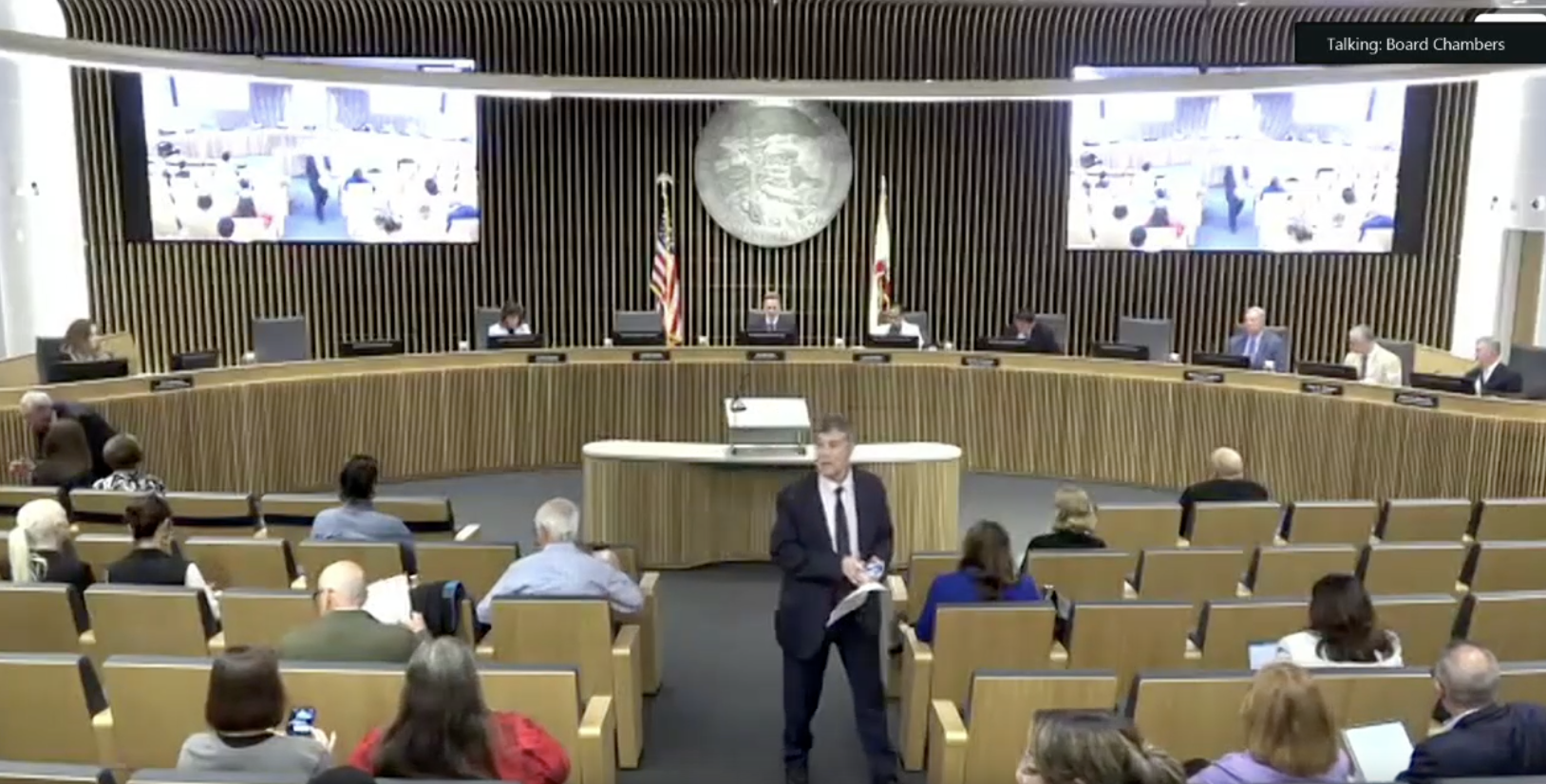
Board of Supervisors - Jun 09, 2026 - Meeting

Board of Supervisors - Jun 09, 2026 - Meeting

Board of SupervisorsSan Mateo CountyJune 9, 2026

Sources:

Locunity is a independent informational service and is not an official government page for this commission.We use AI-assisted analysis and human editorial review to publish information.

Board Adopts $5.2B Budget as State Funding Threat Looms Over Services

San Mateo County supervisors approved a $5.2 billion budget built on a funding assumption the state may not honor, greenlit a $200 million behavioral health plan under a hard state deadline, and launched a $10 million childcare initiative without a single employer commitment in hand. Every major item passed unanimously, but not without tension — particularly from Board President Noelia Corzo, who questioned the pace of spending amid fiscal uncertainty.

  • $5.2 billion budget adopted, but losing state VLF reimbursement would erase 18% of the general fund and force shelter closures, layoffs, and hiring freezes
  • $200M behavioral health plan approved before June 30 state deadline, with amendment preserving flexibility to revise funding commitments
  • $10M childcare initiative advances despite no employer sign-ons and incomplete program design
  • Community-based providers turn out in force to defend behavioral health funding
  • Supervisor Speier reveals family's Holocaust connection during Jewish Heritage Month proclamation
  • Board authorizes eminent domain for La Honda road repair protecting 300 properties

A $5.2 Billion Budget Built on an Uncertain Promise

Why it matters: The county's entire fiscal outlook hinges on whether Sacramento restores Vehicle License Fee reimbursement — a single revenue stream that represents 18% of the general fund. Without it, San Mateo County faces immediate deficits and service cuts that would reshape government operations for a decade.

Where things stand: County Executive Officer Mike Callagy and County CFO Roberto Manquilla presented two budget scenarios. With full VLF, the county maintains structural balance through FY 2029-30, adds 61 positions (15 net new), invests proactively in capital projects to avoid cost inflation, and holds reserves at roughly 16-17%. Without VLF, the math breaks immediately — over $1 billion in cuts over the next decade, potential shelter closures, layoffs, and a hiring freeze.

The county has proactively paid down pension obligations to 95% funded status, a buffer that staff emphasized would provide some resilience. But the compounding threat of federal HR1 funding losses alongside VLF creates what Callagy described as a structural crisis.

Supervisor Jackie Speier pressed staff on $800,000 budgeted for processing a backlog of 776 concealed weapons permits in the Sheriff's department. Callagy described the Sheriff's department budget situation in blunt terms: "The department budget was nothing short of a disaster. I've never seen a turnaround of that magnitude where they went from a healthy reserve to an unbelievable deficit," said County Executive Officer Mike Callagy.

Board President Noelia Corzo, participating remotely, noted at the start of the meeting that the budget item had been moved from its originally scheduled June 23 date: "This agenda item was actually previously set for June 23rd and was changed without my prior approval as president," she said, adding she would not have intentionally missed the in-person budget adoption.

Yahir Ortega of the Thrive Alliance urged the board to prioritize affordability, racial equity, and nonprofit funding, warning that cuts disproportionately affect Black, Latino, immigrant, and disabled communities.

Decisions: Passed 5-0 (For: Speier, Mueller, Gauthier, Canepa, Corzo; Against: none; Absent: none).

What's next: The adopted budget assumes full VLF restoration. If the state does not act, staff will need to return with emergency contingency measures.


$200M Behavioral Health Plan Clears Mandatory State Deadline

The basics: Proposition 1 replaced the Mental Health Services Act (MHSA) with the broader Behavioral Health Services Act (BHSA), requiring every county to submit a new three-year integrated plan by June 30 or face corrective action and potential clawback of state behavioral health dollars.

Why it matters: The plan covers $200 million in direct services reaching 18,000 adults and 8,000 children and youth annually, $22 million in housing interventions, $17 million in early intervention for ages 0-25, and rental assistance for 400 individuals. Missing the deadline would jeopardize services for 26,000 clients.

Where things stand: Director of Behavioral Health and Recovery Services Jay Africa presented the plan, which references the Horizon Recovery Center's BCHIP approval but omits a specific address due to ongoing location negotiations. Community-based providers turned out in force to support the plan.

Melissa Platt of the Mental Health Association of San Mateo County reported serving 766 people this year through shelters, housing, and community case management. Mark Cloutier, CEO of Caminar, noted approximately $18 million in services across outpatient mental health, residential treatment, and substance use programs. Anya Shapiro of YouthPoint Health reported 78% of youth completing behavioral health programs show significant improvement. Carrie Kirby of CTK Counseling Center said their 15-person team served nearly 1,300 residents. Laura Rodriguez of Puente described serving 72 of 159 students in rural South Coast schools, citing geographic isolation and provider shortages. Salvador Blancas of the Latino Commission on Alcohol and Drugs shared a personal story of 17 years of recovery from meth addiction.

The other side: Tazo Zografos, a public commenter, supported the plan generally but raised concerns about the proposed 69-bed Horizon Treatment Services detox facility at 101 N. El Camino Real, questioning inflated need estimates and suggesting Mala Road as an alternative. Natalia, another public commenter, asked the board to withdraw $2 million in support for Horizon's real estate acquisition, citing suspended licenses and a lack of community engagement.

Supervisor Speier raised concerns about overrepresentation of Latino and Black youth in maltreatment allegations and underaccess by women and Latinx residents. She successfully amended the resolution to add a whereas clause preserving the county's right to submit plan revisions: "Approval by this board of the county BHSA Three-Year Integrated Plan shall not foreclose the county submission to the state of any revisions to the plan necessitated, for example, by the county's change in funding commitments described in the plan," said Supervisor Jackie Speier.

Decisions: Passed 5-0 as amended (For: Speier, Mueller, Gauthier, Canepa, Corzo; Against: none; Absent: none).

What's next: The plan must be submitted to the state by June 30.


$10M Childcare Bet Advances Without a Single Employer on Board

Why it matters: San Mateo County loses an estimated $775 million annually in productivity due to childcare costs. The Childcare Central Initiative targets the "missing middle" — families who earn too much for subsidies but too little to afford market-rate care.

Where things stand: Co-sponsored by Supervisors Speier and Gauthier, the $10 million initiative includes two components: a $1.135 million technology contract with Tootris for a countywide childcare navigation hub, and $8.865 million for a Tri-Share pilot splitting costs between the county (12.5%), employers (12.5%), and families (75%). The hub targets a fall 2026 launch with Tri-Share following in early 2027. If fully subscribed, the pilot could serve 1,200 children.

"Child care is a public need that has been treated like a private luxury for far too long," said Supervisor Jackie Speier.

The other side: David Fleishman, executive director of 4Cs of San Mateo County, strongly recommended against spending county money on the Tootris platform, noting that 4Cs — the existing state-funded childcare resource and referral agency — had just launched a comparable portal. He urged directing all funds to the Tri-Share pilot instead. Karen Hospilletta, a 31-year childcare provider and 4Cs board member, agreed.

Heather Cleary of Peninsula Family Service supported both the hub and Tri-Share. Mindy Bennett of Child Care Aware of Missouri endorsed Tootris's capabilities from statewide implementation experience. Connie Zhu of Unitely urged Chinese and other language accessibility be built in from the start.

Board President Corzo expressed significant reservations: "I do feel uncomfortable moving forward on an item that I feel like has a lot of unknowns still for it and at a time when we may be facing real fiscal uncertainty within our county," said Board President Noelia Corzo. She cited incomplete program design, no employer commitments, and union consultation that had not yet begun — but ultimately voted yes.

Vice President Ray Mueller defended the approach: "I actually look at it as a strength of the program that the $8 million isn't going to be spent unless the public sector participates with us," said Vice President Ray Mueller.

Deputy County Executive Rocio Kurzykin and Executive Policy and Program Manager Linda Wolin presented the staff overview.

Decisions: Passed 5-0 (For: Speier, Mueller, Gauthier, Canepa, Corzo; Against: none; Absent: none).

What's next: Staff must secure employer participation before Tri-Share dollars flow. The navigation hub is targeted for fall 2026.


Heritage Proclamations Carry Personal Weight

PRIDE Month: Year-Round Visibility

Board President Corzo, the board's liaison to the LGBTQIA+ Commission, sponsored a proclamation designating June 2026 as LGBTQIA+ PRIDE Month. Commission co-chairs Vanessa Lemos Tapia and Dana Johnson presented. Johnson — a transgender non-binary individual — honored trans and non-binary ancestors and called for the Pride parade to return to downtown San Mateo. The Bay Area's largest free sober Pride event was announced for June 13 at Central Park in San Mateo.

Alex Lyman Golding, assistant director of the San Mateo County Pride Center, testified that gender-affirming care and LGBTQ care is life saving. Two commission vacancies were announced. Passed 5-0.

Juneteenth: 50 Years in East Palo Alto

Supervisor Gauthier sponsored the Juneteenth proclamation, accepted by Sharifah Wilson of the East Palo Alto Community Archive on behalf of four partner organizations. The three-day event runs June 19-21. Supervisor Speier highlighted how a visit to the American Revolution Museum in Philadelphia showed how African American history has been stripped from national parks. Passed 5-0.

Jewish American Heritage Month: A Family Secret Revealed

Supervisor Speier disclosed during the JCRC Bay Area presentation that she is one-quarter Jewish — a fact she learned only later in life: "I am one quarter Jewish, but I did not know that until much later in life because it was basically excluded from my life experience," she said, explaining that her grandfather was taken on Kristallnacht and imprisoned at Buchenwald, information she discovered through the Holocaust Museum after her father had died.

Mayor Julia Mates of Belmont, representing JCRC Bay Area, emphasized the Jewish community's diversity and contributions over 80 years. President Corzo honored Dr. Susanna Kukis, a Jewish community member who recently passed.


Minor Items

  • Consent calendar approved 5-0, including $54 million for an animal care contract extension, $44 million-plus in behavioral health residential contracts, homeless shelter operations increases, Housing Authority labor agreements, and a special election ordinance for Charter amendments. Items 11 and 12 were moved from the regular agenda to consent; item 20 was removed entirely.
  • CSA No. 1 parcel tax set at $65 per parcel for police and structural fire services in San Mateo Highlands, backed by 87.8% voter approval. Passed 5-0.
  • North Fair Oaks garbage and recyclables collection charges placed on the tax roll for FY 2026-27 with no rate increase. Passed 5-0.
  • Sewer service charges for 10 county districts placed on the tax roll through FY 2027-28 at previously approved rates. Passed 5-0.
  • Entrada Way slip-out repair in La Honda: Board certified the environmental review and adopted a resolution of necessity for eminent domain easements, protecting the sole access route for approximately 300 properties. Passed 5-0.
  • Brown Act SB 707 policy adopted, meeting the July 1, 2026 state deadline for a formal plan to restore remote public participation during internet or phone service disruptions. Passed 5-0.
  • Closed session: Board voted 4-0 (Canepa absent) to initiate one lawsuit and join one amicus brief; details to be disclosed when cases are formally commenced.
  • Public commenter Eric Dentler shared a personal project documenting the history of San Francisco sound and music venues along El Camino Real. Joanne Rakoski of Faith in Action Bay Area urged expansion of the Pacific Safe Parking Program into unincorporated areas like El Granada for families living in RVs.
Board Adopts $5.2B Budget as State Funding Threat Looms Over Services | Board of Supervisors | Locunity