
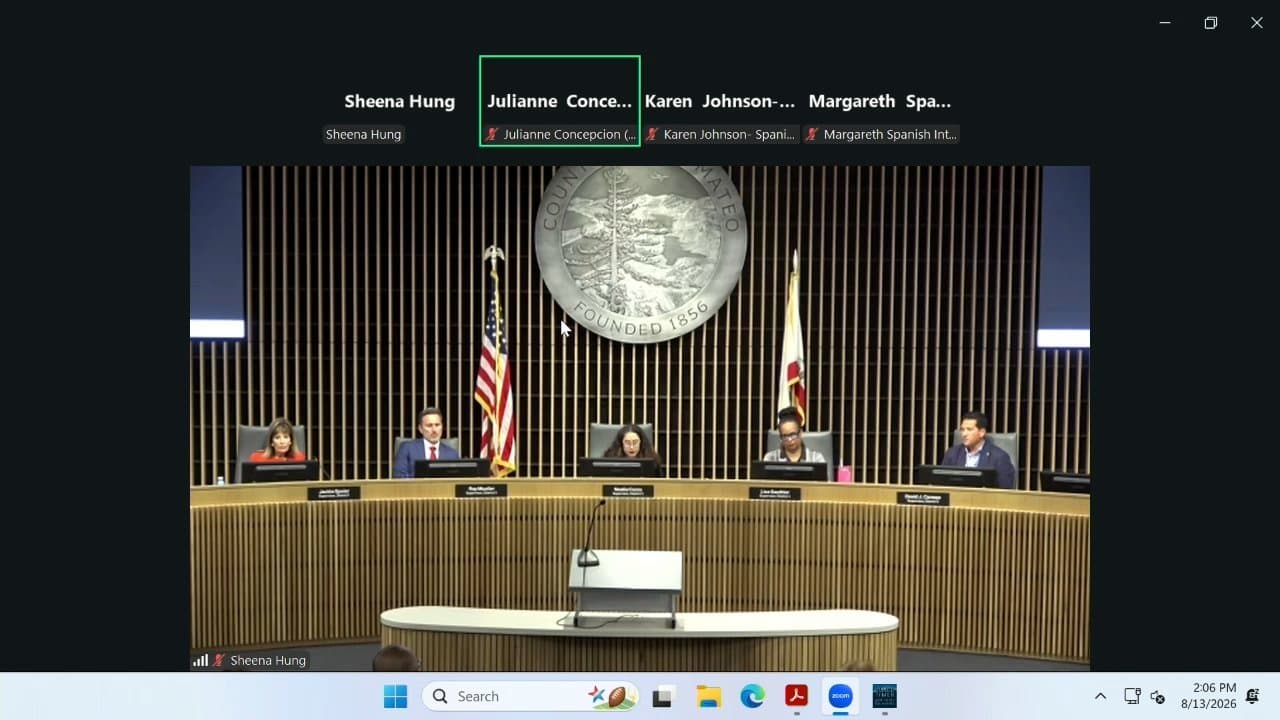
County and 20 Cities Sound Alarm on $236M State Funding Crisis
Board of Supervisors • San Mateo CountyAugust 13, 2026
Locunity is an independent informational service and is not an official government page for this commission. All information is sourced from public footage and an analysis of official agendas with the aid of responsible, fact-checked AI. to report an error or omission.
San Mateo County convened a rare multiagency special meeting on Aug. 13 to confront a single, cascading threat: a $236 million state shortfall in vehicle license fee (VLF) funding that could eliminate more than 1,000 public sector jobs, shutter fire stations, gut mental health programs, and strip subsidized childcare from hundreds of families across every corner of the county.
- $134.2 million county shortfall puts 603 positions at risk, from deputy sheriffs to nurse home visitors
- 14 cities detail individual shortfalls ranging from $4.3 million to $13.2 million, with cuts hitting fire stations, libraries, senior centers, and childcare
- Burlingame mayor confronts Sacramento: "Stop telling us what to do if you're not going to pay us what you owe"
- South San Francisco warns 815 children could lose subsidized childcare if VLF cuts take hold
- Supervisors launch two-week sprint to secure a permanent fix in the legislature's trailer bill before the August deadline
- Board calls on residents to flood the governor's office with calls and contact the Becerra campaign to lock in VLF restoration under the next administration
A Broken Promise Worth $236 Million
County Executive Mike Callagy laid out a staggering financial picture for the Board of Supervisors and representatives from all 20 cities and towns in the county: a $134.2 million VLF shortfall that would put 603 county positions at risk and ripple into every service residents rely on.
Why it matters: The VLF — a property-tax-based funding mechanism that replaced vehicle license fees under a 2004 state deal — is the backbone of county and city general funds. Sacramento's funding formula now singles out San Mateo County for a loss that Callagy called unprecedented.
"Nowhere in the history of the state of California can we find a situation where one county is targeted to the extent of losing $236 million," said County Executive Mike Callagy.
Where things stand: The cuts would land hardest on the county's most vulnerable. Safety net services face a $49.9 million hit, eliminating 191 health department positions — 90% of which provide direct patient care. Behavioral health services would shrink, elder abuse response would slow, nurse home visiting programs would be cut by one-third, and school-based mental health programs would be eliminated. The county's Human Services Agency would lose approximately 100 positions, lengthening wait times for food assistance and benefits — compounded by new federal HR1 verification requirements.
Public safety faces a $42 million-plus shortfall. The county could lose 52 sworn deputies, including 44 deputy sheriffs and eight sergeants. Two substations — North Fair Oaks and Broadway — could close. A jail facility could be shuttered. Forty probation positions overseeing 1,100 people, including 284 domestic violence offenders, are at risk. Twenty-three district attorney positions and cuts to 911 dispatch, which handles 300,000 calls annually, round out the public safety toll. Community services ($28.3 million) would see park closures, reduced building and planning capacity, and degraded technology infrastructure.
Callagy warned the damage would compound: the workforce reductions would also trigger the loss of $15 million in state and federal matching funds.
"This is a broken system. We gave up something in 2004 and we were promised, promised by the state to get that back through the property tax allocation through VLF. And they have now singled us out and reneged on that," he said.
City by City, the Pain Adds Up
Fourteen cities and towns each took the microphone to describe what the VLF shortfall means on their streets — and the picture was uniformly grim.
Daly City: $12.15 Million
Mayor Glenn Sylvester detailed a shortfall that could eliminate 50 positions, a fire engine company, a mental health clinician program, and close senior centers and library programs. He framed the crisis at every scale — local, regional, and statewide.
"When Sacramento reduces funding for local government, Sacramento does not deliver the service cuts, the local communities do. The cuts happen in our neighborhoods," said Mayor Sylvester.
South San Francisco: $13.2 Million
City Manager Laura Snidman described the county's largest cumulative city shortfall: 100-plus positions at risk, including the potential closure of a fire station, elimination of 13 firefighter positions, and the end of a community learning center. The most striking cut: elimination of all subsidized childcare.
"We would have to eliminate potentially all subsidized childcare. This is preschool, early learning, and after school care, impacting up to 815 children, leaving working parents scrambling for an already scarce resource," said City Manager Snidman.
Burlingame: A Direct Challenge to Sacramento
Mayor Michael Brownrigg did not mince words. He noted that Burlingame added 1,800 homes and rezoned 100 acres for housing at the state's urging — and is now watching Sacramento renege on the financial promises that made that growth possible.
"Stop telling us what to do if you're not going to pay us what you owe," said Mayor Brownrigg.
Pacifica: A Cruel Paradox
Mayor Christine Bowles described a city already facing a $3.8 million structural deficit that is pursuing a sales tax ballot measure to stabilize its finances — only to watch the state prepare to claw back nearly as much through the VLF.
"Isn't it maddening that to put something on the ballot and then that is proposed to raise $5 million for our city, and now next year, the state is looking to take away $4.5 million extra from the VLF. It's maddening," said Mayor Bowles. She warned Pacifica could lose 20 to 25 positions — 15% of its workforce.
Portola Valley: Reserves on a Clock
Councilmember Judith Hasco issued one of the starkest warnings of the afternoon: without VLF restoration, the small town's reserves will hit minimum levels by fiscal year 2027-28 and be fully depleted by fiscal year 2029-30.
"Our reserve fund will fall below the minimum reserve policy level by the end of fiscal year 27-28 and will be depleted by the end of fiscal year 29-30," said Councilmember Hasco. That trajectory could force a formal fiscal emergency declaration.
East Palo Alto: 13% of the General Fund
Vice Mayor Ruben Abrica and Assistant City Manager Cherie Klima described a $4.6 million shortfall that represents 13% of the general fund for a predominantly low-income Latino community — a population least equipped to absorb the loss of public services.
San Mateo: 70 Positions, a Fire Station, and Homelessness Outreach
Mayor Adam Lorraine outlined a $12.9 million shortfall that could eliminate 70 positions, close a fire station, and end both homelessness outreach and the city's mental health co-responder program.
The Rest of the County
- Foster City faces a $5 million total impact (including its share of consolidated fire services), equivalent to 13 positions.
- Belmont is looking at a hit of roughly 10% of its general fund.
- Menlo Park faces a $5.4 million shortfall that could cut 27 positions — 9% of staff — and reduce library hours by up to 50%.
- Millbrae would defer Safe Routes to Schools and flood infrastructure.
- Redwood City identified approximately 40 frontline positions at risk.
- San Bruno emphasized the cascading mutual aid impacts when neighboring cities lose firefighters and deputies.
- San Carlos faces a $4.4 million shortfall (6% of its budget), potentially growing to $6 million if more school districts change their VLF status, threatening 19 positions.
Labor Sounds the Alarm: 1,000 Jobs at Stake
Julie Lind of the San Mateo Labor Council warned that the shortfall threatens up to 1,000 family-sustaining public sector careers, and that the economic damage extends well beyond government payrolls.
"We in the labor community are deeply concerned about the possibility of losing as many as 1,000 public sector jobs. These are good, family-sustaining careers," said Lind. She cautioned that rebuilding institutional knowledge after experienced public servants leave is extraordinarily difficult: "Once that experience and institutional knowledge walks" out the door, she said, it may not come back.
Two-Week Sprint, Then a Longer Fight
The Board of Supervisors used the final portion of the meeting to map out a multiphase advocacy strategy.
Why it matters: The legislature's trailer bill — the vehicle that wraps up the annual state budget — closes by the end of August. If San Mateo County cannot secure a permanent VLF fix in that window, the next opportunity will not come until the next governor takes office and submits a first budget.
Supervisor Ray Mueller laid out the timeline bluntly.
"We have between now until the end of August — and frankly, it's a shorter time period than that — to try to get into the legislature's trailer bill, which wraps up their budget. After that, we're pretty much closed for this year," said Supervisor Mueller.
He asked every city to activate its community networks — school districts, parent groups, senior communities, special districts — and contact the leading gubernatorial candidate's campaign directly: "The most important thing, in addition to all of that, is that I would ask you all to tell everybody you know to start contacting the Becerra campaign."
If the trailer bill push fails, Supervisor Mueller outlined a longer-term strategy: organizing study sessions in each city during the first five months of the new year and pressing the next governor's Department of Finance to prioritize VLF restoration from day one.
Supervisor Jackie Speier escalated the urgency. Drawing on her experience in Sacramento, she called for a grassroots blitz targeting the governor's office, Senate president pro tem, Assembly speaker, and budget committee chairs — within the next two weeks.
"If you make it your priority today and tonight to contact everyone on your address book and ask them to call the governor's office — we need a hurricane," said Supervisor Speier. She added a warning drawn from years in the Capitol: "Having been there decades ago, I can tell you there's a cynicism there." Sustained pressure, she said, is the only antidote.
Supervisor Lisa Gauthier questioned whether Sacramento is paying attention at all, given the compound burden of federal HR1 cuts landing simultaneously: "I don't think Sacramento wants to show that they don't have a heart. But right now, I wonder if Sacramento has a heart for the residents of California, in particular, San Mateo County."
Supervisor David Canepa praised the unity on display and urged hope, calling the gathering a powerful show of collective resolve.
What's next: Cities were directed to immediately activate their contract lobbyists and community networks. The two-week push targets the legislature's trailer bill. If that fails, cities and the county will organize a sustained campaign into 2027, including individual city study sessions and direct outreach to both gubernatorial campaigns.
- Procedural votes: The Board of Supervisors unanimously approved (5-0, roll call) a motion to establish the multiagency meeting framework, designate Board President Noelia Corzo as chair, and authorize the Clerk for meeting administration. Daly City, the only city with a quorum, also approved unanimously (3-0, show of hands). No other city had enough council members present for formal legislative action.
- No public comments were received during the meeting.