Governing Board - Mar 10, 2026 - Meeting
Governing Board • San Francisco Unified School DistrictMarch 10, 2026
Locunity is a independent informational service and is not an official government page for this commission.We use AI-assisted analysis and human editorial review to publish information.
Board Ratifies $183M Teacher Contract, Faces Fiscal Cliff by 2028-29
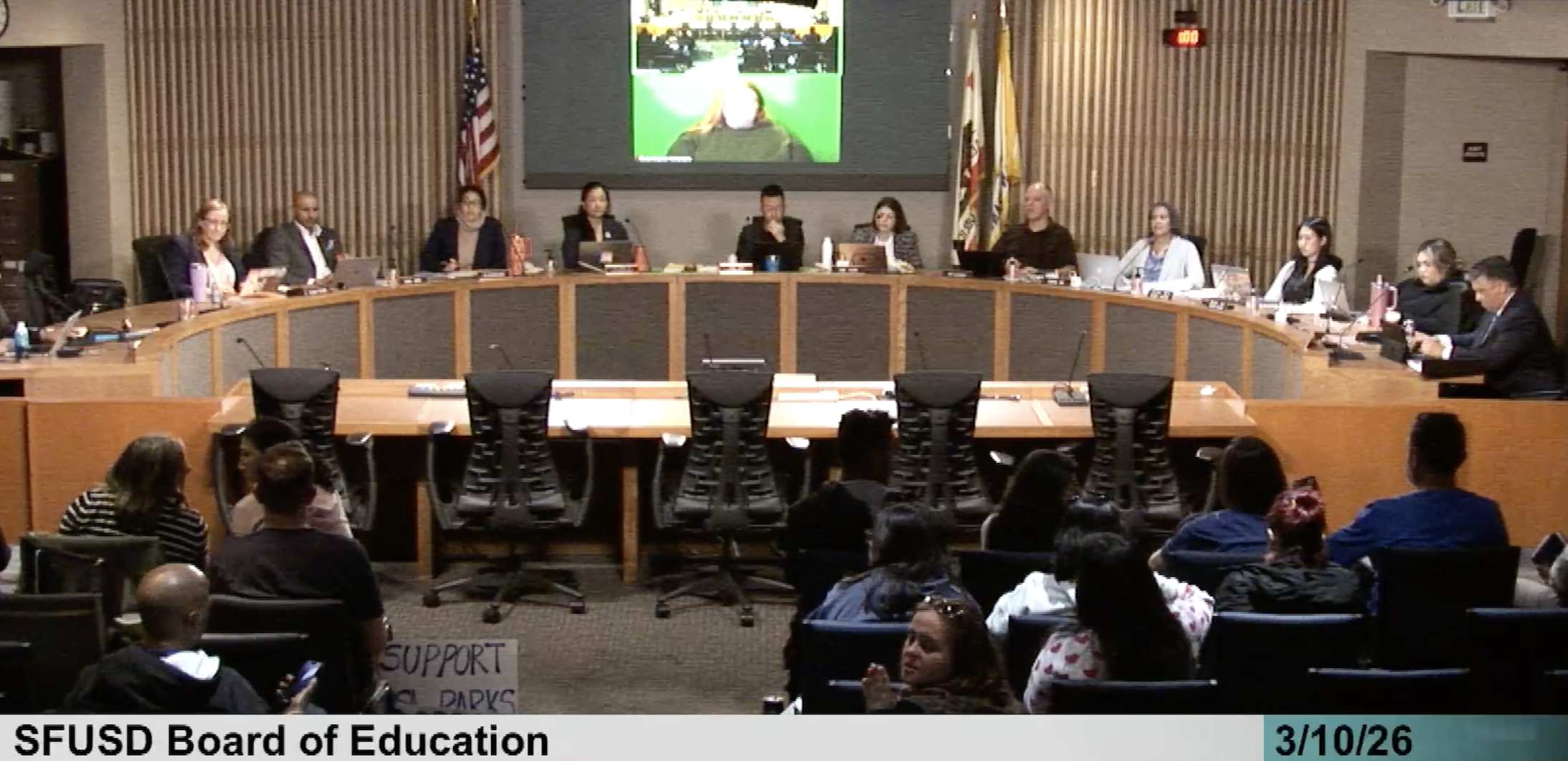
The San Francisco Board of Education unanimously approved the post-strike contract with the teachers' union, locking in raises and fully funded healthcare — then turned to a budget report warning the district could run out of reserves within two years. In between, dozens of parents, students, and workers packed the meeting to fight for school programs, demand contract negotiations, and expose payroll failures.
$183M UESF teacher contract ratified 7-0 after four-day strike, with 4.5% and 4% raises plus fully funded healthcare tied to a parcel tax renewal
Budget report warns 2028-29 is "danger year" with a $126 million restricted-fund deficit that could push SFUSD toward state receivership
Guadalupe Elementary families rally against $6 million student busing program and denial of summer literacy and Spanish TK classes
SEIU workers still without a contract since June 2024; UESF president reports teachers going unpaid due to systemic payroll failures
Rosa Parks Elementary's parents demand staffing for a school where nearly one-third of students have IEPs but the assistant principal works half-time
EPA clean air grant deadline looms as speakers warn classroom filtration is five years out of date
The Post-Strike Deal: $183M in Raises and Healthcare
The board voted 7-0 to ratify the tentative agreement between SFUSD and the United Educators of San Francisco, ending a chapter that included a four-day educator strike. The deal delivers 4.5% salary increases in year one and 4% in year two, plus fully funded healthcare benefits — a centerpiece demand of the union.
Why it matters: The healthcare provision alone carries a first-year price tag of $20.7 million, escalating to $42.3 million in year two with built-in assumptions of 10% cost growth and 10% migration of employees onto the plan. The total announced cost is $183 million, though the AB 1200 general fund figure is $156 million — a gap Commissioner Matt Alexander pressed staff to explain publicly.
"The announced cost of the agreement was $183 million. But in the AB 1200, the three-year cost adds up to $156 million. So what's the discrepancy there?" said Alexander.
Deputy Superintendent Chris Mount-Benites explained that the $183 million figure includes employees paid from non-general-fund sources and deferred costs for onboarding nonpublic agency contractors as district employees — expenses that fall outside the AB 1200 certification window.
The parcel tax question: Healthcare funding hinges on the QTEA parcel tax. Commissioner Supryia Ray asked what happens if it isn't renewed. Staff confirmed the contract contains trigger language requiring the district and union to return to the bargaining table if the tax fails — but the fiscal exposure remains enormous. The district's other post-employment benefits (OPEB) liability stands at $654 million, entirely unfunded.
"Our OPEB liability is entirely unfunded in this district," said Mount-Benites .
Commissioner Parag Gupta warned that the board must think beyond the celebration. He urged the district and labor partners to jointly press Sacramento and City Hall for more funding rather than face impossible tradeoffs internally.
Decisions: Passed 7-0. Student delegates also voted yes in an advisory capacity.
What's next: The QTEA parcel tax renewal will be the critical test. If it fails, the district faces renegotiation on healthcare — the contract's most expensive provision — with no fallback funding identified.
The Danger Year: 2028-29 Budget Projections Flash Red
Minutes after approving the teacher contract, the board turned to the Second Interim Report — the state-mandated financial checkup — and heard staff describe a fiscal trajectory that could lead to insolvency within two years.
The basics: The district improved from "negative" to "qualified" certification, meaning it can now demonstrate the ability to meet financial obligations for the current year and one additional year, but not the full three-year window required for a "positive" rating.
Where things stand: The current-year unrestricted general fund shows a $49 million shortfall. Staff addressed this by applying the "first dollar principle" — shifting eligible expenses from the unrestricted fund to the restricted fund, which has less spending flexibility but carries specific revenue streams. The maneuver relieves pressure on one side of the ledger but creates a new crisis on the other: restricted-fund deficits balloon to $67 million in 2026-27, $96 million in 2027-28, and $126 million in 2028-29, when the restricted ending fund balance approaches zero.
On the unrestricted side, a four-part fiscal stabilization plan targeting approximately $46 million in savings keeps projections barely positive — but only $14 million remains in 2028-29 for a $1.4 billion budget. A razor-thin margin.
"The 2028-29 year is a danger year for the district financially, and that's what needs to be solved for," said Deputy Superintendent Chris Mount-Benites.
The stabilization plan includes: staff alignment with declining enrollment ($17 million), central office reductions ($15.3 million), special education contractor-to-employee conversion ($6 million), and additional central office contract reductions ($8 million).
Special education spending under a microscope: Commissioner Matt Alexander zeroed in on the special education contracting budget, where the 5000s series grew from $219 million to a projected $298 million — yet only $94 million had actually been spent at the time of reporting.
"I was shocked to see that we've only spent $94 million in that $300 million budget," he said, questioning why only $6 million is targeted for contractor-to-employee conversion savings.
Mount-Benites acknowledged the pattern points to systemic inefficiency and requires looking into.
The other side: Commissioner Parag Gupta praised staff for dramatically tightening budget accuracy — variance swings have dropped from 40%+ in prior years to within 5%. Commissioner Alida Fisher pushed for impact assessments on proposed cuts, urged the district to maximize untapped revenue including state child development funds, and flagged concerns about HR capacity to execute the contractor-to-employee transition. She noted deep anxiety among families about what special education restructuring will mean in practice.
"There's been a huge lack of clarity in our own budget maneuvers internally and how that's impacted sped," Commissioner Fisher said.
Additional headwinds include the governor's proposed budget lowering COLA projections, reducing SFUSD revenue by $3.7 million in 2026-27 and $6 million in 2027-28, compounding annually. Staff also warned the district's unduplicated pupil percentage is declining faster than overall enrollment — meaning SFUSD is disproportionately losing its highest-need students, which reduces supplemental funding.
Decisions: The Second Interim Report passed 7-0 with qualified certification.
What's next: The fiscal stabilization plan must begin producing measurable savings immediately. The restricted-fund deficit trajectory sets up a collision with the UESF contract's healthcare costs by 2028-29, with the QTEA parcel tax renewal as the linchpin.
Guadalupe Elementary Families Fight for Their School
A delegation of students, parents, and staff from Guadalupe Elementary delivered some of the evening's most pointed testimony, challenging the district on three fronts: the denial of the Springboard summer literacy program, the rejection of a Spanish TK class, and the continuation of a $6 million busing program that sends roughly 50 neighborhood students to west side schools.
Why it matters: Community members argue the district is simultaneously defunding their school and paying millions to bus their own neighborhood's children elsewhere — a policy they call segregation by another name.
Principal Raj Sharma reported that third graders at Guadalupe showed the highest literacy growth in the district, and chronic absenteeism dropped even as ICE raids destabilized families. The school offered to run Springboard in bungalows during construction, but was denied. A Spanish TK class was rejected despite more than 60 preschool students in the school's Spanish-language pipeline and a willing teacher.
Parent Roberto cited California School Dashboard data showing Latino students 78.6% below standard in English language arts and detailed the systematic removal of supports — a bilingual speech therapist, the iReady learning platform, and now Springboard.
Community Schools Coordinator Corey Robinson framed the busing program as the sharpest grievance, calling it "financing segregation." He argued the district reversed a prior decision to discontinue the route and that school choice policies disproportionately harm families who cannot navigate the enrollment system.
Fifth-grader Camila put it plainly, challenging the board on how the district lacks money for Springboard but has $6 million to bus students to West Portal.
What's next: No formal action was taken. Board President Phil Kim clarified after public comment that no layoff notices were on the evening's agenda. The community's demands — Springboard restoration, Spanish TK approval, and an end to neighborhood busing — remain unresolved.
Labor Tensions: Expired Contract, Broken Paychecks
Multiple labor representatives painted a picture of a district struggling to meet its most basic obligations to workers.
SEIU 1021 members — representing custodians, nutrition workers, clerks, and community school coordinators — told the board their contract has been expired since June 30, 2024. Josh Davidson, the district's chef and an SEIU member, reported being asked to increase his team's workload by 60% with no additional staff, in part because the open contract prevents new hiring.
United Educators of San Francisco (UESF) President Cassondra Curiel delivered an extensive report on systemic payroll failures. Substitutes covering more than 100 teacher vacancies were not being paid. A salaried classroom teacher received a $30 paycheck. HSA and FSA deductions were being withheld from paychecks but not deposited into employee accounts. CalSTRS retirement contributions showed discrepancies. She called for a systems-level approach rather than fixing problems one at a time.
Teanna Tillery spoke against preliminary paraeducator layoffs — noting this was the fifth consecutive year she has made the same plea. She argued the annual cycle of layoff notices creates "preliminary notice fatigue" that drives qualified educators away. She highlighted that 21 security aides now face layoffs, even though a decade-old reduction in their hours was only recently corrected.
Bilingual educator concerns: Multiple speakers from Chinese for Affirmative Action and a Cantonese-speaking parent opposed potential bilingual educator layoffs. Emily from Chinese for Affirmative Action argued that cutting bilingual staff would cause families to leave for private or charter options, contradicting the district's public celebration of its bilingual programs.
Board President Phil Kim clarified that no layoff notices were on the evening's agenda and stated the district does not intend to lay off bilingual educators.
Rosa Parks Families Push for Special Education Staffing
At least six parents from Rosa Parks Elementary — home to four distinct programs including early education, special day classes, the Japanese Bilingual Bicultural program, and STEAM — testified that the school is at a breaking point.
Nearly one-third of Rosa Parks students have Individualized Education Programs, placing it among the district's highest-need campuses. Yet the assistant principal position is funded at only 0.5 FTE, and the school must use discretionary funds intended for its mandated programs to cover resource specialist and support positions.
Parent Kiyomi described the school as being "at a crossroads" and requested a full-time assistant principal, two full-time Resource Specialist Program (RSP) teachers, and three RSP paraeducators. Speakers referenced the 2022-23 school year when the AP position was lost entirely, leading to skyrocketing truancy and cratering academic performance.
Ms. Marshall of the NAACP also advocated for Rosa Parks, noting that last-hired-first-fired layoff policies disproportionately affect Black and brown educators.
Minor Items
The board approved the tentative agreement with Common Crafts and IBEW Local 6, covering the district's building trades and electrical workers. The contract includes "Me Too" clauses that automatically matched the pay increases negotiated in the UESF deal — adding 2.5% and 2% differentials to the base raises these workers had originally secured.
EPA clean air grant deadline, April 15: Three speakers — parent and electrical engineer Dava Vrikini Sri Krishna, UCSF Cardiology Manager Valerie Karp, and teacher Rory Abernethy — urged the district to apply for federal funding to upgrade classroom air filtration from 150 CFM to the 750 CFM now required by updated standards. Karp cited data showing the LA fires released eight times more particulate matter than the Twin Towers disaster.
AROC contract passes on consent: Two speakers — Jared Boygan and Vivian Safran — opposed consent calendar item G14, a contract with the Arab Resource and Organizing Center, citing a federal Office of Civil Rights investigation. No board member pulled the item. The consent calendar passed 6-0 with Kim recused due to his employment with the City and County of San Francisco. Huling presided over the vote.
Closed session: The board voted on three litigation matters. Fisher cast the sole dissenting vote on one anticipated litigation item.
Student delegate reports: Student delegates reported on a youth summit and student engagement activities.
Superintendent's report: Superintendent Dr. Maria Su announced 2026-27 enrollment assignments will go out to families March 16 and reported the district hosted the California Association for Bilingual Education conference, where it recruited bilingual teachers. She honored the memory of educator Ruth Taylor, praised by the San Francisco Alliance of Black School Educators. "Ruth was born to teach. She had that unique gift and connection to all of her students and families, connecting to their mind, their heart and spirit," said Su.