
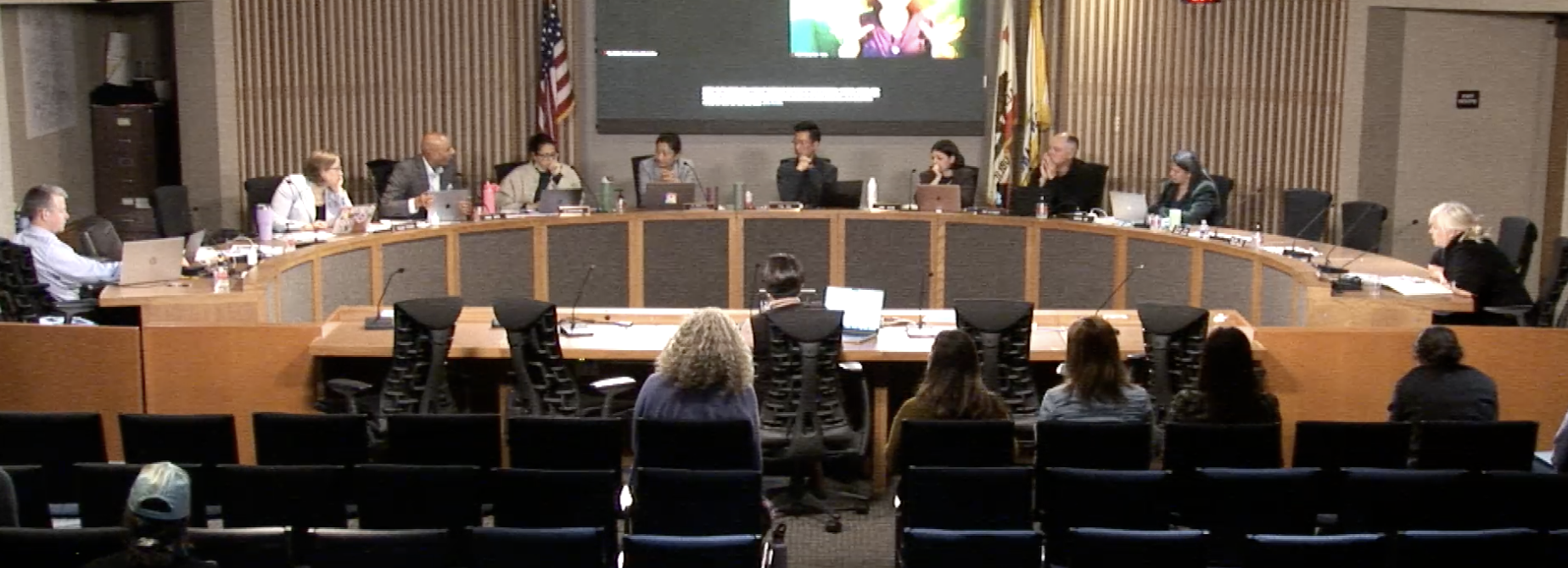
Governing Board - May 12, 2026 - Meeting

Governing Board - May 12, 2026 - Meeting

Governing BoardSan Francisco Unified School DistrictMay 12, 2026

Sources:

Locunity is a independent informational service and is not an official government page for this commission.We use AI-assisted analysis and human editorial review to publish information.

SFUSD Plots Multi-Year Enrollment Overhaul, Deferring School Closures

Superintendent Dr. Maria Su laid out an ambitious multi-year timeline to redesign how 50,000 students are assigned to schools — expanding programs first, redrawing enrollment zones second, and pushing any school closures to 2029 at the earliest — while the district celebrated its first positive fiscal certification in years.

  • Enrollment redesign targets 2028-29 launch, with board proposal by April 2027 and closures deferred until at least a full year of data is collected under the new system

  • District reaches positive fiscal status for the first time in recent memory, eliminating the need for a state-mandated stabilization plan after saving $32.3M from vacancies and $69.7M from underspent budgets

  • Galileo High School staff report two firearm incidents in two weeks and no principal for a month, pleading for board intervention

  • Asian PAC demands standardized language curriculum across immersion programs, a bilingual teacher pipeline, and disaggregated data for 28% of students lumped into one "Asian" category

  • Parents and students deliver emotional testimony against school closures affecting newcomer and biliteracy communities, teacher consolidation chaos at Mission High, and the absence of a cell phone policy ahead of a July 1 state deadline


The Big Bet: Growth Before Closures

Superintendent Dr. Maria Su unveiled a sequenced plan that prioritizes new programs and student assignment redesign over the politically explosive question of closing schools — asking a restless board to wait three more years before touching facilities.

The basics: SFUSD operates 155 facilities averaging 73 years old, with 14,000-plus empty seats and only 27% of K-5 students attending their neighborhood school. The current lottery system, created decades ago to promote diversity, has instead driven 35% of San Francisco's school-age children out of the district entirely.

Why it matters: The superintendent is wagering that building attractive programs will draw families back and generate the enrollment data needed to make smarter closure decisions — rather than closing schools first and risking the "doom loop" of declining enrollment that national research documents.

Where things stand: The plan moves in three phases: new program launches in 2026-27 (transitional kindergarten seats, a TK-8 Mandarin immersion school, and a county non-public school for special education students); a student assignment redesign with community engagement beginning fall 2026 and a board proposal by April 2027 for 2028-29 implementation; and potential closures, mergers, or co-locations only after a full year of enrollment data under the new system.

"Under this proposal, the earliest we would begin identifying potential closures and mergers or co-locations will be after we implement the first year of student assignment, which will be in 28-29," said Superintendent Dr. Maria Su.

She argued that the current enrollment picture in the city's southeast — where schools are most vulnerable — is distorted by the lottery. "We are currently looking at a handful of schools that are in our southeast sector of the city. And if we were to then close those schools and then change our student enrollment policy, we might find ourselves in a position where we would have to open up those schools again," she said, noting 2,700 students are bused out of southeast neighborhoods.

The other side: Board members pushed back hard on the timeline. Board Member Supryia Ray delivered the evening's sharpest critique, calculating that the proposed expansions would generate fewer than 1,000 new students — a fraction of the 14,000-seat gap. "I worry that we are going to be operating on hope rather than reality," she said.

Board Member Alida Fisher flagged that only 27% of K-5 students attend their home attendance area school and pressed on why the existing zone policy (Board Policy 5101.2) has never been implemented. Staff member Hong Mei Peng explained that Stanford simulations showed the current policy wouldn't materially improve diversity or proximity and could actually cause enrollment declines.

Board Member Matt Alexander struck a more supportive tone on the growth-first approach — "I think it's one of the problems with taking a school closure first approach is that it can lead to sort of a doom loop attitude" — but pushed for concrete bridging support, suggesting the district cost out temporarily overstaffing under-enrolled schools during the transition.

Fisher also raised a pointed concern about accountability, noting that programmatic closures are already happening without board approval. "We know that there are currently school closures and programmatic closures or mergers happening that have not been in line with the board direction around guardrail one," she said.

What's next: The superintendent proposed creating an ad hoc committee and providing regular board updates. The board took no formal vote — this was a discussion item — but the tension between the superintendent's patience and several commissioners' urgency signals this will be one of the most contested policy debates of the year. The board voted 7-0 to extend the meeting past 10 p.m. to finish the discussion.


Fiscal Turnaround: District Hits Positive Certification

SFUSD's board unanimously approved a third interim financial report that marks a dramatic reversal: the district has moved from negative to positive fiscal certification in a single year, and the California Department of Education has confirmed no fiscal stabilization plan is needed.

Why it matters: A positive certification means the district can adopt its budget with a narrative explanation rather than a state-mandated corrective action plan — the first time in recent memory. It gives the board financial breathing room as it confronts enrollment redesign and deferred maintenance decisions.

Where things stand: The turnaround was driven by disciplined budget-to-actual alignment. The district saved $32.3M from 334 vacant positions, captured $69.7M from underspent supplies and materials budgets, and saved $5.2M from aligning filled-position budgets to actual costs. The unrestricted general fund deficit shrank from $49.4M at second interim to $21.5M.

"CDE has notified and agrees with us that an FSP is no longer needed," said Chris, the district's chief financial officer. He explained the budgeting philosophy shift: "If we've been allocating $100 to you for the past five years and you've only spent 70 of it, we're not giving you $100 anymore, we're only giving you the 70."

Multi-year projections show no deficit spending on the unrestricted side for the next two years, with a $30M deficit appearing in year three driven primarily by 10% annual health benefit cost increases. The board's 8% local reserve in Fund 17 remains untouched. The QTEA parcel tax renewal in 2028 is a key assumption underpinning the projections.

The other side: Board Member Matt Alexander pressed on a pattern that had drawn educator suspicion: mid-year budget increases at first interim — supplies and services jumping from $219M to $297M — that then came back down. "People were asking me with this kind of suspicious sort of like, were they trying to hide money?" he said. The CFO pointed to a previously under-budgeted $30M special education transportation contract and the broader shift to actual-spending-based budgeting.

Board Member Alida Fisher raised concerns from the Special Education Parent Advisory Committee about a $27M reduction in the 2026-27 special education budget and underspending patterns. The CFO indicated the adjustments reflect alignment to actual expenditure rather than cuts to services.

Decisions: Approved 7-0 (For: Alexander, Fisher, Gupta, Huling, Ray, Weissman-Ward, Kim; Against: 0; Absent: 0).


Galileo Staff Sound the Alarm on Safety and Leadership Vacuum

Teachers and a school psychologist painted a dire picture of conditions at Galileo High School, which has been without a principal for about a month and has cycled through seven principals in 12 years.

Why it matters: Staff described a school where two firearm incidents occurred in a two-week span, IEP meetings are out of compliance without an administrator present, and a $6M bleacher replacement was completed while the building's elevator has been broken for nearly two years.

Danny Lynch, a 12-year Galileo teacher, asked the board to consider alternative leadership models given the constant turnover. Maureen Brown, a school psychologist, reported that autistic students are being traumatized by the instability. Lee Schimmel, an English teacher, described the firearm incidents and called the situation "neglect." Another speaker reported armed robberies occurring on or near campus. Multiple speakers urged board members to visit Galileo in person.


Asian PAC: Language Programs Need Standards, Not Just Strategy

The Asian Parent Advisory Committee, formed in September 2023, presented three recommendations addressing what co-chair Kimberly Chong described as a system where students arrive at middle school with wildly different language skills depending on which elementary school they attended.

Why it matters: Asian students make up 28% of SFUSD's enrollment but are classified as a single group, obscuring the vastly different needs of Chinese, Filipino, Vietnamese, Pacific Islander, and other subgroups. The PAC argues the district cannot serve these students equitably without disaggregated data.

Where things stand: The three recommendations are: standardize curriculum, grade-level proficiencies, and teaching materials across all language programs; build a local bilingual teacher pipeline through university partnerships (including a free BCLAD scholarship program with SF State); and integrate disaggregated Asian subgroup data into planning cycles.

Chong described the curriculum gap in concrete terms: "The teacher had to start from teaching elementary school materials. And also, there are schools that are really advancing very well, such as Alice Fong Yu." Orlando Leon, the PAC's secretary, emphasized the need for execution beyond strategic alignment.

Superintendent Dr. Maria Su confirmed 308 seniors will receive the State Seal of Biliteracy and noted the SF State scholarship program already allows teachers to earn BCLAD certification for free. Staff member Ms. Krugman from Multilingual Pathways acknowledged that a Chinese Language Arts curriculum adoption has not recently been done, unlike other content areas where the district translates adopted curriculum into Chinese.

The board directed staff to follow up on data disaggregation, with a commitment to more comprehensive Asian subgroup data on public dashboards by the beginning of the 2026-27 school year.


Community Outcry: Academy Closure, Teacher Chaos, Cell Phone Deadline

Public comment stretched across multiple urgent fronts, with organized groups and individuals delivering some of the evening's most emotional testimony.

Academy Closure Draws Anguished Student Testimony

Toto Honeyball, an Academy student, delivered a searing rebuke of the board over the school's closure, which she said upended nearly 100 children's lives, split friend groups, and left staff without jobs. Fellow student Finnegan described the instability of worrying about new schools and teacher placements while peers at other schools enjoy end-of-year activities.

Beyond Academy, speakers from Calendario Advocates, San Francisco Education Alliance, and Parents for Public Schools argued the district is destabilizing newcomer and bilingual programs — then claiming low demand to justify closures. Blanca Catalan of Calendario Advocates said the district claims low demand after failing to invest in newcomer and biliteracy schools. Another commenter called the superintendent's plan "school closures in disguise."

Mission High Teacher Consolidation

Sarah Mukhtari Fox, a consolidated teacher at Mission High, described having only one hour to fill out her five school preferences. She was placed at an elementary school against her will and denied a leave of absence because she was informed of consolidation four days after the deadline. She brought over 90 student testimonials. Colleague Sarah Kossoff described broader chaos from three consolidations past the April 20 deadline.

Cell Phone Policy Push

Five parents — Christine Ho, An Tran, Paula Yee, Alice Myers, and Joni Tatar — urged the board to adopt a strict "off and away, bell to bell" cell phone policy, noting SFUSD has no policy despite California's Phone Free School Act requiring adoption by July 1. They cited cyberbullying, mental health, and academic dishonesty concerns, noting LA, San Diego, and Santa Clara school districts have already complied.


Minor Items

  • Mission Bay School completed at $104M — the first new SFUSD construction in over a decade. The facilities team reported $200M-plus in active bond projects and plans for a $270M second bond issuance from the 2024 bond.

  • Elevator crisis: The district has 10 elevators completely out of service across its facilities and plans to modernize six, after spending $2M in repairs on a $360K maintenance contract. Board Member Alida Fisher flagged it as a legal liability and educational access issue.

  • Heat work order resolution improved 70%, from an average of 80 days to 7 days.

  • Legislative overview approved 7-0 with an amendment to move AB 1861 — which would require CDE to create a public database of special education IDEA violation complaints by 2030 — from "watch" to "support."

  • Two executive contracts approved 7-0: James Harrell as Associate Superintendent of Human Resources ($270,865) and John Davis as Deputy Superintendent of Educational Services ($340,752), both on two-year terms.

  • JROTC teaching waiver approved 7-0 for Mission High School.

  • Consent calendar approved 6-0 with Board President Phil Kim recused due to an employment conflict with the City and County of San Francisco. The superintendent pulled the Partners in School Innovation contract. The consent calendar included adoption of a schoolyard comprehensive plan covering outdoor learning, stormwater management, and climate-proofing.

  • Student delegates announced Nellie Folksman (George Washington High School) as the next student delegate and promoted Student Advisory Council applications.

  • Superintendent's report: Over 1,500 families have been offered waitlist seats. Outdoor graduation ceremonies are planned at Kezar Stadium June 1-3.

  • Special education budget concerns: Lillian Lim of the CAC for Special Education reported the 2026-27 special education budget is approximately 10% lower ($27M reduction) and year-to-date spending is 19% below budget.

  • Yick Wo combo class issue: A parent asked for consistent combo-class thresholds, noting 74 students in second and third grades exceed the 66-student cap for three classrooms, with waitlisted students being blocked from enrollment.

SFUSD Plots Multi-Year Enrollment Overhaul, Deferring School Closures | Governing Board | Locunity