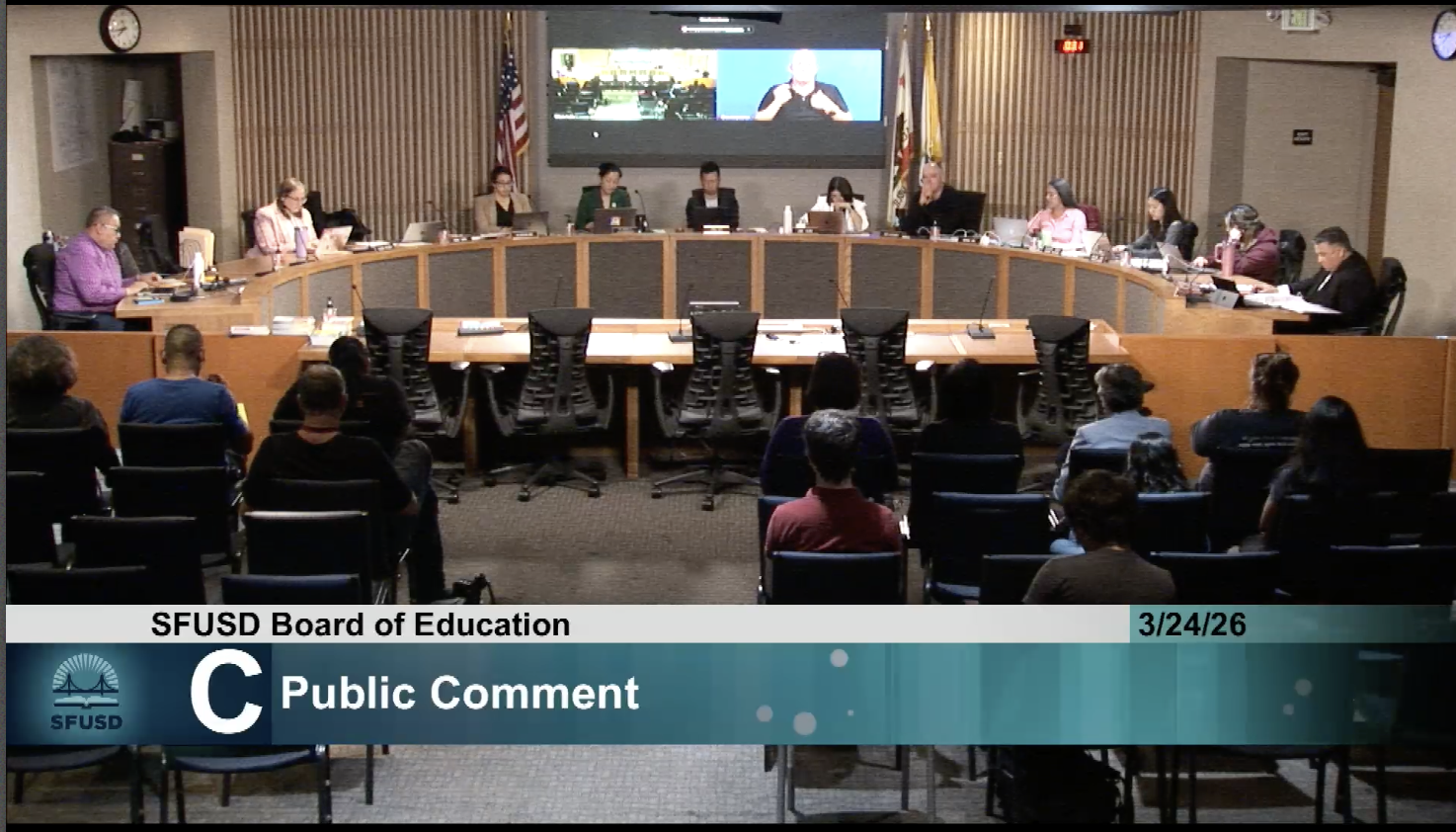
Governing Board - Mar 24, 2026 - Meeting
Governing Board • San Francisco Unified School DistrictMarch 24, 2026
Locunity is a independent informational service and is not an official government page for this commission.We use AI-assisted analysis and human editorial review to publish information.
Board Approves Landmark Algebra Policy 4-3 After Decade-Long Debate
The San Francisco Board of Education ended a marathon session March 24 by restoring Algebra 1 to all middle schools — backed by Stanford research but split sharply over how much choice to give families — while voting to extend the school year into June to recover from February's teacher strike. Beneath both headline votes, alarming progress reports revealed that the district's literacy and math gains remain stuck: only two-thirds of classrooms are using the board-approved curriculum, and student practice metrics are near zero.
Algebra returns to all SFUSD middle schools as board approves expanded math policy 4-3, with Stanford pilot data showing halved repeat rates and major equity gains
Contentious opt-out amendment splits board on whether commissioners are micromanaging or protecting student access
Third-grade literacy declines despite curriculum adoption; decodable text usage observed in as few as 0–9% of classrooms
Five school days added in June to make up for strike losses, passing 6-1 over widespread family and community concerns
Dozens of students demand school safety plans for immigrant families and reverse of newcomer program cuts as Mission Education Center enrollment collapses
Paraeducator layoffs hit fifth straight year, with seniority errors in notices causing panic at school sites
Elementary student expulsion fails 1-6, and the district loses jurisdiction over the case
Algebra for All: A Decade-Long Fight Reaches the Finish Line
The basics: SFUSD has spent more than a decade debating whether to require all eighth graders to take Algebra 1 or allow schools to offer it only as an elective. The new 2026 Math Placement Policy creates an "expanded math" model — students take both Math 8 and Algebra 1 simultaneously — starting in the 2026-27 school year. Two schools, including Hoover, will pilot a "braided compression" model that integrates both courses into a single period.
Why it matters: Stanford research presented to the board found that students taking both Math 8 and Algebra 1 had half the algebra repeat rate in ninth grade and showed substantial learning gains — with no evidence of academic harm. The data also revealed a powerful equity signal: at pilot schools that actively encouraged enrollment, focal student participation jumped from 59% to 85%.
Where things stand: Stanford Professor Tom Dee presented the pilot findings, telling the board that "at three of these six algebra-as-elective schools, there was encouragement of students who met the automatic enrollment criteria to take algebra. And we saw that drive participation in the course. And it had dramatic effects among focal students." But he urged caution about generalizing: "We can't necessarily infer that the absence of harm would generalize to the campuses that didn't choose that model."
Superintendent Maria Su said the opt-out pathway was shaped by family feedback: "I heard a lot from families who said that they truly believed that their child was ready to go straight into Algebra 1. And we did not want to take that opportunity away from that student."
The original policy language required students to be "secure" in all standards to opt out — a threshold that would have qualified only 23 students districtwide. Removing that word expanded eligibility to approximately 499 students, or about 15% of eighth graders.
The other side: Vice President Jaime Huling introduced an amendment going further — removing specific assessment thresholds entirely in favor of district-determined proficiency criteria and directing that provisions "be interpreted to expand rather than restrict access to Algebra 1." She highlighted the equity gap in the pilot data: "at schools with algebra, 89% of students enrolled in algebra, and at schools with algebra as an elective, only 29% of students did."
The amendment ignited a sharp governance clash. Commissioner Matt Alexander warned that the board was overstepping its role: "If we're going to govern from the dais and mandate how they do algebra, that's the board running our schools." Commissioner Alida Fisher agreed: "A whole lot of this policy is superintendent work. But when it comes to reflecting the values of the community, here we are." Commissioner Lisa Weissman-Ward also opposed the amendment as too technical for board action.
Decisions: The amendment passed 4-3 (For: Huling, Kim, Gupta, Ray; Against: Alexander, Weissman-Ward, Fisher). The full policy as amended passed on the identical 4-3 split. Approximately 4,000 eighth graders annually will now be auto-enrolled in expanded math, with roughly 500 potentially eligible to opt out with parental consent.
What's next: Two schools will pilot the braided compression model next year. The district will need to establish the specific proficiency criteria for opt-outs and set up counselor meeting timelines for families considering the pathway.
Reading Crisis Deepens: Curriculum on Shelves, Practice Near Zero
Why it matters: The district's flagship Goal 1 — getting third graders to read proficiently by 2027 — moved backward, not forward. Overall third-grade literacy declined slightly from fall to winter, with kindergarten and first grade the only bright spots.
Where things stand: Staff presented 19 slides of progress monitoring data connecting TNTP learning walk observations, STAR assessment results, and educator surveys. The headline finding: while 67% of classrooms were observed using the adopted curriculum materials, measures of "academic ownership" — whether students are carrying the cognitive load, practicing independently, and working with decodable texts — remained critically low. Decodable text usage was observed in 0–9% of classrooms.
Commissioner Alida Fisher zeroed in on the gap: "The data around the usage of decodable text is scary bad — zero percent for students independently practicing targeted skills in the context of decodable texts."
Staff described the district's theory of action: curriculum is the floor, not the ceiling, and teachers need deeper internalization, coaching, and enabling conditions at school sites to translate materials into high-quality practice. The percentage of teachers independently reviewing data for instructional improvement rose from 57% to 67% — progress, but not fast enough.
Board President Phil Kim pressed staff on the bottleneck: "How are we understanding whether or not teacher practice and behavior is improving so that these things go up?" Staff acknowledged "significant room for growth around the consistency of implementation" of coaching, with some schools meeting weekly for teacher collaboration and others only monthly.
Superintendent Maria Su connected the challenge to a broader crisis: "Having students lose 5 million hours of instruction per year is not okay," citing chronic absenteeism that she estimated costs the district $50–60 million annually.
What's next: The district is revising coaching cycle guidelines with TNTP, aligning coaching between the LEAD and CNI departments, and holding citywide principal-coach meetings three times a year aligned to STAR assessment windows. The February teacher strike likely further depressed interim results.
Five June Days Added to Recover Strike Losses — Over Deep Frustration
Why it matters: Without additional instructional days, SFUSD would finish the year with only 175 days — five short of the 180-day minimum. Falling below the threshold would reduce the district's Average Daily Attendance funding denominator for three rolling years, costing millions.
Where things stand: Associate Superintendent of HR Amy Baer explained that the proposal was negotiated with UESF leadership and the district's calendar committee. Educators who struck will not receive extra pay for the added days — those days were already docked — but the one transition day would require compensation. Impacts on special education extended school year programs, UASF, and SEIU staff require further bargaining.
Commissioner Supryia Ray, the lone no vote, argued: "This is fundamentally not family and student friendly. And I am very, very concerned about the message that this sends to our students and families." She raised concerns about chronic absenteeism messaging and the disruption to summer programs and community partners.
Vice President Jaime Huling voted yes but didn't hide her frustration: "I am very disappointed for our students, for many of our educators and staff, for our families that we are in the situation of having this be the recommendation." She noted the proposal should have been spread across the current and future school years rather than concentrated in June.
Decisions: The calendar amendment passed 6-1 (For: Alexander, Huling, Kim, Weissman-Ward, Gupta, Fisher; Against: Ray).
What's next: The district must finalize bargaining with SEIU and UASF over impacts to classified and support staff. Attendance on the added June days remains an open question.
Students, Families Demand School Safety Plans as Newcomer Programs Collapse
Why it matters: Over a dozen students and community members delivered more than 1,000 postcards to the board demanding a formal school safety plan protecting immigrant families from ICE enforcement and a reversal of cuts to newcomer education programs.
Where things stand: Speakers from Johanna youth group, Galileo High School, SF International High School, June Jordan High School, and community organizations SOMCAN and Jobs and Justice SF told the board that the SFUSD enrollment center is actively misdirecting families away from newcomer programs like Mission Education Center, telling them schools are "full" or "bad." A retired 38-year teacher reported MEC enrollment dropped from hundreds of students to 11, with zero projected for next year. A public commenter identified as Jessica Agnos, a community schools coordinator and SEIU steward, said undermining newcomer programs contradicts the voter-approved Student Success Fund.
Speaker Erin Antcliffe warned that eliminating MEC could cost the district more than $1 million annually in lost grants. Multiple speakers said Superintendent Su had ignored repeated invitations to meet with students at SF International.
Mason Waller, a public commenter, challenged the district's transparency claims: "President Kim had dismissed concerns about bilingual staff cuts and Superintendent Su agreed, despite literally planning to cut newcomer programs."
The coalition demanded the superintendent meet with youth groups, parents, and community organizations to collaboratively create, adopt, and implement a safety plan across all school sites.
Eighth-Grade Math: Mixed First Year for New Curriculum
Why it matters: The district's Goal 2 — eighth-grade math proficiency — showed marginal overall gains in the first year of the newly adopted Amplify Desmos Math K-8 curriculum, but student practice and cognitive engagement metrics lagged well behind targets.
Where things stand: TNTP learning walk data showed significant improvement in curriculum use from the 2023 diagnostic to January 2026, but academic ownership indicators — students explaining their thinking, asking questions about peers' work, carrying the cognitive load — remained below 40% in observed classrooms. Small increases appeared for overall Goal 2 and interim Goal 2.3, while Goals 2.1 and 2.2 dipped slightly within margin of error.
Staff described plans including deeper lesson internalization sessions with principals and assistant principals, alignment of coaching across departments, and focused professional development. As with literacy, the February strike may have depressed interim results.
The San Francisco NAACP urged the board to ensure every student has concurrent access to math and algebra instruction with credentialed teachers and support.
Paraeducator Layoffs Hit Fifth Straight Year
UESF Vice President of Paraeducators Tiana Tillery told the board her members are facing layoff notices for the fifth consecutive year — and this time, seniority errors in the notices sent the wrong paraeducators into panic.
"This is my fifth year standing at the podium talking about paraeducator layoffs. The fifth year, the same conversation. Fifth year of the same fear," she said. "When a paraeducator receives a layoff notice, it does not just affect one adult, it affects the students they work with every single day."
She described the loss of small group instruction, one-on-one support, and behavior intervention that follows when paraeducators — among the district's lowest-paid workers — are cut, and demanded the district rescind erroneous notices immediately.
Minor Items
Student expulsions: The board approved four of five stipulated expulsion agreements unanimously. One elementary student case (matter 2025-2622) failed 1-6 — only Commissioner Ray voted yes — meaning the district loses jurisdiction entirely under state law.
Provisional internship permit: One special education teaching permit for early education approved 7-0.
Consent calendar: Approved 6-0, with Board President Kim recusing himself due to a potential conflict of interest involving City and County of San Francisco contracts.
Closed session report: The board gave legal direction on anticipated litigation and accepted two employee resignations via settlement agreements.
Health education warning: Public commenters Christopher Pepper and Katrina Kabila told the board that middle school health classes are projected to drop from 11 schools to just 2 next year, despite no formal board decision. Kabila warned students will turn to AI chatbots for health information without proper instruction.
TEELE program funding: Christina Velasco, a 28-year SFUSD veteran, urged full funding for the TEELE leadership induction program, warning SFUSD would become the only Bay Area county without an equity-centered leader induction program. She cited $75,000-plus costs to replace a single school leader.
Payroll system concerns: A public commenter identified as Darius, a data engineer, described finding broken payroll systems and undelivered consultant work dating back seven years since joining the district after the 2022 payroll debacle.
Meeting extension: The board voted 7-0 to extend the session past 10 p.m.