Governing Board - Apr 28, 2026 - Meeting

Governing Board - Apr 28, 2026 - Meeting

Governing BoardSan Francisco Unified School DistrictApril 28, 2026

Sources:

Locunity is a independent informational service and is not an official government page for this commission.We use AI-assisted analysis and human editorial review to publish information.

Board Adopts Ethnic Studies Curriculum 6-1 After Marathon Hearing

The SFUSD Board of Education met for nearly eight hours on April 28, choosing a packed public hearing over sleep to advance the district's first comprehensive history textbook update in two decades — and its most politically charged ethnic studies vote yet. The meeting also became an early proving ground for June's looming budget battle, with four commissioners publicly conditioning their budget votes on targeted investments in Black student achievement and chronic absenteeism.

  • Voices ethnic studies curriculum adopted 6-1 after dozens of students, educators and community organizations pack the board room

  • Black families demand budget accountability — Commissioner Alexander says he will vote no on June budget without targeted investments in Black student achievement

  • Chronic absenteeism projected to exceed 25%, worsening from last year as staffing cuts undermine attendance work

  • Four commissioners draw budget red lines, tying their June votes to attendance, discipline and racial equity spending

  • All district union contracts finalized through June 2028 in unanimous votes

  • Management pay raises pass 6-1 amid conflict-of-interest questions and calls for comparative data


Ethnic Studies and History Textbooks Clear the Board

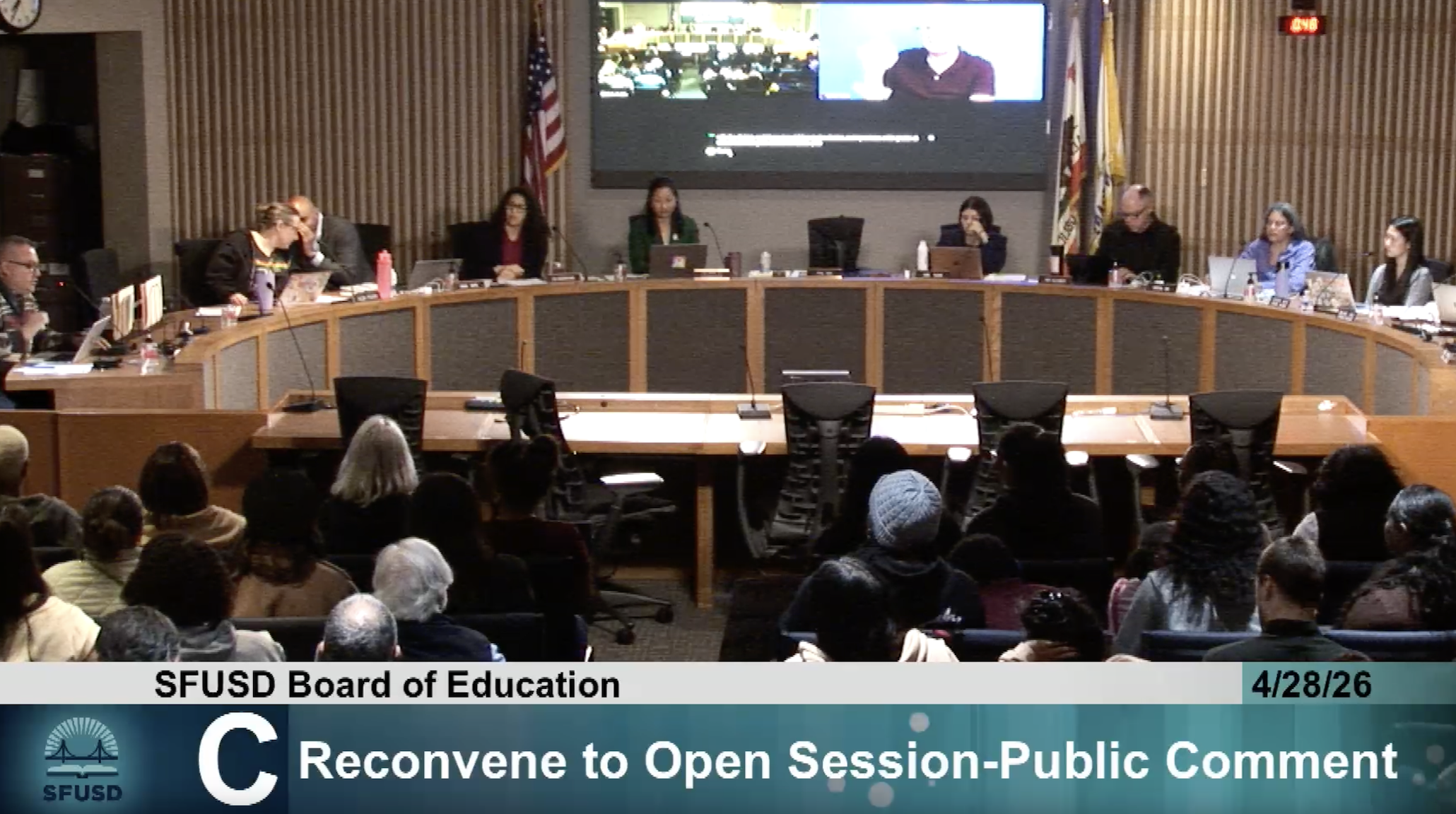
After hearing from what appeared to be the largest public turnout of the year, the San Francisco Board of Education voted 6-1 to adopt the Voices ethnic studies curriculum alongside Inquire Ed for elementary and McGraw Hill for high school history courses — a combined $7.3 million investment that replaces materials last updated in 2006.

Why it matters: California's AB 101 requires at least two semesters of ethnic studies for the graduating class of 2028. San Francisco, the birthplace of ethnic studies after the 1968 Third World Liberation Front strikes at San Francisco State, had been running the course off locally developed materials. The Voices textbook, published by Gibbs Smith, gives the district its first formally adopted ethnic studies textbook, backed by a pilot process and curriculum review that began in fall 2022.

Where things stand: Staff presented pilot data showing strong alignment with California standards and affirming content, with localized material identified as a growth area. Assistant Superintendent Devin Krugman walked the board through the review process and publisher evaluations, noting no middle school program was adopted because no evaluated program outperformed the district's existing TCI History Alive series.

The public hearing was overwhelmingly supportive. Students from Galileo, Lowell, Washington, Balboa and Lincoln testified about how ethnic studies shaped their identities and built empathy. Organizations including AROC, Chinese Progressive Association, Chinese for Affirmative Action, People Organizing to Demand Environmental and Racial Justice (PODER), Five Elements Youth Collective, and the NAACP spoke in favor.

"Devaluing ethnic studies robs students of navigating an uncertain world," said Tina Dang, a youth organizer with the Chinese Progressive Association.

A speaker cited a 2026 research article showing a 15% increase in students meeting a 3.0 GPA threshold from SFUSD ethnic studies enrollment.

The other side: A smaller group of speakers opposed the Voices textbook specifically.

"I wonder how many kids will dare to disagree with the Voices framing that they're given," said Commissioner Supryia Ray, who voted no.

She cited procedural concerns — ethnic studies was bundled into the broader history/social studies item without separate public notice — and substantive objections to the liberated ethnic studies framework. Ray also formally requested that the board revisit its policy on the two-semester ethnic studies mandate for public discussion and input. Parent review committee member Scott Kravitz argued the committee was stacked with supporters and that dissenting scores were averaged away. Substitute teacher Dennis Fox said the curriculum uses a victim-oppression worldview that excludes Jewish history.

Ray moved to divide the vote so commissioners could support history/social studies textbooks while opposing ethnic studies separately. Commissioner Matt Alexander and Commissioner Parag Gupta voted yes on the motion to divide; Board President Phil Kim, Vice President Jaime Huling, Commissioner Lisa Weissman-Ward and Commissioner Alida Fisher voted no. The motion failed 4-3.

Decisions: The combined adoption passed 6-1, with Ray casting the lone no vote. The $7.3 million covers five-year contracts for all teacher and student materials and digital licenses across elementary and high school.

What's next: Staff will focus professional development on implementing the new materials, with the ethnic studies graduation requirement taking effect for the class of 2028.


Black Families Lay Down a Budget Marker

Three parent leaders from the African American Parent Advisory Council (AAPAC) delivered the council's annual report — titled "The Power of Black Family: From Advocacy to Accountability" — and what followed was the most direct pre-budget confrontation this board has seen.

The basics: AAPAC, which has advocated for Black students for over a decade, presented three recommendations: strengthen academic ownership through consistent progress monitoring and grade-level math instruction; expand restorative practices with site-based leads, dedicated funding and publicly disaggregated discipline data; and deepen family partnerships with infrastructure funding, district-wide engagement standards and public reporting.

Where things stand: Rhonda Batiste, an AAPAC founding member, and Raymond Robinson, an AAPAC parent, detailed over a decade of work including 39 school expansions and literacy campaigns. Lachelle, a parent at Starr King Elementary, described the daily reality of families pushing for tools like Amira for literacy and IXL for math that are inconsistently implemented. Reverend Amos Brown of the NAACP brought five decades of institutional memory to bear:

"We've always had data, but we not had determination. I have come to board meetings for now fifty years."

Commissioner Matt Alexander then drew a line in the sand.

"I'm going to vote no on the budget this year in June unless I see very specifically targeted and specific investments that are based on current success and are going to improve achievement for Black students," he said.

He pointed to the lesson study math pilot at John Muir Elementary, where Black student math proficiency went from 10% to over 50%, as a model that should be scaled. Commissioner Alida Fisher cited the district's own 2021 CCEIS report, which identified "systemic racism and cultural dissonance" as root causes of discipline disparities, noting that not much has changed five years later.

Decisions: Superintendent Dr. Maria Hsu committed on the record to including targeted investments in the June budget.

"I commit to starting and working with our parents. I've heard loud and clear from both Commissioner Alexander and now Commissioner Fisher that you expect us to do better and make sure that the budget that we present in June includes something in it that would indicate that we are serious about action," Hsu said.

What's next: The superintendent's June budget proposal will be the first test of whether these commitments translate into line items. At least two commissioners have publicly staked their votes on seeing concrete investments.


Chronic Absenteeism Worsens — and Commissioners Say the Budget Is to Blame

The Guardrail 2 monitoring report, presented by Assistant Superintendent Tony Payne and Karen Fraleigh Norman, delivered a mixed picture: the district met its sense-of-belonging target for students, but chronic absenteeism is trending toward 25%, up from 24% last year. African American students remain significantly disproportionately suspended, especially at the middle and high school levels.

Why it matters: Chronic absenteeism directly reduces per-pupil funding tied to average daily attendance — making it both a student welfare crisis and a budget crisis. Only 64% of schools report fully implementing Coordinated Care Team plans, and a single staff member currently manages 315 tier-three students, the district's most chronically absent.

Where things stand: A bright-spot school was highlighted where relational strategies and a family liaison reduced absenteeism. Principal Malea Mouton-Fuentes of Willie Brown Middle School described her school's shift from a referral room to a push-in restorative practices model:

"When you're in schools and you're under-resourced and you don't have time, a lot of times the disciplinary means are much easier than the restorative practices. It requires staffing, it requires time, it requires a real commitment from leadership."

Multiple commissioners turned the monitoring report into an early budget fight. Commissioner Alida Fisher argued that staffing cuts are making the problem worse:

"When we say in our budget study session that chronic absenteeism is a bigger driver to our budget deficit than declining enrollment, we're cutting off our nose to spite our face."

Vice President Jaime Huling was equally blunt:

"I will not be voting for a budget that relies on outside funding that is not guaranteed, that we have seen attempts to fundraise outside for funding things like major decisions not come through in a timely way."

What's next: The chronic absenteeism data will feed directly into budget negotiations ahead of the June adoption vote.


Management Raises Pass 6-1 Amid Structural Questions

The board approved compensation increases for unrepresented classified management — positions ranging from education policy analysts to the superintendent — on a 6-1 vote, with Commissioner Matt Alexander casting the lone no.

Why it matters: The debate exposed structural tensions in how the district pays its highest-level non-union employees during a period of significant budget cuts and layoffs that have disproportionately affected this same group.

Where things stand: Alexander objected to the supporting memo's claim that inflation affects all employees equally, calling it "false and probably offensive to some of our lower-paid employees." He said the raises lacked comparative data from other districts and any performance-based rationale, but offered to support a revised proposal backed by evidence.

Commissioner Supryia Ray raised a conflict-of-interest concern: management staff effectively negotiate raises with fellow management. Senior Deputy General Counsel Christine Lee explained that unrepresented staff receive corresponding increases to their aligned bargaining units and noted that one set of negotiations had gone all the way to fact-finding.

Decisions: The item passed 6-1 (For: Kim, Huling, Weissman-Ward, Gupta, Fisher, Ray; Against: Alexander; Absent: 0).


Minor Items

  • Multi-year labor agreements with IFPTE Local 21, IUOE Local 39 and SEIU Local 1021 approved 7-0, completing all active union negotiations and providing budget predictability through June 2028.

  • Four executive employment contracts approved 7-0.

  • Emergency declaration for fire-damaged field turf replacement at Thurgood Marshall Academic High School approved 7-0; emergency procurement aims to restore the field before fall term.

  • PIPs and waivers approved 7-0.

  • Student expulsions: Four stipulated expulsion agreements approved; one elementary school case rejected unanimously 7-0 no.

  • 865 Market Street ground lease amendment pulled from consent and approved 5-2 (Ray and Alexander voting no).

  • Closed session report: Board gave direction to counsel on anticipated litigation and accepted two employee resignations through settlement agreements.