Governing Board - Sep 22, 2026 - Meeting
Governing Board • San Francisco Unified School DistrictSeptember 22, 2026
Locunity is an independent informational service and is not an official government page for this commission. All information is sourced from public footage and an analysis of official agendas with the aid of responsible, fact-checked AI. to report an error or omission.
Board Rejects Math Report Despite Gains as Parents Sound Alarms on Lead and AI
SFUSD's board unanimously voted to reject its own math proficiency monitoring report — not because progress didn't happen, but because the district's stated goal is now mathematically out of reach. Meanwhile, parents packed the meeting to demand action on lead contamination at a Chinatown school and a fast-growing coalition pressed the board to rein in AI and device use in elementary classrooms.
- Board votes 0-7 to reject math monitoring report, acknowledging the 65% proficiency target for 2028 is unreachable despite a 4-point gain to 45%
- Chinese Immersion School families demand district delay window demolition set for Oct. 9 that could spread lead contamination, submitting a 100-signature petition
- 275-member parent group pushes for AI moratorium and device restrictions in early grades, presenting 1,000+ petition signatures
- NAACP leaders condemn anti-Black racism at Lincoln High School, calling on the board to publicly address a September incident
- 20-year Project Labor Agreement renewed unanimously for $1.5 billion in bond-funded school construction
- Board settles 19 student cases totaling more than $800,000 in closed session
A 4-Point Gain — and a Unanimous Rejection
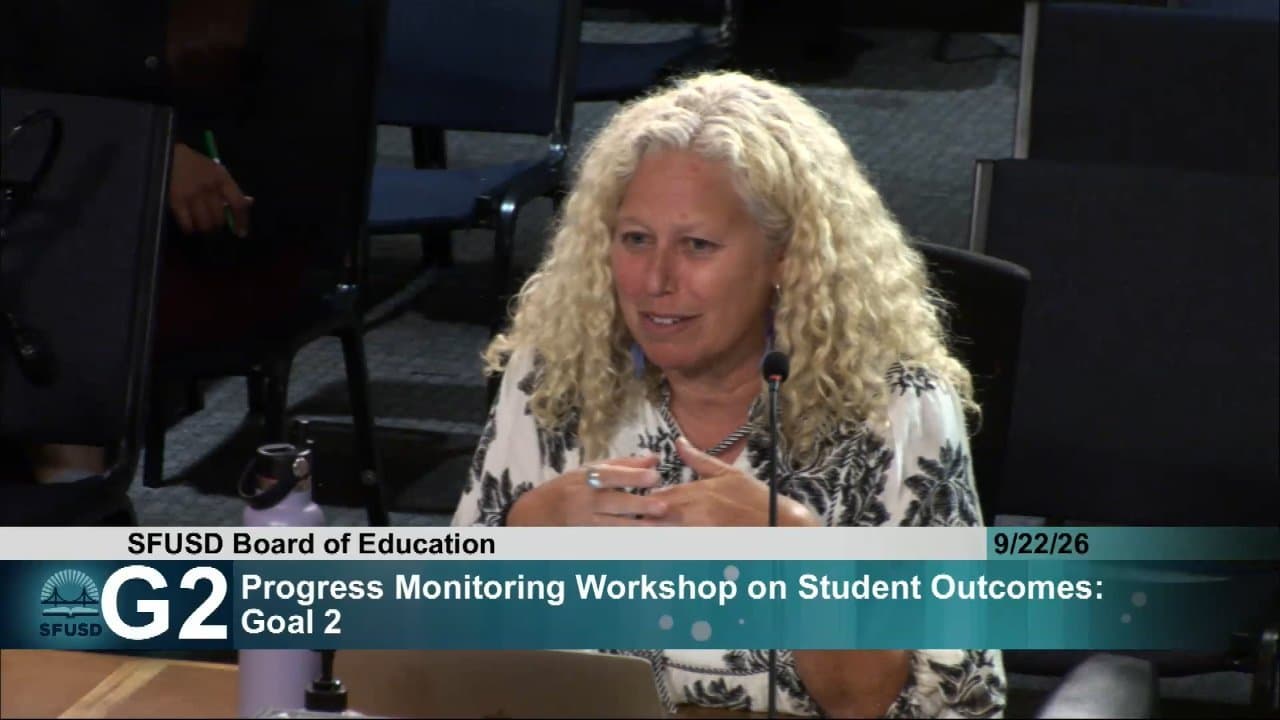
The longest and most consequential discussion of the evening centered on SFUSD's Goal 2: getting 65% of 8th graders to math proficiency on the state SBAC exam by 2028. Preliminary data showed proficiency climbed from 41% to 45% — real progress, but still 20 points short of the target with only two years left.
Why it matters: The board's unanimous vote to reject the monitoring report isn't a rebuke of teachers or staff. It's a formal signal that the district's strategic framework needs resetting — and that every math dollar, staffing decision, and curriculum initiative will be re-evaluated against new, more realistic interim targets the superintendent is expected to present in October.
Where things stand: Staff presented a theory of action built on three pillars: a new K-8 math curriculum (Illustrative Math and Amplify Desmos, now in year two), intensified teacher professional development with release days and administrator calibration, and student ownership of learning. The district completed more than 500 learning walk observations in September alone. Lab schools are receiving targeted coaching from TNTP, and the "Each and Every Student by Name" initiative is expanding to 6th-grade math for African American students.
Gains were uneven across student groups. Latinx students improved, and Filipino 8th graders posted a statistically significant 10-point jump — prompting Commissioner Lisa Weissman-Ward to press for specifics: "What do we know about the specific conditions or effective practices in those classrooms that accounted for that? I mean, that was massive progress." Staff acknowledged the small sample size makes it difficult to isolate causes.
African American and Pacific Islander students, however, saw flat or declining results — a persistent gap that weighed heavily on the board.
The other side: Commissioners pushed hard on whether the district can distinguish genuine strategic impact from post-COVID rebound. President Phil Kim asked pointedly: "How do we know that the gains that we're experiencing now are just not a recalibration back to our pre-COVID days?" Staff could not yet fully answer.
Commissioner Alida Fisher challenged the blurriness between inputs and outcomes: "I'm really struggling to understand the specific outcomes here and what we're actually going to be measuring and monitoring." She also questioned whether school leaders have enough support to execute the strategies while running their buildings: "Do we have the appropriate level of resources in place to make sure that we can implement these strategies with fidelity and collect the amount of data we need?"
Commissioner Matt Alexander asked staff to identify where focal students are succeeding: "Where are the places where we are seeing success and what are we learning from that about which strategies are working for focal students?" Commissioner Supryia Ray probed whether students are struggling with academic stamina and perseverance, and questioned the shift from implementing curriculum with "fidelity" to "integrity."
Vice President Jaime Huling pressed on whether $12.5 million in new state funds is being directed toward Goal 2 strategies: "Do the strategies that are described here allocate those funds or represent any kind of changes in funding allocations toward meeting Goal 2?"
Decisions: The board voted 0-7 to not accept the report (For: 0, Against: 7, Absent: 0). President Kim emphasized the vote reflects the goal structure, not staff performance: "By no means is this an indication of our belief or confidence in at least the work that we are seeing. This is a question of whether or not we are actually seeing the progress that we want to see or not, or plans that do that."
What's next: The superintendent is expected to present one-year interim targets in October. The board will also launch VVGG (Vision, Values, Goals, and Guardrails) listening sessions to recalibrate multi-year strategic goals.
Lead Fears Erupt at Chinese Immersion School
Parents, Kids Plead: Move the Window Work to Summer
Seven speakers — including two elementary-age students — delivered urgent testimony about lead contamination risks at Chinese Immersion School at DeAvila, where the district has scheduled window demolition to begin Oct. 9. Elevated lead levels have already been found in bathrooms and play areas, and some students have tested positive for lead exposure.
Why it matters: The demolition would disturb lead-containing materials during the school year, with children present. Parents say the district originally planned the work for summer but changed course — and that current safety measures are inadequate.
Where things stand: Elia Chako, an 8-year-old 3rd grader, told the board she and her sister have already had lead exposure and described being confined indoors for recess and PE. James Freeman Cross, another young student, asked that crews clean up and do the work when kids aren't at school.
Parent Nancy Chang described gaps in containment sheeting and delayed notification of test results. Thomas Saiget, a chemical and biomedical engineer, called for more testing inside school buildings — hallways, cafeteria, and TK classrooms — and characterized mopping as "quick, cheap insurance against permanent lead damage."
Parent Nick Hay delivered perhaps the most pointed critique, challenging the district's reliance on a 400 micrograms per square foot standard that he called obsolete. The EPA health clearance standard for indoor floors, he noted, is 5 micrograms — 80 times lower. He cited UCSF experts and CDC/AAP guidance that no safe lead level exists for children.
Parent Lori submitted a community petition signed by more than 100 families requesting the district reschedule window demolition to summer 2027 and professionally wet-clean play yards. Parent Ranjit Chako noted the district originally planned summer removal but reversed that decision.
What's next: Window demolition is currently scheduled for Oct. 9. The board took no formal action during public comment, but the volume and intensity of testimony — including from young children describing their own lead exposure — puts immediate pressure on district staff to respond before work begins.
Parent Coalition Targets AI and Screens in Elementary Classrooms
A coordinated bloc of parents, students, and teachers from Tech in Check — a 275-member group spanning 56 SFUSD schools — used the public comment period to present a 1,000-signature petition demanding three things: a moratorium on student generative AI use, grade-level limits on one-to-one devices with no recreational screen exposure, and social media-free schools.
Why it matters: The district's next scheduled technology policy discussion is not until March, frustrating parents who see cities like Seattle and Los Angeles moving ahead with restrictions now.
Where things stand: The specific flash point was Amira, an AI-powered reading platform. Parents said it was introduced without clear parental notification, collects student voice recordings without transparent consent, and makes marketing claims not supported by independent studies. Parent Ashley Ahern highlighted the lack of notification. Cody, a 3rd grader at Lafayette Elementary, and Hannah, a 1st grader, described firsthand frustrations with Amira's voice recognition failures — with Hannah having to sit in a closet yelling at the device.
Robert Schneider, a PE teacher, argued elementary students need protected screen-free time. A 27-year SFUSD veteran teacher, Ms. Dalu, expressed concern about AI replacing trained educators for reading screening and questioned the fiscal responsibility of such investments given the district's other financial pressures.
Parent Brandy Markman called for restoring monthly program and curriculum committee meetings — eliminated under the district's student outcomes-focused governance model — noting the next tech discussion isn't until March. Parent Carly Danielson questioned the practice of having 8-year-olds sign Chromebook contracts when the district lacks a clear technology policy.
What's next: No board action was taken. The next scheduled discussion of technology policy is in March, unless the board moves to accelerate it.
NAACP Leaders Demand Board Address Racism After Lincoln High Incident
Reverend Amos Brown, NAACP President Emeritus, delivered an extended and impassioned public comment about a Sept. 4 incident at Lincoln High School involving racialized, bigoted language targeting Black students. He described a pattern of double standards in disciplining racially motivated behavior and demanded the board publicly support the superintendent in condemning such incidents.
Brown referenced a parent who appeared on television, telling the board: "On a television station there was broadcasted a parent who called Black children animals, and that has taken on a life of his own." He called on Asian community leaders and the board alike to stand publicly against anti-Black racism.
Virginia Marshall, also affiliated with the NAACP, echoed these concerns and called for more parent workshops to address the racism students bring from home. Both speakers urged the board to ensure all students have an environment free of racial harm.
20-Year Labor Partnership Renewed for Bond Construction
The board unanimously approved the 2026 Project Labor Agreement with the San Francisco Building and Construction Trades Council, governing workforce standards for approximately $1.5 billion in voter-approved bond-funded school construction.
Why it matters: The PLA locks in local hire requirements, prevailing wages, and — for the first time — apprenticeship and workforce development provisions aligned with the district's updated career and technical education programs for students.
Bond Program Director Lisenia Ibarra presented the agreement, noting it marks 20 years of partnership. She explained the prior 2013 language was not aligned with current College and Career Readiness offerings; the updated PLA now works alongside a new student career pathways policy approved on the consent calendar.
Rudy Gonzalez, Secretary-Treasurer of the San Francisco Building and Construction Trades Council, testified in support: "This month marks the 20th year that we have been partners in construction, and to our young ones, the message is received, and our contractors owe the cleanest work environment regardless of their affiliation under this PLA."
Vice President Jaime Huling offered appreciation from a labor family perspective: "I think the fact that we can be so committed to working with labor locally is key, not just for the district but for the community."
Decisions: Approved 7-0 (For: 7, Against: 0, Absent: 0).
Textbook Resolution Approved After Reopened Hearing
The board approved its annual Williams Act textbook sufficiency resolution certifying that students have adequate instructional materials — but only after an unusual procedural move.
President Kim reopened the public hearing after discovering Dr. Vanessa Marrero, President of Parents for Public Schools of SF, had been missed as a virtual commenter during the initial vote. Marrero urged the board to look beyond compliance numbers, arguing that true sufficiency means modified text and assistive technology for special education students from day one, robust English learner development materials, and curricula built around Universal Design for Learning.
Decisions: Revote approved 7-0 (For: 7, Against: 0, Absent: 0). Student delegates also voted yes (advisory).
Minor Items
- Consent calendar (E1–E46) approved 6-0; President Kim recused due to employment with the City and County of San Francisco. Included a new student career pathways and workforce development policy.
- Seven student expulsion agreements (matters 3–9, 2026–2027) approved; all unanimous except matter 8, which passed 6-1 with Commissioner Fisher voting no.
- Closed session: Board approved 19 student settlement agreements totaling more than $800,000, mostly involving Office of Administrative Hearings special education cases. The largest was $250,000. Three employee settlements were also approved. Commissioner Fisher voted no on one student matter (6-1); Commissioner Ray voted no on two employee settlements (both 6-1).
- CBOC vacancy alert: Citizens' Bond Oversight Committee Vice Chair Lawrence Lee warned that three members' terms expire Oct. 10, which would drop the committee below its legally required seven members. He also flagged a $7.8 million duplicate entry caught during bond oversight review.
- A 6th grader at James Lick Middle School, Emberly Getty-Bye, shared a positive update about starting middle school and praised teachers and the Spanish immersion program.
- A District 3 parent, Alex Lugash, alleged that The New School charter enrolled two kindergartners into first grade mid-year without meeting the Sept. 1 age cutoff, calling it fraud and requesting board investigation.