Governing Board - Apr 14, 2026 - Meeting

Governing Board - Apr 14, 2026 - Meeting

Governing BoardSan Francisco Unified School DistrictApril 14, 2026

Sources:

Locunity is a independent informational service and is not an official government page for this commission.We use AI-assisted analysis and human editorial review to publish information.

Board Extends Academic Goals to 2028 as LGBTQ Safety Becomes Attendance Priority

The SFUSD Board of Education ran past 10 p.m. on April 14, unanimously extending its marquee academic targets by a year while confronting an uncomfortable truth: the district's most ambitious goals may be mathematically out of reach, and the students skipping school at the highest rates are queer and transgender youth who don't feel safe.

  • Board votes 7-0 to push the 70% third-grade literacy target to 2028 after staff reveals site-level goals were already quietly decoupled because double-digit annual growth was "demoralizing"
  • QTPAC delivers three formal recommendations on mandatory LGBTQ educator training, all-gender changing rooms, and alternative PE options — backed by data showing queer and trans students skip school at 2–8x the rate of peers
  • Guadalupe Elementary families rally for Spanish bilingual TK, presenting 200 petition signatures and noting only two of the district's 74 elementary schools offer the program
  • Teachers, parents, and the NAACP slam a $144–$224/hour consulting contract on the consent calendar, citing the strike fact-finding report's warning about overspending on outside contractors
  • 94% of families received an enrollment placement on their application — a first in years, with waitlist assignments beginning April 20

The Goals Gap: Board Buys Time but Wrestles With What's Realistic

Why it matters: SFUSD's Vision, Values, Goals and Guardrails — adopted in 2022 after extensive community engagement — set targets of 70% third-grade literacy, 65% eighth-grade math proficiency, and 75% college/career readiness. Those targets were due in 2027. The board just acknowledged it won't get there on time, and the internal data is more sobering than the public number suggests.

Where things stand: Dr. Moonhawk Kim, SFUSD's RPA director, laid bare the math: "If we were to continue to aim to meet the VVGGs that was set by the end of 2027, that would imply that many school sites would have to aim for a double digit growth during the school year. Which is not realistic. It is actually demoralizing to see those numbers on paper."

RPA had already quietly decoupled individual school targets from the district-wide goals for the current year — a significant admission that the accountability framework underpinning the district's strategic plan had functionally broken down.

Superintendent Dr. Hsu provided context on the scale of the ambition: "If 70% of our third grade were reading at the third grade level, it would put SFUSD at the 99th percentile in the state of California."

AJ Crabill, a governance coach from the Council of Great City Schools joining remotely, framed the tension directly: "The question of how high or low your targets is isn't bounded by what other large urbans have done. It isn't bounded by what you've done. It is largely bounded by what resource allocation does the board." He advised that the extension pushes the replacement deadline to fall 2027, meaning community listening would need to begin by January 2027.

The other side: Board members supported the extension but drew sharp lines on what comes next. Commissioner Matt Alexander backed extending but insisted on seeing progress first: "It's okay if we still have these really ambitious goals. What I want to see is progress."

Commissioner Supryia Ray pushed in the opposite direction — accountability for implementation — arguing that the problem isn't just the targets but follow-through: "We frankly have almost like a problem not just of absenteeism of our students, but absenteeism of practice, absenteeism of the curriculum in our classes where we have a full third of classes that are not getting the curriculum that we have invested in."

Vice President Jaime Huling was firm that lowering targets without community engagement would be unacceptable given the thousands of community inputs that shaped the original goals: "I would not support and would not vote for a resolution that changed the target."

Commissioner Alida Fisher challenged the measurement itself, arguing "our SBAC scores are not what we should be measuring. These are our SBAC scores. Do not tell us how well our students read."

President Phil Kim aligned with preserving the targets for now: "I think I would also oppose changing these without some significant community input."

Decisions: The board voted 7-0 to adopt the updated 2025-26 governance calendar and the resolution extending VVGGs through 2028. Staff was directed to return May 12 with modeling on realistic projections tied to school reorganization planning. Superintendent Dr. Hsu noted the district is in a stronger fiscal position after last year's stabilization work, and Hong Mei Peng outlined how the governance calendar connects goal-setting to the school reorganization timeline.

What's next: The May 12 board meeting is now the key date — staff will present modeling that attempts to reconcile aspiration with achievability, with school reorganization decisions expected to shape resource allocation and, ultimately, whether the 2028 targets are credible.


QTPAC Makes the Case: LGBTQ Safety Is an Attendance Crisis

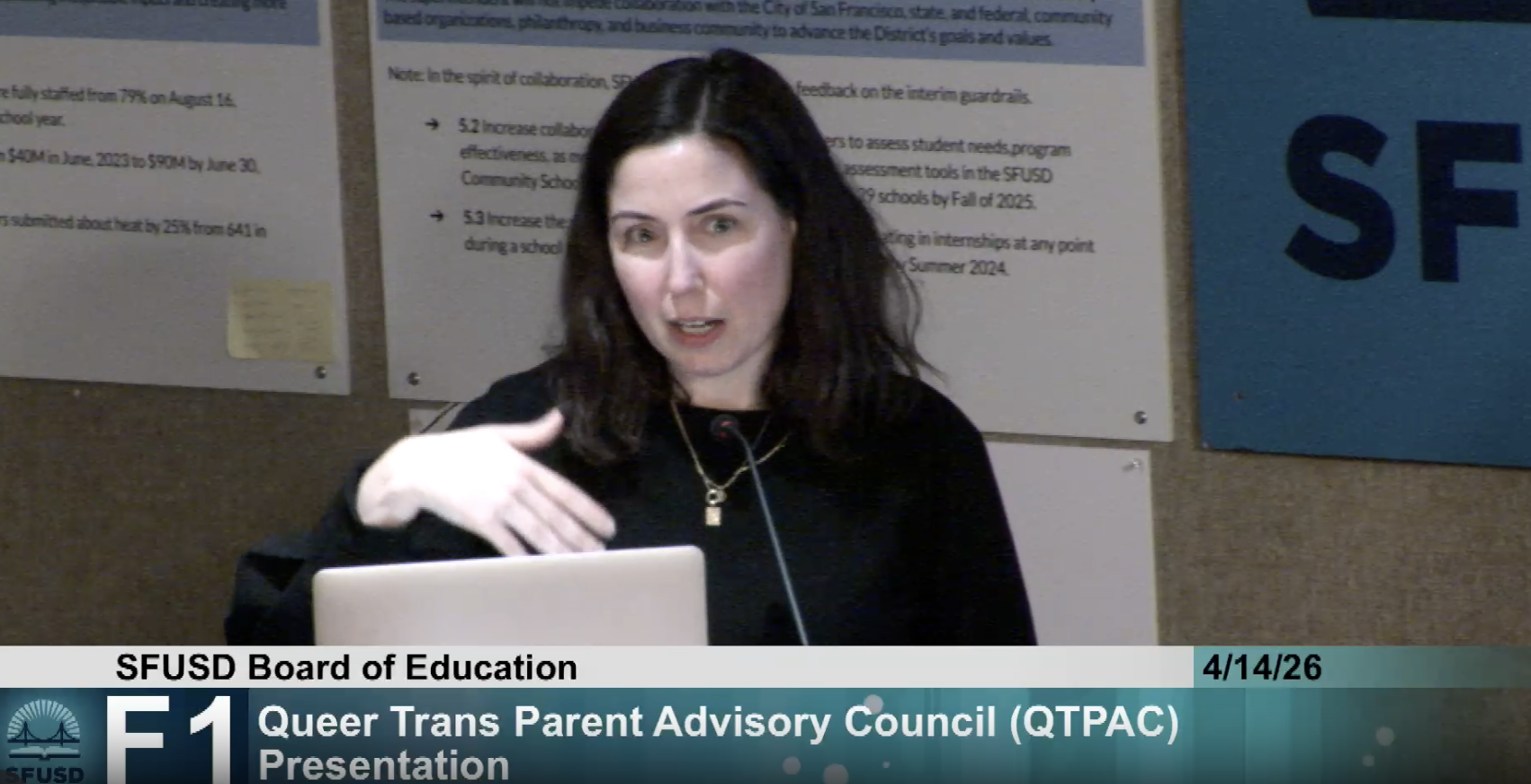
The basics: The Queer Trans Parent Advisory Council, formed by board resolution in 2022 and active since November 2024, presented three formal recommendations after 12 meetings of engagement.

Why it matters: 30% of SFUSD students identify as queer and roughly 6% as transgender or gender questioning. QTPAC Chair Maggie McAdam connected the data directly to the district's biggest operational challenge: "Queer and trans students in our district report skipping school at rates two to eight times higher than cisgender straight kids in the same cohorts. Supporting queer and trans students is an attendance issue."

The national context is stark: 39% of queer and trans youth seriously considered suicide in 2024, and over 400,000 trans people have left states with anti-trans laws.

Where things stand: The three recommendations target distinct gaps:

Recommendation 1 (Training): Sasha Harris-Cronin, a QTPAC member, called for mandated reporting on compliance with California Ed Code requiring seventh- through 12th-grade certificated staff to receive at least one hour of sexual orientation and gender identity training per year via the PRISM program, plus an optional module for Pre-K through sixth-grade staff. LGBTQ Student Services Coordinator Kenna Hazelwood described the current model as on-request — schools must invite her — and acknowledged its limitations.

Recommendation 2 (Facilities): Em, QTPAC's vice chair, pushed for all-gender changing rooms at every school with PE and binary changing rooms, going beyond the single ADA-compliant all-gender restroom per campus required by SB 760. Only three sites are currently slated for future all-gender changing rooms.

Recommendation 3 (PE): Celestina Pearl proposed expanding independent study PE beyond alternative high schools, allowing students to fulfill PE requirements through community arts, dance, and other activities supervised by credentialed teachers.

Board members responded with both urgency and operational questions. Commissioner Fisher tied the issue to the district's structural deficit: "When we heard in our budget study session earlier this year that absenteeism and chronic absenteeism are more impactful to our structural deficit than declining enrollment, making sure that all of our students feel safe and welcoming seems paramount to closing that deficit."

Commissioner Alexander pressed staff on the ad hoc nature of current educator training: "How are we training our educators to ensure that they're keeping queer students safe?"

Commissioner Lisa Weissman-Ward flagged social media algorithms as an accelerating threat and suggested interim policy changes around PE uniforms being optional. Assistant Superintendent Devin Krugman highlighted new history/social studies curriculum with LGBTQ representation. Assistant Superintendent Jennifer Steiner described advisory lessons and administrator boundary trainings. Assistant Superintendent Davina Goldwasser discussed monthly belonging series and student clubs at the high school level.

President Kim directed the superintendent to partner with QTPAC on policy recommendations and requested a report back sooner than a year: "We need to be the premier district in the country where LGBTQ students feel safe, supported, and proud, and we can't go around wearing Pride shirts if we're not doing that."

What's next: Superintendent Dr. Hsu committed to exploring bond funding for facilities improvements, expanding social-emotional programming, and continuing to work with parents and school leaders. The board signaled support for moving from reactive, opt-in training to proactive, system-wide approaches.


Guadalupe Families Demand Bilingual TK With 200 Signatures in Hand

Why it matters: Only two of SFUSD's 74 elementary schools offer Spanish bilingual transitional kindergarten, despite significant demand from Spanish-speaking families. A sustained campaign by Guadalupe Elementary parents, students, and staff dominated the public comment period.

Where things stand: Roberto Guzman Rivera, a Guadalupe parent, told the board the families had found a willing bilingual TK teacher and already had 30 applicants — with only 20 accepted. The families collected 200 petition signatures. Blanca Catalan of Coleman Advocates noted only two schools districtwide offer Spanish bilingual TK, with over 100 Spanish-speaking students in the Guadalupe area.

Julie Carnelia, a 20-year SFUSD veteran and National Board certified teacher at Guadalupe, provided the academic case: none of her Spanish bilingual kindergarteners had attended bilingual TK, leaving them at a disadvantage entering her classroom. Mei Yin, a counselor at Guadalupe for over 20 years, echoed the need, describing students being transferred to other schools instead of staying at their neighborhood campus.

Students Angela Garcia and Camila Martinez asked the board directly for more reading support and bilingual instruction. Sandra, a parent, described how her daughter lost Spanish-language therapy services and was offered a school in Chinatown she cannot reach as a single parent. Maria Deludre described her daughter's difficult experience in English-only TK instruction.

Separately, Ishita Verma, a Mission Bay parent, asked for an additional TK classroom at the new Mission Bay school, which has over 100 students on a waitlist.

What's next: The board took no formal action on the bilingual TK request, but the organized campaign — complete with petition signatures, a willing teacher, and student testimony — puts pressure on the superintendent and staff to address the gap.


Speakers Blast $200/Hour Consulting Contract as It Passes on Consent

Why it matters: The February fact-finding report from the recent SFUSD teacher strike identified overspending on contracted services as a major district problem. Multiple speakers targeted the Partners in School Innovation contract — included in the consent calendar — as a test case for whether the board would change course.

Where things stand: Chris Clouse, SPED department head at Washington High School, flagged the contract's rates of $144–$224 per hour for coaching principals and instructional leaders, arguing these should be in-house union positions. Alisa Nguyen called the spending a challenge to equity, listing priorities that should receive funding instead: staffing classrooms, school nurses, and social workers.

Gloria, a Mission High parent, contrasted the expensive contract with the district's inability to fund a bilingual TK teacher at Guadalupe. Ms. Marshall, representing the NAACP and Alliance of Life School Educators, asked the board to redirect the funds to teachers and retired teachers. Rachel Jones of Coleman Advocates echoed these concerns.

Decisions: The consent calendar passed 6-0, with President Kim recused due to city employment. Item 39, a Guadalupe construction contract, was pulled from consent for re-noticing under public contracting rules — but the Partners in School Innovation contract remained and was approved. Advocates may continue to press the issue at future meetings.


Minor Items

  • Superintendent Dr. Hsu announced that 94% of families received a spot on their enrollment application for 2026-27, a first in years. Waitlist assignments begin April 20; families will receive notifications via email, text, and robocall and must accept by Friday of that week.
  • SFUSD Pride Month: Superintendent Dr. Hsu marked the district's unique April celebration, dating to 1990, and affirmed the district's commitment to queer, transgender, and gender-expansive students and staff.
  • The board approved one bilingual elementary teacher waiver (7-0) and the annual Declaration of Need for Fully Qualified Teachers filed with the California Commission on Teacher Credentialing (7-0).
  • The Student Delegate reported on a Youth Summit focused on "Building Bridges, Not Borders" with workshops and budget feedback sessions.
  • Darius Bagehetti questioned how much of the education budget goes to finance operations errors, legacy systems consultants, and overtime administration, estimating $4–$6 million spent managing employee retirement savings.
  • The board voted 7-0 to extend the meeting past 10 p.m. and adjourned at 10:10 p.m.