Police Commission - Jun 10, 2026 - Meeting

Police Commission - Jun 10, 2026 - Meeting

Police CommissionSan FranciscoJune 10, 2026

Sources:

Locunity is a independent informational service and is not an official government page for this commission.We use AI-assisted analysis and human editorial review to publish information.

Commission Overhauls SFPD Policymaking Rules After Two-Hour Debate

The San Francisco Police Commission advanced two major policy rewrites Wednesday — one modernizing how officers interact with Deaf and Hard of Hearing residents, the other restructuring how every future SFPD policy gets made. The latter exposed a fault line between commissioners who want faster reform cycles and those who fear streamlining could quietly erode oversight built during the DOJ reform era.

  • SFPD's policymaking rulebook rewritten, 6-1, after marathon debate over whether the overhaul weakens the Department of Police Accountability's formal role; three amendments preserved commission oversight
  • Groundbreaking Deaf/HoH policy approved unanimously, condensing a 17-page order into five pages with an officer visor card and ASL training video — weeks before San Francisco hosts the National Association of the Deaf
  • Overall crime down 22% year-to-date, with auto burglaries plunging 42%, as the department scales up for the FIFA World Cup
  • First Amendment policing policy tapped for community review in 2026, putting protest-related police conduct under a public working group
  • Public commenters challenge commission accessibility, with the Officers for Justice demanding district-based meetings and a grieving mother marking nearly 20 years without justice for her murdered son

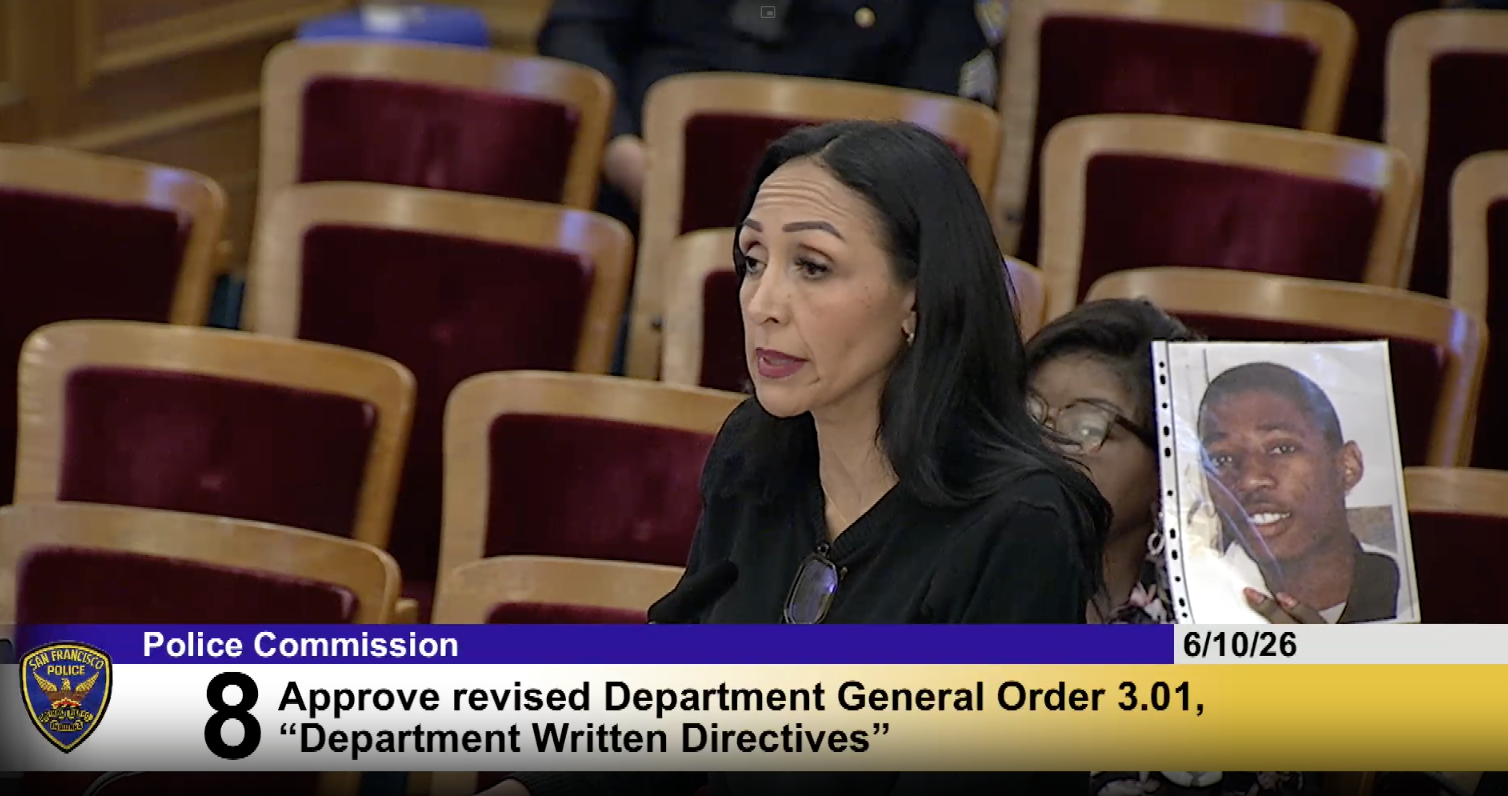
The Rules Behind the Rules: DGO 3.01 Overhaul Splits Commission

Department General Order 3.01 is the meta-policy — it governs how all 120-plus SFPD general orders are drafted, reviewed, and adopted. Wednesday's overhaul was the night's longest and most contentious item, consuming over two hours of debate and producing the only split votes of the meeting.

The basics: The revision, driven by Proposition E requirements (SF Admin Code 96i), codifies the Policy Development Division as SFPD's centralized policy unit, switches timelines from business days to calendar days, and aims to compress a standard DGO development cycle from 230-plus business days — well over a year — to completion within a single calendar year.

Why it matters: Every police reform, use-of-force update, and community-facing protocol flows through DGO 3.01. Changes here determine the speed and transparency of all future policy development — and who gets a seat at the table.

Where things stand: PDD Director Aja Steeves presented the revision as a practical necessity. "That ends up to be 230 business days. And I do want to mention that's the minimum," she said of the current timeline.

Vice President Kevin Benedicto zeroed in on what the new draft removes. The prior version explicitly carved out roles for the Department of Police Accountability to initiate policy changes, participate in concurrence, and jointly respond to public comments. The new version relies on practice rather than written requirements.

"The former version of 3.01 had a category of initiated DGO," Vice President Benedicto said. "There was a category in the prior version for when DPA wanted to initiate a DGO that is no longer present in this draft."

Director Steeves pushed back with data, arguing that DPA had been largely non-responsive in the formal process. "On the DGOs that we've submitted where there is a public format with the grid, DPA's square is just no response, no additional response, no additional response," she said, citing a roughly 20% response rate on stage-one feedback opportunities.

The other side: Commissioner Cindy Elias rooted her concerns in the department's DOJ reform history, arguing that informal practices are insufficient safeguards.

"I've learned being on this commission as a lawyer, if it's not in writing, then it's up for interpretation," Commissioner Elias said. "It's always good practice to have things in writing and to be clear on what's going to happen rather than just saying, oh, well, DPA is invited."

She successfully pushed three amendments onto the final version: PDD must respond to every recommendation on the public review grid; PDD must notify working groups of substantive concurrence changes before commission submission; and PDD must submit the annual review list for agendizing in the first two commission meetings of the calendar year — or the list is deemed approved.

Commissioner Elias framed the last amendment as a safeguard against bureaucratic delay. "We need in writing the ability as a full commission to look at this list and have that discussion," she said.

Decisions: The first vote on the initial two amendments passed 5-2 — Commissioner Elias herself voted no, signaling she wanted to force consideration of the third amendment before final passage. Vice President Benedicto also voted no. The third amendment then passed 5-2, with President C. Don Clay and Commissioner W.S. Wilson Leung dissenting. On final passage with all three amendments, the vote was 6-1 (For: President Clay, Commissioner Scott, Commissioner Leung, Commissioner Elias, Commissioner Pratibha Tekkey, Commissioner Lowe; Against: Vice President Benedicto). The revised DGO now advances to meet and confer.

What's next: The meet-and-confer process with the police officers' union will determine the final form of DGO 3.01 before it takes effect. The three amendments represent binding requirements that will shape every future policy development cycle.


Progress Through Partnership: Deaf/HoH Policy Sets a New Standard

Why it matters: San Francisco will host the National Association of the Deaf conference in the coming weeks, bringing more than 1,500 attendees to the city during Disability Pride Month. The unanimously approved DGO 5.23 revision positions the city as a national model for disability-inclusive policing.

Where things stand: The Policy Development Division led a revamped working group process that included eight community members, representatives from Board of Supervisors districts, the District Attorney's office, the Office on Disability and Accessibility, and Access SOS. The group met seven times between August 2025 and January 2026 and produced a policy that condenses the prior 17-page order to roughly five pages.

Practical tools include an officer visor card — pairing routine language access reminders with less frequent Deaf/HoH interaction protocols — a training video with ASL key phrases, and the addition of an ASL interpreter to the SFPD public-facing website.

"We completely revamped the working group process in 2025 based on feedback that we received in 2024," said PDD Director Aja Steeves. "This really does establish the gold standard that we'd like to continue moving forward."

The visor card was officer-originated. "This came from a sworn member and was perfected through our discussions with our working group members," Director Steeves said.

President C. Don Clay praised the revision's clarity, recalling frustration with the prior version's density. "How do you expect an officer to understand this?" he said of the old order. Vice President Kevin Benedicto called the approach "progress through partnership" and urged PDD to adopt it as a standard for all future working groups.

Commissioner Mattie Scott spoke personally as a person who wears hearing aids, describing the policy as directly relevant to her own experience. Commissioner Scott also praised the working group process's inclusiveness.

Public commenter Gavin Impet, a civilian working group participant, shared his personal connection through his deaf mother and highlighted the practical challenge officers face in distinguishing hard-of-hearing individuals from non-English speakers during encounters. Eli Gillardin, the city's ADA coordinator from the Office on Disability and Accessibility, endorsed the policy and noted San Francisco's leadership in disability rights dating to the Section 504 sit-ins.

Decisions: Approved 7-0 to advance to meet and confer. (For: President Clay, Vice President Benedicto, Commissioner Scott, Commissioner Leung, Commissioner Elias, Commissioner Tekkey, Commissioner Lowe.)


Crime Down Across the Board as SFPD Gears Up for FIFA World Cup

Chief Derrick Lew reported broad crime declines: overall crime down 22% year-to-date, violent crime down 11%, robberies down 19% (firearms robberies down 31%), burglaries down 26%, motor vehicle theft down 26%, and auto burglaries — long a signature San Francisco problem — down 42%. Gun violence (persons injured or killed by firearms) fell 15%. Human trafficking cases dropped 38%.

One notable exception: homicides stood at 17 year-to-date, up from 10 in the same period in 2025. No homicides occurred during the reporting week; two non-fatal shootings were reported.

What's next: The department announced preparations for the FIFA World Cup, starting the day after the meeting and running through July 19. Chief Lew described coordination with Santa Clara and San Jose jurisdictions. Commissioner Mattie Scott asked about tourist safety during overlapping summer events including Juneteenth and Pride; the chief described outreach through district stations, newsletters, and rental car agencies. A Class 288 recruit graduation was announced for June 15.


Voices From the Public: Access, Justice, and Accountability

Several public commenters challenged the commission on engagement and responsiveness.

A representative from the Officers for Justice criticized newer commissioners for not reaching out to the organization, demanded the return of district-based meetings and Zoom participation discontinued since the pandemic, and said the chief has not met with OFJ or the NAACP.

Mattie Scott, the mother of Aubrey Abracasa — murdered on Aug. 14, 2006, at age 17 with a semiautomatic weapon — made an emotional plea about the $250,000 reward and named suspects who remain unprosecuted after nearly 20 years. She returned during the chief's report to urge wider awareness of a new tipster payment policy allowing anonymous tips and rewards.

Jessica Pesico, a District 10 supervisor candidate and registered nurse, asked the commission to avoid scheduling meetings during major events and proposed investigative reforms including quiet victim interview spaces, photography screening, and separate structured interviews with alleged aggressors.


DPA Welcomes Diverse Ninth-Year Intern Cohort

DPA Director Paul Henderson introduced the 2026 Law and Social Justice Reform intern cohort, coordinated by Tanetta Thompson. The class of 11 students — one high school student, six undergraduates, and four law students — come from 11 schools including Howard University, Columbia, UC Berkeley, UCLA, UPenn, USF Law, and Southern University Law Center. Four HBCUs are represented, with students from California, Georgia, Colorado, and Missouri.

Seven partner agencies are hosting interns: SFPD Police Legal, Adult Probation, PUC, SF Superior Court (Judges Fleming and Cephas), the Mayor's Office of Victim Rights, and the Department on the Status of Women.

"Every DPA intern presentation for the last few years has, in some form, found its way to a DGO or an active policy," Vice President Kevin Benedicto told the cohort.

Director Henderson flagged complications with intern housing funding that had been available in prior years through OFA/HRC. Vice President Benedicto said he would follow up at a board meeting. Director Henderson also announced the DPA would be relocating to 1455 Market St., with updates to follow.


Minor Items

  • Consent calendar approved 7-0: Commission received and filed the SFPD and DPA document protocol report for Q1 2026.
  • First Amendment policy for community review: DGO 8.10, governing police conduct at protests and free speech events, unanimously designated for the 2026 community policy working group. Vice President Benedicto called it his top choice, citing "badly needed updates."
  • Zero discipline case backlog: President Clay reported all discipline cases assigned with protocols in place with the sergeants.
  • Sgt. Jesse Farrell honored as officer of the week for connecting 21 garage burglaries through DNA evidence. The 24-year SFPD veteran recognized a distinctive pattern — suspects drilling holes in garage doors and manipulating emergency release mechanisms — from a prior patrol arrest.
  • Juneteenth celebration: A public commenter promoted the June 19 event at the Heritage Center (3030 Fillmore St.). Ace Washer, Fillmore Corridor Ambassador, requested SFPD assistance including flags and a white horse for a parade down Fillmore Street.
  • Closed session: Commission entered closed session (7-0) and voted unanimously to not disclose discussions.
Commission Overhauls SFPD Policymaking Rules After Two-Hour Debate | Police Commission | Locunity