
Police Commission - Jul 08, 2026 - Meeting

Police Commission - Jul 08, 2026 - Meeting

Police CommissionSan FranciscoJuly 8, 2026

Sources:

Locunity is a independent informational service and is not an official government page for this commission.We use AI-assisted analysis and human editorial review to publish information.

Trans Community Demands Accountability After Pride Weekend Arrests

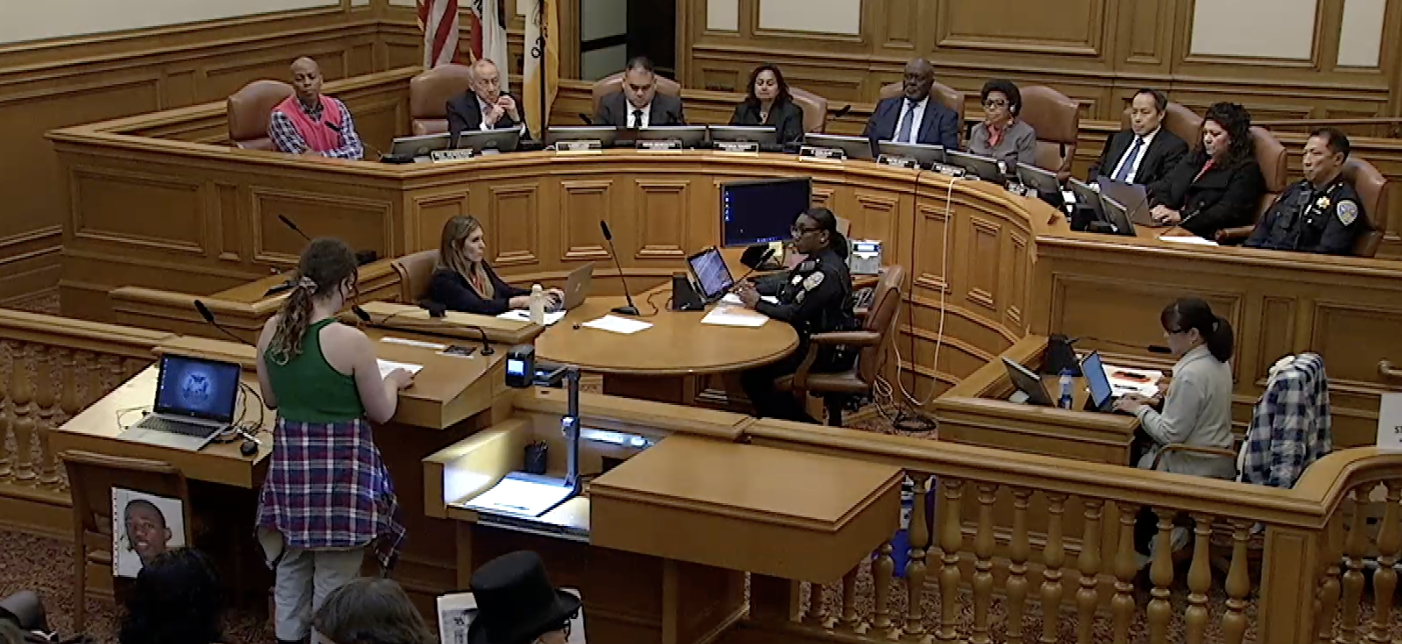
The San Francisco Police Commission's first meeting since Pride Weekend became a reckoning. Over a dozen community members delivered impassioned testimony condemning SFPD's use of force at the Trans March and an unpermitted Stud Alley block party, while Chief Liu defended the arrests and commissioners pledged a town hall and full public airing of the department's response. Separately, the commission unanimously adopted three major policy revisions — on body cameras, language access and deaf/hard-of-hearing interactions — that will change how officers engage with vulnerable populations starting Aug. 19.

  • Trans community members flood commission to denounce police violence at Pride Weekend events, describing arrests, shoves, drone surveillance and a reported concussion across two June incidents
  • Chief Liu reports 26 total arrests and nine uses of force at the Trans March and Stud Alley, says suspects targeted for felony vandalism — not for being transgender
  • Commissioners unanimously back town hall, public posting of the department's response to Supervisor Fielder's letter of inquiry, due July 16
  • Three policies adopted 7-0: revised body-camera rules, a language access overhaul banning family interpreters, and a deaf/hard-of-hearing policy featuring a VISOR card drawing national interest
  • DPA reports complaints up 22% while cutting average processing time nearly in half, to 93 days
  • Part 1 crimes down 23% year-to-date, with auto burglaries down 43% and homicides reclassified to 16

"The Arrests Were Not Targeted at the Transgender Community"

The meeting's longest and most heated agenda items — general public comment and the Chief's report — centered on two June events: the Trans March on June 26 and an unpermitted Stud Alley block party on June 27.

Why it matters: San Francisco markets itself as a transgender sanctuary city. The Pride Weekend police response — arrests at the historic intersection of Turk and Taylor, site of the 1966 Compton's Cafeteria riots — has drawn a Board of Supervisors letter of inquiry and threatens that reputation at a moment when trans residents in other states are looking to San Francisco as a refuge.

Where things stand: Chief Derrick Lew provided the commission's first detailed operational account. At the Trans March, officers used drones to track two suspects spraying paint from Super Soaker-style water guns on buildings and security cameras. When officers moved to arrest the suspects near Turk and Taylor, a crowd of roughly 300 intervened, linking arms and throwing bottles. Six arrests were made, with charges including felony vandalism with hate crime enhancement, conspiracy and battery on a peace officer. The Chief reported eight uses of force at the Trans March and one at Stud Alley, where a crowd built barricades and blocked streets with boulders; 20 additional arrests were made there.

"I want to be clear that the 2026 San Francisco Police Department supports the LGBTQ community. Full stop," said Chief Lew. "The arrests of the Trans March were not targeted at the transgender community. They were targeted at a few people amongst thousands of peaceful participants who chose to break the law."

He confirmed he is in discussions with supervisors about a community forum and will respond to Supervisor Fielder's letter of inquiry by the July 16 deadline.

The other side: Speaker after speaker challenged the Chief's framing. Multiple community members questioned why identified suspects could not have been arrested after the crowd dispersed rather than during the march itself — a tactical choice that escalated the confrontation.

A public commenter named Dakota, a Mission District resident, asked why identified suspects needed to be arrested during the march rather than afterward, urging the commission to consider the fear of trans people who have relocated from hostile states.

Karen Fleshman, a D5 resident and trans ally, called the arrest response excessive, arguing that paint is not a weapon and criticizing private camera networks feeding footage to police.

Dalia, a SOMA resident, raised alarms about the surveillance apparatus — drones, license plate readers, flock cameras — and questioned fiscal priorities during a budget crisis. Kendall, a Tenderloin resident, invoked the Compton's Cafeteria riots and urged commissioners of color to empathize with the queer and trans community's experience.

DPA Director Paul Henderson confirmed the agency received a surge of complaints tied to the Pride incidents. "We had a large spike in cases that came in related to the Pride event and the Stud event that's been discussed tonight, and those cases now represent open investigations with the agencies," he said, encouraging community members to file formal complaints through DPA's independent process.

Decisions: Commissioners did not take a formal vote on the Pride incidents but unanimously signaled support for multiple follow-up actions. Commissioner Cindy Elias requested the department's response to the letter of inquiry be posted publicly and agendized for a full commission hearing. "I also will be asking to agendize the department's responses to the letter of inquiry so that we have an opportunity to have that open dialogue and discussion and the community has a space to come and provide feedback," she said.

Commissioner Mattie Scott recommended a prevention-focused model for future Pride events, drawing on the community ambassador approach used at Juneteenth. "I'm just thinking of prevention and a better way of handling this is hearing your voice with a town hall meeting with our chief and others and the supervisors on our board, as well as our mayor," she said.

Vice Chair Kevin Benedicto urged solutions and emphasized DPA's independence. "DPA investigators are independent from SFPD. There are statutory requirements or law requirements for their independence. And all DPA complaints are investigated," he said.

What's next: The Chief's written response to Supervisor Fielder's letter of inquiry is due July 16. Commissioners plan to agendize the response for public discussion. A community town hall is in planning. The commission also faces criticism from community members for not having proactively placed the Pride incidents on this meeting's agenda.


Body-Camera Policy Gets Clearest Rewrite Yet

Why it matters: Just two years after its last update, DGO 10.11 on body-worn cameras was overhauled based on feedback from more than 120 officers who identified pain points in the 2024 version — a fast-turnaround, iterative model the commission wants to institutionalize.

Where things stand: Aja Steeves of SFPD's Policy Development Division presented the revised order, which restructures the activation section into a two-column table format for clarity, simplifies definitions, updates auto-tagging language and incorporates the Airport Bureau. PDD also produced a new summary cover sheet highlighting major changes.

Vice Chair Benedicto praised the iterative approach and requested another feedback cycle in 18 months. Commissioner Larry Yee asked about a provision regarding broken cameras, which Steeves clarified as a member responsibility — not an exception to wearing a body-worn camera.

Steeves described a proposed implementation unit that would track whether policies are working in practice. "PDD is putting out a proposal to build up an implementation unit specifically. We're looking at current staff that does this work, potentially moving them over so that they can track the implementation of policies with data and research," she said.

One public commenter argued body cameras should remain on from the start of a shift to the end.

Decisions: Approved 7-0 for meet-and-confer with affected bargaining units (For: 7, Against: 0, Absent: 0).


Family Members Banned as Interpreters Under New Language Access Policy

The basics: DGO 5.20 governs how SFPD provides language services to people with limited English proficiency during police encounters, both criminal and non-criminal.

Why it matters: In the context of heightened federal immigration enforcement, the revised policy aims to reassure immigrant communities that they can safely report crimes without relying on family members, children or bystanders to interpret — situations that can compromise both accuracy and safety.

Where things stand: The policy went through meet-and-confer with the POA, SEIU 1021, Local 21 and MEA, with no additional bargaining unit edits. SFPD's Policy Development Division collaborated with Chinese for Affirmative Action, OCEA, Community Youth Center and Chinatown Community Development Center on training scripts. Key provisions include requiring certified bilingual members for police encounters and mandating training for all SFPD employees every two years.

Three community speakers praised the process. Jose N., speaking for Chinese for Affirmative Action and the Immigrant Rights Commission, urged ongoing consultation during implementation. Crystal Van, a CAA senior program manager, thanked the commission and urged continued partnership with the Language Access Network of San Francisco.

Vice Chair Benedicto confirmed training materials would be ready by the Aug. 19 effective date.

Decisions: Adopted 7-0 with a 30-business-day implementation period, effective Aug. 19 (For: 7, Against: 0, Absent: 0).


SFPD's Deaf/Hard-of-Hearing Policy Draws National Attention

DGO 5.23 was unanimously adopted after SFPD co-presented the policy updates with the Office of Disability and Accessibility at the National Association of the Deaf conference. The centerpiece: a new VISOR card and an updated website with ASL interpretation. Law enforcement agencies from across the country requested the VISOR card template.

Michael Petrellis, a public commenter who is hard of hearing, shared personal experience with hearing-device malfunctions and emphasized the importance of hand gestures and lip reading. A child of a deaf adult recommended videophone relay services and basic sign language training for officers.

Decisions: Adopted 7-0 with a 30-business-day implementation period aligned with DGO 5.20, effective Aug. 19 (For: 7, Against: 0, Absent: 0).


DPA Halves Case Processing Time as Complaints Surge

Nicole Armstrong, DPA's COO/CFO, presented the agency's 2025 Annual Statistical Report in a new HTML-based format designed for accessibility across devices and languages.

"We received a total of 899 complaints, a 22% increase over 2024," Armstrong said. "This growth signals greater visibility of accessibility of DPA services. Not necessarily more misconduct, but more community trust in the oversight process."

Average case processing time dropped from 191 to 93 days — well below the city charter's nine-month deadline. Investigators handled more than 2,000 allegations; 79 were sustained, with neglect of duty the most common finding. The Tenderloin generated the most complaints but did not correlate with calls-for-service volume. DPA's SB 1421 disclosure team released 54,086 pages of records from 1,153 cases.

Commissioner Elias asked about the agency's capacity, noting DPA intake is now receiving up to 10 cases daily, up from one to five. The Mayor's Budget Office approved funding for two new investigators.


Crime Continues Downward Trend

Chief Lew reported Part 1 crimes down 23% year-to-date compared to 2025. Violent crimes were down 9%, homicides stood at 16 (reduced from 17 after a medical examiner reclassification), gun violence injuries were down 18%, robberies down 20% and auto burglaries down 43%. Commissioner Elias questioned a concentration of six homicides in Southern Station versus the historically higher Bayview. The Chief explained Southern incidents were unrelated one-offs, unlike Bayview's retaliatory violence pattern, requiring different intervention strategies. One non-fatal shooting occurred during the reporting period at a FIFA watch party in Mission Bay.


Minor Items

  • Officer recognition: An Airport Bureau officer was recognized for recovering a passenger's lost medication at SFO.
  • Consent calendar: Approved 7-0 with an amendment by Commissioner W.S. Wilson Leung to pull the SFPD SPARKS report for Q1 2026 for future agendizing rather than routine filing.
  • Annual performance reviews: President C. Don Clay directed all commissioners to prepare for a September agenda item launching the commission's first formal annual performance review process for the Police Chief and DPA Director.
  • ALPR audit: DPA Director Henderson confirmed an audit of automated license plate reader surveillance is in the planning phase.
Trans Community Demands Accountability After Pride Weekend Arrests | Police Commission | Locunity