
Police Commission - Apr 01, 2026 - Meeting

Police Commission - Apr 01, 2026 - Meeting

Police CommissionSan FranciscoApril 1, 2026

Sources:

Locunity is a independent informational service and is not an official government page for this commission.We use AI-assisted analysis and human editorial review to publish information.

Commission Advances Language-Access Overhaul 5-1 as Community Groups Plead for More Time

The San Francisco Police Commission on April 1 pushed a sweeping rewrite of its language-access policy toward labor negotiations despite an organized plea from immigrant-rights organizations to slow down — then heard a detailed chief's report revealing that homicides have tripled year-over-year even as overall crime continues to fall. The split vote on DGO 5.20 and Chief Lew's first public accounting of the SFO ICE detention dominated a meeting that ran past three hours.

  • Revised language-access policy (DGO 5.20) advances 5-1 after community groups cite late document release; VP Benedicto casts lone dissent calling it a "happy no"

  • Homicides triple to 14 year-to-date versus 4 in 2025 even as Part 1 crimes drop 28%; 13 of 14 cases closed

  • Chief Lew publicly details SFO ICE incident timeline, declares SFPD did not coordinate with federal agents and "100% supports" the immigrant community

  • Vietnamese becomes SFPD's newest required core language, with vital-document translations due by June 23

  • Bilingual-officer pin pilot launches at five stations — Central, Mission, Ingleside, Bayview, and Richmond — inspired by longtime community advocate Marlene Tran

  • DPA complaint volume runs 16% above last year, with 196 open investigations and a surge of new cases from the SFO incident


Language-Access Policy Splits Commission and Community

The Commission voted 5-1 to advance a revised Department General Order 5.20 — SFPD's governing policy on serving residents with limited English proficiency — to meet-and-confer with the Police Officers' Association, SEIU Local 21, and the Municipal Executives' Association. The lone dissent came from Vice President Kevin Benedicto, who said he supported the substance of the policy but wanted more time for community organizations to weigh in.

The basics: DGO 5.20 sets the rules for how SFPD interacts with people who don't speak English. The revision, two years in the making, was shaped by three community listening sessions totaling five hours, convened under Commission Resolution 2613. Organizations including the Language Access Network of SF (LANSF), Chinese for Affirmative Action (CAA), and the Coalition for Community Safety and Justice (CCSJ) participated alongside the Office of Small Enterprise and Access (OSEA), the DPA, and the Bar Association of San Francisco.

Why it matters: For the first time, the revised policy extends language-access obligations beyond sworn officers to all public-facing city employees, including public service aides and civilian clerks — a significant expansion of who is accountable when someone who doesn't speak English walks into a district station. The update also adds Vietnamese as a required language, prohibits the use of family members, neighbors, or children as interpreters during criminal investigations except in emergencies, and changes training frequency from periodic to every two years.

Where things stand: Director Asha Steeves of SFPD's Policy Development Division presented the final draft and described both the progress and the friction of the listening sessions.

"There were a lot of requests for SFPD to do a line-by-line justification of all the changes, which really took away from the resolution's intent to hear directly from the community," she said.

Chief Derrick Lew met with CAA the day before the vote and described the conversation as productive. He framed language access as already embedded in SFPD culture:

"If you listen to the radio for any amount of time, you're going to hear SFPD officers asking, 'Can I get a Cantonese speaker? Can I get a Spanish speaker?'"

The other side: Five community groups — LANSF, CCSJ, CAA, a Cantonese-speaking resident, and the Latina advocacy organization Mujeres Unidas y Activas — all asked the Commission to postpone the vote. Their core complaints: the latest draft was shared only the preceding Friday, community feedback was submitted just a day before the meeting, and key terms remained unresolved. "'Preferred language' is undefined while 'primary language' is defined," said Janice Li from CCSJ, who attended all three listening sessions and urged the Commission to use "shall" instead of the weaker "should" in accountability provisions. Annette Wong of CAA noted that monolingual Spanish speakers who followed her to the microphone could not get interpreters because notice was too late — underscoring the very access gaps the policy is meant to fix.

Annie Lee of LANSF and CAA acknowledged that some of the network's suggestions had been incorporated, including maintaining two-year training intervals, but urged the Commission "not to swing too far toward brevity" and asked that language about the harm of failing to provide language access be restored.

Leticia of Mujeres Unidas y Activas spoke in Spanish without interpretation, describing language access as essential for domestic violence victims who fear calling police — especially amid confusion between local officers and federal immigration agents.

Decisions: Commissioner W.S. Wilson Leung moved the motion to advance, arguing the process had stalled long enough.

"I think this has been lagging for around two years now. And I think it's probably time to move on," he said.

Commissioner Larry Yee seconded. Benedicto cast the sole dissent, framing it as supportive of the policy's goals:

"My vote to not advance the motion today, I want to call it a happy no. It's not a no that we shouldn't pass this. It's a no that tonight we should allow for — how many community voices didn't know this was happening today or couldn't get access to translation."

President C. Don Clay pushed back firmly, noting the vote was not the finish line:

"We're not close to the finish line. Whatever happens tonight, this still has to go through a process with meet and confer with the Police Officers' Association as well as now the other non-police-officer employees."

The motion passed 5-1 (For: Clay, Tekkey, Scott, Leung, Yee; Against: Benedicto; Absent: Elias).

What's next: The revised DGO 5.20 now enters meet-and-confer negotiations with three bargaining units — POA, SEIU Local 21, and MEA — before returning to the Commission for final adoption.


Homicides Triple Even as Overall Crime Plummets

Chief Derrick Lew opened his weekly report with a statistical split that defined the evening: Part 1 crimes are down 28% year-to-date, violent crimes down 19%, robberies down 33%, and property crimes down 30%. But homicides have surged to 14 — versus just 4 at the same point in 2025 — and gun violence is up 18%.

Why it matters: The gap between a broadly improving crime picture and a sharp spike in lethal violence suggests a growing lethality problem even as overall criminal activity recedes. The chief emphasized that the homicides are not random.

Where things stand: Lew detailed four March homicides: a shooting at 3rd and Harrison (two suspects arrested); a Sunnydale neighborhood shooting (open investigation — the lone unsolved case); a shooting at a Taraval residence (arrest made); and a Tenderloin assault in which a woman was pushed, hit her head, and later died (arrest made). Of the 14 homicides, 13 have been closed. SFPD has seized 251 firearms year-to-date, including 24 ghost guns.

Commissioner W.S. Wilson Leung pressed on the closure rate and confirmed that none of the homicides were random. President C. Don Clay praised community cooperation:

"The way the community has reached out to the department in helping to solve these crimes has to be encouraging for everyone in the city. They're not randomized, but when they are, people are helping — whereas before they didn't want to talk to the police."


Chief Details SFO ICE Incident, Declares SFPD "100% Supports" Immigrants

Chief Derrick Lew provided his first detailed public timeline of the March 22 incident at SFO's Terminal 3, in which plainclothes ICE agents detained an individual while uniformed Customs and Border Protection officers were also present. SFPD responded to a 911 welfare check call and arrived to find what the chief described as a chaotic scene.

Why it matters: The incident generated widespread public alarm and Department of Police Accountability complaints, with community members unclear on whether SFPD participated in the detention. The chief's on-the-record account establishes the department's official position as federal immigration enforcement intensifies nationally.

Where things stand: Lew stated there was "absolutely no preplanning or pre-coordination" between SFPD and ICE, and that SFPD's role was strictly maintaining public safety. He clarified that the uniformed officers seen escorting the detainee in a wheelchair were CBP — whose blue uniforms resemble SFPD's — not San Francisco police.

"I just want to make it clear that that was not SFPD. We did not restrain anyone, we did not put handcuffs on anyone, we didn't do any sort of physical manipulation of anyone," he said. "The SFPD 100% supports and is committed to our immigrant community. And that's the bottom line."

Commissioner Pratibha Tekkey stressed that the chief needed to deliver that message directly to immigrant communities:

"Anytime you get an opportunity, you have to say it out loud because it is important to hear directly from a person who makes a lot of decisions."

Commissioner Larry Yee raised concerns about armed federal agents entering SFO without notifying SFPD. Lew confirmed SFPD was not alerted in advance. Commissioner W.S. Wilson Leung noted that extensive federal law enforcement — CBP, TSA, and others — is already stationed at the airport as a matter of routine.

Vice President Kevin Benedicto urged the department to guard against incremental normalization:

"One small accommodation can get made that isn't something like cooperation, and then another and then another. And before you know it, you look back and a lot of changes have been made."

The DPA confirmed it has received and opened cases stemming from the incident.


Vietnamese Becomes Core Language; Pin Pilot Launches at Five Stations

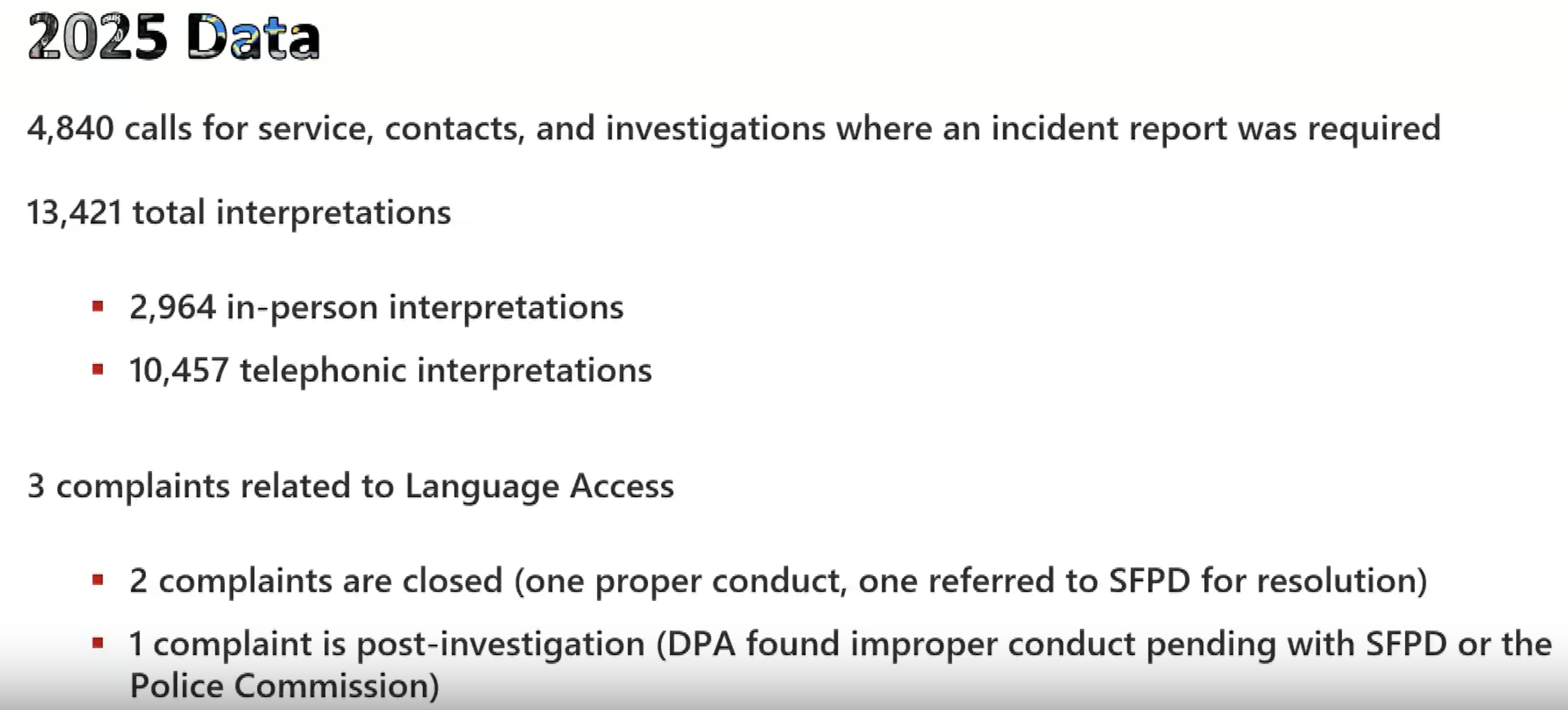
Director Asha Steeves presented the 2025 LEP Annual Report, showing SFPD now has 468 certified bilingual members and 573 total bilingual members across more than 36 languages, with 38 newly certified in 2025. The department handled approximately 4,840 calls for service requiring interpretation and more than 13,000 total interpretations last year, with only three language-access complaints filed.

Why it matters: On Feb. 23, 2026, the Office of Small Enterprise and Access determined Vietnamese meets the substantial LEP threshold, making it a required core language. Vital documents must be translated into Vietnamese by June 23.

SFPD will also pilot bilingual-identification pins at five stations with high LEP populations — Central, Mission, Ingleside, Bayview, and Richmond. The pins, which cost about $13 each and read "I speak [language]" in that language, were inspired by longtime Visitation Valley community member Marlene Tran, who proposed the idea years ago and saw it first adopted by the San Francisco Sheriff's Department. Tran addressed the Commission during public comment and described the meeting as "a very happy day for San Franciscans who need language access services."

Commissioner Pratibha Tekkey asked about outreach plans to educate community members about the pins. Commissioner Mattie Scott requested that the Eritrean and Ethiopian communities concentrated in her district be included in language-access outreach:

"I don't see on the list the Eritrean or Ethiopian folks that's highly concentrated in my community. It's a lot. And we've been talking with them about this, and so they want to make sure that they're going to be included."

Steeves committed to issuing a department notice by May to standardize how station captains publish newsletters — in translatable web formats rather than PDFs — after Tekkey raised accessibility concerns. The department is also updating its training video for interactions with deaf and hard-of-hearing individuals (DGO 5.23), with filming starting April 16.


Minor Items

  • Bay Bridge bicycle takeover thwarted: SFPD and CHP intercepted approximately 85 cyclists who attempted to ride onto the Bay Bridge upper deck against traffic on March 28, issuing 85 citations and seizing 85 bicycles.

  • SFO bomb threat: A bomb threat on March 28 prompted a full airport garage search during an already busy day with First Amendment activity; approximately 25,000 people attended the No Kings rally, which was facilitated without incident.

  • SFPD Academy: 101 recruits currently enrolled; a class of 41 is set to graduate — the department's largest graduating class since 2017.

  • DPA caseload: Since March 18, DPA opened 85 new cases and closed 99, leaving 196 open investigations. Eight investigations exceed 270 days; all but one are tolled. Forty-eight sustained cases remain pending with SFPD and three with the Police Commission.

  • Chinatown safety meeting: Commissioner Yee reported attending a community safety meeting in Chinatown following a contractor fatality and a stabbing.

  • Crime Victims Month: Commissioner Scott announced events for Crime Victims United Month in April.

  • Consent calendar approved 6-0: Received and filed the Safe Streets for All Q4 2025 report and the Commission's Q1 2026 disciplinary actions report.

  • Closed session: The Commission entered closed session (6-0) and voted 6-0 not to disclose its discussions.

  • Officer recognition withdrawn: The weekly officer recognition certificate for Officer Nelson Orantez was removed from the agenda.

Commission Advances Language-Access Overhaul 5-1 as Community Groups Plead for More Time | Police Commission | Locunity