
Discipline Backlog Shrinks to 9 as Commissioners Push Plate-Reader Rules
Police Commission • San FranciscoOctober 7, 2026
Locunity is an independent informational service and is not an official government page for this commission. All information is sourced from public footage and an analysis of official agendas with the aid of responsible, fact-checked AI. to report an error or omission.
San Francisco's police discipline machine has nearly cleared a backlog that stood at 124 cases in 2023. The cleanup still runs on a 600-row spreadsheet, and the police union arrived with its own list of grievances. At its Oct. 7, 2026, meeting, the Police Commission also challenged SFPD's plan to enforce new license plate reader limits through internal notices rather than a public General Order.
Pending chief's hearings fell from 124 to 9 after commanders were added as hearing officers.
DPA wants Commission help replacing a spreadsheet it uses to track officer discipline outcomes.
Police union says DPA rarely grants investigative hearings and will submit grievances in writing.
SFPD sets a 30-day window for license plate data but plans no General Order. Two commissioners objected.
DPA interns urge bans on facial recognition and predictive policing in a future AI order.
Part 1 crime is down 19%, but homicides are up 11% year to date.
The Discipline Backlog Is Nearly Gone
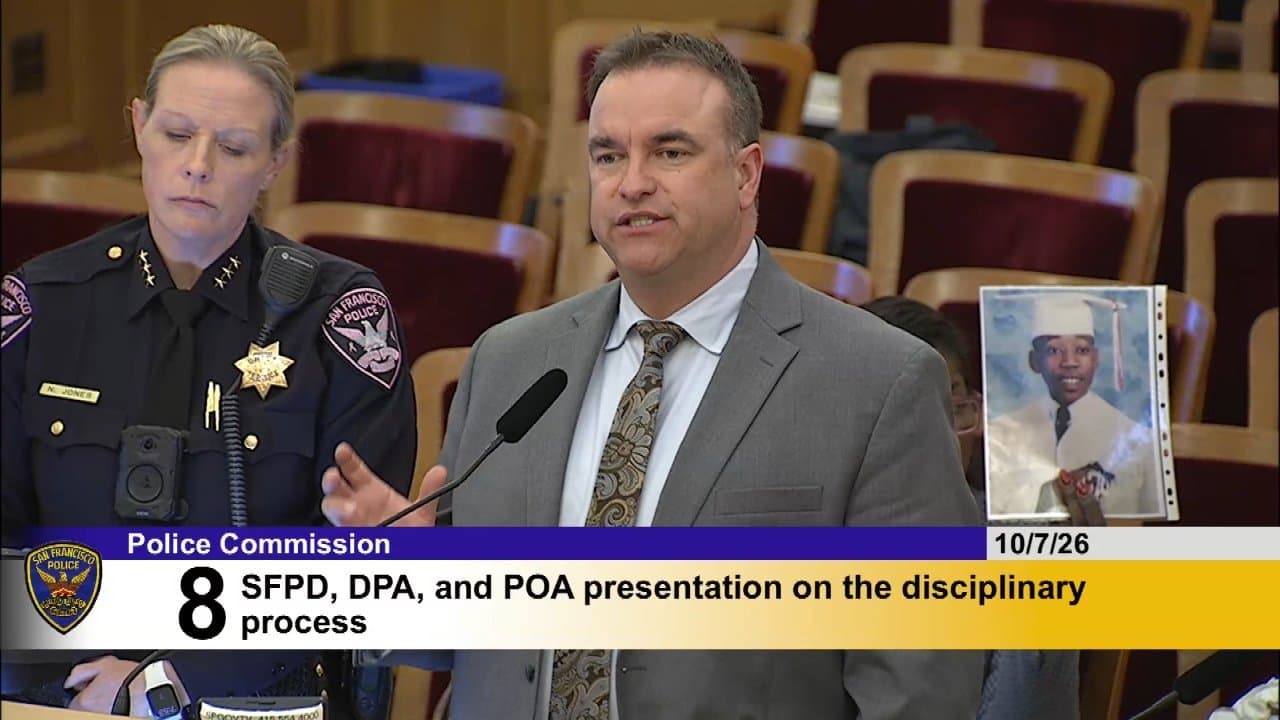
The basics: Commander Thomas Harvey, commanding officer of SFPD's Risk Management Division, walked through DGO 2.07, SFPD's discipline rule. The chief can impose up to a 10-day suspension. Cases ranging from 11 days to termination go to the Commission.
Why it matters: Slow hearings delay accountability for sustained misconduct. A rare joint briefing by SFPD, the Department of Police Accountability (DPA) and the Police Officers Association (POA) showed that bottleneck has largely broken.
Where things stand: An April 2025 rule change added in-rank commanders as chief's hearing officers. Pending chief's hearings dropped from 124 in April 2023 (66 DPA, 58 IAD) to 7 DPA and 2 IAD cases as of Sept. 30.
Sustained rates: Harvey put IAD's sustained rate between 40% and 60% and said he believed DPA's was 3.7% last year.
DPA's model: DPA Chief Legal Officer Sharon Wu said no DPA staff are former SFPD officers. She said DPA targets completing cases within nine months, ahead of the one-year "3304" deadline under the Peace Officer Bill of Rights.
The spreadsheet problem: DPA Chief Operating Officer Nicole Armstrong said discipline outcomes reach DPA through an Excel file with 30 columns, nearly 600 rows and no notifications. She said DPA has worked with SFPD on a fix for more than four years.
"DPA has already had the funds, and we've had the funds for the last 3 years. We got it from COIT to be able to do this project," said Armstrong.
Wu called the manual reconciliation "just wasted manpower as far as I'm concerned." Harvey countered that remaining volume is low enough to handle informally. Commissioner Kevin Benedicto disagreed: "Now is the time to build those structures when it is manageable," he said.
An unnamed SFPD representative said the department has no opposition to a technology solution. "Our RFP will be out shortly for a new vendor for a records management system, and we hope to marry that in conjunction with it," the representative said.
The other side: POA Legal Defense Administrator Chignell described the relationship among the three parties as adversarial but collegial. He argued the union deserves credit for the backlog drop.
"The reason that the hearings are down and the dispositions are in small numbers that are pending is because of the work that we do with the risk management team in terms of negotiating cases," Chignell said.
"So the DPA, we've made scores and scores and scores of requests for investigative hearings. I think we've only had a handful that have been allowed by the director," he added.
Chignell also criticized SFPD's administration for not taking part in the Commission on Streamlining Task Force debate. He said that proposal would have shifted DPA cases to administrative law judges and expanded the chief's power. He noted the mayor's charter amendments on the Nov. 3 ballot did not include it. He named the DA–SFPD memorandum of understanding, and the administrative discipline that follows from it, as the union's major issue.
Commission President C. Don Clay stopped POA panel attorney Scott Burrell from arguing Fourth Amendment cases and recruit due process. Clay said the item was about process, not legal issues.
Decisions and stakeholder impacts: The item was informational, and no vote was taken. Benedicto flagged abeyance as an area of broad discretion that can create a perception of inconsistency. DPA and the POA both called the practice a deterrent. Commissioner Pratibha Tekkey asked for mediation counts and outcomes. Wu said DPA mediates fewer cases than it would like because both parties must agree.
What's next: DPA and SFPD are expected to provide an IAD-versus-DPA case breakdown and mediation data. The POA will submit grievances in writing, which Clay asked be shared with the other parties. Benedicto said a future agendized item is possible.
Plate-Reader Limits Arrive Without a General Order
Why it matters: Automated license plate readers (ALPR) log vehicle movements citywide. Who can search that data, and for how long, is a central surveillance question.
Where things stand: Police Chief Derrick Lew described safeguards that follow a joint announcement with Mayor Lurie, DPA and supervisors:
General access to plate data will be limited to 30 days.
Every lookup will require a CAD or case number.
Federal and out-of-state agencies are already barred from the database.
Unauthorized access or sharing "could lead to discipline up to and including termination," Lew said.
"We don't do mass surveillance," Lew said.
The rules will roll out through department notices, building on a notice staff said was issued Oct. 5 and a 19B surveillance policy approved by the Board of Supervisors. Assistant Chief Jones said one element requires meet-and-confer talks with the POA, and he expects the notices within about a month.
"There's no plan at this time to have a department general order related to this," Jones said. "I think that the technology is changing so rapidly that we're trying to get our arms around it right now."
The other side: Benedicto urged a General Order, which he called the gold standard. He noted that the DOJ and members of the public have criticized notices and unit orders as hard to find. Commissioner Cindy Elias shared that concern and pointed to the backlash over the drone policy when community members felt excluded.
"It was changed to 30 days, and I think the recommendation or standard practice was 7," Elias said. She asked for an explanation of the deviation.
Decisions and stakeholder impacts: No vote was taken. Elias said she had not received written findings from SFPD's internal ALPR audit. Lew said the audit is complete and agreed to provide them. DPA Policy Director Jamal Anderson said DPA's independent ALPR audit, begun in April 2026, is still ongoing.
What's next: Benedicto requested an agendized ALPR presentation with all written materials before year end. Elias asked to agendize the HRC report and its implementation, including DPA's role.
Interns Draw AI Red Lines for SFPD
Why it matters: SFPD is expected to write a General Order on artificial intelligence. DPA's summer interns argue the current rules fall short of state law.
Where things stand: DPA's Tanetta Thompson, director of racial equity and recruitment, introduced a cohort of 20 interns. The interns ranged from high school students to law clerks. Thompson said their work ends with four recommendations: "prohibit facial recognition, prioritize data privacy, mandate algorithmic validation, and prohibit predictive policing."
One intern presenter said "Department Notice 25-064 lacks 4 key safeguards that state law requires." Those are disclosure language, officer signature verification, first-draft retention and an audit trail, all tied to Penal Code 13663.
Other recommendations from the interns:
Facial recognition: Remove the exigent-circumstance exception. Presenters cited error rates up to 35% for darker-skinned women.
Predictive policing: Hold off, citing search disparities of 47% for Black residents and 28% for Latino residents.
Translation: Pilot AI translation alongside existing services.
Kevin Hornbeck, a USF School of Law student, said SFPD "should publicly disclose the mathematical weight assigned to any protected characteristic by the AI models it uses."
What's next: The Commission took no action. Clay thanked the students.
Crime Falls, Homicides Rise as Families Press for Answers
Where things stand: Lew reported violent crime down 10% and property crime down 20% year to date. Homicides stand at 21, compared with 19 at this point in 2025.
Weekly violent crime rose from 57 to 71 incidents. That included three homicides:
1100 block of Thomas, Bayview (case open)
900 block of Market, Southern district (arrest made)
Unit block of Rowell Court (case open)
A Sept. 30 multi-agency fugitive warrant operation targeting drug markets led to 84 arrests.
Commissioner Mattie Scott warned that October through February is historically peak homicide season. "We would definitely engage the community within 48 hours, let them know, getting their support and getting their feedback on the needs of the community," she said. Lew said SFPD increased visibility after the killings and is discussing faster outreach with the homicide unit.
Public pressure: A public commenter disputed SFPD's account of dispersal orders before 18 Trans March arrests on Washburn Street. "Following a September 14th court hearing, all charges for all 18 arrested individuals were dropped," the commenter said. Lew said a town hall with the Office of Transgender Initiatives has no date yet. "I hope that I can come back next week and tell you that we have a date," he said.
A mother whose son was killed in 2006 returned throughout the meeting. She noted a $250,000 reward has produced no tips and asked for monthly updates from the cold case investigator. "I'm hurting because I still want justice for my child, and this is what I need to heal," she said.
District 9 resident Amelia Harmon questioned the removal of peer counselors from street crisis teams. She asked whether SFPD and DPH are coordinating on the issue.
Q3 2026 Disciplinary Actions Report received and filed. For: 6, Against: 0, Absent: 1 (Elias).
Sept. 2 and Sept. 9 minutes adopted. For: 6, Against: 0, Absent: 1 (Elias).
DPA caseload: 99 cases opened and 158 closed in four weeks. Neglect of duty was the most common allegation.
Academy: 81 recruits are enrolled and five lateral officers were sworn in. Officers for Justice offered to help with recruitment.
Closed session: Commissioners voted 7-0 to enter on litigation and labor matters, then 6-0 not to disclose the discussion (Elias not called).
Looking ahead: Drone policy DGO 10.12 returns next week. Benedicto aims to bring an update to the 20-year-old Resolution 2706 on SFPD reporting requirements before year end. Commissioner Larry Yee requested a January assessment of the Community Engagement Division. The DGO 8.10 First Amendment working group meets biweekly in public.