
Police Commission - Jun 17, 2026 - Meeting
Police Commission • San FranciscoJune 17, 2026
Locunity is a independent informational service and is not an official government page for this commission.We use AI-assisted analysis and human editorial review to publish information.
SFPD Catches 299 Unauthorized Federal Queries of License Plate Data
The San Francisco Police Commission's June 17 meeting opened with a bombshell: an internal SFPD audit uncovered nearly 300 unauthorized searches of the department's license plate reader database by federal and out-of-state agencies — searches that violated California law and were immediately shut down. The disclosure dominated the evening, but commissioners also advanced two modernized general orders, heard that overall crime is down 22% (even as homicides surged 70%), and learned that police recruitment applications have nearly doubled year-over-year.
- SFPD discovers 299 unauthorized federal and out-of-state queries of its license plate reader data, cuts off access immediately
- Overall crime drops 22%, but homicides jump 70% — from 10 to 17 year-to-date
- Police officer applications surge 94% to 4,083 in half a year
- DPA flags victim notification gaps and missing less-lethal weapons at critical scenes
- Commission advances first update to non-sworn complaint policy in 30 years on 6-1 vote
How Federal Analysts Got Into San Francisco's Surveillance Database
The basics: SFPD operates an automated license plate reader (ALPR) network through the Flock Safety platform, which captures and stores images of vehicle plates across the city. California law — including SB 34 — restricts how this data can be shared and queried. The Northern California Regional Intelligence Center (NCRIC) is a fusion center that connects Bay Area law enforcement agencies for intelligence sharing.
Why it matters: An internal SFPD audit discovered that NCRIC had granted nighttime access to its ALPR database to analysts at the Western States Information Network (WSIN), a separate intelligence network. Those analysts — working on behalf of federal and out-of-state agencies — ran 299 queries without authorization, making San Francisco the first California agency to catch what appears to be a statewide problem.
Where things stand: Chief Derrick Lew told commissioners the audit was triggered by SFPD's own internal review of the Flock Safety platform as part of a May 2026 compliance check. When the unauthorized queries surfaced, the department immediately terminated NCRIC's access.
"SFPD was the first and only agency to discover this statewide issue through its audit," said Chief Lew. He stressed the importance of public trust: "It's very important to me as the chief of this organization to make sure that the community understand that we're using this technology in a righteous way."
The 299 queries represented approximately 0.005% of total queries audited. The audit found the searches were tied to investigations of serious crimes — homicide, child sexual abuse, and drug and gun trafficking. Critically, the audit found no queries related to immigration enforcement or reproductive rights, and no searches from Immigration and Customs Enforcement or the Department of Homeland Security.
Commission President C. Don Clay praised the department's self-policing: "It's really nice to see that the audit process does work here in San Francisco."
The other side: Commissioner Cindy Elias pressed for more: "Is there a report that we'll be following? The audit findings in some sort of written fashion that will be available to the public as well." Commissioner Larry Yee went further, asking whether other agencies' access should also be cut and suggesting SFPD send formal warnings to all connected agencies about California's data restrictions. "I'm wondering whether it might help to send a warning out or a reminder to those agencies about the California law," Commissioner Yee said.
Vice President Kevin Benedicto confirmed the audit materials would be posted on the commission's website.
Decisions: No formal vote was required; the disclosure was part of the Chief's Report. DPA Director Paul Henderson confirmed that his office's independent ALPR audit remains ongoing: "These inquiries are also at the core of related issues. We will continue to keep everyone updated."
What's next: The DPA's separate ALPR audit will continue. The disclosure has been shared with the Human Rights Commission and DPA. The findings could fuel broader legislative scrutiny of how fusion centers share sensitive surveillance data statewide.
Crime Down, but Homicides Tell a Different Story
Why it matters: Part 1 crimes — the FBI's standard measure for serious offenses — fell 22% year-to-date, with property crimes down 23% and auto burglaries, one of San Francisco's most visible quality-of-life issues, plunging 42%. Violent crimes declined 12%, with robberies down 20% and firearm robberies down 32%.
But homicides jumped 70%, with 17 recorded year-to-date compared to 10 in 2025. Gun violence overall is down 17%, making the homicide spike a statistical outlier in an otherwise improving picture.
Chief Lew credited ALPR as a critical tool in driving crime reductions, calling it "an everyday tool for officers" and "a cornerstone" of the department's crime-fighting operations. He also highlighted a proactive human trafficking operation on June 12, tied to FIFA World Cup preparations, that recovered firearms, ammunition, and high-capacity magazines. Human trafficking incidents are down 31%.
Discipline Board Finds Policy Gaps on Victim Notification, Less-Lethal Weapons
Why it matters: The quarterly Disciplinary Review Board report surfaced four policy failures — systemic problems that affect how SFPD serves crime victims and responds to armed standoffs in public spaces.
Where things stand: Sharon Wu, from the Department of Police Accountability, presented findings from Q1 2026. Internal Affairs reported 41 allegations across 26 cases involving 35 employees; DPA reported 18 allegations across 11 cases involving 14 officers. The most common categories were conduct unbecoming (35%) and neglect of duty (30%).
Two of the four DPA-identified policy failures involved crime victims who were never told whether their cases were assigned for investigation. Wu pointed to DPA's own system as a model: "At DPA when we get a complaint, we give a complainant a PIN number. That PIN number they can put into our system. It tells them where the case is assigned and who the investigator is."
The third failure involved the September 2024 officer-involved shooting near Powell Street BART station. A suspect fled from a stolen vehicle with a revolver through Mint Plaza and into the crowded station. A sergeant on scene was trained in Extended Range Impact Weapons (ERIW) — a less-lethal option — but did not have one available. Wu said DPA concluded "if the individual at Mint Plaza, that sergeant who was ERIW trained had an ERIW, there was a good potential that that particular event could have been contained in a more isolated area."
Vice President Benedicto noted this was not a one-off: "This isn't the first time that there's been an issue where we didn't have an ERIW at a scene where it might have been helpful."
Chief Lew acknowledged the gap but explained the practical challenge: sergeants ride alone, and ERIW deployment requires lethal cover from a second officer.
The fourth policy failure involved a 1994 property order that placed sole responsibility on the arresting officer for prisoner property. A new DGO in concurrence addresses shared and transferred responsibility. The Office of Equity and Inclusion found no disparities or inequities in the quarter's cases.
What's next: DPA and SFPD are exploring electronic notification systems for crime victims. The ERIW deployment recommendation faces logistical constraints but remains under discussion.
Officer-Involved Shootings: All Four Found Within Policy
Lt. Lisa Springer from Internal Affairs presented the Serious Incident Review Board's Q1 2026 findings, covering four officer-involved shootings spanning 2023 to 2025. All were found within department policy. There were no in-custody deaths reviewed.
The cases tested a range of scenarios: a 3.5-hour armed standoff on Bosworth Street that ended when the suspect grabbed a revolver (May 2023); a vehicle driven into the Chinese Consulate followed by a knife attack (October 2023); the Powell Street BART pursuit where officers used bola wrap three times unsuccessfully before the suspect raised a firearm (September 2024); and a backyard incident where a suspect pointed a firearm at officers and a department drone (March 2025).
First Complaint Policy Update in 30 Years Advances — but Not Unanimously
The basics: Department General Order 2.05 governs complaints against non-sworn SFPD employees. It had not been updated since 1994.
Where things stand: The revision, presented by Lt. Springer, modernized language, separated complaint intake from investigation, and requires supervisors to immediately notify Internal Affairs for serious allegations. The department received 13 public comments that prompted 11 revisions.
Vice President Benedicto praised the update for being shorter and incorporating public feedback. But he asked about the removal of the formal investigation report section. Lt. Springer explained that material now lives in a station-level IAD guide on the department intranet.
The other side: Commissioner Elias objected. She cited DOJ recommendations calling for all relevant procedures to be contained in the DGO itself: "The DOJ recommendations, one of their recommendations is they wanted the DGOs to have all the information available to officers instead of referring them to linked documents like department bulletins or notices and other guides." She also asked whether public-facing information about complaint findings could be incorporated. Lt. Springer agreed to consult with the written directives unit.
Decisions: The motion to advance DGO 2.05 to meet and confer passed 6-1. Commissioner Elias cast the sole dissenting vote. (For: Clay, Scott, Leung, Benedicto, Tekkey, Yee; Against: Elias)
Death Investigation Policy Modernized Unanimously
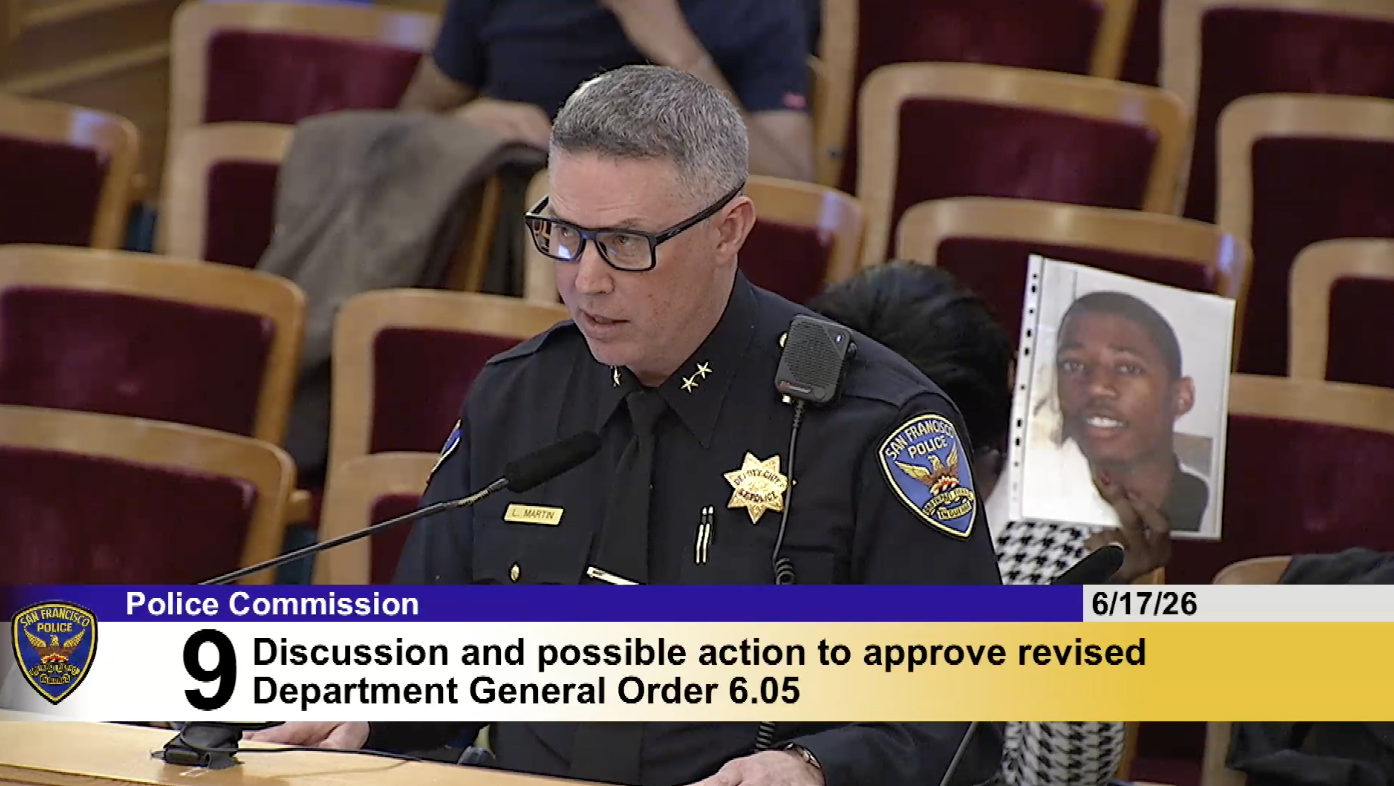
Deputy Chief Luke Martin presented a rewritten DGO 6.05 on death investigations, cutting the order from nine to five pages. Key changes include a new section on the death case standby process coordinating the medical examiner, fire department, and police; strengthened overdose death investigation criteria with clear narcotics unit referral processes; provisions addressing California's End of Life Options Act; integration of body-worn camera use for creating digital copies of medical examiner receipts; and new language framing the body as evidence with unbroken chain-of-custody requirements.
Decisions: The motion to advance to meet and confer passed unanimously, 7-0.
Minor Items
- DPA budget: Director Henderson reported presenting the annual DPA budget to the Board of Supervisors on June 12. The response was supportive, but the budget remains unfinalized pending negotiations with the Mayor's office. During the reporting period, DPA opened 10 cases and closed 26.
- Recruitment surge: President Clay announced SFPD received 4,083 applications through mid-June — a 94% increase over 2025 — with 882 in May alone and 102 on a single day, May 16. The 288th recruit class graduated 17 officers, seven of whom are bilingual. The next incoming class is expected to include approximately 50 recruits.
- Cold case plea: A public commenter, the mother of Aubrey Arba Casta, continued her 20-year advocacy for justice in her 17-year-old son's unsolved 2006 murder, naming suspects and calling for expanded tipster outreach beyond the police department website. She invited officials including the Mayor to an August memorial street-naming ceremony.
- Closed session: The commission voted unanimously (7-0) to enter closed session and subsequently voted unanimously (7-0) not to disclose any closed session discussions.