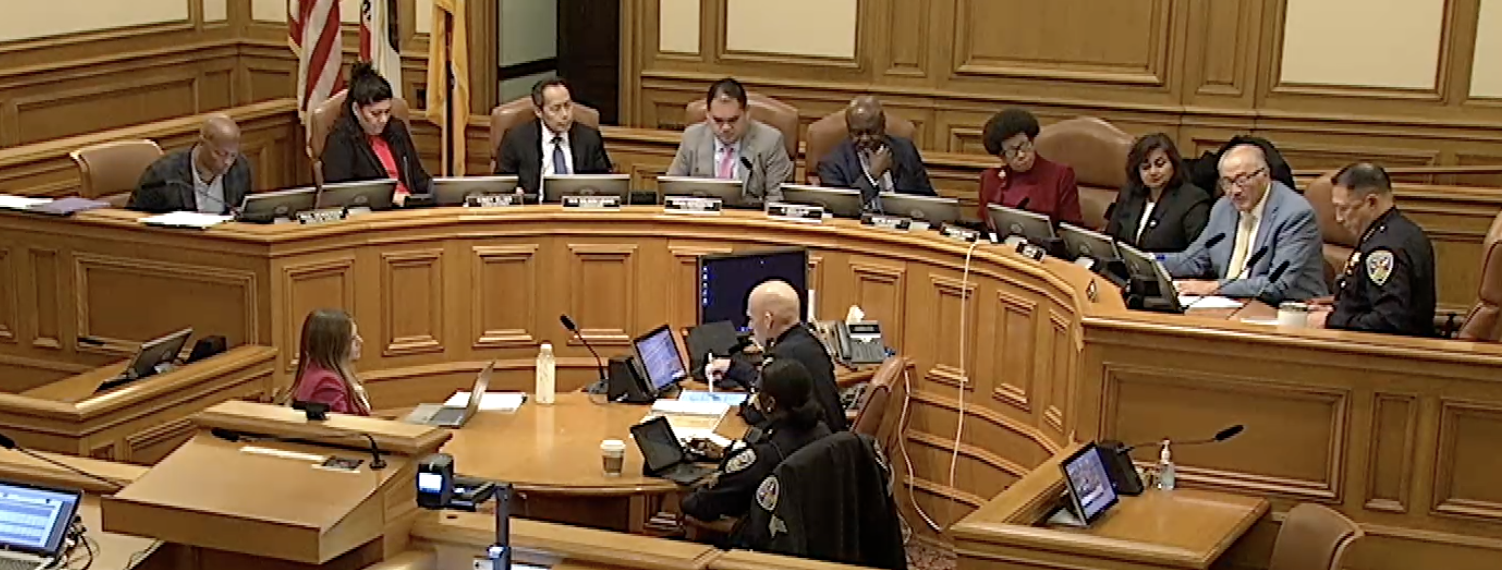
Police Commission - Mar 04, 2026 - Meeting

Police Commission - Mar 04, 2026 - Meeting

Police CommissionSan FranciscoMarch 4, 2026

Sources:

Locunity is a independent informational service and is not an official government page for this commission.We use AI-assisted analysis and human editorial review to publish information.

Homicides Increase as San Francisco Loses Violence Intervention Funding

The San Francisco Police Commission confronted a stark contradiction: overall crime is plummeting, but people are dying at an alarming rate. Nine homicides year-to-date — up from just one at this point last year — dominated a meeting that also revealed the loss of state funding for the community intervention programs designed to prevent exactly this kind of spike. Commissioners pressed Chief Derrick Lew on what comes next as summer approaches, budgets shrink, and the city's most vulnerable neighborhoods brace for more violence.

  • Homicides jump from 1 to 9 year-to-date as city loses CalVIP violence intervention funding heading into summer

  • Chief defends new promotion practices that weigh resumes and interviews alongside civil service test scores, breaking eight years of strict rank-order policy

  • SFPD recruiting hits historic highs — 803 applications in January, 100+ recruits now in the academy — but attrition remains a concern

  • Annual military equipment report details 98 drones, 1 Bearcat, and plans to expand as commissioners demand more deployment data before Board of Supervisors vote

  • In-custody deaths policy adopted unanimously, effective April 16, after expedited police union negotiations

  • Mother of murder victim returns to demand action on unsolved homicides and youth resources


Nine Dead, Prevention Funding Gone

Why it matters: The loss of CalVIP funding — the state program that paid for community-based gun violence intervention — lands just as lethal violence is accelerating and the city faces a broader budget deficit that has already gutted youth programs. The convergence creates a gap in the city's violence prevention infrastructure at the worst possible time.

Where things stand: Chief Derrick Lew opened his weekly report with a jarring juxtaposition. Overall Part 1 crimes are down 35% year-to-date, and total gun violence victims are roughly flat. But homicides have exploded.

"As of this reporting period, there are eight homicides. However, including this morning, there are now nine homicides year to date in 2026, compared to one in 2025," said Chief Lew. (Lightly edited for clarity.) The most recent killing occurred that morning on the 100 block of 6th Street.

The Chief described SFPD's shooting review process, which categorizes incidents as one-off versus retaliatory to determine whether law enforcement or community intervention is the better response. But he acknowledged a critical tool is now missing: "I believe we just lost our funding from Cal VIP that allowed us to pay for some of this work."

Commissioner Cindy Elias connected the dots between budget austerity and rising violence, noting "several budget cuts, several programs and a huge deficit San Francisco is facing, resulting in these programs and resources, particularly for our youth, being eliminated." She pressed the Chief on what the department is doing to fill the gap. Chief Lew committed to working through the challenge but acknowledged reduced budgets make it harder.

President C. Don Clay probed the nature of the violence, asking whether the killings are close-range or at a distance — a distinction that speaks to the type of violence gripping the city. "Who lives or dies? That's a whole different issue. And generally when they're closer up, then you have that fatality type of thing," President Clay said.

Commissioner Larry Yee highlighted that 152 firearms, including 13 ghost guns, have been seized year-to-date. Commissioner Mattie Scott raised gun trafficking as a contributing factor.

A Mother's Plea

The human cost was laid bare by a public commenter, the mother of a murder victim who returned to the commission to demand accountability for unsolved homicides. She spoke during both general public comment and the Chief's report, warning that summer is approaching and children have no gyms, programs, or safe places. She pleaded for anonymous tipster programs to help solve killings, showed visual displays of unsolved homicide victims, and noted that a sitting commissioner also lost a child to violence. She expressed fear for her 12 grandchildren's safety.

What's next: The commission requested future data comparing gun seizure numbers year-over-year. The CalVIP funding gap and youth program cuts remain unresolved as the city heads into warmer months, historically the most violent period.


Chief Defends Promotion Shakeup

Why it matters: For nearly eight years, SFPD promotions followed strict civil service test rank order. That era is over — and the change affects career paths for hundreds of officers and could reshape the department's leadership pipeline.

Where things stand: Commissioner Elias questioned recent promotions that deviated from rank-order results. Chief Lew explained the department now incorporates secondary criteria including resume reviews and interview performance.

"Really our belief is that a one day performance on a test isn't indicative completely of someone's fit for a position," Chief Lew said.

The department proactively reached out to passed-over candidates and PEG (Police Employee Groups) to explain the new process. Commissioner Elias urged the department to provide clearer written criteria and to communicate expectations at district stations: "Are there things that you're going to or can the command staff go to the district stations and really reiterate to the members what you're looking for in leaders or future leaders here in the police department?" Chief Lew agreed.

Commissioner Elias also requested a future update on the chief hearing backlog, asking for case counts and solutions implemented to clear it.

What's next: The department committed to distributing written guidance on promotion criteria to district stations.


Recruiting Surge Meets Attrition Problem

Why it matters: After years of staffing shortages, SFPD is finally seeing a flood of applicants — but the pipeline means little if recruits can't make it through the academy.

Where things stand: Chief Lew reported the 289th recruit class of 39 officers just started, pushing total academy enrollment past 100.

"We broke a record for one month with 803 applications in January. And this last week of February, we saw 220 applications come in. So that's the single highest week we've had in five years," the Chief said. The department is on pace for over 10,000 applications this year.

Vice President Kevin Benedicto flagged persistent attrition challenges, particularly with the Emergency Vehicle Operations Course (EVOC) and written tests. "I wonder if we could get a report sometime in the late spring or summer on efforts on how those attrition numbers are looking and on some of the various initiatives and efforts that the department has undertaken to reduce that," Vice President Benedicto said.

Commissioner Pratibha Tekkey asked about plans for community policing and foot beats as staffing grows. Chief Lew indicated such deployments would increase as officers come on board. The 289th class is expected to graduate in approximately seven months.


Military Equipment Report Heads to Board

Why it matters: Under state law AB 481, police departments must publicly report their military equipment inventory and seek legislative approval to continue using it. The SFPD report now goes to the Board of Supervisors — and commissioners made clear they want sharper data before signing off on expansion.

Where things stand: Government Affairs Manager Carl Nicita and Acting Captain Mason presented the 2025 annual report. Key inventory highlights:

  • 98 drones deployed 1,122 times at an annual cost of $5.3 million

  • 1 Lenco Bearcat armored vehicle deployed 42 times

  • 229 forty-millimeter launchers deployed 38 times, now being issued citywide to patrol

  • 16 fully automatic submachine guns and 64 fully automatic short-barrel tactical rifles (one used in an officer-involved shooting resulting in a suspect's death)

  • 4 Long Range Acoustic Devices (LRADs) used 52 times as public address systems

  • 17 unmanned ground vehicles used 7 times

  • Two active investigations relate to a single incident involving possible misuse of pepper ball projectiles and a 40mm foam baton

The department seeks to acquire a second Bearcat and additional drones in 2026, pending UASI grant funding.

Commissioner Elias questioned the cost, deployment context, and necessity of a second armored vehicle: "It would be interesting to know of the 42 times, what were high risk and then what other, what were they used for in other incidents?"

Acting Captain Mason defended the Bearcat as purely defensive: "It's really a mechanism to save lives, to be safe, to save the officers and to rescue people." Commissioner W.S. Wilson Leung confirmed the vehicle has no offensive capability. Commissioner Yee asked about drone distribution across the city and suggested deploying some to Treasure Island.

What's next: The report proceeds to the Board of Supervisors for approval. Commissioners signaled they want more granular deployment data before endorsing equipment expansion.


In-Custody Deaths Policy Adopted Unanimously

Decisions: The commission voted 7-0 to adopt revised DGO 8.12 on in-custody deaths, with a 30-day implementation timeline and an effective date of April 16, 2026. President Clay acknowledged the Police Officers Association for an expedited meet-and-confer process and recognized Assistant Chief Jones and Policy Manager Aja Steeves for managing the effort. No public comment was offered on the item.

(For: Clay, Benedicto, Elias, Yee, Tekkey, Scott, Leung; Against: 0; Absent: 0)


Minor Items

  • Consent calendar partially approved 5-0 (Scott and Leung absent at start of meeting): Bias Audit of Electronic Communication Devices and Non-City Entity Camera Policy Quarterly Report received and filed. Commissioner Tekkey pulled the Limited English Proficiency 2025 Annual Report for a future standalone presentation.

  • Minutes for Jan. 7 and Jan. 14, 2026, meetings adopted 5-0 (Scott and Leung absent).

  • DPA Director Paul Henderson reported new complaints down nearly 20% in early 2026 compared to the same period last year, but still 10% above pre-surge baseline levels; 197 open cases; zero missed statutory deadlines; 67 sustained cases pending SFPD direction (a new low). DPA also participated in the first of three working group sessions updating DGO 5.20 on language access for limited English proficient persons.

  • Weekly officer recognition was withdrawn from this week's agenda.

  • President Clay noted no new discipline cases or appeals before the commission.

  • Closed session entered unanimously (7-0); commission voted 7-0 not to disclose discussion beyond non-privileged information on Item 12A.