
Police Commission - Jul 15, 2026 - Meeting
Police Commission • San FranciscoJuly 15, 2026
Locunity is a independent informational service and is not an official government page for this commission.We use AI-assisted analysis and human editorial review to publish information.
SFPD Drone Program Hailed for 600 Arrests, Then Hit With Security Breach
The San Francisco Police Commission's July 15 meeting opened with celebration of its drone program — and pivoted quickly to damage control after a magazine exposé revealed publicly accessible drone footage. Across a packed agenda, commissioners also pressed the chief on Trans March accountability, flagged an upcoming audit of the department's controversial license plate reader system, and heard a crisis worker's urgent warning about the loss of peer counselors from the city's behavioral health response.
Part 1 crimes down 21% year-to-date, with auto burglaries plummeting 40% — but homicides are up from 13 to 16
Wired magazine exposé revealed publicly discoverable links to SFPD drone footage; Chief says all 20 recorded incidents were in-policy and the vulnerability has been closed
Commissioner flags upcoming DPA audit of Flock ALPR surveillance system after LAPD drops its own Flock contract
Chief postpones Trans March town hall, citing active criminal investigations; commissioners push alternative community engagement formats
Crisis worker warns Fire Department plans to remove peer counselors from Street Crisis Response Team, threatening police de-escalation capacity
Commission unanimously approves expanded temporary modified duty policy covering civilian employees for the first time since 2004
Drone Glory, Then a Security Scare
The basics: SFPD's Phoenix Drone as First Responder program has become a centerpiece of the department's crime-reduction strategy, using drones launched from rooftops to provide aerial support for officers responding to violent crimes, stolen vehicles and search warrants. The program operates out of the Real Time Investigation Center.
Why it matters: The Commission honored Officer Kevin O'Donnell for his work on the Phoenix program — but the celebration was quickly complicated by a Wired magazine report revealing that URLs providing access to drone footage were publicly discoverable on a security researcher's website. The breach exposed approximately 20 incidents recorded over two days.
Where things stand: Chief Derrick Lew confirmed all 20 recorded incidents were in-policy, and the links were immediately disabled. All such links remain off pending new security measures. He credited the drone program with assisting in more than 600 arrests while acknowledging the stakes.
"Along with that awesome tool comes an awesome responsibility by the San Francisco Police Department to ensure that we're using those tools in a lawful manner and that we are safeguarding people's privacy," said Chief Lew.
The other side: During public comment, a community member argued drones were obtrusive during the Trans March and that drone-gathered intelligence led to the police escalation that they said turned "one of the largest celebrations of Trans Pride into a violent event." The commenter also raised concerns about cross-state risks for transgender individuals whose images may have been captured.
Commissioner W.S. Wilson Leung offered a measured framing: "The technology doesn't police. It's the people who do."
What's next: The Commission also accepted a $3 million gift from the SF Police Community Foundation specifically for Real Time Investigation Center technology through the consent calendar — funding that sustains the very surveillance infrastructure now under heightened scrutiny.
Crime Numbers: A Strong Hand With an Asterisk
Chief Lew reported broad declines across every major crime category as of July 12. Part 1 crimes are down 21% year-to-date compared to 2025. Property crimes dropped 22%, with auto burglaries down 40%, motor vehicle theft down 26%, burglaries down 26% and larceny down 21%. Robberies fell 20%, with firearm robberies down 24%.
The asterisk: homicides stand at 16 versus 13 last year — a 23% increase even as gun violence overall (persons injured or killed by firearm) is down 16% and firearm assaults are down 27%. The department has seized 514 firearms year-to-date.
Trans March Accountability: Town Hall Delayed, Pressure Building
Why it matters: For the second consecutive week, community members appeared before the Commission demanding answers about SFPD's policing of the Trans March and Stud Alley events. The recurring appearances signal deepening community frustration with the department's pace of accountability.
Where things stand: Chief Lew said he is amenable to a future town hall but will not commit to a date. "I am amenable to a future town hall in some format. I think at this point I'm unable to commit to a date for a few reasons," he said, citing an active investigation and pending criminal cases. The Chief confirmed he has submitted the letter of inquiry response to Supervisor Fielder.
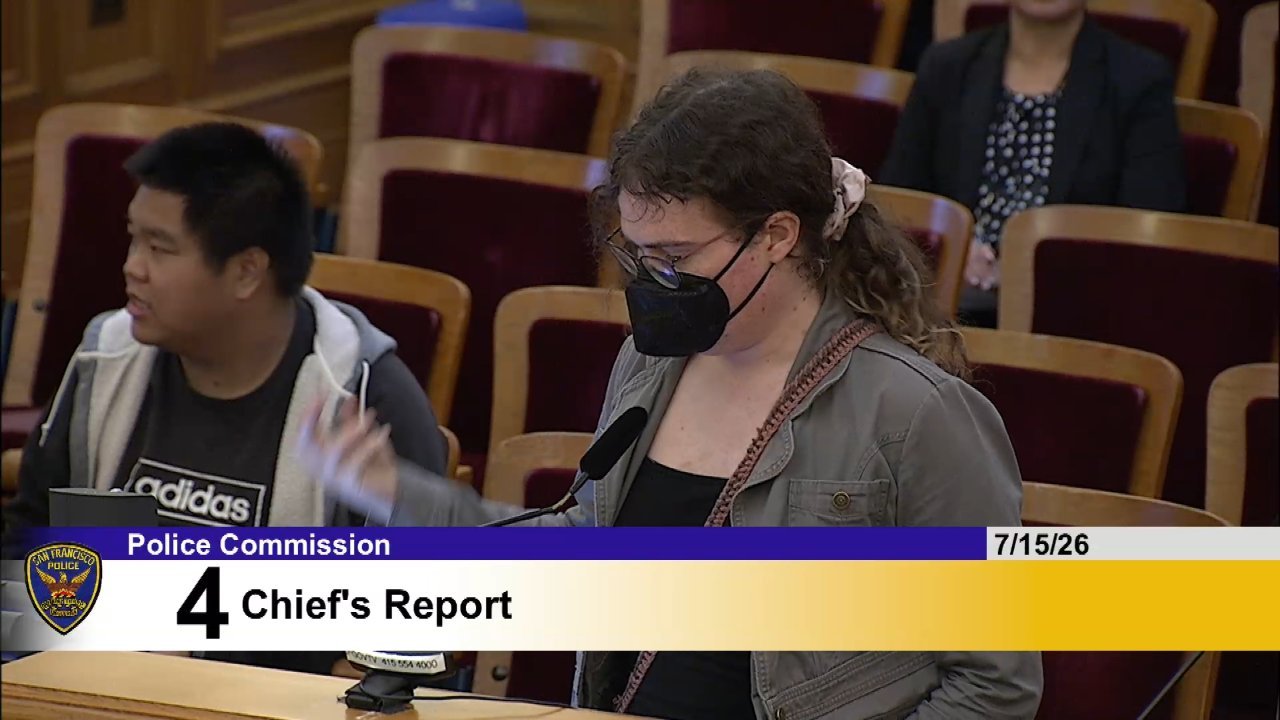
A public commenter returning for the second week directly challenged the department's response, questioning the officer count as far too low and disputing the claim that police did not "intervene broadly in the march."
The other side: Commissioners pushed for alternatives. Commissioner Cindy Elias suggested a more private format: "Maybe you can think of a way for maybe a more private, intimate forum where you don't necessarily have to give out information, but just allow the community to come and express their concern so that you can hear some of their experiences firsthand."
Commissioner Kevin Benedicto advocated a broader approach: "I think it doesn't have to be either or." He called for targeted meetings between command staff and march organizers, substantive updates at commission meetings, and a formal OIS-style town hall — an "all of the above strategy."
DPA Director Paul Henderson reported that his agency has open cases from both the Trans March and Stud Alley incidents, that new individuals came forward after the prior week's meeting, and that he met with Honey Mahogany from the Office of Transgender Initiatives to facilitate anonymous complaints. "People can contact DPA and share information with our agency anonymously. And she offered to use her office in case folks want to speak with her office and share information with them to get to us as well," Director Henderson said.
Flock License Plate Readers Face Audit After LAPD Drops the System
The basics: Flock automated license plate readers (ALPRs) capture and store images of vehicle plates, allowing law enforcement to track movements. SFPD uses the system, but it has been the subject of two data breaches — one in 2024 and a Northern California Regional Intelligence Center leak revealed the prior month.
Why it matters: During general public comment, Zachary Schwartz of DFLOC SF called for an independent audit, citing those breaches and alleging a likely violation of California Civil Code 1798.90.55, which bans agencies from sharing ALPR data with out-of-state entities. "The Police Department has likely violated California Civil Code 1798.90.55, which bans agencies in the State of California from sharing data with out-of-state" agencies, Schwartz said. He also requested an update on the internal inquiry into the NCRIC leak; the Chief had none.
Decisions: During Commission Reports, Commissioner Benedicto revealed that LAPD declined to renew its Flock contract and pressed the Chief on whether that was influencing SFPD's own evaluation. Chief Lew said he had no further information. Commissioner Benedicto then highlighted an upcoming DPA audit of ALPR use led by Audit Director Steve Flaherty: "The DPA has multiple award-winning audit team and this audit could not be more timely."
What's next: The DPA audit could force a fundamental reassessment of how SFPD deploys Flock technology, particularly given the convergence of data breach concerns, privacy law questions and LAPD's decision to walk away.
Crisis Worker Sounds Alarm on Peer Counselor Removal
Why it matters: Amelia, a direct service provider with nearly nine years of experience — including five on the Street Crisis Response Team — warned the Commission that the Fire Department is planning to remove peer counselors from the SCRT. The change was announced at the Fire Commission the prior Wednesday. The SCRT operates as part of the city's 911 first response system, pairing peer counselors with clinicians and EMTs to respond to behavioral health crises.
Amelia painted a vivid picture of peers' impact on the ground, sharing examples of successful de-escalation that sworn officers alone could not achieve. "To the officers that called for peer intervention when a half dozen sworn staff couldn't make someone drop a bat, thank you. She dropped it. We hugged and walked hand in hand into the ambulance," she told the Commission.
Returning during public comment on the Chief's Report, she emphasized officers welcome the support: "Every time the PD has requested, they have been very glad that we're there, very glad that they're sharing the weight and the responsibility of what it is to work with people with behavioral health crises and or homelessness."
Commissioner Benedicto asked Chief Lew about the change; the Chief said he had no information. Commissioner Benedicto requested an update, noting the CIT program's success and asking for written updates during the Commission's summer recess if warranted.
POA Pushes for Dismissed Recruit's Due Process
Attorney Scott Burrell told the Commission that a dismissed recruit was not afforded due process rights — specifically a Loudermill hearing, the constitutional right of a public employee to confront the reasons for dismissal. He asked the Commission to review the matter urgently and direct the department to provide the hearing, citing Charter sections 4.109 and 8.343.
Paul Chignell, Legal Defense Administrator of the San Francisco Police Officers Association, followed in an unusual appearance during general public comment, invoking his personal role in the original court case that established the Loudermill standard statewide. "I have spoken to her training officers and her training sergeant in this case, as well as multiple officers at Tenderloin Station, and the department's rationale for her termination cannot be supported," Chignell said.
Light-Duty Policy Gets First Overhaul in Two Decades
The Commission unanimously approved a revised Department General Order 11.12, the department's Temporary Modified Duty policy, last updated in 2004.
ADA Coordinator Penny Sie presented the changes, which were shaped by 12 public comments that yielded eight revisions. Key updates: non-sworn employees are now eligible for temporary modified duty for the first time; temporary modified duty is separated from reasonable accommodations; and the Family Support Unit successfully pushed to allow temporary modified duty assignments at district stations — keeping injured or accommodated employees closer to home.
Commissioner Benedicto confirmed the order covers both sworn and non-sworn personnel, meaning the meet-and-confer process will likely involve both the POA and civilian employee unions. The motion, made by Commissioner Benedicto and seconded by Commissioner Pratibha Tekkey, passed 6-0 (For: 6, Against: 0, Absent: 1 — Commissioner Mattie Scott excused).
Minor Items
Consent calendar approved 6-0 (Scott absent): included an in-kind gift from Oracle Park, a $3 million SF Police Community Foundation gift for Real Time Investigation Center technology, and $103,000 for the O2X wellness initiative.
Language identification pins: Commissioner Benedicto followed up on a community-inspired initiative. The Assistant Chief confirmed the pins are not a budget issue and SFPD is identifying officers at district stations who will wear them; the uniform policy is being revised. The Sheriff's Office has already begun its rollout.
Phone scam warning: Chief Lew alerted the public that scammers are spoofing SFPD phone numbers.
Capsized vessel: One fatality reported from a capsized vessel in the bay during the prior week.
Promotional ceremony: President C. Don Clay announced an Aug. 13 promotional ceremony.
Closed session: The Commission voted 5-0 to enter closed session (For: 5, Recused: 1 — Commissioner Elias, whose spouse works for a firm representing the plaintiff; Absent: 1 — Commissioner Scott) and 5-0 not to disclose any discussion held in closed session.