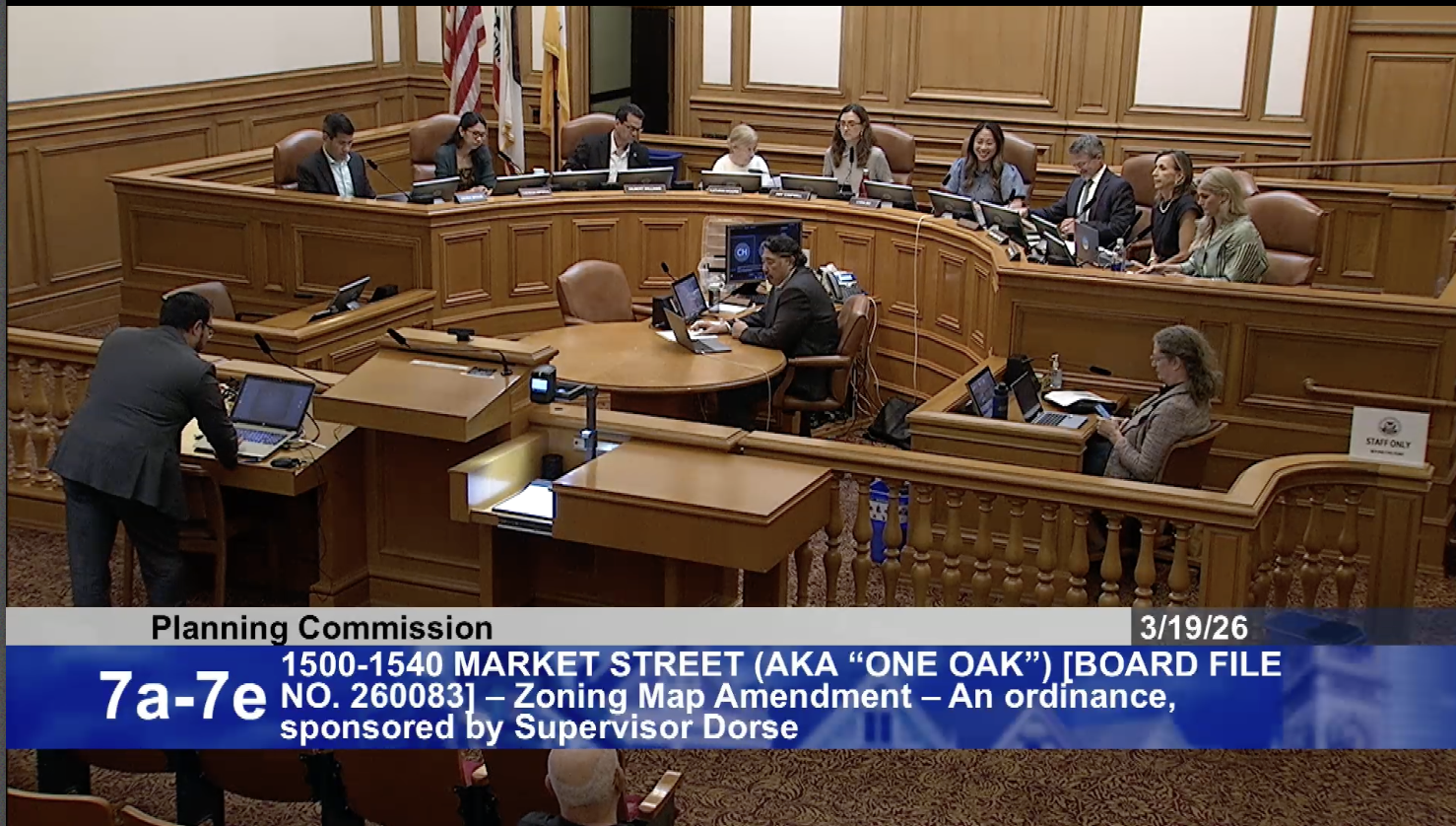
Planning Commission - Mar 19, 2026 - Meeting

Planning Commission - Mar 19, 2026 - Meeting

Planning CommissionSan FranciscoMarch 19, 2026

Sources:

Locunity is a independent informational service and is not an official government page for this commission.We use AI-assisted analysis and human editorial review to publish information.

541-Unit Tower Advances as SF Shields Neighborhoods From State Zoning Mandate

The San Francisco Planning Commission took two headline actions March 19: approving a citywide alternative plan that blocks state-imposed height increases on more than 120,000 residential parcels, and green-lighting a 541-unit residential tower at Van Ness and Market that labor, neighbors, and commissioners debated for nearly an hour. Together, the votes signal a city determined to keep zoning authority at home while prodding stalled housing production forward.

  • 541-unit 1 Oak tower at Van Ness and Market approved 5-1, generating over $20 million in affordable housing fees and thousands of union construction hours at a long-vacant site

  • SB 79 alternative plan adopted 4-2, preserving local zoning control by demonstrating San Francisco's housing capacity exceeds state requirements by more than 100,000 units

  • Two dissenting commissioners warn SB 79 is state overreach even as they acknowledge the alternative plan is the pragmatic path

  • Planning director reports SF is behind on housing targets for both market-rate and affordable production, with a detailed hearing set for April 19

  • Union trades turn out in force for One Oak, citing apprenticeship pipelines and a $3.77 economic multiplier per construction dollar


Screenshot 2026 03 20 at 1.46.40 PM

One Oak Tower: Labor Rallies, Neighbors Push Back on Podium Height

The commission spent nearly an hour on the modified One Oak project at 1500–1540 Market Street — a 400-foot residential tower that adds 81 units over a previously approved 460-unit plan, bringing the total to 541. Five entitlement actions were on the table: a zoning map amendment raising the podium height limit from 120 to 140 feet, CEQA findings with a statement of overriding considerations, a downtown project authorization with six exceptions, shadow findings for Patricia Green, and a Zoning Administrator variance for above-grade parking setback.

Why it matters: The parcel at Van Ness and Market has sat undeveloped for years at one of San Francisco's most visible intersections. The project will contribute over $20 million to the city's affordable housing fund and arrives during a construction downturn that has left union workers scrambling for hours.

Where things stand: Senior Planner Joseph Sacchi recommended approval, finding the project consistent with the General Plan and the Market & Octavia Area Plan. The redesign eliminates ground-floor retail in favor of a community room and leasing office for day-one activation, and shifts the unit mix away from two-bedrooms. The developer, Emerald Fund, is using pipeline project legislation for financial feasibility.

A parade of building trades representatives urged approval. "For every dollar of construction wages and activity you put in, you get an economic output of $3.77. This is a specific area of our mid-Market area which has been depressed," said Rudy Gonzalez, SF Building and Construction Trades Council representative. Eddie Reyes, president of Ironworkers Local 377, cited apprenticeship opportunities for young people, minorities, and women during the post-COVID slowdown. J. Anthony Menhivar of Carpenters Union Local 22 emphasized Emerald Fund's commitment to union labor. Tup Fisher, executive vice president of Washington Capital Management — the site owner and union pension fund advisor — detailed more than $500 million in San Francisco development and urged approval as supporting union workers and pension returns.

The other side: Three speakers from The Oak, a 109-unit adjacent building, supported the project in principle but opposed the podium height increase. Ryan Hong, owner of The Oak, said the jump from 120 to 140 feet would reduce natural light and privacy for east-facing units. Jeff Koo, property manager of The Oak, echoed those concerns, and a resident named Ethan said he depends on sunlight in his unit for mental health while working from home.

Commissioner Derek W. Braun defended the podium height as reasonable, noting The Oak itself rises to a similar height. "The increased podium at 140 feet, that's also allowed through the alternative pathway created through our family zoning. So there is actually another pathway anyway that would still sort of by rights, if certain requirements are met, allow 140-foot podium," he said.

Commissioner Theresa Imperial cast the lone dissenting vote, pressing the developer on affordable housing. "This is a great opportunity for on-site housing and that is something that I am really struggling with," she said. Commissioner Gilbert Williams voted yes but called the absence of on-site affordable units "a missed opportunity." Commissioner Imperial also urged the developer and city to assist All Star Cafe, a small business that will be demolished for the project.

President Amy Campbell praised the design improvements and described the height request as "quite reasonable in light of what we have the market right now and what we wanted to see happen to encourage people continue to keep on investing in San Francisco."

Decisions: The commission approved the project 5-1 (For: So, Braun, Moore, Campbell, Williams; Against: Imperial; Absent: McGarry). The Zoning Administrator granted the variance with standard conditions.

What's next: The zoning map amendment heads to the Board of Supervisors for final action.


SB 79 Alternative Plan: Local Control Preserved — Barely

Commissioners voted 4-2 to recommend approval of a citywide alternative plan under Senate Bill 79, the Abundant and Affordable Homes Near Transit Act, which takes effect July 1.

The basics: Without a locally adopted alternative, SB 79 would automatically impose five-to-nine-story height allowances across San Francisco's residential neighborhoods near major transit stops. The alternative plan demonstrates the city's total housing capacity exceeds what SB 79 would require by more than 100,000 units and nearly 200 million square feet — a surplus made possible largely by the recently adopted family zoning plan.

Why it matters: This is the mechanism by which San Francisco retains neighborhood-level zoning control for the foreseeable future. Staff noted San Francisco may be the largest city pursuing a full citywide alternative plan.

Where things stand: The ordinance, presented by planner Sarah Richardson and planner Josh Waski, has four parts: permanently excluding three industrial employment hubs (roughly 2,000 parcels) from SB 79; temporarily exempting low-resource census tracts south of 16th Street and in Mission Bay until 2032; adding a density and height exception for parcels within a half-mile of transit stops outside the family zoning area; and adopting the citywide alternative plan.

Commissioner Braun moved approval, framing transit-oriented housing as common sense. "I fully support the basic premise of SB 79, to ensure that our major transit investments are effective, that they're worthwhile by constraining housing near them, and to create transportation choices for people," he said.

The other side: Vice President Kathrin Moore voted no, tying her dissent to her earlier opposition to the family zoning plan. "Since I am not supporting the family zoning plan, I will not support this," she said, while requesting the department monitor transportation service levels as densities increase. Commissioner Williams also voted no, calling the state mandate overreach: "I think the state overplayed its hand, forcing jurisdictions like San Francisco to do things that we're capable of doing on our own." Both dissenters acknowledged the quality of staff work.

Planning Director Sarah Dennis-Phillips offered a blunt warning to those considering a no vote: "If you do dislike the bill, you would want to support an alternative to it and not to support it coming into full effect."

President Campbell noted San Francisco's unique position: "Isn't that San Francisco is like the only city and county that are subject to SB 79, where we actually have done our work ahead of this."

Commissioner Imperial asked what happens when the temporary exemptions for low-resource tracts expire in 2032; staff confirmed the alternative plan must be recertified with each housing element cycle.

Decisions: Approved 4-2 (For: So, Braun, Imperial, Campbell; Against: Williams, Moore; Absent: McGarry). Staff member Diana Law was recognized for extensive GIS work supporting the plan.

What's next: The ordinance goes to the Board of Supervisors. The alternative plan must be recertified when the city adopts its next housing element.


Decades-Old Deck Gets a Privacy Screen

A dispute between neighbors at 2460 and 2454 Francisco Street laid bare the challenges of retrofitting fire-code compliance onto decades-old conditions in San Francisco's dense housing stock.

Where things stand: The Department of Building Inspection required a one-hour-rated firewall at a second-floor deck in a shared light well at 2460 Francisco Street. The deck was built around 1984 under a finaled permit and has been used for 40 years by the current owners, Judy Kimball and her husband Chuck, ages 88 and 85. Neighbor Steve Grossman of 2454 Francisco Street sought a six-foot firewall plus sprinkler system, citing fire safety, cooking smoke entering his nine windows, and severe privacy concerns given only 3 feet 8 inches of separation between the buildings. Project architect Darren McMurtry argued the deck is legal, code-compliant, and that a six-foot wall would create a cage-like effect.

Staff architect David Winslow noted the deck would not be allowed under today's code but exists as a legal nonconforming condition. He recommended taking discretionary review and requiring a privacy screen to six feet above deck level — a compromise splitting the difference between the neighbor's demand and the owners' desire to preserve their outdoor space.

Decisions: Commissioner Braun moved to take DR and approve with the privacy screen modification. Approved 6-0 (Absent: McGarry).


Screenshot 2026 03 20 at 1.48.03 PM

Minor Items

  • 77 Broad Street DR continued to April 16, 2026 (6-0; McGarry absent).

  • 2620 20th Street rear addition approved after the commission unanimously declined to take discretionary review (6-0). A neighbor raised concerns about structural risk and privacy from a modest one-story addition and deck; staff found no exceptional circumstances. The central dispute — whether an overhead structure is a trellis or a roof — was deemed a building code matter for DBI.

  • Planning director reported the launch of an online development impact fee calculator replacing manual spreadsheets, and a new PermitSF/OpenGov online permitting system that has doubled permit volume, with 35% of submissions filed during off-hours.

  • Legislative update: The Mission and 9th Street special use district for 100% affordable housing at 1270 Mission Street advanced at the Board of Supervisors, with Supervisor Chan joining as co-sponsor. The 2245 Post Street SUD received a first reading.

  • Public commenter Sue Hester noted the April 2 hearing may be canceled (no items remaining) and that the April 9 hearing is already canceled.

Quote lightly edited for clarity. Review original transcript for full quote.