
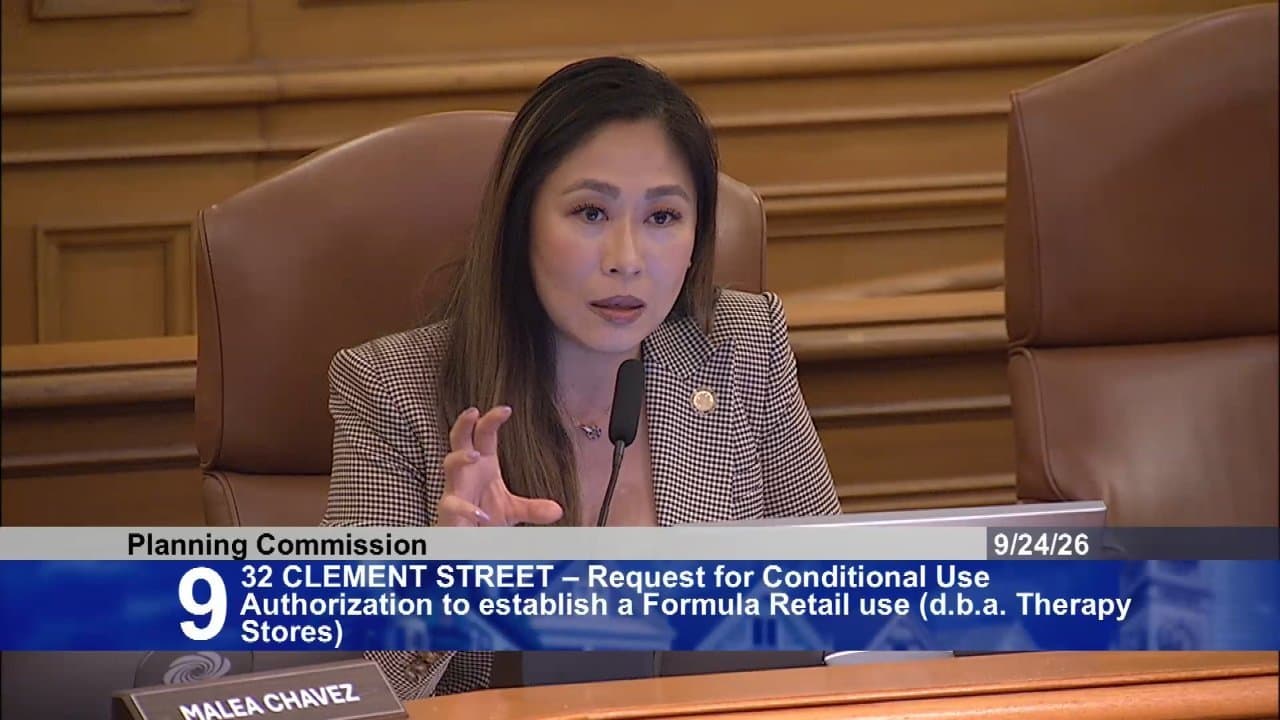
Therapy Stores Wins Contentious Formula Retail Approval on Clement Street
Planning Commission • San FranciscoSeptember 24, 2026
Locunity is an independent informational service and is not an official government page for this commission. All information is sourced from public footage and an analysis of official agendas with the aid of responsible, fact-checked AI. to report an error or omission.
The San Francisco Planning Commission navigated a charged debate over independent retail identity on one of the city's most beloved shopping corridors, ultimately green-lighting a locally founded chain's 11th location alongside a major Central SoMa office tower extension and a new social services building for the iconic GLIDE Foundation — all against a backdrop of optimism about the city's economic rebound.
- Therapy Stores wins 6-0 formula retail approval on Clement Street despite organized opposition from the merchants association and neighboring independent shop owners citing merchandise overlap and code violations
- BXP secures 18-month extension for 981,000-SF Central SoMa office tower, citing AI-driven leasing demand and over 9 million SF of active tenant requirements
- GLIDE Foundation approved for 7-story, 41,173-SF social services building in the Tenderloin, replacing a surface parking lot and adding major streetscape improvements
- Commissioners and the planning director celebrate SF's recovery momentum, citing Mayor Lurie's enthusiasm at a business breakfast and national praise for the city's downtown strategy
- New Commissioner Malia Chavez formally welcomed, completing the fully seated seven-member commission for the first time in recent memory
A Local Chain, a Neighborhood's Identity, and a 6-0 Vote
The meeting's longest and most contentious item tested San Francisco's formula retail controls against an unlikely target: a shop born 32 years ago at 16th and Guerrero that grew one storefront at a time into an 11-location chain, triggering the city's conditional use authorization requirement under Section 303.1.
The basics: Therapy Stores sought a CUA to open at 32 Clement Street in the Inner Richmond, a space vacant since 2024. Because the Clement Street location would be the chain's 11th, the store crossed the planning code's formula retail threshold, requiring commission review. An enforcement complaint filed in March 2026 cited unpermitted change of use, unauthorized signage, and merchandise display before the CUA was even filed.
Why it matters: The case put a fine point on a question San Francisco has wrestled with for years — when a locally grown business becomes big enough to trigger protections designed to keep corporate chains off neighborhood corridors, should it be treated the same as a national franchise?
Where things stand: Jing Chen, owner and co-founder of Therapy Stores, told the commission she started the business with her husband decades ago and framed herself as a neighborhood entrepreneur, not a corporate operator.
The Clement Street Merchants Association mounted organized opposition. Chris Gwyer, president of the Clement Street Merchants Association, told commissioners the group had gathered a 393-signature petition against the project and accused the applicant of setting up a turnkey store before seeking permits.
Several independent shop owners testified that Therapy's merchandise directly duplicates what they already sell. Amanda Weld, owner of Tantrum at 248 Clement, told the commission that Therapy carries 22 major brands also sold at her store within three blocks and urged commissioners to uphold formula retail protections.
Alyssa Anderson, owner of Foggy Notion and former vice president of the Clement Street Merchants Association, alleged that Therapy owns empty storefronts in Oakland, Placerville, and San Bruno, arguing those vacant locations undercut the applicant's claims of community investment. Lindsay Hanson, owner of The Future Past, called the chain's offerings "the antithesis" of unique independent shops.
Richard Weld, an Inner Richmond resident and Clement Street shop owner, argued the store offers "no unique or needed use" and emphasized the applicant "acted first and sought permission later" by accumulating three code violations before filing for the CUA.
Supporters pushed back. Rick Salazar, a sales agent who has worked with Therapy for 40 years, said the store was instructed to avoid selling items that overlap with neighboring merchants on Clement. Agnes Leong, an Inner Richmond resident and part-time employee at Schubert's Bakery, said merchants should welcome new neighbors and noted the store fills a two-year vacancy. Hannah Manos, a member of the Junior League of San Francisco, defended Jing Chen's character and said the owner "funnels everything back into the business and into the community." Employees Nikki and Noemia also testified in support.
The department reported receiving 46 support letters with 720 petition signatures and 16 opposition letters with 309 petition signatures.
The other side: During deliberation, commissioners wrestled openly with the case. Commissioner Chen captured the tension most directly: "I feel very uncomfortable by the fact that we're being asked to decide this on the basis of character attestations about whether someone is being truthful or lying, or whether someone is in good faith, or whether they are a good person." Chen questioned whether the 11th store created any additional harm compared to a 9th or 10th store — when no CUA would have been required — and concluded it did not.
Commissioner McGarry, himself an Inner Richmond resident, acknowledged the merchandise overlap but argued, "One neighbour just can't tell another neighbour what they can do and what they cannot do. They have to work together."
Commissioner Chavez called it "a really hard one," adding: "We want to support growth of businesses. We also want to support competition." She ultimately supported approval based on the business's track record.
Acting Chair Lydia So delivered the most pointed message directly to the applicant: "I really wish that you are going to be a good neighbor to the Merchants Association and also along the Clement Street corridor."
Staff confirmed the commission cannot legally condition merchandise selection.
Decisions: Approved 6-0 (For: Chavez, Chen, Koppel, McDonald, McGarry, So; Absent: Campbell) with staff conditions per Exhibit A.
What's next: The approval sets a precedent for how San Francisco's formula retail controls apply to locally grown chains crossing the 11-store threshold. Whether Therapy differentiates its Clement Street offerings and builds relationships with neighboring merchants — as commissioners urged — will be watched closely by the corridor's tight-knit business community.
BXP's Billion-Dollar Bet on Central SoMa Gets More Time
The commission unanimously extended entitlements for one of the largest speculative office projects in the city's pipeline, giving Boston Properties (BXP) 18 more months to launch construction of a 14-story, 981,000-gross-square-foot mixed-use tower at 725-765 Harrison Street in Central SoMa.
The basics: Originally approved in 2019 and modified in 2022, the project calls for demolishing six existing buildings and constructing a 185-foot tower with approximately 810,000 SF of office space, plus retail, production-distribution-repair space, childcare, and a dedicated parcel for affordable housing. The three-year performance period expired in 2025; BXP sought an extension to March 24, 2028.
Why it matters: If BXP can land a 30–50% prelease, the project could become San Francisco's first major new office tower in years — a concrete test of whether the AI-fueled leasing boom translates into actual construction amid elevated interest rates.
Where things stand: Aaron Fenton, senior vice president at BXP, described securing New York board approval in January 2020 for a full speculative build exceeding $1 billion — right before the pandemic froze everything. He told commissioners that demand has since surged: "There are more and more tenants that are in the market that are growing into that size range, literally on a weekly basis. We've never seen this amount of tenant demand in the market. There's over 9 million square feet as of this week."
Alex Weinberg, BXP representative, cited the company's 680 Folsom building filling with 200,000 SF of new leases as evidence of AI-driven demand. BXP has already begun demolishing existing buildings and pulling site permits to demonstrate market readiness.
Staff noted that Ordinance 0326, adopted in January 2026, introduced new tenant protection and residential demolition criteria applicable to the CUA extension, requiring the commission to make new findings. Staff reported the project met all eight criteria. Commissioner McDonald asked about the new 70% threshold for residential demolition criteria; staff explained the Tenant Protection Ordinance aimed to make criteria more objective. Commissioner Koppel praised BXP's history of investing in downtown San Francisco. Commissioner Chen asked about the PDR requirement under Prop X/Section 202.8.
Decisions: Approved 6-0 (For: Chavez, Chen, Koppel, McDonald, McGarry, So; Absent: Campbell). The acting zoning administrator also granted variances.
GLIDE Foundation Approved for New Tenderloin Campus Building
The commission gave the GLIDE Foundation unanimous approval to build a seven-story, 41,173-SF social service and philanthropic facility at 334 Ellis Street, consolidating one of the city's most iconic community organizations onto a single Tenderloin campus.
The basics: The project replaces a surface parking lot and merges three lots — including the GLIDE church and existing service building — into one campus. The new building reaches 95 feet, 5 inches with a setback seventh story. Variances were requested for minor ground-floor ceiling height deviations caused by the sloping street frontage and for bike parking/shower/locker requirements calculated on new construction area rather than the combined lot.
Why it matters: GLIDE has served the Tenderloin for nearly 100 years. The project adds significant streetscape improvements, including an 82-foot sidewalk bulb-out and new street trees, to one of the city's most challenged neighborhoods.
Paula Collins, board member and real estate committee chair of the GLIDE Foundation, outlined the organization's extensive programs. Melinda Sarajapour, attorney at Rubin, Junius & Rose representing GLIDE, detailed the design review process and streetscape improvements. No opposition was received.
Commissioners were effusive. Commissioner McGarry said: "I do know that there is certain organizations that do God's work, and Glide Memorial does God's work." Commissioner McDonald praised the project as "designed to fit so sensitively into the surrounding neighborhood and to recognize and appreciate and respond to what is going on around it." Commissioner Chavez called it a creative use of a parking lot.
Decisions: Approved 6-0 (For: Chavez, Chen, Koppel, McDonald, McGarry, So; Absent: Campbell). Variances also granted.
Recovery Momentum: Commissioners and Director Sound an Optimistic Note
Multiple commissioners and Planning Director Sarah Dennis-Phillips used the meeting's opening segments to frame a narrative of citywide economic recovery.
Commissioner Koppel and Commissioner McGarry both reported attending a San Francisco Business Times breakfast where Mayor Lurie expressed optimism about the city's trajectory. McGarry said the enthusiasm was genuine: "This city is bouncing back and everybody's excited about it and everybody's in lockstep with it too. Nobody was faking it there. They were all actually in it to win it."
Director Dennis-Phillips shared that staff member Lily Langlois participated in a national advisory panel in Los Angeles, where "other cities continually mentioned how impressed they were by San Francisco's ability and continued progress moving forward." Dennis-Phillips also formally welcomed Commissioner Malia Chavez, noting the commission is now fully seated for the first time in a while, calling it "one of the most stable and vibrant commissions that I think many of us have seen."
Commissioner Chavez thanked her colleagues and said she was "looking forward to participating and learning and listening and hopefully being part of San Francisco on the rise."
Minor Items
- 590 Van Ness Avenue CUA approved on consent calendar, 6-0.
- 3837 18th Street discretionary review continued to Oct. 15, 2026.
- September 10, 2026, meeting minutes adopted unanimously.
- Board of Supervisors updates: Mixed-use signage and commercial-to-residential adaptive reuse ordinances passed on first read; the PG&E power asset acquisition EIR appeal was denied.
- General public comment: A speaker raised concerns that a Clayton Street project approved the prior week was described by the sponsor as "tantamount to demolition" but was noticed as an alteration, questioning SB 330 compliance. Jerry Drattler alleged DBI covered up 88 unpermitted condo units at 2177 3rd Street, an Aligned Real Estate project, citing discrepancies between building permits, approved plans, and assessor-recorded deeds, and urged the commission to place the developer and project engineers on the expanded code compliance list.