Planning Commission - Jun 18, 2026 - Meeting
Planning Commission • San FranciscoJune 18, 2026
Locunity is a independent informational service and is not an official government page for this commission.We use AI-assisted analysis and human editorial review to publish information.
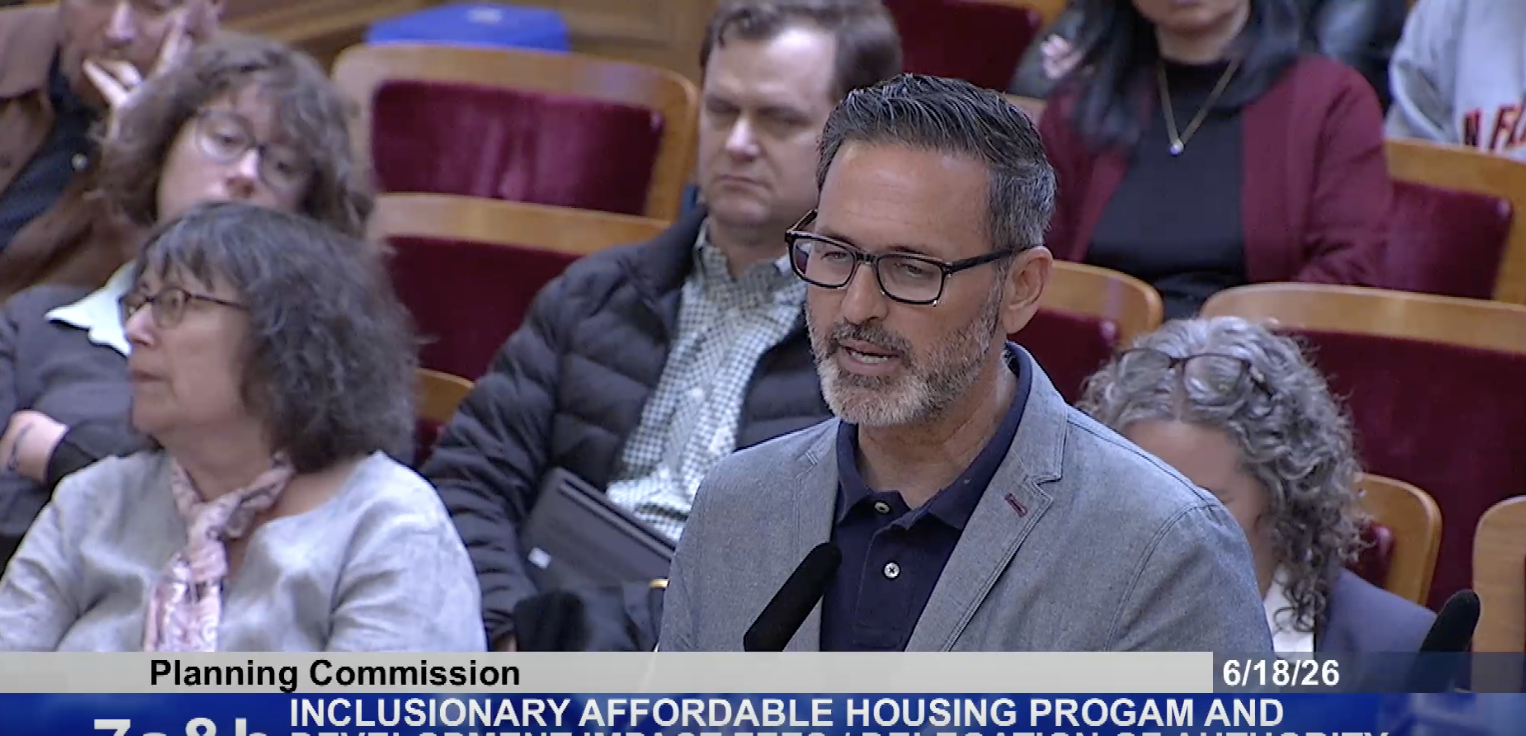
Planning Commission Approves Dramatic Cut to Inclusionary Housing Rates in Contentious 4-2 Vote
San Francisco's Planning Commission advanced the most significant overhaul of the city's affordable housing production framework in years, slashing on-site inclusionary requirements to 5% and development impact fees by 67% — a bet that unlocking stalled market-rate projects will produce more housing overall, but only if voters approve a companion $3 billion Housing Trust Fund in November. The four-hour hearing drew more than 20 speakers and laid bare a fundamental divide over whether the city's deepening construction recession or its displacement crisis should drive policy.
- Inclusionary housing rate drops to 5% and development impact fees cut by two-thirds, with projects under 25 units exempt, in a 4-2 vote
- Bayview bar permitting broadened beyond Supervisor Walton's narrower proposal, conditionally permitting all bars in the 3rd Street Alcohol Restricted Use District (4-2)
- Contested demolition at 2785 San Bruno Ave approved unanimously after application errors corrected; two rent-controlled replacement units required
- St. Ignatius wins bike parking reduction to 70 spaces after compromise with Outer Sunset Neighbors (6-0)
- Commissioners honor Vice President Kathrin Moore after 20+ years as the city's longest-serving Planning Commissioner
The Inclusionary Fight: 5% Rate, $3 Billion Gamble
Why it matters: This is the most consequential change to San Francisco's affordable housing machinery in years, dropping on-site requirements from a temporary 12% to a permanent 5%, eliminating the middle-income tier, exempting projects under 25 units, and cutting development impact fees by two-thirds. The entire framework now hinges on a November ballot measure — the Housing Trust Fund charter amendment — that would increase the city's annual affordable housing contribution from $50 million to $125 million and capture property tax growth from new development, projecting $3 billion over 30 years.
Where things stand: The controller's feasibility analysis found that no level of inclusionary housing is currently economically feasible for market-rate projects, with annual housing production down 70% from pre-pandemic levels. The Technical Advisory Committee unanimously recommended lowering rates to 5%, though TAC member Shannon Way pushed back on the characterization of consensus, describing the process as chaotic with no formal vote.
The hearing split sharply between two coalitions. Opponents — including SOMCAN, Senior and Disability Action, the Bill Sorro Housing Program, the American Indian Cultural District, and housing advocate Calvin Welch — argued the reduction dismantles a critical affordable housing tool with no guarantee of replacement funding. Supporters — including SPUR, the Housing Action Coalition, Building Trades, Strada, the Housing Accelerator Fund, Mercy Housing, and Abundant SF — contended the current requirements produce zero affordable units when projects aren't built.
"Every percentage point can represent hundreds of families, seniors, lower income residents, formerly homeless residents not afforded an opportunity for a stable affordable home," said Commissioner Gilbert Williams, who delivered extensive prepared remarks opposing the ordinance. Williams argued the reduction would disproportionately harm vulnerable communities and dismantle anti-displacement protections in the Mission, SOMA, and Eastern Neighborhoods.
Commissioner Kathrin Moore zeroed in on the timing disconnect between cuts taking effect and Housing Trust Fund revenue arriving in 2029: "It's kind of like wanting to skydive and be very excited about it and potentially the parachute doesn't open."
The other side: Commissioner Sean McGarry, representing the Building Trades, framed the vote through the lens of a construction recession devastating union workers. "2017, 4,972 units. 2025, 2,406, 48% reduction. My members build those. And if they're not being built, they're not working," he said.
Commissioner Lydia So stressed the need for a new approach: "I think we cannot solve a housing shortage by making it harder to build housing."
Commissioner Derek Braun supported the motion but expressed discomfort about the risk. "I would just say I think it might be worth considering accelerating reconsideration of the inclusionary requirements if possible, if that ballot measure doesn't pass," he said. Braun also advocated for future study of geographically targeted requirements based on submarket conditions.
Among public commenters, Kate Hartley, chief legal officer of the Housing Accelerator Fund, argued the inclusionary ordinance as currently written is not reliable year-to-year and does not enable good planning, while a Housing Trust Fund extended for 30 years does. Lori Droste, SPUR's housing and planning director, called the reforms evidence-based. Jesse Blount of Strada, a TAC member since inception, described the Housing Trust Fund as creating a dependable affordable housing financing source independent of market conditions.
On the opposing side, Welch — an original member of the task force that created inclusionary zoning — noted that 2017's peak production of 4,972 units occurred at the height of inclusionary requirements, while 2025 saw only 2,406 units despite reduced requirements. Mitch Mankin of the SF Housing Development Corporation pointed out that no Bay Area city has an inclusionary rate below 10%.
Representatives of the American Indian Cultural District delivered some of the hearing's most emotional testimony. Mary Travis Allen, co-chair of the district and a Planning Equity Council member, urged commissioners to give meaning to equity, noting that the American Indian community has the highest rate of homelessness in the city.
Decisions: The motion passed 4-2 (For: McGarry, So, Braun, Campbell; Against: Williams, Moore; Absent: Imperial) with three staff modifications including corrections to code references and alignment of the North of Market Residential SUD height provisions. A companion resolution delegating authority to the Planning Director to administratively modify inclusionary conditions for pipeline projects passed on the same 4-2 vote.
What's next: The ordinance heads to the Board of Supervisors, where a majority has already co-sponsored the paired Housing Trust Fund charter amendment. Voters will decide on the ballot measure in November. If the trust fund fails, Commissioner Braun's call for accelerated reconsideration of the rates could become the next flashpoint.
Bayview Bar Rules: Commission Goes Broader Than Supervisor Walton Intended
Why it matters: The Commission chose to reshape decades-old alcohol restrictions in the Bayview rather than narrowly tailoring relief to a single historic establishment, setting up a potential clash with Supervisor Walton at the Board of Supervisors.
Where things stand: Walton's proposed ordinance would have allowed bars with pre-2003 ABC licenses to re-establish after closures of up to 10 years and relocate within the 3rd Street Alcohol Restricted Use District as principally permitted. Staff presenter Veronica Flores explained that only one establishment — Sam Jordan's Bar — appears eligible under those narrow criteria. Staff recommended a broader modification: conditionally permitting all bars within the RUD, creating a more equitable framework that wouldn't privilege a single business.
The other side: Commissioner Moore expressed concerns about loosening protections in vulnerable communities without the supervisor's explicit support, warning that the alcohol restriction framework was designed to protect Bayview residents. Commissioner Williams echoed those views.
Commissioner Braun supported the broader approach as a way to further conversation about updating the RUD.
Decisions: Passed 4-2 (For: McGarry, So, Braun, Campbell; Against: Williams, Moore; Absent: Imperial). The same split as the inclusionary vote.
What's next: The ordinance moves to the Board of Supervisors, where Supervisor Walton could push back on the broader modification his office did not request.
2785 San Bruno Ave: Demolition Approved After Rocky Application History
Why it matters: A contested demolition with a decade-long history of opposition raised questions about how the city tracks unauthorized dwelling units and rent control compliance across ownership changes.
Where things stand: The Huang family sought to demolish a single-family home and an unauthorized rear dwelling unit to construct a three-story mixed-use building with three units and ground-floor commercial. The project was previously denied by the Board of Supervisors in 2016. Staff planner Maggie Lausch presented the case, noting that the initial 2025 application incorrectly stated only one unit existed and that the site was owner-occupied. After an opponent brought the prior Board findings to the department's attention, staff required corrected materials acknowledging two rent-controlled units. The project now includes two rent-controlled replacement one-bedroom units and a new three-bedroom family-sized unit.
The other side: Adjacent owner Dr. Michael Wong argued the sponsor never lived at the site and that over 60% of immediate surrounding neighbors support saving the building. Attorney Steve Williams argued the application affidavits were false and that the project doesn't satisfy demolition criteria under Section 317. Teresa Dugue of the SF Community Empowerment Center asked the commission to deny the project, representing approximately 200 community members concerned about preserving naturally affordable housing.
Commissioner Braun acknowledged the errors but found the project's current form meets code requirements and serves housing goals.
Decisions: Approved unanimously 6-0 (Imperial absent) with conditions.
St. Ignatius Bike Parking: Community Compromise Yields 70 Spaces
Why it matters: The compromise between St. Ignatius and Outer Sunset Neighbors sets a template for how schools can negotiate bicycle infrastructure requirements with neighborhoods while the city pursues its goal of 80% low-carbon trips by 2030.
Where things stand: St. Ignatius College Preparatory sought to reduce 120 required Class 1 bicycle parking spaces in its campus expansion project. The original request was for just 20 spaces, which drew community concern. After a continuance and outreach with Outer Sunset Neighbors, the school revised its request to 70 spaces relocated to a more accessible ground-floor location. Alice Duzdiker of Outer Sunset Neighbors supported the compromise while urging the school to conduct baseline transportation surveys.
Commissioner So championed adding a monitoring condition for bike parking usage, which was incorporated into the motion. Commissioner Moore supported the compromise but cautioned against singling out one school for special monitoring. Commissioner Braun emphasized that mode shift requires stellar end-destination facilities.
Decisions: Approved unanimously 6-0 (Imperial absent) with monitoring conditions requiring usage reports at 6 months and 1 year after the facility is operational.
Minor Items
- Draft minutes for May 21 and May 28 meetings adopted unanimously 6-0.
- Balboa Reservoir special use district passed the Board of Supervisors on second reading, clearing the way for a major housing and mixed-use project in District 7.
- Engine 33 received a landmark designation from the Historic Preservation Commission.
- Planning Department budget is moving through the city process largely unchanged, per Director's Report.
- Commissioner Moore tribute: Former city planner Diane Oshima and project sponsor attorney John Kevlin were among those honoring Vice President Kathrin Moore in her second-to-last meeting after more than 20 years of service — believed to be the longest tenure for a San Francisco Planning Commissioner. Kevlin credited Moore with making him a better land use attorney.
- Public commenter Georgia Schuttish argued that projects approved as tantamount to demolition should carry permanent application forms rather than alteration permits.