Planning Commission - Sep 17, 2026 - Meeting
Planning Commission • San FranciscoSeptember 17, 2026
Locunity is a independent informational service and is not an official government page for this commission.We use AI-assisted analysis and human editorial review to publish information.
Nine-Unit Hillside Project Advances After Neighbors Plead for Safety
The San Francisco Planning Commission's Sept. 17 hearing turned into a lesson in the gap between housing production and construction accountability, as seven downhill neighbors arrived to describe falling trees, cliff erosion and fire access failures — none of which the commission has the power to regulate. Every item on the agenda passed 5-0, but not before commissioners wrestled with how to reassure a community that fears for its safety on one of the city's steepest slopes.
Nine-unit Clayton Street housing project approved after emotional public testimony about steep-slope construction safety
Commission adopts up-to-$150,000 penalty criteria for developers who lie about tenants on planning applications
Google wins office expansion into vacant ground floor of landmark Hills Brothers Coffee Building — the first use of the city's new historic adaptive reuse code
New commissioner Liz Chavez confirmed by Board of Supervisors; 45-day data center moratorium introduced
Fear on the Hillside: Clayton Street Housing Greenlit With New Safeguards
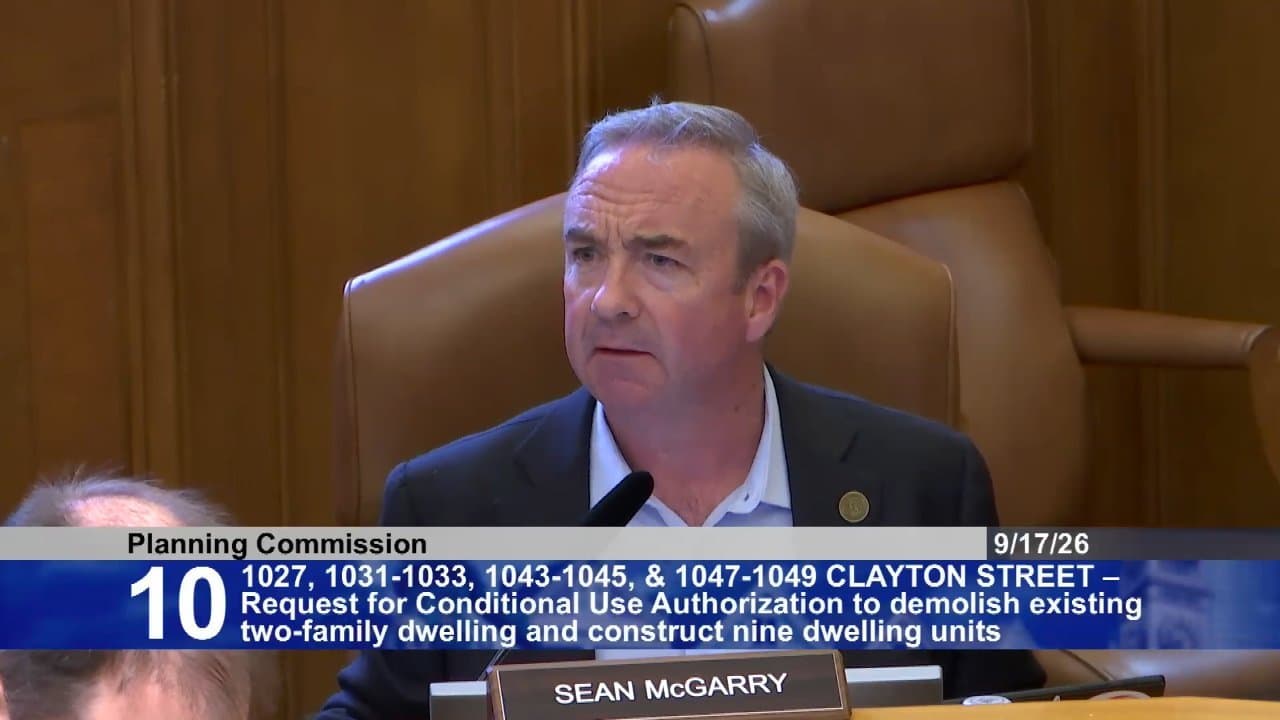
The most contested item of the evening — consuming roughly 80 minutes of discussion — was the conditional use authorization to demolish an existing two-unit rent-controlled building at 1043-1045 Clayton Street and build nine units across five contiguous lots in the Cole Valley/Ashbury Heights area.
The basics: The project was previously approved in 2020 and again in 2023, but the CUA validity period lapsed in March 2024. The new proposal replaces two rent-controlled units with nine homes — each roughly 3,000 square feet, with the single-family units closer to 5,000 — adding seven net new units to the city's housing stock.
Where things stand: Seven of nine public commenters were Belvedere Street residents who live downhill from the project site — on what multiple speakers described as a cliff, not merely a hill. None opposed the housing project itself. Their concerns centered on what happens during construction: loose soil, a dangerous 100-year-old eucalyptus tree, rodent infestations disturbed by demolition, drainage failures and fire access.
Leila Branston, a Belvedere Street resident, recounted a 2017 cypress tree collapse that nearly struck her daughter and a neighboring child, and asked the commission to require tree removal before any other work begins and to appoint an independent ombudsman for the project.
Steven Barrabee, an adjacent neighbor on Clayton Street, told commissioners he had previously withdrawn a discretionary review request based on a negotiated three-foot setback agreement — which the current plans no longer honor. "The new plans now show a 6,200-square-foot building built directly on the lot line," he said, describing a 40-foot wall that would extend 12 yards past his building.
Commissioner Sean McGarry pressed architect Jeremy Schaub of Schaub Lee Architects on engineering controls, drainage and the abandoned setback deal, framing the slope as something far steeper than a typical San Francisco hillside.
"This is not a hill, it's actually a cliff, and there is going to be runoff on it," McGarry said.
Commissioner Joel Koppel was the most reluctant to proceed. "I don't think people should have to fear for their lives," he said. "This is a great addition to the housing stock, which in general we're always promoting. But I am not seeing enough here to make the neighbors feel comfortable with this proceeding." He ultimately voted yes.
The other side: Commissioner Lydia So noted the project complies with the city's new Family Zoning Plan and Design Standards, including required setbacks. So urged neighbors to give the project team another chance to address concerns through the DBI permitting process still to come.
Planning Director Sarah Dennis-Phillips acknowledged a systemic communication failure. "It's clear that both Planning and DBI, as departments and project sponsors, need to do a better job of educating our constituents about the process stage that we are at and the process stages to come and where those commitments can be met," she said — a nod to the fact that many of the neighbors' construction-safety concerns fall under the Department of Building Inspection's jurisdiction, not the Planning Commission's.
Decisions: The commission approved the project 5-0 (For: Koppel, McDonald, McGarry, So, Campbell; Against: none; Absent: none) with an added condition requiring a community liaison — a designated contact posted on-site and shared with planning staff — to serve as a bridge between the developer and neighbors during construction.
What's next: The project moves to the DBI permitting process, where detailed engineering, foundation, stormwater and tree-removal plans will be reviewed. The community liaison requirement takes effect immediately.
Lying About Tenants Now Carries a $150,000 Price Tag
The commission unanimously adopted seven criteria the Zoning Administrator must weigh when assessing penalties against developers who misrepresent tenant information on planning applications — putting teeth into an ordinance adopted last year.
The basics: In 2023, the Board of Supervisors raised daily enforcement penalties from $250 to $1,000 and created one-time punitive penalties for removing units without authorization (up to $250,000 per unit) and damaging historic buildings (up to $500,000). A subsequent ordinance added a third bucket: up to $150,000 per violation for misrepresenting tenant information. The commission's role Thursday was to adopt the criteria the Zoning Administrator uses to set the actual penalty amount.
Where things stand: Zoning Administrator Corey Teague walked commissioners through the seven factors, which include: whether a larger number of tenants were misrepresented; whether protected tenants under Administrative Code sections 37.9(I) and (J) were involved; documented tenant harassment findings; and whether payment plans are appropriate. He confirmed the penalties are not retroactive — violations must occur after the ordinance's effective date.
"For any of these violations that may fall into one of these now three separate buckets for increased one-time penalties, the violation needed to actually occur after the effective date of the ordinance," Teague said.
President Amy Campbell questioned the difference between "may warrant" and "warrant" language in the criteria, asking whether uniform phrasing would give the Zoning Administrator more flexibility. Teague explained the differentiation was deliberate, assigning different weight to different factors.
Public commenter Jerry Dratler urged the commission to investigate what he called a poster child for the legislation: 3199 Jackson Street (actually 104-114 Presidio Avenue). "It's a $32 million estate that was for sale that used to be seven units. It bulked up from 14,000 square feet to 26,000 square feet," he said, alleging $2.5 million in work was done while DBI valued unpermitted work at only $85,000. Georgia Schutich suggested stamping plans with relevant enforcement code sections as a visible warning to applicants and DBI inspectors.
Decisions: Approved 5-0 (For: Koppel, McDonald, McGarry, So, Campbell; Against: none; Absent: none). Commissioner Joel Koppel moved to adopt with direction to investigate the 3199 Jackson Street case.
Google Moves Into Vacant Landmark as City Tests New Adaptive Reuse Code
The commission approved a 33,385-gross-square-foot small-cap office allocation for Google to expand into long-vacant ground-floor retail space at 345 Spear Street / 2 Harrison Street — the landmark Hills Brothers Coffee Building (Landmark #157) — marking the first project to use newly adopted Planning Code Section 202.11(D)(2)(A), which principally permits certain uses in historic buildings for adaptive reuse.
Why it matters: The approval tests a citywide policy shift away from requiring ground-floor retail in struggling downtown areas. The spaces have been vacant since 2019-2020. With roughly 613,577 square feet remaining in the small cap under Proposition M, this allocation represents approximately 5% of available office space.
Where things stand: Google has been a San Francisco tenant since 2007. Earlier this year, 21,213 square feet of office had been approved for the building under the 24,999-square-foot threshold; this additional 12,172 square feet triggered the cumulative five-year threshold requiring commission action. Project sponsor representative Amy Lee argued the choice was straightforward.
"The practical choice is not between an active retail tenant and an office. It is between a space that has remained vacant for years and a committed existing tenant prepared to occupy and invest in it," she said.
The allocation includes a new community space for Bay Area nonprofits.
Commissioner Lydia So pushed for a stronger finding to ensure ongoing public and nonprofit access to the community space, not just a website promise. "I would like to support this motion if my colleague will allow me to add a recommendation for Google to commit on a certain amount of number of times of access to the public," she said. President Amy Campbell praised the city's openness to non-retail ground-floor uses downtown.
Decisions: Approved 5-0 (For: Koppel, McDonald, McGarry, So, Campbell; Against: none; Absent: none) with an added finding on Google's commitment to maintaining public access to the ground-floor community space.
Bernal Heights Addition Sails Through as Challenger No-Shows
A discretionary review request challenging a code-compliant remodel and third-floor addition at 103 Banks Street in Bernal Heights was quickly dismissed after the requester, a neighbor across the street who objected to a peaked roof design, failed to appear.
Staff architect Trent Greenan presented the project, noting the building had been reclassified from historic Category B to Category C, allowing more design flexibility. Staff found the project consistent with the Residential Design Guidelines. The project sponsor's representative said the family needs more space and the project is fully code-compliant. Commissioner Lydia So moved to not take DR and approve as proposed; passed 5-0 (For: Koppel, McDonald, McGarry, So, Campbell; Against: none; Absent: none).
Minor Items
871 De Haro Street discretionary review continued to Dec. 17, 2026. Approved 5-0.
800 Irving Street CUA for a BMO Bank branch (formula retail financial service) approved on consent, 5-0.
Sept. 3 draft minutes adopted, 5-0.
Cannabis cultivation expansion at 2089 Ingalls Street in Hunters Point approved 5-0, doubling indoor growing space from ~1,875 to ~4,135 square feet in a PDR-2 warehouse. No public opposition. The Bayview Hunters Point CAC did not give an affirmative vote; one member cited air quality concerns.
Planning Director Sarah Dennis-Phillips announced the launch of electronic kitchen, bath and electrical permits on the Permit SF portal, with roughly 20% of initial applications coming in during off-hours. The department also won three Northern California APA Awards: the Family Zoning Plan (Planning Excellence), Design Standards (Urban Design) and a Special Recognition Award for mid-career planner Lisa Chen.
New Planning Commissioner Liz Chavez was confirmed by the Board of Supervisors and will join the commission the following week.
Supervisor Walton introduced interim controls imposing a 45-day moratorium on new data center construction.
The Board of Supervisors approved a $22 million OpenGov contract extension on a 10-1 vote.
Supervisor Dorsey's legislation modifying sign controls in mixed-use districts and commercial-to-residential adaptive reuse program amendments received unanimous approval at the Land Use Committee.
The Historic Preservation Commission recommended eight legacy businesses to the Office of Small Business.
A general public commenter, Georgia Schutich, urged the commission to support elimination of the Ellis Act in San Francisco, citing AI-driven gentrification fears, rising all-cash home purchases and a property that resold from $4 million to $7.6 million in two years