
Planning Commission - Jun 25, 2026 - Meeting

Planning Commission - Jun 25, 2026 - Meeting

Planning CommissionSan FranciscoJune 25, 2026

Sources:

Locunity is a independent informational service and is not an official government page for this commission.We use AI-assisted analysis and human editorial review to publish information.

Planning Commission Loses Three Community Champions in Historic Turnover

San Francisco's Planning Commission bid farewell to three departing commissioners on June 25 — including Vice President Kathrin Moore, whose 20-year tenure is the longest in commission history — in an emotional session that drew more than 20 public speakers from neighborhood groups, housing nonprofits, and preservation organizations. The unprecedented simultaneous departure of all three board-appointed commissioners now threatens the body's ability to convene a quorum when it returns in September.

  • Record-setting vice president, two fellow commissioners depart in historic turnover that leaves Planning Commission facing a quorum crisis
  • Over 20 public speakers from neighborhood associations, housing nonprofits, and cultural organizations rally to honor departing commissioners and urge swift replacement appointments
  • Draft EIR for Pier 92 sand plant modernization in the Bayview finds no significant unavoidable impacts; enhanced dust controls proposed at facility operating since 1982
  • Neighbors challenge St. Ignatius field lighting EIR, alleging flawed noise, glare, and wildlife analysis for 150 nights of 90-foot stadium lights
  • Bayview lifelong resident proposes three-unit mixed-use infill on vacant Third Street lot, wins praise from all commissioners for voluntary ground-floor retail

A Commission at a Crossroads: 20 Years of Institutional Memory Walk Out the Door

The longest farewell in recent Planning Commission memory consumed the first half of the June 25 meeting, as commissioners, staff, and a parade of community voices marked the departures of Vice President Kathrin Moore, Commissioner Gilbert Williams, and former Commissioner Theresa Imperial.

Why it matters: All three are board-appointed seats. Their simultaneous departure is, by the commission secretary's account, unprecedented — and it creates an immediate governance problem. Commission Secretary Jonas P. Ionin warned bluntly: "The departure of all three board appointments leaves us in an unprecedented circumstance. So I hope the mayor and the board president act swiftly in their nominations. Otherwise, it threatens our ability to convene a quorum in September."

Where things stand: Vice President Moore, an architect by training, served 20 years across multiple reappointments — a tenure President Amy Campbell commemorated with a formal proclamation noting it spanned "two decades, over two centuries." Moore used her farewell to issue a charge to the department and the public alike: "The best planning in the city is done and propelled based on the public voice. This city has developed and has been exemplary for decades, not only across the country, but across the world. Citizen participation is invented in this city."

She also praised the department's work on its housing element: "You have crafted a housing element that is anchored in equity and in the commitment to equity. And you are practicing that with every project that is in front of us."

Commissioner Williams gave emotional remarks, asking the commission to carry forward his priorities. "My hope is that someone on this commission will take up the affordable housing banner that I kind of assumed a lot of the time. I just think it's a very important issue and extremely important," he said.

Commissioner Braun praised Moore's institutional memory and Williams' passion. Commissioner Imperial, who had already departed the commission, appeared during the meeting to offer her own farewell.

A Groundswell of Public Tribute

The general public comment period became an extended tribute session, with speakers from across San Francisco's civic landscape lining up to honor the departing commissioners and express alarm at the loss.

Calvin Welch, a longtime housing advocate, praised Moore as a rare development professional who shared expertise with the general public for two decades. Roberto Alfaro, executive director of HOMEY (Homies Organizing the Mission to Empower Youth), cited the Plaza 16 coalition's work securing affordable housing at 16th and Mission, saying homes are now going up and families being housed because of the commissioners' work.

Reina, a community organizer speaking in personal capacity from PODER, offered the sharpest critique of the commission's broader direction, thanking the departing members for resisting what she called a tendency toward rubber-stamping decisions that do not benefit working-class people of color. She urged remaining commissioners to push back against state housing laws and find the courage to champion affordable housing.

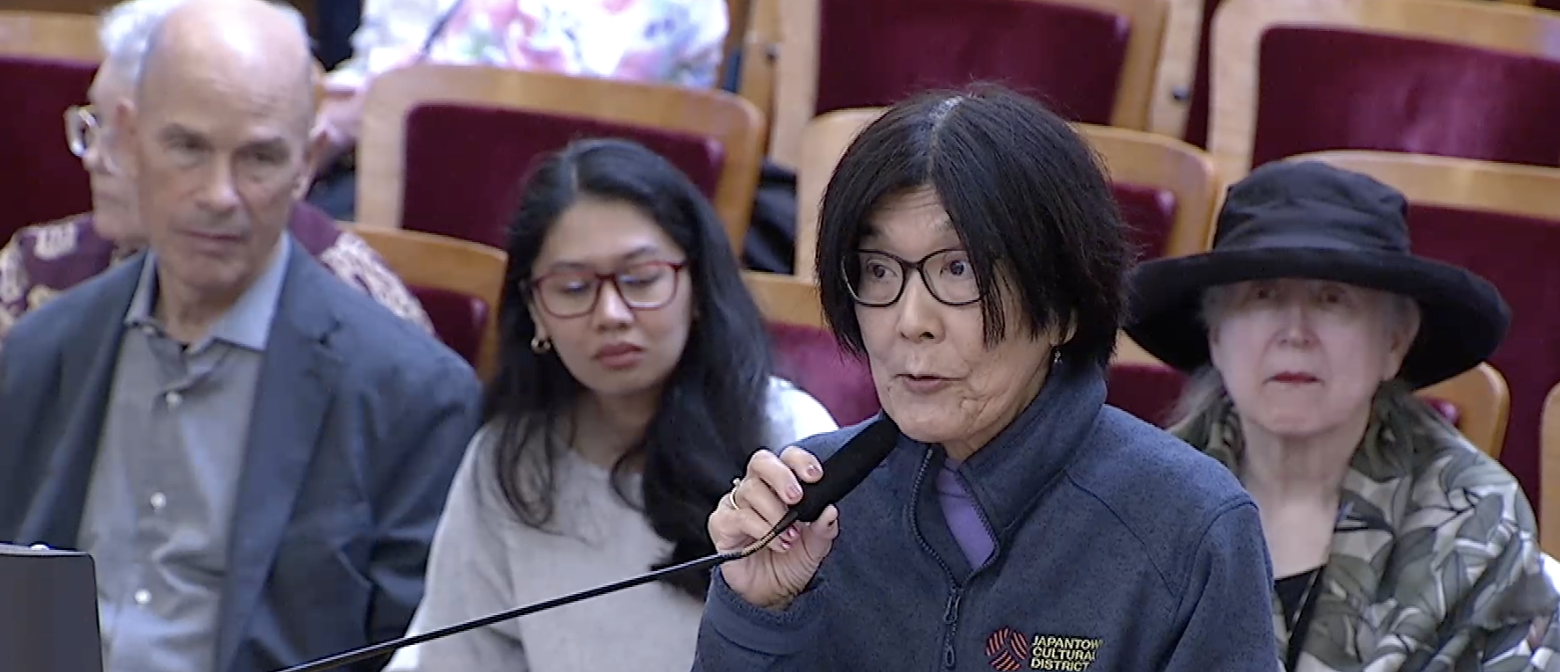
Lori Yamauchi of the Japantown Task Force recalled that during Moore's tenure, the Japantown Neighborhood Commercial District, Special Use District, and Design Guidelines were all approved. Dan Hoodap of the Port of San Francisco thanked Moore for approximately 20 years on the Waterfront Design Advisory Committee, listing contributions to Mission Rock, Pier 70, the Exploratorium, the Cruise Terminal, and the Ferry Terminal expansion. Katherine Petron of San Francisco Heritage highlighted Moore's unparalleled urban design expertise and mentorship of fellow commissioners.

Representatives from the Chinatown Community Development Center, Telegraph Hill Dwellers, Coalition for San Francisco Neighborhoods, Pacific Heights Residents Association, REAP SF, and the Ganis Corridor Neighborhoods Council also spoke. Marlene Moore of the Ganis Corridor Neighborhoods Council described working with Vice President Moore for 20 years on the CPMC hospital project, noting Moore walked their coalition of 25 organizations through changes that kept St. Luke's Hospital open and reduced the Van Ness hospital from 600 to 300 beds.

Sue Hester closed the public comment period by noting that drawing more than 20 voluntary speakers to a commission meeting demonstrates how meaningful these commissioners were, and urged the mayor and board president to fill seats quickly.

What's next: The mayor and board president must nominate replacements for all three board-appointed seats before September or the commission risks being unable to convene.


Neighbors Signal Legal Fight Over St. Ignatius Field Lights

The commission held a public hearing on the Draft Environmental Impact Report for the St. Ignatius Field Lighting Project at 2001 37th Ave. — a project with an unusual backstory. St. Ignatius installed four 90-foot light standards at J.B. Murphy Field after receiving a categorical CEQA exemption in 2020, but a California Court of Appeal reversed that determination in 2022, ruling a full EIR was required. The lights have been operating under a court-allowed limited schedule during environmental review.

The basics: The project proposes continued operation of the existing lights for up to 150 evenings per school year, with lights off by 9:30 p.m. on 135 evenings and by 10 p.m. on up to 15 evenings. Staff environmental coordinator Don Lewis presented the Draft EIR, which found all impacts less than significant with no mitigation required. Four alternatives were analyzed, including reduced-lighting options derived from prior Superior Court and Board of Supervisors actions.

Where things stand: Three members of the public spoke in opposition, each previewing what appears to be a coordinated technical challenge. Deborah Brown of the St. Ignatius Neighborhood Association announced that lighting and noise experts will submit detailed comments challenging the study's methodology. She said the lighting study "draws conclusions that are not based on evidence" and the noise study "incorrectly interprets the city noise ordinance."

Helmut Schmidt, a resident living across from the field for 20 years, testified that stadium lights shine into bedrooms even with blackout shades and the PA system can be heard inside closed homes. He emphasized that St. Ignatius is "not a neighborhood school" and the burden does not benefit the Sunset.

Kathryn Howard identified errors in the biological resources section, citing a 2023 Smithsonian study she said contradicts the EIR's claims about bird migration timing, and raised cumulative impact concerns from increasing nighttime lighting citywide, including at the Beach Chalet soccer fields and Crocker Amazon.

The other side: No supporters of the project spoke during the hearing.

Decisions: No vote was taken; the hearing was informational. The comment period is open until July 13, 2026.

Commissioners signaled sympathy with neighborhood concerns. Vice President Moore urged consideration of LED light health effects and questioned the scope of the lighting schedule, saying "the length of days throughout the year, this is almost half of the year that tariff is happening every night, seems to be excessive." Commissioner Williams called the 90-foot towers "excessive" and urged St. Ignatius to find a compromise with neighbors. Commissioner Braun encouraged the department to conduct a robust review of comments "to ensure that this is an airtight EIR document, especially relative to any potential standards and thresholds of significance for lighting and glare."

What's next: Written comments are due July 13, 2026. The neighborhood association's promised expert testimony could shape whether the final EIR survives legal challenge — a real prospect given the project's prior court reversal.


Pier 92 Sand Plant Upgrade Clears Environmental Review With No Major Flags

The Draft EIR for the Pier 92 Modernization and Plant Replacement Project at 480 Amador St. found no significant and unavoidable environmental impacts — a clean bill of health for a facility that has processed marine sand in the Bayview since 1982.

The basics: The 4.4-acre site receives sand by barge via Islais Creek Channel. The proposed modernization by Martin Marietta would install new processing equipment with enhanced environmental controls, including covered conveyors, a 63-foot warehouse to enclose stockpiles and truck loading areas, and paved surfaces to reduce fugitive dust. The facility footprint would expand to 5.2 acres under a new Port lease, with processing capacity of up to 800,000 tons of sand annually.

Why it matters: The Bayview has long borne a disproportionate share of San Francisco's industrial pollution. This modernization would add dust controls that do not currently exist at the site, potentially improving air quality for surrounding residents.

Where things stand: Staff environmental coordinator Jennifer McKellar presented the findings in her final presentation before leaving the Planning Department after 10 years of service. Only one member of the public spoke. Glenn Phillips, executive director of the Golden Gate Bird Alliance, voiced support, noting Martin Marietta has been an exceptional neighbor to the adjacent Pier 94 wetland restoration site and the upgraded conveyors and covers will reduce dust entering the ecologically sensitive area.

Commissioner Williams emphasized the importance of EIRs for protecting Bayview Hunters Point residents: "These environmental impact reports lay out the realities on the ground solutions to curb the impacts. But most of all, they protect the people of that community." Vice President Moore noted interest in Islais Creek as an important open space resource and sand as a non-renewable resource. Commissioner Braun found no issues with the analysis.

What's next: The public comment period closes July 6, 2026. A Responses to Comments document is expected later this year.


Bayview Native Plans Mixed-Use Infill on Vacant Third Street Lot

Commissioners offered warm feedback for a proposed three-unit mixed-use building at 5154 3rd St. in the Bayview, presented as an SB 423 informational item — a state streamlining process that bypasses discretionary review.

The basics: Architect Ashton Richards presented plans for a three-story building on a vacant 1,559-square-foot lot in the Bayview Neighborhood Commercial district. The project would include one ground-floor commercial space (434 square feet), one ground-floor studio (293 square feet), and two two-bedroom units above. The building reaches 31 feet at the front and 37 feet at a penthouse. The ground-floor commercial space is intentionally small-scale — designed, Richards said, to be within economic reach for a new business owner.

Why it matters: Property owner Demetrius Williams, a 55-year Bayview resident whose father owned Club Long Island on Third Street, expressed a vision to bring foot traffic back to the corridor and encourage more development. The project represents community-driven investment in a historically underserved neighborhood, though financing constraints forced a pivot from affordable to market-rate units.

Where things stand: Vice President Moore expressed support and understanding of the lending constraints. Commissioner Braun called it a "pretty modest infill project" that would activate the vacant lot and offered design suggestions about accommodating a neighbor's light well. Commissioner Williams expressed appreciation for the owner's commitment to his neighborhood.

President Campbell commended the voluntary inclusion of ground-floor retail, noting the owner was not obligated to include it: "I don't think you're obligated to put retail. I think you could have used that real estate to accommodate a car. And so I just want to extra appreciate the activation on the ground floor with the retail opportunity." Williams confirmed the retail would be affordable.

What's next: As an SB 423 project, the proposal follows a streamlined ministerial approval process. No vote was taken at this hearing.


Minor Items

  • 871 De Haro St. discretionary review (Item 9) continued to July 30, 2026. (Passed 4-0; Commissioners So, McGarry, and Imperial absent.)
  • 1601 Dolores St. conditional use authorization approved on consent, 4-0, with no public opposition.
  • Phase 2 integration of the Planning Department and the Department of Building Inspection takes effect July 1, merging finance, HR, communications, and compliance teams under Planning. Phase 1 occurred in March 2026.
  • The permit center will be closed for in-person service July 3 due to the Independence Day holiday.
  • The Planning Department announced a July 11 Day of Service in the Tenderloin community.
  • The Board of Supervisors passed a commendation of Vice President Moore.
Planning Commission Loses Three Community Champions in Historic Turnover | Planning Commission | Locunity