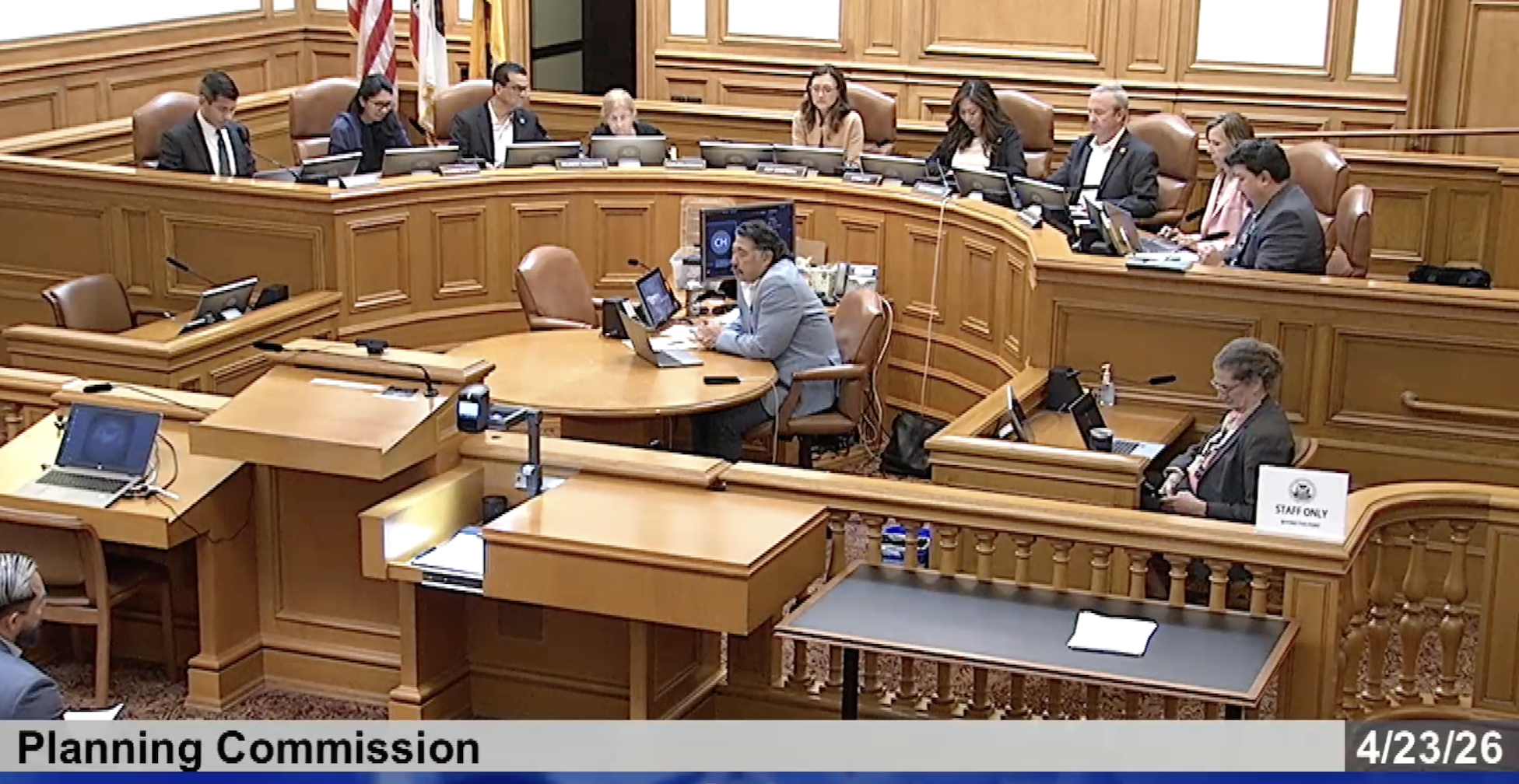
Planning Commission - Apr 23, 2026 - Meeting

Planning Commission - Apr 23, 2026 - Meeting

Planning CommissionSan FranciscoApril 23, 2026

Sources:

Locunity is a independent informational service and is not an official government page for this commission.We use AI-assisted analysis and human editorial review to publish information.

Database Fix Reveals 40,000 Missing Housing Units as Commission Greenlights Castro Bookstore-Bar

The San Francisco Planning Commission opened its April 23 meeting with a revelation: a deep audit of the city's land use database uncovered roughly 40,000 residential units that had never been counted. Commissioners then turned to the evening's only land use case, unanimously approving a romance bookstore with wine service in the Castro — complete with conditions negotiated by the neighborhood to protect nearby residents.

  • Planning Department discovers 40,000 previously uncounted housing units after cross-referencing assessor, COSTAR, and permitting data — but the correction won't count toward state RHNA targets

  • "Love Potion Library," a romance bookstore and tea room with wine service, approved 7-0 at 284 Noe Street with hour limits and noise protections brokered by the Dubose Triangle Neighborhood Association

  • Board of Supervisors advances 29 landmark designations across Districts 3 and 8 and amends SB 79 legislation to incorporate Planning Commission recommendations

  • Family zoning plan, design standards, and Ocean Beach Climate Change Adaptation EIR win APA awards; planner Lisa Chen earns Mid Career Planner recognition


The City's Housing Data Was Off by 40,000 Units

The basics: The Planning Department's data analysis group, led by a staffer named Reza, conducted a comprehensive audit of the city's land use database — cross-referencing the assessor's tax rolls, COSTAR commercial real estate data, Department of Building Inspection permitting records, and the department's own planning permits. The team supplemented the digital review with manual fieldwork, ultimately identifying approximately 40,000 residential units that had never been captured.

Why it matters: San Francisco's housing production dashboards and development pipeline tracker are key tools for policymakers, developers, and advocates tracking progress on housing goals. An undercount of this magnitude means prior analyses of citywide housing stock were working from incomplete data. The update also now counts home-based businesses and commercial land uses and synchronizes data across the department's public-facing dashboards to establish a single source of truth.

Where things stand: Commission President Amy Campbell described the effort as detective work spanning multiple agencies.

"Our staff has really been doing some yeoman's detective work, crossing other agencies' database and actually doing fieldwork," she said. "It addressed what was an undercount of roughly 40,000 residential units citywide that our database wasn't capturing."

She later elaborated on the methodology. The team examined the assessor's tax rolls, COSTAR data, DBI and planning permitting data, and cross-referenced those sources. They also did additional manual review.

Commissioner Derek Braun pressed on whether the department had any prior awareness of the gap.

"Was there awareness that we probably had an undercount of housing units just through comparison to census data or other sources?" he asked.

Campbell indicated she would follow up on whether the magnitude had been previously suspected.

Commissioner Sean McGarry asked whether the newly counted units would help with the city's Regional Housing Needs Allocation goals. Vice President Kathrin Moore indicated they would not — the units already exist and therefore do not count as new housing production toward RHNA targets.

Commissioner Theresa Imperial suggested the database and website updates be presented at a future commission meeting for public benefit.

"I'm wondering if that can be something presented in the commission in the future," she said. "It seems like the public may need to know about the updates on this."

What's next: The department has not announced a formal public presentation on the database corrections but commissioners expressed interest in one. The updated dashboards are live on the department's website.


A Romance Bookstore With Wine Service Wins Unanimous Approval

The basics: Love Potion Library is a romance bookstore and tea room proposed for 284 Noe Street in the Upper Market Neighborhood Commercial Transit district. The business would offer ancillary wine service under a Type 42 beer and wine license in a two-story building that previously housed a pet food store on the ground floor with a residential unit above. A conditional use authorization is required for the bar component.

Why it matters: The approval adds a creative retail concept to a Castro corridor with vacant storefronts, while the negotiated conditions — brokered between the Dubose Triangle Neighborhood Association, project sponsor Veena Patel, and planning staff — offer a potential template for approving hospitality uses near homes in mixed-use districts.

Where things stand: Senior Planner John Dacey presented the case, detailing the three conditions recommended by the DTNA:

"The conditions would limit the hours of alcohol service from 9 a.m. to 10 p.m. Sunday through Thursday and 9 a.m. to 11 p.m. on Fridays and Saturdays, not allow for alcohol consumption outside of the building, and limit access to the backyard to employees only."

Patel agreed to all three.

Vice President Kathrin Moore moved to approve, singling out Dacey's work with the neighborhood group:

"He took it over the goal line and found a common ground for what really meets all of the concerns that we as commissioners over the years have expressed about similar projects."

Commissioner Derek W. Braun brought a personal lens.

"As somebody who spent a very long time living above commercial uses in the Castro, I know how the noise can also be disruptive. And so it feels like this is a good assurance and balance for future potential business owners at this location."

Decisions: The motion passed 7-0 (For: Campbell, Moore, Braun, Imperial, McGarry, So, Williams; Against: none; Absent: none). No public comment was received.


Awards Season for the Planning Department

The department collected four honors from the American Planning Association's Northern California chapter and the Association of Environmental Planners. The family zoning plan won the APA's Planning Excellence award and an Award of Merit. The department's design standards received the Urban Design Award of Merit. The Ocean Beach Climate Change Adaptation EIR will receive an Award of Merit from the Association of Environmental Planners. Staff member Lisa Chen earned the APA's Mid Career Planner special recognition award.

Vice President Kathrin Moore also urged the department to create training videos for the newly updated website. Commission President Amy Campbell described successful in-person outreach at district workshops in Districts 2 and 4, where staff demonstrated the planning portal in real time.

"It's been really fascinating to be able to show people, oh, this is what you do. And they get it right away," she said.


Minor Items

  • 4620 Mission Street (Case 2025-010376CUA): Conditional use authorization approved 7-0 on consent with no discussion or public comment.

  • 394 Naples Street (Case 2024-008383CDUA): Application withdrawn by the applicant before the hearing.

  • Board of Supervisors updates: The Land Use and Transportation Committee initiated 15 landmark designations in District 3 identified through the family zoning plan and amended SB 79 legislation to incorporate Planning Commission recommendations before forwarding it with a positive recommendation. At the full board, 14 District 8 landmark designations passed second reading and the 1 Oak ordinance passed first reading.

Database Fix Reveals 40,000 Missing Housing Units as Commission Greenlights Castro Bookstore-Bar | Planning Commission | Locunity