
San Francisco Hits Pause on Data Centers With 45-Day Moratorium
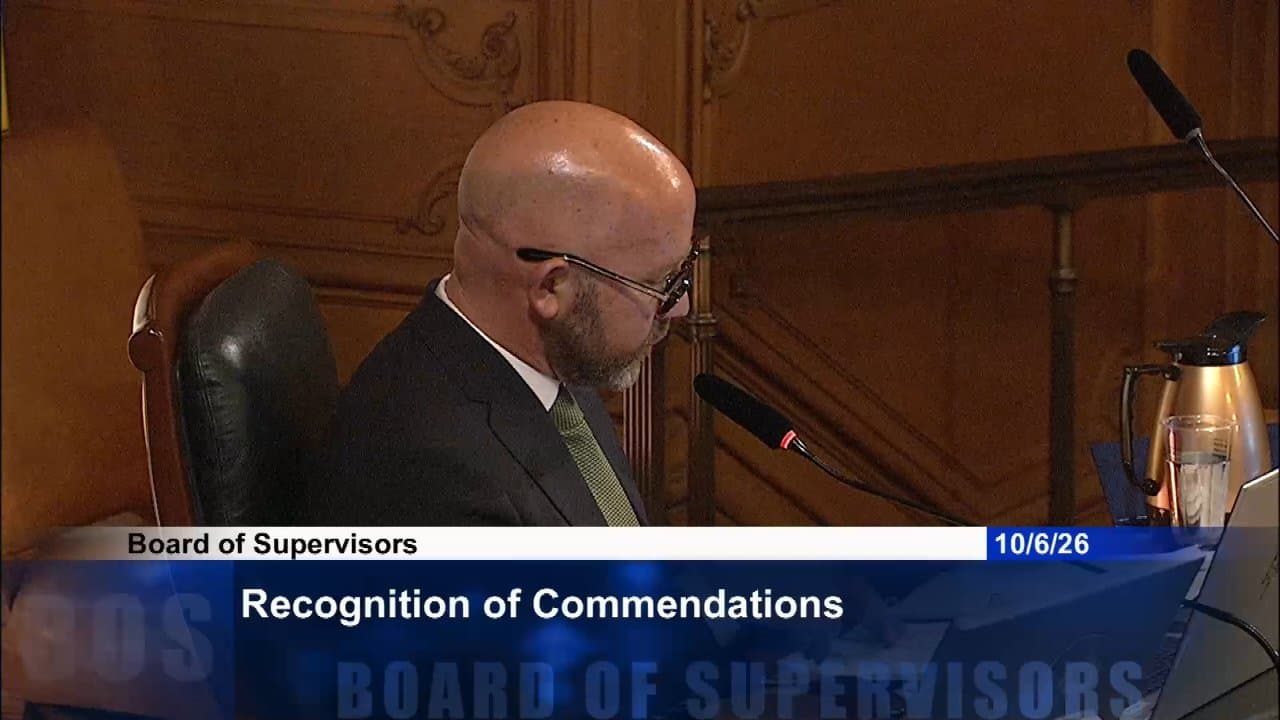
Board of Supervisors • San FranciscoOctober 6, 2026
Locunity is an independent informational service and is not an official government page for this commission. All information is sourced from public footage and an analysis of official agendas with the aid of responsible, fact-checked AI. to report an error or omission.
San Francisco has hit the brakes on data centers, the power- and water-hungry engines of the AI boom. On Oct. 6, 2026, supervisors voted 11-0 for an urgency ordinance that takes effect immediately, while a divided board also narrowed the window for environmental appeals and a raft of new bills set up fights over labor, code enforcement and recovery services.
1 big thing: Citywide data center moratorium passes 11-0 and takes effect immediately
CEQA appeal window cut from 30 to 15 days on a 10-1 vote, with Supervisor Connie Chan opposed
New bills target self-checkout staffing, repeat code violators and free meeting space for recovery groups
Six HIV advocates rally as the board recognizes Oct. 10 as National PrEP Day
Roughly $530M in SFPUC bonds and $110M in utility contracts clear without debate
45-Day Freeze on Data Centers Takes Effect
The basics: An interim zoning moratorium is a temporary ban, authorized under California Government Code Section 65858, that lets a city pause a land use while it writes permanent rules. Because it is an urgency measure, it needed 9 of 11 votes.
Why it matters: San Francisco has no specific long-term controls on data centers and no clear definition of one. The 45-day ban stops all city approvals now, before permanent rules exist.
Where things stand: Supervisor Shamann Walton, District 10, authored the ordinance with co-sponsors Supervisor Connie Chan, District 1, Supervisor Jackie Fielder, District 9, and Supervisor Chyanne Chen, District 11. The ordinance cites a current and immediate threat to public health, safety or welfare.
"The 45-day moratorium is an interim measure authorized under state law that gives the city time to study the impacts of data centers and develop updated long-term regulations," said Walton.
Walton said the study period will cover energy, water, air quality, land use and community impacts, and will produce a data center definition that everyone can understand. The Planning Department must report to the Clerk within 25 days on the steps it has taken. A hearing must follow no later than 35 days after enactment. The Land Use and Transportation Committee heard the item Oct. 5.
Decisions and stakeholder impacts: The ordinance passed on the same roll call as earlier items (For: 11, Against: 0) and took effect immediately. Any developer or operator seeking city approval for a data center is frozen out for now. Neighborhoods already flagged for air quality problems have the most at stake in the permanent rules.
During general public comment, Jazzy, a public commenter, praised the pause. She cited state air quality assessments under the Assembly Bill 617 Community Air Protection Program in Portola, Mission Bay, the Mission and Bayview-Hunters Point, and argued data centers should not be sited near people. Peter Warfield, head of the Library Users Association, urged a broader look at AI's risks to safety, privacy and democracy. Grace Reed, a UCSF epidemiology student, called in to support the moratorium. The clerk ruled she could not speak to the item because public comment had already been taken in committee.
What's next: Planning's 25-day report is the first test of whether the pause becomes permanent regulation.
Board Narrows CEQA Appeals Over One Dissent
The basics: The California Environmental Quality Act (CEQA) requires environmental review of projects. San Francisco's Administrative Code layers on local procedures beyond what the state requires.
Why it matters: Neighborhood groups have used local CEQA rules to challenge projects. This ordinance narrows both the time they have to appeal and the grounds they can cite.
Where things stand: The ordinance makes four changes:
Removes shadow analysis as a specific environmental impact category
Cuts the window to appeal CEQA determinations to the board from 30 days to 15
Drops local procedures for environmental documents that CEQA does not require
Implements recent state law changes on CEQA timing
Chan requested a roll call. No floor debate occurred.
The other side: Chan cast the only no vote of the meeting. She did not explain her vote on the floor.
Decisions and stakeholder impacts: The ordinance passed on first reading (For: 10, Against: 1, Chan). During the roll call, an unidentified voice said "no" just before the clerk recorded Supervisor Alan Wong, District 4, as voting aye. The clerk's announced tally of 10-1 stands, but official minutes should confirm it.
Developers gain speed and certainty. Residents and advocacy groups that file appeals now have half the time to act. Shadow impacts are no longer a stand-alone ground for challenge.
What's next: The ordinance still requires final passage.
New Bills Target Checkout Lanes, Code Violators
Why it matters: The day's introductions preview fights over automation and union jobs, accountability for builders and funding for recovery services. None has been voted on yet.
Self-checkout staffing: Board President Rafael Mandelman introduced a bill requiring covered stores to have a human attendant for every three self-checkout stations in operation. "The legislation does not ban self-checkout, and it only applies to grocery stores over 10,000 square feet and drugstores," said Mandelman.
Mandelman cited a 2023 Grabango analysis that put losses from theft and error, known as shrink, at 3.5% of sales at self-checkout versus 0.21% at staffed lanes. He also cited a 2026 ECR Retail Loss and University of Leicester study that found 22% higher losses in the first year after stores add self-checkout. The bill was developed with UFCW Local 5, the City Attorney's Office and the Office of Labor Standards. Early co-sponsors are Supervisor Stephen Sherrill, District 2, Chen, Walton and Fielder. Large grocers and drugstore chains face new staffing costs, and union clerks stand to gain.
Tougher list for repeat code violators: Supervisor Danny Sauter, District 3, would rename the Expanded Compliance Control Program as the Compliance Oversight Program. The program was created in 2021 after the Rodrigo Santos scandal and has listed seven people.
Sauter pointed to 524 Vallejo, where "some bad actors illegally converted a 4-unit building into a single-family home." He also cited a wall removal at Butter and Crumble.
The bill would:
Give Planning more discretion to count Planning Code violations
Formalize Planning staff at final inspections
Allow listing for egregious violations
Extend the lookback window from 18 months to 48 months
The Building Inspection Commission would still hear cases, with the Department of Building Inspection director deciding. Supervisor Myrna Melgar, District 7, and Sherrill are co-sponsors.
Free rooms for recovery groups: Supervisor Matt Dorsey, District 6, introduced the Sober Spaces Program. It would require Recreation and Park Department and Police Department community rooms to be available any day of the year at no cost to abstinence-based mutual help groups such as AA, NA and SMART Recovery. A new fund, administered by MOHCD, would issue grants to sober nonprofits like Castro Country Club and The Dry Dock.
"San Francisco is blessed with a large and incredibly vibrant recovery community, yet it remains one of our most underfunded constituencies," said Dorsey. He has seven co-sponsors.
HIV Advocates Pack Comment for PrEP Day
Why it matters: PrEP is a medication that prevents HIV. Six speakers, organized through the San Francisco AIDS Foundation and HIV Advocacy Network, used Item 35 to press the city to protect prevention funding.
Where things stand: Andy Stone, a public commenter, said he paid more than $1,000 a month for PrEP before he got a copay card. Terry Miller recalled losing friends to AIDS 30 years ago. William Dean called the resolution a signal to departments and the mayor that the city is moving toward zero new infections. Justice Duma tied it to reducing stigma and the city's Getting to Zero initiative.
"We must protect PrEP and PEP navigation, support innovations like long-acting injectable PrEP, and reach people where they are at," said Xander Briere, policy and education co-chair, HIV Advocacy Network. He highlighted inequities facing Black, brown, immigrant, trans and unhoused residents.
Adam Varoqua, a former PrEP counselor, added: "We need to continue funding PrEP services throughout our systems of care."
Decisions and stakeholder impacts: Speakers credited Mandelman, Dorsey and Chen as sponsors. Item 35 passed with Items 32 and 34 (For: 11, Against: 0), recognizing Oct. 10 as National PrEP Day. The resolution is symbolic. The advocates' real target is future budget decisions on navigation services.
Half a Billion in Utility Debt, No Debate
Why it matters: These obligations are backed by water, sewer and power ratepayers and will shape SFPUC finances for years.
Where things stand: The board authorized revenue bonds to prepay each utility's share of base rent at the SFPUC's 525 Golden Gate Ave. headquarters:
About $492.8M for water
$24.5M for wastewater
$12.6M for power
The bonds needed a two-thirds vote and passed on first reading, 11-0.
The board also approved:
Four $20M, five-year as-needed Hetch Hetchy asset management contracts with Stantec, AECOM, Jacobs and Lee Inc.
A $30M, 10-year Deloitte power capital program management contract with a five-year option
An increase to Polydyne's wastewater polymer contract to about $12M
A no-cost Caltrans maintenance agreement for pump station security upgrades
Decisions and stakeholder impacts: All passed 11-0 without discussion. Consultants gain multiyear work. Ratepayers carry the debt.
Commendations Double as Political Statements
The board's commendations ceremony, which honored Latino Heritage Month leaders and others, turned pointed. Recognizing CAIR-SF Bay Area's 32nd anniversary, Supervisor Bilal Mahmood, District 5, responded to Florida's move to place the group on a watch list. "One, Ron DeSantis can go screw himself. And then second, as the first Muslim member of the San Francisco Board of Supervisors, I know firsthand the work CAIR does," said Mahmood.
Zahra Billu, executive director, CAIR San Francisco Bay Area, cited Pew data: "Anti-Muslim sentiment is worse today than it was in the months immediately following the 9/11 attacks."
A co-founder of the San Francisco Lowrider Council, honored for its 45th anniversary, recounted 113 arrests over cruising and closed with a request: "So today we're asking you to hold AI accountable."
Other honorees included former supervisor, treasurer and SFPUC General Manager Susan Leal; CARECEN; and SFPD Lts. Alan Levy and Daniel Dadette, recognized for solving the 1978 Marissa Harvey cold case.
Pension board disclosure: Mandelman sent back to committee, without objection, an ordinance eliminating disclosure rules for Retirement, Health Service and Retiree Healthcare Trust Fund board elections. He cited talks with Protect Our Benefits. Dorsey seconded.
Census: Chen amended a resolution opposing proposed 2030 Census changes that would exclude non-citizens, warning of lost federal funding. Walton seconded, and the amended resolution was adopted without objection.
Airport and health money: The board approved a $7.1M rent abatement for United Airlines, about $2.4M in HRSA HIV grant funds, a roughly $475,000 security grant and a 555 Polk St. lease at $202,000 a year.
Green building and landmarks: Stronger green building rules for city buildings passed 11-0. The Compton's Cafeteria landmark expanded to the full 101-121 Taylor St. building on first reading.
Rent control clash: In public comment, Business and Housing Network President Mina Young urged rejection of File 260962, and a tenant backer defended rent stabilization.
Looking ahead: Planning's data center report is due within 25 days, with a hearing within 35 days of enactment. The CEQA ordinance, SFPUC bonds and Compton's landmark still need final passage. The board adjourned in memory of Retirement Board President Leona Bridges.