
Fielder Seeks $1.765M for Immigrant Legal Defense, With Mayor's Backing
Board of Supervisors • San FranciscoOctober 20, 2026
Locunity is an independent informational service and is not an official government page for this commission. All information is sourced from public footage and an analysis of official agendas with the aid of responsible, fact-checked AI. to report an error or omission.
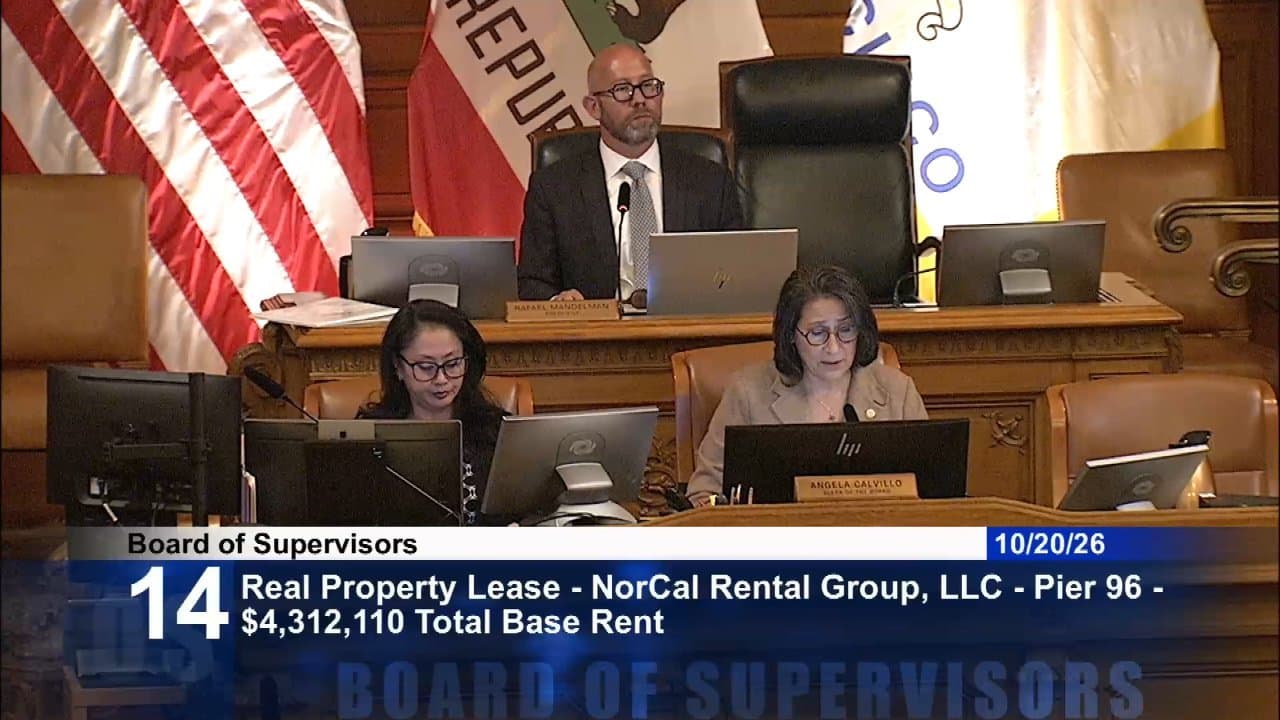
San Francisco's Board of Supervisors took up immigrant legal defense Oct. 20. Supervisor Jackie Fielder, District 9, introduced a $1.765 million supplemental appropriation for rapid response and habeas legal services. Mayor Daniel Lurie endorsed it from the dais, and public commenters said it still isn't enough. The board also gave final passage to a CEQA streamlining ordinance on an 8-1 vote and saw introduction of Freedom West 2.0, a proposal for nearly 2,400 homes in the Fillmore.
$1.765M immigrant legal services appropriation introduced, with mayoral support and a waived 30-day wait
CEQA streamlining finally passes 8-1: shadow analysis dropped, appeal window cut to 15 days
Freedom West 2.0 introduced: nearly 2,400 homes to replace a Western Addition co-op
Six union contracts extended through June 2031 with a layoff moratorium, on first reading
Rental fee disclosure and eviction limits advance as evictions near 4,000 this year
Immigrant Legal Defense Money Moves Fast
The basics: A supplemental appropriation adds money to the current budget outside the annual cycle. Habeas petitions are court filings that challenge whether a person's detention is lawful.
Why it matters: The $1.765 million would fund rapid response and habeas legal services. Fielder pointed to reported ICE detentions in SoMa and to detained people being denied access to lawyers.
Where things stand: Fielder introduced the ordinance during new business, named her co-sponsors and described the city's response infrastructure.
"The Rapid Response Network is on call 24/7 to verify and respond to ICE activity in our streets," said Jackie Fielder, Supervisor, District 9.
She thanked Supervisor Matt Dorsey, District 6, who chairs the budget committee, and Board President Rafael Mandelman for waiving the standard 30-day wait. That procedural step lets the item move faster than usual. Lurie opened his 2 p.m. appearance by condemning federal immigration enforcement and signaled he will not block the spending.
The other side: The pushback came from people asking for more, not less. Public commenter Leah McGeever supported funding for the Pro Bono Bay Area Habeas Network and urged wealthy donors to match the city's contribution. Public commenter Richard S.D. Peterson said residents threatened by ICE face a 40-month backlog for legal representation.
Decisions and stakeholder impacts: No vote was taken. Immigrant residents, legal aid nonprofits and the Rapid Response Network stand to benefit. A mayor who supports the item and a board that waived the wait both point toward a quick path. The 40-month backlog figure suggests $1.765 million addresses only part of the demand.
What's next: The appropriation returns for committee and board action in coming weeks.
Freedom West and the Housing Permitting Push
Why it matters: Several introductions on Oct. 20 share one goal: getting housing and neighborhood retail through City Hall faster.
Where things stand: Freedom West 2.0, the largest of them, comes from Mayor Daniel Lurie through a development agreement and a special use district. It would rebuild Freedom West, a 382-home, Black-owned limited-equity co-op in the Western Addition. Supervisor Bilal Mahmood, District 5, a co-sponsor, said the co-op cannot use traditional affordable housing financing.
"The project includes nearly 2,400 homes, including replacement units for existing Freedom West resident shareholders, 133 additional affordable homes, and 1,885 market-rate units," said Bilal Mahmood, Supervisor, District 5.
The package includes:
- A 115-unit senior building already underway
- Retail space
- A hotel that requires a conditional use permit
- Green space on the Octavia right-of-way
- A STEM Innovation Center
The development agreement requires affordable housing, infrastructure and prevailing wages. The special use district sets new height and design rules. The project ranks among the largest housing proposals in District 5.
Grocery rules: Mahmood also introduced legislation to ease formula retail rules for grocers and pharmacies. Under current law, chains with more than 11 locations worldwide face extra review.
"That additional review can add 6 to 9 months to the permitting process," Mahmood said.
The bill would let these businesses take over existing formula retail storefronts or change operators without a new conditional use authorization. It would also allow accessory uses such as banks and pharmacies. Grocers could use up to 49% of their space for accessory restaurants under a single approval. Supervisor Myrna Melgar, District 7, and Supervisor Stephen Sherrill, District 2, are early co-sponsors, and the bill builds on Melgar's earlier legislation.
Office-to-housing: Supervisor Danny Sauter, District 3, asked the City Attorney to draft legislation expanding the adaptive reuse program. The program helps convert empty commercial buildings into homes. Four projects at 2300 Stockton, 575 Sutter, 901 Market and 150 Hayes are creating nearly 500 homes and saving 6 to 12 months of project time.
"In short, the program works, but it is limited today by the initial guidelines and boundaries that were developed in 2023," said Danny Sauter, Supervisor, District 3.
His request would extend the program's boundaries into Districts 3, 6, 2 and 5, including SoMa and Van Ness Avenue, and add local incentives.
Decisions and stakeholder impacts: No votes yet. Freedom West shareholders, building trades and District 5 renters have the most at stake in the development agreement. Grocery chains, pharmacies and commercial property owners would gain under the permitting changes.
What's next: The Planning Commission is expected to take up a general plan amendment for Freedom West later this year.
CEQA Streamlining Clears Final Vote, 8-1
The basics: CEQA, the California Environmental Quality Act, requires environmental review of projects. Local rules govern how San Francisco carries out that review and handles appeals.
Why it matters: The ordinance removes shadow analysis as an environmental impact. It also cuts the window to appeal CEQA determinations to the board from 30 days to 15. Both changes may speed housing and other projects.
Where things stand: The Administrative Code amendment simplifies local CEQA procedures and removes steps that state law does not require. It also implements state changes on timing. The ordinance passed without debate.
The other side: Supervisor Connie Chan, District 1, cast the lone no vote. She did not explain it on the record.
Decisions and stakeholder impacts: For: 8 (Mahmood, Mandelman, Sauter, Sherrill, Walton, Wong, Dorsey, Fielder). Against: 1 (Chan). Absent: 2 (Chen, Melgar). Developers and housing advocates gain a shorter, more predictable review. Neighbors who have used shadow impacts or appeals to challenge projects lose time and one line of argument.
Tenant Protections and Union Deals Advance
Why it matters: Two packages that passed on first reading affect renters and the city's workforce costs for years.
Where things stand: Items 17-20 passed without objection. The tenant measures would require landlords to disclose total monthly rental costs and let tenants exit leases over undisclosed fees. They would also bar evictions for unpaid rent below HUD fair market rent. Companion ordinances lower minimum ceiling heights in existing buildings to 7 feet for habitable rooms and 6 feet for other rooms, and change the mezzanine threshold.
Gail Gilman, executive director of the Eviction Defense Collaborative, used her commendation remarks to press the board for more. She said evictions will reach 4,000 this year, the highest in over a decade.
On labor, the board advanced six memorandum of understanding (MOU) amendments from the Government Audit and Oversight Committee, covering:
- IFPTE Local 21
- Municipal Executives Association
- SEIU Local 1021
- DA Investigators Association
- Laborers Local 261
- Plumbers Local 38
The deals extend contracts through June 2031, set base wage increases and bar permanent civil service layoffs through June 30, 2029. Item 24 was amended to strike a sentence on a labor-management committee.
Decisions and stakeholder impacts: Renters gain clearer pricing and a floor against small-dollar evictions. Landlords face new disclosure duties. Thousands of city workers get wage and job security, while the city locks in labor costs.
What's next: Both packages return for second reading.
Mayor's Public Safety Scorecard
Where things stand: Lurie used his special order appearance to lay out his administration's enforcement-plus-treatment approach.
"Fatal overdoses are down almost 40% since 2023, and unsheltered homelessness is at a 15-year low," said Daniel Lurie, Mayor.
He cited:
- More than 6,000 arrests by the Drug Market Agency Coordination Center
- 17,000 people in treatment
- More than 200 new treatment beds since January 2025
He acknowledged that patients often do not stay on their medication. He also said SFPD is adopting trauma-informed sexual assault investigation reforms. He credited Melgar and the Commission on the Status of Women for a joint hearing on the issue.
The other side: McGeever criticized SFPD and the District Attorney on both drug enforcement and sexual assault investigations.
Traffic: Mandelman called his fifth hearing on traffic enforcement. Citations fell from 129,597 in 2014 to 4,006 in 2022 and are up 41% in 2026.
"SFPD issued 20,393 citations in 2025, and we are on pace for a stronger 2026," said Rafael Mandelman, Board President.
Speeding citations remain flat at 1,160 in the first half of the year, compared with 1,138, even as pedestrian deaths rise. Mandelman credited Walk SF and the SF Bicycle Coalition for their advocacy.
What's next: The Land Use and Transportation Committee will hear an update on SFPD enforcement and SFMTA's speed camera program on Nov. 16.
Minor Items
SFPUC headquarters bonds: Finally passed, authorizing about $530M to prepay lease financing for 525 Golden Gate Ave.
Items 6-16 approved: These include a $25.5M SFO shuttle contract increase, a $14.2M behavioral health grant and $658,000 for election costs.
Hardware retailer tax credit: Passed first reading 9-0; the credit covers tax years 2026 through 2035, retroactive to Jan. 1, 2026.
Cesar Chavez Street renaming: Fielder introduced a resolution to rename it Las Campesinas Street, honoring women farmworkers.
Stop AI: Public commenters Guido Reichsteiner and Wind Kaufman urged the board to declare an AI emergency.
Looking Ahead
Watch for committee hearings on the immigrant legal services appropriation and second readings of the tenant and labor packages. The board adjourned in memory of retired Deputy Chief Ann Mannix and her daughter, Katie, among others.