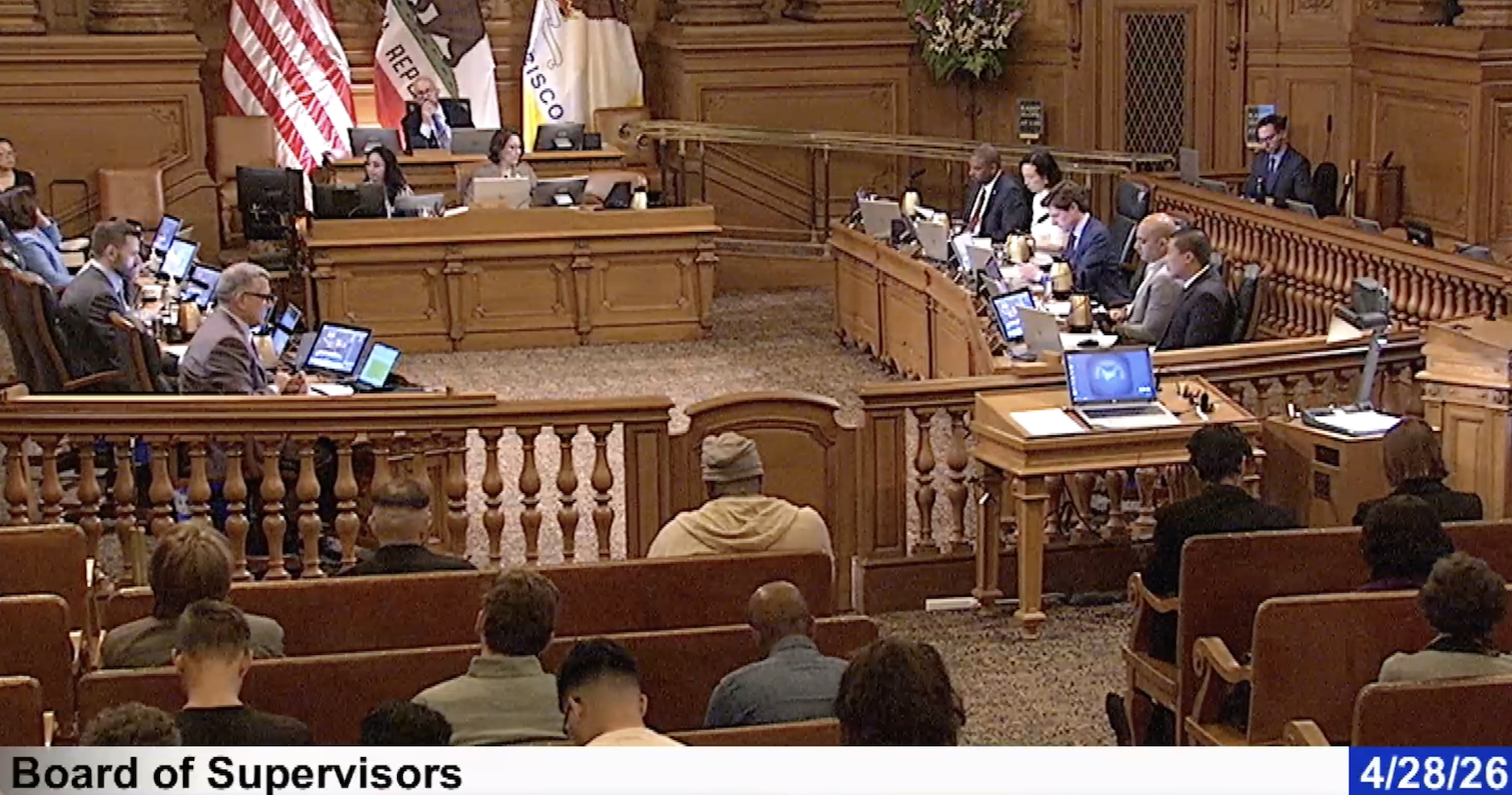
Board of Supervisors - Apr 28, 2026 - Regular Meeting

Board of Supervisors - Apr 28, 2026 - Regular Meeting

Board of SupervisorsSan FranciscoApril 28, 2026

Sources:

Locunity is a independent informational service and is not an official government page for this commission.We use AI-assisted analysis and human editorial review to publish information.

Board Advances SB 79 Alternative Plan After Last-Minute State Compliance Fix

The San Francisco Board of Supervisors spent much of its April 28 meeting navigating the tension between local land use control and state housing mandates, unanimously passing an amended ordinance that shields every parcel in the city from SB 79's transit-oriented upzoning requirements — but only after a surprise amendment exposed how much the plan's final shape still depends on the state. The board also approved the Sheriff's first-responder drone over a lone civil rights dissent, accepted a $6.25 million federal police hiring grant with sanctuary protections intact, and introduced new legislation to expand paid family leave and landmark the Compton's Cafeteria building.

  • SF's SB 79 alternative plan passes unanimously after Dorsey amendment lets Planning adjust exemptions based on state guidance

  • Sheriff wins drone and pepper spray approval 9-1; Walton casts lone no vote over civil rights concerns

  • $6.25M federal grant for 50 new police officers accepted after City Attorney David Chiu confirms sanctuary city law is protected

  • Paid family leave expansion introduced, cutting eligibility from 180 to 90 days as part of new "Stroller Act"

  • Compton's Cafeteria building eyed for full landmark designation, targeting GEO Group's federal transitional facility

  • Landmark process launched for Transamerica Pyramid, Vesuvio Cafe and 10 other historic properties


SB 79 Alternative: A Last-Minute Fix Exposes Ongoing State Friction

The meeting's most consequential and debated action was the ordinance creating San Francisco's alternative compliance plan for SB 79, the state law requiring residential upzoning near transit stops. The alternative plan — which, if accepted by the California Department of Housing and Community Development, shields every parcel in the city from state-imposed zoning changes through 2031 — passed 10-0 on first reading. But it nearly didn't go so smoothly.

Why it matters: SB 79 is one of Sacramento's most aggressive tools for forcing housing production near transit. San Francisco's alternative plan is a bet that the city can satisfy state requirements on its own terms, preserving local control over zoning while still meeting housing goals. The stakes: if HCD rejects the plan, state upzoning rules kick in automatically.

Where things stand: Supervisor Matt Dorsey (District 6), who had intended to vote no on the ordinance, reversed course after learning that HCD is actively questioning whether the city can permanently exempt parcels in his district — particularly industrial employment hubs in SOMA — where housing is already allowed under existing zoning. Dorsey proposed an amendment, drafted by Planning staff and deemed non-substantive by City Attorney David Chiu, that would authorize the Planning Director to administratively remove parcels from the exemption tables if HCD deems them ineligible — without returning to the Board for approval.

"I have had reservations about this legislation in my time on this board. I've been consistent in my stance on housing policy and that I think we need to do everything we can to eliminate barriers to housing production," said Dorsey.

Planning staff explained that the state is still interpreting SB 79 in real time. Joshua Switzki, of the San Francisco Planning Department, told the board that HCD's guidance is evolving, requiring flexibility in the city's approach. Lisa Gluckstein, also of Planning, elaborated on the distinction between permanent and temporary exemptions and the administrative mechanism the amendment would create.

Supervisor Bilal Mahmood (District 5) supported the amendment, saying he wanted to encourage "more frank conversations about the future of these zones" — particularly SOMA's mixed-use industrial areas where housing and employment uses coexist uneasily.

The other side: Supervisor Connie Chan (District 1) voted against the amendment — the only no.

"The state government has been overreached in the way that dictating our local government having planning and zoning issues and our zoning policies," she argued.

Chan nonetheless voted yes on the final ordinance.

Supervisor Myrna Melgar (District 7), who chairs the Land Use Committee, supported the amendment but did not hide her frustration with the timeline:

"I don't think there's any hurry here. I think we could have waited a week or two to get clarity from HCD."

Decisions: The Dorsey amendment passed 9-1 (For: Sherrill, Sauter, Wong, Mahmood, Dorsey, Melgar, Mandelman, Walton, Chen; Against: Chan, Absent: Fielder). The amended ordinance then passed 10-0 on first reading (Fielder absent).

What's next: The ordinance requires a second reading. Meanwhile, the plan's final scope remains fluid — HCD is still reviewing which parcels qualify for permanent exemptions, and the new amendment gives Planning authority to make adjustments without returning to the board.


Sheriff Wins Drone Approval Over Walton's Civil Rights Objection

The board voted 9-1 to accept the Sheriff's annual military equipment use report and authorize two new pieces of equipment: a Drone for First Responder (DFR) unit to be deployed at the San Bruno jail facility, and an OC pepper spray "tear ball" grenade.

Why it matters: The vote is the latest test of San Francisco's tolerance for expanding law enforcement surveillance technology — a debate that has intensified since the board's contested 2022 vote on police access to private cameras.

Where things stand: Sheriff Paul Miyamoto explained that the drone is designed for monitoring incarcerated individuals in outdoor areas and searching for medical walkaways at the San Bruno facility. It carries no facial recognition capability and is intended as an observation platform that also supplements staffing shortages. The tear ball grenade delivers OC pepper spray — not CS or CN gas — as a safer crowd-control alternative, adopted after a past training incident in which gas drifted into a nearby school.

Supervisor Shamann Walton (District 10) pressed the Sheriff on whether drone technology can ever fully protect civil rights.

"I don't think there is any way possible to protect everyone's civil rights with drone technology," Walton said.

He casted the sole no vote and signaling his opposition extends to SFPD's drone program as well.

Decisions: Adopted 9-1 (For: Chan, Sherrill, Sauter, Wong, Mahmood, Dorsey, Melgar, Mandelman, Chen; Against: Walton; Absent: Fielder).


$6.25M Federal Grant for 50 Officers Clears Sanctuary City Test

The board advanced an ordinance authorizing SFPD to accept and expend a $6.25 million COPS Hiring Program grant from the U.S. Department of Justice, funding 50 new police officer positions through approximately September 2030.

Why it matters: Federal grants to local police departments have become a flashpoint in the national sanctuary city debate. DOJ conditions on some grants have historically required cooperation with federal immigration enforcement — conditions San Francisco has resisted in court.

Where things stand: Supervisor Connie Chan sought explicit confirmation on the record that accepting the grant would not compromise the city's sanctuary city law. Deputy City Attorney Brad Russi confirmed that the city has prevailed so far in litigation challenging DOJ conditions, and that a preliminary injunction currently prevents compliance with the contested requirements.

Decisions: Passed on first reading without objection (For: 10, Absent: 1 — Fielder).


Compton's Cafeteria Landmark, Paid Family Leave and Downtown CBD Top New Legislation

Supervisors used the roll call for new business to introduce several major pieces of legislation that will shape upcoming policy debates.

Compton's Cafeteria: Supervisor Bilal Mahmood introduced legislation to landmark the entire building at 101-121 Taylor Street — the site of the historic 1966 Compton's Cafeteria uprising, a foundational moment in the transgender rights movement. The building currently houses a GEO Group transitional facility operating under federal and ICE contracts.

"GEO Group is operating this building in a way that is at odds with the spirit of freedom of civil rights that embodies the events that took place there 60 years ago," Mahmood said.

The legislation was developed in partnership with the Turk and Taylor Initiative, the Compton Coalition, and the Transgender District.

Paid Family Leave Expansion: Supervisor Danny Sauter (District 3) introduced legislation to reduce the employment threshold for paid family leave eligibility from 180 to 90 days — part of a broader initiative he calls the "Stroller Act."

"This effort, supporting tomorrow's residents with opportunity, livability, learning, education and resources, will include multiple initiatives to shape San Francisco to become more friendly, accessible and affordable to those raising young families," Sauter said.

Supervisor Matt Dorsey echoed the sentiment, noting he became a father a year ago:

"Raising a young child in San Francisco isn't easy and I say that as someone with means and privilege."

Downtown CBD Renewal: Sauter also introduced legislation to allow the Downtown Community Benefit District (Downtown SF Partnership) to renew and expand from 43 to 70 blocks with a 10-year term running January 2027 through December 2036.

What's next: All three items will move through committee before returning to the full board.


Transamerica Pyramid, Vesuvio Cafe Among 12 Sites Starting Landmark Process

The board adopted resolutions initiating landmark designation for 12 properties, predominantly in District 3. Notable sites include the Transamerica Pyramid (600 Montgomery), Vesuvio Cafe (253 Columbus), California Masonic Memorial Temple (1111 California), Pinocchio's (500 Broadway), and the Maybeck Building (1736 Stockton).

Supervisor Danny Sauter asked to re-refer Item 29 — the Great China Theater at 626 Jackson Street — back to the Land Use Committee for additional work. The remaining 12 resolutions were adopted.

What's next: Landmark initiation starts a formal historic preservation review that could ultimately restrict future alterations to some of the city's most iconic buildings.


Sam Dodge Honored for 12 Years of Homelessness Innovation

The 2:30 p.m. special order featured commendations from five supervisors, with the most extensive tribute honoring Sam Dodge for 12 years of service to the city. Supervisor Shamann Walton credited Dodge with creating navigation centers, the PIT Stop program, the Healthy Streets Operations Center, DMACC and the HART team — programs that have become central to San Francisco's homelessness response infrastructure.

In an emotional farewell, Dodge redirected the recognition to the city workers he served alongside:

"Every corner of this city government, I found talented, dedicated, and deeply committed people. People who showed up every day in conditions that were often difficult, sometimes dangerous, or even deadly, and almost always thankless."

He urged the city to stay grounded in its approach:

"The people we serve are not problems to be managed. They are neighbors who know the solutions. They are people in the middle of a story. And we get the privilege of being part of how that turns out."

Other honorees included Susan Gage for volunteer work in Russian Hill; the Lowell High School girls varsity soccer team for their historic CIF Division 5 state championship — the first women's high school soccer state title in California history; Mika Kie Weissbuch, co-director of the SF Disability Cultural Center, for Autism Acceptance Month; and Val Caniparoli for 53 seasons with the San Francisco Ballet.

Supervisor Myrna Melgar used the Lowell recognition to make a broader point:

"We have had countless recognitions of boys teams that have done championships, but it is very seldom that we recognize women's sports and we need to do more of it."


Minor Items

  • Police and firefighter union contracts: Three MOUs with SFPOA and IAFF Local 798 (Units 1 and 2), effective July 1, 2026, through June 30, 2030, passed on first reading.

  • ~$37.5M in HUD funds authorized: Board approved four resolutions for FY 26-27 federal entitlements — CDBG ($21.5M), HOME ($6.6M), ESG ($1.7M) and HOPWA ($7.7M).

  • SFPUC Green Infrastructure Grant Program delegation extended five years through July 1, 2031.

  • One Oak Street zoning map amendment increasing podium height from 120 to 140 feet finally passed.

  • Glen Park and Upper Fillmore designated as entertainment zones.

  • Pacific Islander Cultural District established in Visitacion Valley and Sunnydale.

  • Curbside EV charging program approved 9-0 (Walton absent), creating an SFMTA permit program for private operators to install chargers on public sidewalks.

  • AB 2276 support: Board backed a state bill piloting intelligent speed assistance devices for severe speeding offenders (10-0).

  • Chinatown Public Health Center lease at 845 Jackson Street extended and expanded, adding $500K for construction improvements.

  • Sheriff's Office performance audit ordered through the Budget and Legislative Analyst.

  • Appointments: John Ma to the Sugary Drinks Distributor Tax Advisory Committee; Timothy Rayouf and Linda Fadiki Richardson reappointed to the Treasure Island Development Authority Board.

  • Closed session: Board met with City Attorney David Chiu on pending litigation; voted not to disclose deliberations (10-0).

  • Star Wars Day declared for May 4, 2026, introduced by Supervisor Mahmood.

  • In memoriam: Meeting adjourned in memory of Dwayne Gaines Sr. and Michael Tilson Thomas, whom Board President Rafael Mandelman recognized as "one of the first openly gay musical conductors of a major orchestra."

Board Advances SB 79 Alternative Plan After Last-Minute State Compliance Fix | Board of Supervisors | Locunity