
Supervisors Finalize Union Deals to 2031 and New Renter Protections
Board of Supervisors • San FranciscoOctober 27, 2026
Locunity is an independent informational service and is not an official government page for this commission. All information is sourced from public footage and an analysis of official agendas with the aid of responsible, fact-checked AI. to report an error or omission.
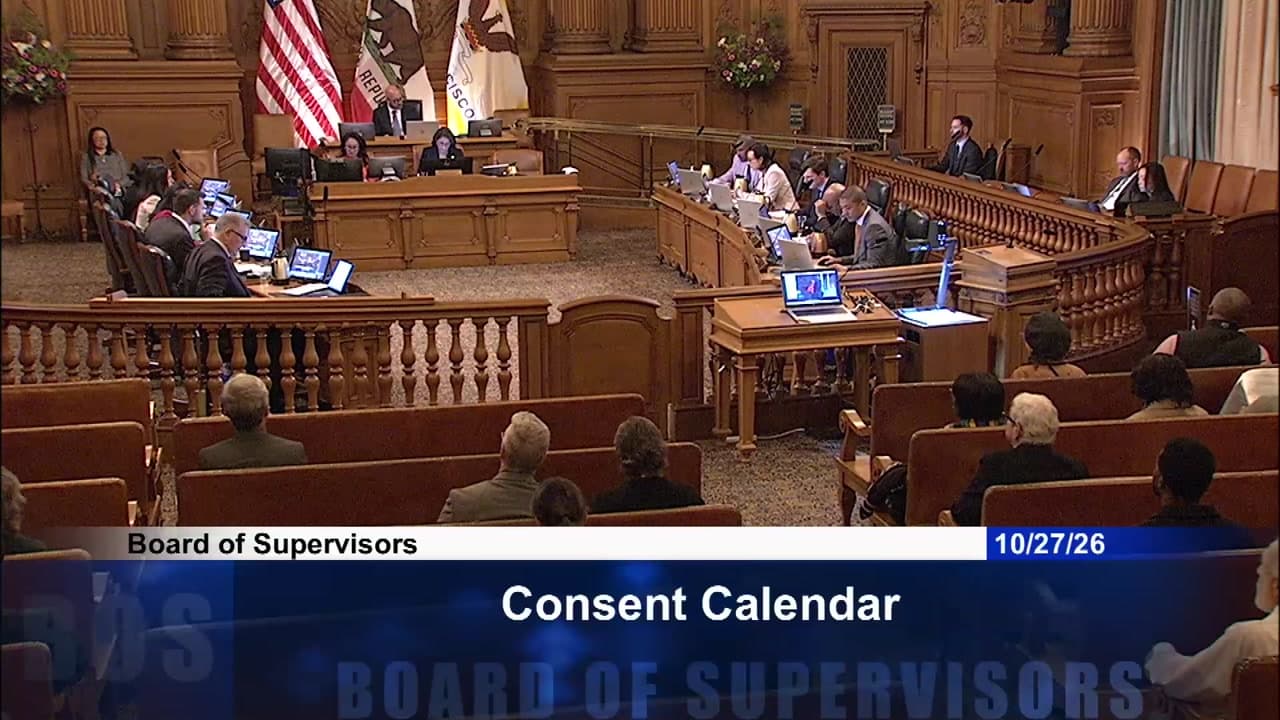
San Francisco's Board of Supervisors on Oct. 27, 2026, gave final passage to six union contract extensions running through June 30, 2031, along with new rules requiring landlords to disclose the full monthly cost of a rental. Both packages cleared without objection or debate, and the board voted 11-0 to concur in the mayor's El Niño storm emergency. New legislation introduced during the meeting previews coming fights over data centers, the commercial vacancy tax and pension risk.
- Six union contracts extended to June 30, 2031, with a no-layoff pledge through June 2029
- Renters gain fee-disclosure rights and an eviction floor tied to HUD fair market rent
- Unanimous 11-0 vote backs El Niño emergency, unlocking fast-track storm procurement
- Walton seeks a 10-month data center moratorium extension, citing grid and water strain
- Mandelman moves to end vacancy tax filings for tenants of occupied storefronts
Labor Peace and Renter Rules Cross the Finish Line
Why it matters: The six contract extensions shape city labor costs and job security for years. The housing ordinances change what landlords must tell tenants before they sign.
Where things stand: Items 17-22 amend the city's 2024-2027 memoranda of understanding (MOUs) with six bargaining units:
- IFPTE Local 21
- Municipal Executives Association
- SEIU Local 1021
- DA Investigators Association
- Laborers Local 261
- Plumbers Local 38
The amendments extend the terms to June 30, 2031, and set wage increases for fiscal years 2027-28 through 2030-31. They also bar layoffs of permanent civil service employees through June 30, 2029. Items 18-22 additionally allow a citywide labor-management committee. The artifact does not include dollar figures for the wage increases.
The housing package:
- Item 24: Listings and leases must disclose the total monthly cost. Tenants may terminate early if disclosures are inadequate, and evictions or late penalties tied to undisclosed fees are restricted.
- Item 26: Bars eviction for unpaid rent below the U.S. Department of Housing and Urban Development's fair market rent standard.
- Items 23 and 25: Lower the minimum ceiling height for habitable rooms in existing buildings to 7 feet and revise the mezzanine threshold.
The other side: No supervisor spoke against either package. During general public comment, public commenter Jessica Pesico thanked the board for the eviction rule, which she described as one month of rent forgiveness. She said job searches can take three months and asked for more time and for rental assistance. Francesca, a Tenderloin resident, raised a related tenant concern. She described a 46-day elevator outage and asked the board to examine enforcement when essential building equipment fails repeatedly.
Decisions and stakeholder impacts: Every item in the unfinished business block, items 15-29, passed by voice on the same roll call as an earlier vote, without objection. No separate tallies were announced. The block also included:
- A hardware retailer tax credit
- An election appropriation
- A property-filing notification ordinance
- Two surveillance technology policies, covering Department of Elections security cameras and Fire Department social media monitoring software
The six unions gain multiyear wage certainty and layoff protection, while the city locks in labor costs into the next decade. Renters gain transparency and a shield against eviction over small balances. Landlords take on new disclosure duties.
What's next: These ordinances received final passage. The artifact notes no further board action.
Board Backs Storm Emergency, Waives Normal Contracting Rules
Why it matters: By concurring in the emergency, the board lets departments buy goods and services quickly, ahead of anticipated El Niño storms.
The basics: An imperative agenda item is one that arises after the agenda is posted. To take it up, the board must first find that action cannot wait, a step required under California's open meetings law, the Brown Act. These findings require eight votes.
Where things stand: The mayor proclaimed a local emergency on Oct. 23, 2026. The board's concurrence allows departments to contract without certain Administrative Code provisions and without Civil Service Commission approval.
Supervisor, District 6 Matt Dorsey moved the findings, and Supervisor, District 11 Chyanne Chen seconded. Both the findings and the concurrence then passed (For: 11, Against: 0, Absent: 0). The 11 votes in favor came from Supervisors Connie Chan, Stephen Sherrill, Danny Sauter, Alan Wong, Bilal Mahmood, Matt Dorsey, Myrna Melgar, Rafael Mandelman, Jackie Fielder, Shamann Walton and Chyanne Chen.
Public comment: Public commenter Otto Duffy recalled early-1980s storms that forced a Golden Gate Bridge closure. He warned that winds above about 60 mph could cause serious trouble this year and spoke in support of preparedness.
Decisions and stakeholder impacts: City departments gain speed and flexibility. The trade-off is less of the routine oversight that normally comes with civil service review and standard procurement.
Data Centers, Vacancy Tax and Pension Risk Hit the Docket
Why it matters: These introductions drew no votes, but they set the board's agenda for the months ahead on land use, taxes and city finances.
Data center pause: Supervisor, District 10 Shamann Walton introduced a 10-month, 15-day extension of the interim moratorium on new data centers. He noted the initial 45-day moratorium was the first step allowed under state law. "45 days was a starting point, not a solution," said Walton.
- Walton cited demands on the electrical grid and water supply, as well as backup generators and noise.
- He pointed to moratoria in Richmond, Oakland, Hayward, Brisbane and Gilroy, and noted San Diego is considering one.
- He plans to review the Planning Department's Nov. 10 report.
Vacancy tax cleanup: Board President Rafael Mandelman introduced an ordinance to simplify filing under Prop D, the commercial vacancy tax voters passed in March 2020. Supervisor, District 4 Alan Wong is co-sponsor.
- Today, owners, tenants and subtenants must all file, regardless of whether the space is occupied.
- For the 2024 tax year, several thousand filings came in, but only about 200 reported a vacancy.
- Failing to file carries a $158 penalty.
- The ordinance would drop the filing requirement for tenants and subtenants only when the space is occupied. Staff from the Treasurer-Tax Collector, the Office of Small Business and the City Attorney helped draft it.
"I supported Prop D, but the process the city has established to implement this tax is, in my view, I suspect in some of yours, unnecessarily burdensome for tenants of commercial buildings," said Mandelman.
Other introductions:
- AI and pensions: A supervisor introduced a resolution urging the San Francisco Employees' Retirement System (SFERS) and CalPERS to examine concentrated risk tied to AI companies. It also urges Congress to reject bailouts. The sponsor warned that pension losses could raise city costs.
- SOGI data hearing: Mandelman requested a hearing on how five departments are implementing the city's 2016 law on collecting sexual orientation and gender identity (SOGI) data. He cited a March report from the Latinx Social Work Caucus at UC Berkeley that found the data lacks a race and ethnicity breakdown. He also noted that the number of trans and non-binary people in the city's homeless point-in-time counts doubled between 2022 and 2024.
- Street trees and sidewalks: Wong introduced a resolution putting Public Works commitments on the record. Public Works pledged to finish its first pruning cycle by the end of the year, move to about 25,000 prunings a year, and complete a tree inventory and a citywide sidewalk damage assessment. "We're requesting a 6-month progress update to keep those improvements moving," said Wong.
- Also introduced: An election integrity resolution, initiation of a Duboce Triangle landmark designation, and resolutions recognizing Golden State Valkyries Day and Diwali Day.
What's next: These items will go to committee or return to the full board in the coming weeks. The data center extension is the one most likely to draw fire from industry and utility stakeholders.
Residents Press on Flock, Pet Sales and the Fillmore
Where things stand: Several themes emerged in general public comment. The board did not respond to any of them.
- License plate readers: Public commenter Marco asked the board to schedule a hearing on renewing the city's contract with Flock Safety, which provides license plate reader cameras. He cited out-of-state searches, a June audit that found illegal searches, low entry of case numbers, 12-month data retention and unsecured video.
- Pet store sales: Jorge Maya, a District 6 resident, asked Supervisor Dorsey to introduce an ordinance extending the city's ban on selling cats, dogs and rabbits to all live animals. Elliot Ryan, a District 7 resident, urged action on a unanimous recommendation from the Commission of Animal Control and Welfare. The two commenters said 30 of the city's 38 pet stores already don't sell animals and that more than 100 rescues and groups support a ban.
- Fillmore Heritage Building: Amos C. Brown, pastor emeritus of Third Baptist Church and a former supervisor, urged legislation to give the building to the African American community and revive the "Harlem of the West." He tied the request to the board's past reparations votes.
- Other comments:
- A commenter proposed Juana Briones de Miranda as an alternative in the Cesar Chavez Street renaming process.
- Derek Allen called for an emergency ordinance banning frontier AI development.
Minor Items
- Routine votes: Consent items 1-14 and the Sept. 22, 2026, minutes each passed 11-0.
- New business: The board adopted, without objection, a Produce Market lease, 10 Airport Commission lease amendments, a FEMA warning grant, three appointments and a TNT Supermarket alcohol license resolution.
- Firearm suppliers: An ordinance tightening qualifications and narrowing waivers for city firearm and ammunition suppliers passed on first reading. Brady United Against Gun Violence representatives Kath Sakalakis and Ruth Bornstein praised the measure.
- Resolutions: The board recognized October 2026 as Domestic Violence Awareness Month and declared Oct. 27, 2026, Poder Promotoras Day. Items 49 and 50 passed by voice, and items 51-54 passed 11-0. "This resolution should not be about platitudes, but a firm commitment as a board to stand with survivors in action," said Supervisor, District 7 Myrna Melgar.
- Commendations: The board honored retiring risk manager Matt Hansen, retiring 911 dispatcher Joseph San Juan, Poder promotoras, Italian Community Services, the Lincoln Dragon Boat team, Mary Klipp and Alma Robinson.
Looking ahead: Watch for committee hearings on Walton's data center extension and Mandelman's vacancy tax fix. Wong's resolution also calls for a six-month Public Works update on street trees and sidewalks.