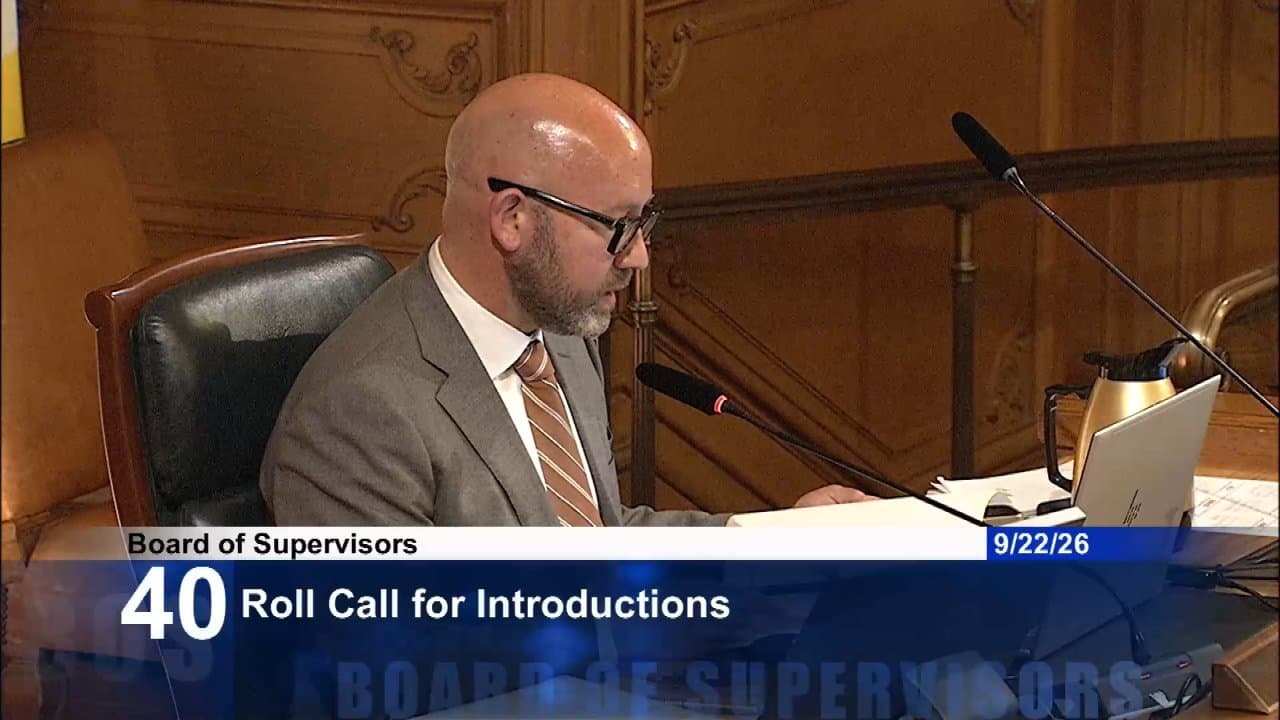
Board of Supervisors - Sep 22, 2026 - Regular Meeting
Board of Supervisors • San FranciscoSeptember 22, 2026
Locunity is an independent informational service and is not an official government page for this commission. All information is sourced from public footage and an analysis of official agendas with the aid of responsible, fact-checked AI. to report an error or omission.
Board Unanimously Rejects PG&E's Environmental Challenge to Municipal Power Plan
San Francisco's Board of Supervisors delivered a resounding 11-0 rebuke to PG&E on Tuesday, clearing a critical environmental review hurdle for the city's potential multi-billion dollar acquisition of the utility's electrical grid. The marathon hearing capped a packed session that also advanced prevailing wages for street cleaning workers, quadrupled the City Attorney's settlement authority, and introduced new legislation on home kitchen businesses and historic district protections.
- Board rejects PG&E and utility workers coalition CEQA appeals of the municipal power acquisition environmental impact report in unanimous 11-0 vote
- Prevailing wage protections expanded to city-funded street cleaning contracts, drawing eight co-sponsors
- City Attorney's settlement cap raised from $25,000 to $100,000 for the first time since the 1980s, with new annual reporting requirements
- Home kitchen legislation introduced to let micro-enterprise kitchens support street food vendors, backed by entrepreneurs and advocacy groups
- Historic district designations launched for the Castro LGBTQ+ corridor and North Beach, adding roughly 264 buildings to landmark rolls
- El Niño preparedness hearing requested as forecasters warn of dramatically increased coastal flooding this winter
Supervisors Slam PG&E in Unanimous Vote on Municipal Power EIR
The basics: The Board held a public hearing on two CEQA appeals challenging the Planning Commission's certification of the Final Environmental Impact Report for the city's proposed acquisition of PG&E-owned electrical transmission and distribution infrastructure. PG&E and the Coalition of California Utility Employees each filed separate appeals arguing the EIR was legally deficient. The Board rejected both and affirmed the EIR on an 11-0 vote, tabling two related items (Items 37 and 38).
Why it matters: This clears the most significant procedural obstacle in San Francisco's century-long pursuit of a municipally owned electrical utility. With the environmental review now affirmed, acquisition proceedings can continue at the California Public Utilities Commission — though years of regulatory, legal, and financial hurdles remain.
Where things stand: Supervisor Matt Dorsey opened the hearing with a blistering speech cataloging PG&E's pattern of obstruction, framing the appeal as a delay tactic in a broader campaign against the city.
"PG&E is a project sponsor's counterparty appealing the environmental review of a project for our city to acquire PG&E's assets for a municipally owned power enterprise," said Supervisor Dorsey. "What makes this particular appeal so galling to me is that of all the processes PG&E could abuse, of all the gears PG&E could choose to gum up … to come into this board chamber and to waste our time with its expensive and dilatory stunts."
Dorsey cited SFPUC estimates that PG&E obstruction has cost the city $76 million since 2018 and blocked nearly 200 projects. He rattled off specific examples: $2.1 million in added costs to an affordable housing project at 2340 San Jose Avenue, $18 million in grid upgrade charges demanded for the Muni Metro East facility, and $3 million per month in streetlight connection fees.
Christian Sebrian, an attorney with Cox Castle Nicholson representing PG&E, argued the EIR failed to analyze the actual project before the CPUC, citing discrepancies including the type of substations evaluated (gas-insulated vs. air-insulated) and insufficient project-level analysis. Rick Franco, an attorney with Adams Rodwell Joseph and Cardozo representing the Coalition of California Utility Employees, argued separately that a revised noise analysis identifying a previously undisclosed impact at the Martin substation constituted significant new information requiring the EIR to be recirculated.
Julie Moore, Principal Environmental Planner with the San Francisco Planning Department, delivered a detailed rebuttal covering all 21 points raised by the appellants. She concluded the EIR fully complies with CEQA, that no significant new information triggered recirculation, and that the mixed project-level and programmatic approach was appropriate given available information. Ron Flynn, Deputy General Manager of SFPUC, supported the Planning Commission's recommendation.
The other side: Three public commenters weighed in. Ms. Arabiel argued against the acquisition, citing the city's budget deficit, the estimated $3.4 billion-plus acquisition cost, and SFPUC's 538 outages on Treasure Island since 1997 as evidence the city cannot operate utilities reliably. Griffin Lee, a District 2 resident with Connected SF, questioned the independence of the Planning Commission's certification. Richard Esty Peterson spoke in opposition to PG&E's appeal.
Decisions: Supervisors were united in their criticism. Supervisor Myrna Melgar drew on her 11 years spanning the Planning Commission and the Board to dismiss the appeal: "I think that this appeal argument is the most ridiculous I've seen, actually."
Supervisor Connie Chan recounted the city's history with PG&E, including the December blackout: "It was very clear to us that the utility infrastructure failed us. The PG&E utilities infrastructure failed us."
Supervisor Bilal Mahmood mocked a portion of the appeal that forced city staff to twice investigate whether the crotch's bumblebee — last seen near San Francisco over a century ago — would be impacted by the project.
Supervisor Dorsey moved to affirm the FEIR, seconded by Supervisor Shamann Walton. The Board voted 11-0 (For: 11, Against: 0, Absent: 0).
What's next: With the environmental review affirmed, the acquisition process moves forward at the CPUC. PG&E retains the ability to challenge the decision in court, and the financial and regulatory path to a city-owned electrical utility remains long and contested.
Home Kitchen Bill Aims to Open Doors for Street Food Entrepreneurs
Why it matters: Supervisor Jackie Fielder introduced legislation to allow micro-enterprise home kitchen operations, known as MECOs, to support compact mobile food operations in San Francisco. California law already permits qualifying small food entrepreneurs to prepare and sell meals from licensed home kitchens, but the new legislation would specifically enable home kitchens to serve as commissary bases for street food vendors — potentially saving operators more than $1,000 per month in commercial commissary fees.
Where things stand: "Operating a brick-and-mortar business can be expensive with costs for permits, licenses, insurance, equipment, commercial commissary kitchens, and other ongoing expenses," said Supervisor Fielder. "These costs can add up to more than $1 million and can make it difficult for entrepreneurs with limited access to capital to enter the formal food economy."
The legislation drew robust public support. Dina Nadler-Serber, a MECO operator in the Bay Area, described how a home kitchen business became a lifeline when her husband was laid off. Kenyatta Robinson, a licensed MECO operator in Contra Costa County, said he launched a barbecue business through the program after being laid off, serving 27 customers in his first year. Natalie Ortiz of Nuestra Causa noted her organization works with 200 street vendors and argued MECOs complete the work started by San Francisco's street vending ordinance. Jessica Rubio, policy director at MEDA, said her organization supported 250 entrepreneurs this year and that MECOs bring informal food businesses into a regulated, tax-paying system.
Roya Begari, executive director of Cook Alliance, presented five years of statewide program data: 97% of MECOs received no complaints, 73% of operators reported meaningful household financial support, 70% are women, and 79% are people of color.
Co-sponsors include Supervisors Melgar, Walton, Mahmood, Chan, and Chen. The legislation was referred to committee.
Castro and North Beach Historic Districts Take Shape
Why it matters: Two supervisors introduced competing visions for local historic preservation — each insisting that protecting San Francisco's architectural heritage does not conflict with building more housing.
Where things stand: Board President Rafael Mandelman introduced a resolution to initiate landmark designation for the Eureka Valley Commercial and Castro Village LGBTQ+ Historic District, covering 64 contributing buildings across two periods of significance: early commercial development (1879–1932) and the emergence of the Castro as the center of gay political and cultural life (1953–1980).
"Most San Franciscans support building more housing. Most San Franciscans also support identifying and preserving our most historically significant buildings. And most San Franciscans recognize that we can do both," said President Mandelman. He noted that only about 1% of San Francisco's buildings carry local landmark designations — far below rates in New York, Boston, and Los Angeles.
Separately, Supervisor Danny Sauter introduced an initiating resolution for a North Beach Historic District, which would be the city's 17th Article 10 historic district and the first in District 3 since 1986. Sauter distinguished his local proposal from a stalled state-level effort: "Our local district will protect historic buildings and honor their history without including garages or empty lots like the state proposal does. We expect that it will designate approximately 200 buildings as contributors to the historic district, not the 700 that the state proposal contains."
The local district would also allow individual property opt-outs and incorporate Historic Preservation Commission feedback on shortcomings in the state nomination.
What's next: Both resolutions were referred to committee. If approved, the two districts would add roughly 264 buildings to the city's landmark rolls.
Settlement Cap Quadruples After Four Decades
Why it matters: The Board passed an amended ordinance on first reading that raises the City Attorney's delegated authority to settle claims from $25,000 to $100,000 — the first increase since the 1980s. The change frees the Board from reviewing hundreds of routine small settlements annually.
Where things stand: President Mandelman introduced floor amendments adding necessary Business and Tax Regulations Code changes that were missed in the original legislation, updating Sections 6.15 and 1113 to match the new $100,000 threshold.
Supervisor Melgar supported the increase but cautioned about losing the Board's ability to detect settlement patterns: "There are sometimes patterns that we see in terms of the settlements for sexual harassment, for example, or against specific classes of people, or because people trip on sidewalks. Those smaller settlements sometimes are indicative that there are systems that we need to address."
Deputy City Attorney Brad Russi confirmed the legislation includes safeguards: "One of the aspects of the legislation would require my office to report to the board and the mayor every year on all the settlements between $25,000 and $100,000. That report would indicate the department involved, the amount of the settlement, and the nature of the allegations in the lawsuit."
Decisions: The amended ordinance passed on first reading without objection.
Prevailing Wages Extended to Street Cleaning Workers
The Board passed on first reading an ordinance amending the Labor and Employment Code to require prevailing wages in city contracts and grants for street cleaning services. The measure attracted broad co-sponsorship from Supervisors Wong, Fielder, Walton, Sherrill, Mahmood, Dorsey, and Melgar — signaling strong consensus on expanding labor protections to workers performing essential publicly funded services.
El Niño Preparedness: Dorsey Warns of Historic Flood Risk
Supervisor Dorsey requested a hearing on San Francisco's readiness for what forecasters warn could be one of the strongest El Niño events on record, citing Governor Newsom's statewide emergency proclamation.
"We're already seeing tides 4 to 6 inches higher than normal, and El Niño is expected to raise those tides by as much as a foot or more this winter," said Supervisor Dorsey. "That could increase the number of king and royal tides from 7 to more than 30, bringing considerably more days of coastal flooding to areas like the Embarcadero near Pier 14."
District 6 includes some of the city's most flood-exposed waterfront areas. Dorsey is seeking information on stormwater system readiness, coordination with state and regional partners, infrastructure gaps, and communication plans. Co-sponsors include Mandelman, Chen, Wong, Walton, and Sauter.
Treatment on Demand Data Reveals 41% Access Gap
President Mandelman called for his sixth hearing on the DPH treatment on demand report, noting this year's report — released Sept. 3, 2026 — provides the clearest picture yet of the gap between policy and reality.
"The report identifies that just 59% of folks seeking withdrawal management are able to access that the day they're seeking it or the day after, which is not a good number and is not treatment on demand," said President Mandelman. He credited DPH Director Daniel Tsai for producing a report that honestly measures the shortfall for the first time in over 20 years.
Tech Procurement Reform Follows OpenGov Findings
Supervisor Fielder introduced legislation updating Admin Code Section 21.30 rules governing solicitation waivers for software procurement. The measure responds to a Budget and Legislative Analyst report she commissioned that found the OpenGov selection process for Permit SF did not violate city requirements but did not conform to best practices.
"The BLA report I commissioned found that the OpenGov selection process did not violate city requirements," said Supervisor Fielder. "However, it did not conform to best practices or typical city practice in procurement."
The amendments align city technology waiver standards with state and federal policies for commercially off-the-shelf products. Co-sponsors include Chan, Walton, and Chen.
Housing Element Equity Check
Supervisor Chyanne Chen introduced a resolution calling on the Planning Department to present its existing state-mandated reporting on the 2020 Housing Element's equity-oriented policy actions in a more accessible format. The Housing Element acknowledges past planning practices contributed to segregation and displacement of American Indian, Black, Japanese, Filipino, and Latino communities. Chen's resolution would enable policymakers and the public to monitor progress on dozens of reparative housing commitments. Co-sponsors include Walton, Chan, and Fielder.
Minor Items
- Consent agenda (Items 1–15): 15 routine items passed unanimously 11-0.
- $200,000 SF Foundation grant authorized for City Attorney's affirmative litigation coalition through September 2028.
- $75 million in SFPUC environmental review contracts approved — five as-needed CEQA/NEPA contracts at up to $15 million each over seven years.
- $28.7 million in emergency housing voucher transition rental subsidies approved through June 2029.
- $11.2 million state grant secured for behavioral health infrastructure at 1660 Mission Street.
- FY 2026–27 property taxes levied at a combined rate of $1 per $100 assessed valuation, including pass-through rates for residential tenants.
- Signage rules eased for large mixed-use lots over half an acre near SOMA (first reading).
- Commercial-to-residential conversions streamlined by removing parking, car-share, and loading requirements (first reading).
- Rent Board members exempted from term limits (first reading).
- Seven members appointed to the Sunshine Ordinance Task Force.
- Transbay Under Ramp Park advanced with street vacation approval (first reading).
- E-bike/e-scooter safety enforcement resolution (Item 45) sent to committee at Supervisor Wong's request rather than adopted on first appearance (Items 42–52 except 45 approved 10-0, Walton excused).
- Commendations recognized Sally Leung (SFPD community liaison), a mountain lion response team, Peter Finn (Teamsters Local 856), Rosa Parks Elementary centennial, Yerba Buena Gardens Conservancy, Los Bomberos de San Francisco, Dr. Joseph Marshall (Alive and Free), and Dave Burke (District 8 Public Safety Liaison).
- Public commenters raised concerns about taxi medallion costs and competition from autonomous vehicles, called for cancellation of the Flock camera contract, and urged action on AI safety governance.