
Board of Supervisors - Jun 16, 2026 - Regular Meeting
Board of Supervisors • San FranciscoJune 16, 2026
Locunity is a independent informational service and is not an official government page for this commission.We use AI-assisted analysis and human editorial review to publish information.
Clinic Closures Ignite Fierce Opposition as DPH Faces Hundreds of Millions in Medicaid Cuts
The San Francisco Board of Supervisors convened for a session dominated by two fiscal crises colliding: a $200 million state loan to keep Muni running and a public hearing that drew dozens of clinicians, patients and advocates demanding the Board reject proposed closures of youth and geriatric mental health clinics driven by massive federal Medicaid cuts. Across both items, the message was the same — the city's safety net is fraying, and the question is who pays the price.
Dozens of providers, patients and union reps blast proposed closures of youth and geriatric clinics, calling DPH savings "a rounding error" against hundreds of millions in lost Medicaid revenue
Board unanimously approves $200M state loan to keep Muni running for 12 years — but the deal hinges on two ballot measures that haven't passed yet
Supervisor Mahmood introduces Affordable Groceries Act, a four-part package including a November ballot measure taxing vacant former grocery and pharmacy storefronts
Supervisor Melgar calls for financial audit of Academy of Sciences after 53 layoffs, deficits and "questionable debt refinancing"
Interim two-year city budget advances on first reading amid deepest fiscal crisis since 2008
Supervisor Dorsey proposes expanding leave-donation program after paralyzed SFPD sergeant was denied benefits twice
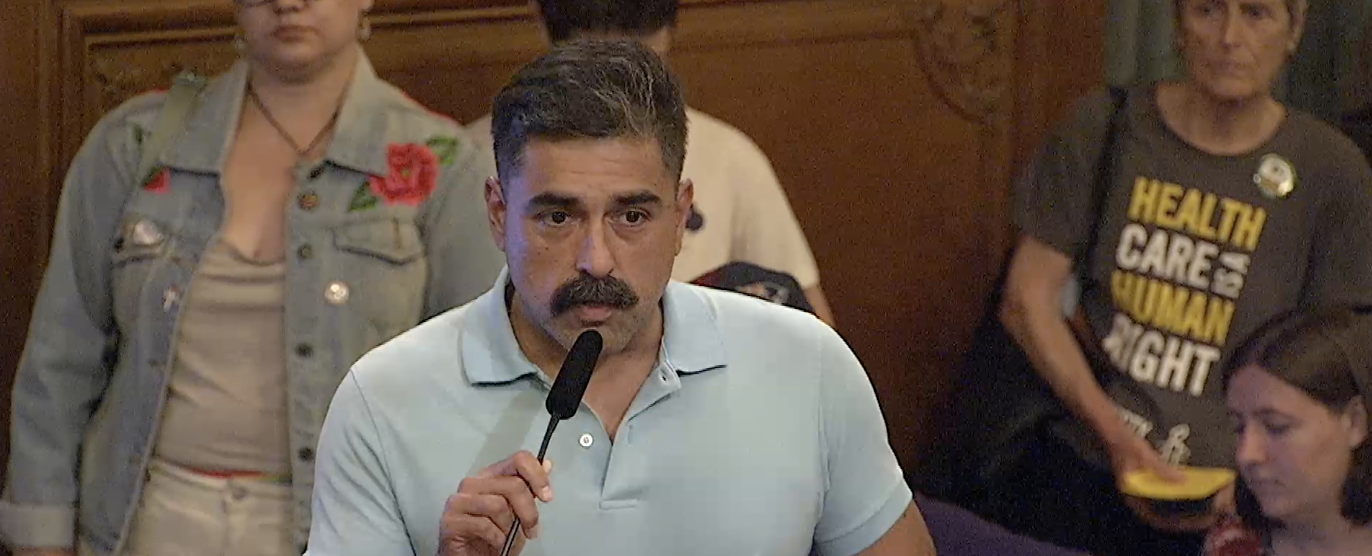
"Deeply, Deeply Vulnerable": Community Erupts Over DPH Clinic Closures
The Board held a legally required Bielenson hearing on the Department of Public Health's proposed reductions to medical services for the upcoming two-year budget — and what followed was the most emotionally charged public comment period of the session, with more than 20 speakers lining up to oppose the cuts.
The basics: A Bielenson hearing is triggered when a county health department proposes to reduce or eliminate health services. It requires a public airing before the Board but does not itself require a vote. The matter was filed after testimony concluded.
Why it matters: Federal and state Medicaid cuts totaling several hundred million dollars are forcing DPH to slash $19.9 million from community-based organization contracts — threatening the last geriatric psychiatric outpatient clinic in San Francisco and specialized youth clinics that serve homeless and LGBTQ youth at the very moment federal support is being withdrawn.
Where things stand: DPH Director Dan Tsai laid out the scale of the crisis: DPH's general fund allocation is rising 32%, from $779 million to $1.03 billion, specifically to backfill lost federal and state revenue — but the department still had to identify $19.9 million in CBO contract reductions.
"The biggest underlying piece for the city's budget and the DPH budget is very, very large cuts to Medicaid, known as Medi-Cal, that are primarily the result of massive, unprecedented, very terrible cuts to the Medicaid program that were voted on by Congress and signed by the President," said Director Tsai.
He reported that $7.1 million in savings comes from contract renegotiations that won't impact services, while other cuts stem from state Behavioral Health Services Act (Prop 1) policy changes restricting what the city can fund. Of 130 consolidated FTE positions, about 100 were vacancy eliminations and 25–27 were reassignments, with actual layoffs limited to two nurses at Laguna Honda Hospital.
"I would acknowledge that the people that are cared for in these clinics are deeply, deeply vulnerable," Tsai said of the proposed clinic consolidations.
Three clinic closures drew the fiercest opposition: Southeast Mission Geriatric Clinic, Cole Street Youth Clinic (operated by Huckleberry Youth Programs), and Michael Baxter Larkin Street Clinic. Speakers argued the savings are tiny — roughly $700,000 per clinic — while the harm would be enormous.
The other side: Clinicians who have worked at these sites for decades challenged DPH's justification head-on. Francisco Ropesa, a 25-year clinician at Southeast Mission Geriatric, testified it is the last geriatric outpatient mental health clinic in the city. He argued that the volume statistics used to justify closure were inaccurate — distorted by chronic understaffing and a new billing system — and that the clinic bills 80% to Medicare, which is not being cut.
"The savings are about $700,000 per clinic — a rounding error against hundreds of millions in shortfall," said Susan Zago, a 19-year clinician at Cole Street Youth Clinic, who described it as the only integrated youth care model in San Francisco. She noted DPH pays zero rent for the youth clinic sites, with overhead covered by the CBOs.
Sophia Padilla of the Michael Baxter Larkin Street Clinic said closures are "based on a false premise of underutilization caused by chronic understaffing" and criticized the lack of a concrete patient transition plan.
Marnie Regan, executive director of Larkin Street Youth Services and chair of the Human Services Provider Association, urged supervisors to halt the reductions, arguing that cutting clinic services shifts costs to emergency rooms, jails and crisis response. She noted the city maintains a $400 million federal and state risk reserve that could be tapped instead.
HIV/AIDS advocates sounded similar alarms. Laura Thomas of the San Francisco AIDS Foundation and the HIV AIDS Provider Network warned that cuts close longstanding HIV and hepatitis prevention programs and eliminate the substance use disorder coordinator position, threatening the city's Getting to Zero goals. Trey Turner, also of the SF AIDS Foundation, challenged the mayor's framing, arguing the administration cannot claim to strengthen the safety net while cutting HIV services and trans community resources.
Labor representatives escalated the confrontation further. Kerry Dahl of SEIU 1021 said no continuity-of-care plan has been shared with the union and criticized plans to move youth patients into adult primary care clinics. Derek Arthur, representing 1,200 Laguna Honda workers, named the two clinical nurse specialists facing layoff — Maria Elena Healy and Lorna Rose — and characterized their elimination as potential targeting of union leaders with irreplaceable expertise.
Anya Worley Zigman of the SF People's Budget Coalition warned supervisors that budget cuts during Pride Month send a clear message about which communities suffer first in hard times.
What's next: The hearing is now filed, but the fight moves to budget deliberations. Supervisors will weigh whether to restore funding for the clinics during the full two-year budget process.
$200M State Loan Keeps Muni Running — With a Big Bet Attached
The Board unanimously approved a $200 million loan from the Metropolitan Transportation Commission to sustain Muni transit operations — a critical lifeline that carries significant long-term fiscal risk.
Why it matters: The loan represents roughly 13% of SFMTA's total operating revenue and is a bridge to new ballot-measure revenue that does not yet exist. If those measures fail, the agency would face service cuts while still owing $30 million a year in debt service.
Where things stand: The loan is authorized under AB 117 and is part of a $590 million pool split among Muni, BART, Caltrain and AC Transit. SFMTA Chief of Staff Judson True explained the structure: a 12-year term with two years of interest-only payments at roughly $8 million per year, followed by 10 years of principal and interest at about $30 million annually. The loan is secured by State Transit Assistance funds, which currently provide SFMTA about $65 million per year.
"The loans will each have a 12-year term with two years of interest only and 10 years that include both interest and principal. We estimate right now that the interest payments are $8 million and the annual payments with both interest and principal are about $30 million," said Chief of Staff True.
Budget Analyst Nick Menard flagged a key vulnerability: SFMTA's second-year budget assumes passage of both a regional sales tax and a parcel tax that together would provide over $300 million in new revenue starting in fiscal year 2027–28.
Supervisor Connie Chan pressed on what happens if the city can't pay. True explained that MTC would withhold STA funds and that loan forgiveness would require future state legislation — there is no automatic off-ramp.
Supervisor Myrna Melgar praised the regional collaboration. "I just wanted to underscore what an unusual collaborative effort it was to get here with all of our neighbors, and it required putting aside our differences," she said.
Decisions: The resolution was adopted 10-0 (For: 10, Against: 0, Absent: 1 — Supervisor Jackie Fielder excused). No members of the public testified on the item.
What's next: The clock is now ticking toward two ballot measures — a regional sales tax and a city parcel tax — that must pass for SFMTA to avoid service cuts while carrying $30 million in annual debt service.
Mahmood Targets Food Deserts With Four-Part Legislative Package
Supervisor Bilal Mahmood unveiled the Affordable Groceries Act, a four-part legislative package addressing San Francisco's growing food desert crisis.
Why it matters: Multiple San Francisco neighborhoods now qualify as food deserts, and grocery prices have surged — milk up 13%, tomatoes up 40% over the prior year, according to Mahmood. The package targets corporate landlords holding former grocery and pharmacy spaces vacant to block competition, a practice that accelerates neighborhood-level food insecurity.
Where things stand: The package includes: (1) an Abandoned Pharmacy and Grocery Tax ballot measure for November targeting large corporations that keep former grocery and pharmacy spaces vacant; (2) an Affordable Grocery Fund for city investment in corner store conversions, building acquisitions and co-op grants; (3) a gross receipts tax credit for pharmacies operating in San Francisco; and (4) an Affordable Groceries Working Group advisory body.
"San Francisco now has multiple food deserts as a result, and the two problems compound each other. Less access and higher prices," said Supervisor Mahmood.
Co-sponsors include Supervisors Melgar, Sherrill, Sauter and Chen. Coalition partners include UFCW, SEIU Local 87, Farming Hope, Booker T. Washington and the Food and Agricultural Action Coalition.
What's next: The November ballot measure will require Board approval to be placed before voters. The remaining components move through the legislative process.
Melgar and Chan Call for Academy of Sciences Audit
Supervisor Myrna Melgar, joined by Budget Chair Connie Chan, introduced a motion directing the Budget and Legislative Analyst and the Comptroller to conduct a performance and management audit of the California Academy of Sciences.
Why it matters: The Academy receives $8.1 million in general fund support and recently laid off 53 workers amid financial deficits and debt refinancing concerns.
"We are deeply troubled by the present financial health of this institution, which has led to 53 workers being laid off earlier this year, along with an unmanaged financial deficit and questionable debt refinancing practices," said Supervisor Melgar. She thanked the workers who unionized and raised concerns, and expressed hope the audit would produce a path toward stronger financial management.
Dorsey: Paralyzed Sergeant Denied Benefits Twice Under Outdated City Rule
Supervisor Matt Dorsey introduced legislation to modernize the TJ Anthony Catastrophic Illness Program, which allows city employees to donate accrued leave to colleagues facing severe medical challenges.
The basics: Current San Francisco law requires a "life-threatening" condition to qualify — a standard narrower than California state law. The proposed legislation would focus on incapacity, extended absence and exhaustion of leave rather than requiring a life-threatening determination.
Dorsey highlighted the case of SFPD Sergeant Kevin Brugaletta, paralyzed from the chest down by a falling tree during a 2024 atmospheric river storm.
"Sergeant Brugaletta is now paralyzed from the chest down, but he continues to work toward recovery despite the severity of his condition. He has applied to the program twice, been denied twice, and has lost two appeals," said Supervisor Dorsey.
What's next: The legislation moves through committee for drafting and hearing.
Minor Items
Interim two-year budget, salary ordinance and OCII budget passed on first reading by voice vote, setting the framework for FY 2026–2028 budget deliberations.
Four labor MOUs finally passed by voice vote: Municipal Executives' Association agreements for fire and police (through June 30, 2030), compensation for unrepresented employees, and an apprenticeship program update with Machinists Union Local 1414.
Balboa Reservoir Special Use District ordinance finally passed, establishing zoning for the housing development.
Downtown Hospitality Zone ordinance finally passed, creating a designated zone with special rules to boost economic activity.
Lithium-ion battery ban advanced on first reading, prohibiting the sale of uncertified batteries to address fire risks from e-bikes and other devices.
Transgender District banner grant ($24,516) finally passed 10-0, waiving competitive bidding for culturally significant placemaking banners in the Tenderloin.
Hunters Point Shipyard Phase 2 final subdivision map approved as amended, authorizing up to 441 residential and 15 commercial condominiums at Candlestick Point.
Dragon Boat Festival Day (June 19, 2026) resolution adopted as amended, 10-0.
Juneteenth celebration resolution adopted without objection.
Commendations honored retiring SFPUC Assistant GM Barbara Hale (21 years building Clean Power SF from 7,800 accounts to 385,000, saving customers $146 million); martial arts instructor Professor Teodora Eldefonso Omo and her children, selected for the 2026 World USA Karate Team in Berlin; 50 years of women's membership at the Dolphin Swimming and Boating Club and South End Rowing Club; and outgoing SF Gay Men's Chorus CEO Christopher Verdugo for a decade of leadership. Supervisor Alan Wong also recognized Dumb Laws Contest winners Mike Knorr and Catherine Roberts for identifying a ceiling height code discrepancy preventing in-law unit legalization.