Board of Supervisors - Jun 30, 2026 - Regular Meeting
Board of Supervisors • San FranciscoJune 30, 2026
Locunity is a independent informational service and is not an official government page for this commission.We use AI-assisted analysis and human editorial review to publish information.
Public Bank Advances, Code Cleanup Stalls as Board Tackles Remote Comment Mandate
The San Francisco Board of Supervisors spent its June 30 meeting wrestling with three very different questions about how government should work — whether the city should create its own bank, whether a 308-page bill can quietly erase decades of reporting requirements, and whether anyone on Earth should be able to call into a Board meeting starting tomorrow. All 11 supervisors were present, including Supervisor Jackie Fielder, who returned from an extended mental health leave.
Public bank charter amendment advances 10-1 as Supervisor Wong casts lone dissent over fiscal risk; continued to July 7 ahead of state deadline
308-page code cleanup ordinance delayed two weeks after supervisors and small business groups flag embedded policy decisions and missing stakeholder outreach
Remote public comment rules adopted under protest as state law SB 707 takes effect July 1, drawing sharp criticism from across the Board
Fair Chance Ordinance expanded to bar employers from using out-of-state convictions for abortion, gender-affirming care, and drag performances
Supervisor Melgar signals rent ordinance overhaul to fight speculative evictions accelerated by the AI economy
Supervisor Fielder demands answers from SFPD on tactical gear deployment at Trans March and Stud Alley during Pride weekend
Public Bank Fight: Equity vs. Fiscal Prudence
Why it matters: A state deadline means San Francisco must act soon if it wants to preserve the option to put a public bank on the November 2026 ballot. The charter amendment would create a Municipal Finance Corporation — the governance skeleton for a city-owned bank designed to fill gaps in small business lending, affordable housing, and climate finance.
Where things stand: Supervisor Connie Chan, the measure's sponsor, framed the bank as a response to market failures.
"When we look around our city, we see clear market gaps for some of the city's most urgent priorities," she said. "These are gaps where small business bleed, where affordable housing starts and where climate projects go unfunded."
Supervisor Bilal Mahmood emphasized that the vote is about preserving future options, not committing funds today.
"This is about maintaining the option for San Francisco to create a public bank in the future," he said. "There's a state deadline that is coming up. And this is not about funding that infrastructure today."
Supervisor Shamann Walton pushed back directly on skeptics, saying his constituents are already asking for better capital access.
"My constituents are asking about home loans, they are asking about business loans, they are asking about ways to access capital that are not always available to everyone," he said.
Supervisor Myrna Melgar connected the debate to racial disparities in private lending, citing Wells Fargo's settlement for discrimination against Black borrowers who had strong credit but were denied mortgages because of their race.
The other side: Supervisor Alan Wong delivered a detailed opposition speech, arguing the city has not earned the institutional trust to run a financial institution during a budget deficit.
"A public bank involves decisions about deposits, lending, credit, regulation and risk management," he said. "Those decisions carry real financial consequences. They demand institutional discipline, insulation from political pressure, transparency, and deep banking expertise."
He urged the Board to strengthen existing community lenders instead.
Supervisor Jackie Fielder credited the SF Public Bank Coalition and traced advocacy back to Supervisor John Avalos in 2008.
Decisions: Continued to July 7 on a 10-1 roll call vote. Wong cast the sole no vote.
What's next: The Board will take the measure up again on July 7, with a state deadline looming that requires action before it can reach the November 2026 ballot.
308-Page Code Cleanup Hits a Wall
The basics: The City Attorney's office introduced an omnibus ordinance a year ago that would modify or remove dozens of reporting requirements across at least nine city codes deemed obsolete, duplicative, or unused. The Government Audit and Oversight Committee heard it the day before, and President Mandelman moved to continue the item after receiving last-minute correspondence from the small business community.
Why it matters: Supervisors warned the bill buries substantive policy decisions inside what looks like housekeeping. If approved, some oversight tools — used by advocates, the civil grand jury, and the public — could vanish without deliberation.
Where things stand: Supervisor Myrna Melgar acknowledged most of the ordinance is genuine cleanup but flagged a critical subset.
"Do we still need to keep track of how many women are depicted in our public art? Do we still need to keep track whether women are being paid the same as men? Do we still need to understand how many rental apartments are being converted to condominiums?" she asked — making clear her answer was yes.
Supervisor Connie Chan questioned why the legislation wasn't broken into single-subject bills and raised concerns about outreach to stakeholders who may rely on reports the City Attorney's office wants to eliminate.
The other side: Supervisor Stephen Sherrill defended the effort, arguing that the city's code has become so dense it undermines the transparency it was designed to ensure.
"Sometimes we decide to be transparent while in actuality drowning people in information, and that becomes the complete opposite of transparency," he said, crediting Supervisor Chyanne Chen's office for substantial amendment work.
Supervisor Shamann Walton questioned why the City Attorney rather than community members initiated the effort and said the Board has bigger priorities.
Decisions: Continued to July 14 without objection.
What's next: Supervisors have two weeks to review the full 308-page document. Small business groups and advocates will have time to identify which reporting requirements they want to preserve before the item returns.
Board Grudgingly Adopts Remote Public Comment Rules
The basics: SB 707, a state law amending the Brown Act, requires all local legislative bodies to accept remote public comment via electronic call-in or video starting July 1. The Board cannot restrict participation to city residents.
Why it matters: Starting tomorrow, anyone anywhere can call into San Francisco Board of Supervisors meetings. Supervisors from across the political spectrum warned this will overwhelm legitimate local participation with bad-faith actors, but noncompliance would expose the city to injunctions and attorney's fees.
Where things stand: Rules Committee Chair Supervisor Shamann Walton noted the state legislature itself does not take remote public comment.
"The state legislature does not even take remote public comment for their meetings," he said. "So how can we be forced to do something that they don't even do?"
Supervisor Stephen Sherrill was blunter, warning that working families, pregnant women, and people with disabilities would be crowded out.
"They're going to get pushed out by all the wackadoodles around the world who decide to opine because they have nothing better to do," he said.
Supervisor Myrna Melgar raised concerns about repeat abusive callers targeting members for their religion, sexual orientation, or gender. Supervisor Connie Chan asked whether remote comment could be narrowed to residents or limited to written submissions. Deputy City Attorney Brad Russi confirmed the law requires an electronic call-in or video option with no geographic filtering, and that noncompliance would expose the city to Brown Act claims and attorney's fees.
Clerk Angela Calvillo outlined the implementation plan: in-person comment will go first, followed by remote callers in sign-up order, with ADA accommodation priority and informational redirections for off-topic speakers.
Decisions: Approved without a roll call vote.
Supervisor Fielder Returns, Demands Answers on SFPD Pride Incidents
Supervisor Jackie Fielder returned to the Board after an extended absence taken on her doctor's recommendation.
"It's not something that I wanted to do, but something that my doctor recommended," she said. "And I'm very glad I did take the time to protect my mental health."
During roll call for introductions, Fielder submitted a letter of inquiry to SFPD about the department's deployment of tactical gear at Trans March and at an event known as Stud Alley during Pride weekend, requesting a response by July 14.
"I was very concerned this weekend seeing reports and video footage of San Francisco police clashing with San Francisco residents and visitors participating in Pride activities in two separate incidents," she said.
The topic also dominated general public comment. A commenter described the police response as a "violent, aggressive, outsized assault on trans people." Stephen Torres the Temporary Program Manager of the Castro LGBTQ Cultural District spoke in support of the Coors Boycott Commemoration Day resolution and connected labor-LGBTQ solidarity to the Pride weekend incidents.
Rent Ordinance Overhaul in the Works
Supervisor Myrna Melgar announced a drafting request to tighten the city's rent ordinance, responding to what she described as a growing wave of speculative evictions and dubious lease violation claims as the AI economy accelerates.
"Recently, we have seen a growing number of news stories about tenants facing outrageous rent increases or dubious claims of violating their leases when the real motivation seems to be to push long term rent control tenants out," she said.
The legislation would sharpen definitions of nuisance, hoarding, and harassment. Supervisor Chyanne Chen is co-sponsoring.
Fair Chance Ordinance: New Protections for Abortion, Trans Care
The Board passed on first reading an ordinance expanding the Fair Chance Ordinance to prohibit employers and affordable housing providers from using out-of-state criminal convictions or arrests for conduct legal in California — specifically abortion, related health care, drag performances, gender-affirming care, and spontaneous abortion — in employment or housing decisions. The ordinance also increases administrative penalties for violations. It passed without discussion by voice vote.
Why it matters: As other states criminalize abortion, gender-affirming care, and drag performances, San Francisco is positioning itself as a legal refuge — ensuring workers and tenants cannot face consequences here for actions legal under California law.
Minor Items
$3.185M in lawsuit settlements approved on consent (11-0), including a $3M settlement for Amaryllis Cruz and Elias Jimenez, a $100,000 unlitigated claim for Craig Banks, and two smaller settlements.
Domestic Violence Shelter-Based Program Fund ordinance finally passed on second reading, renaming the fund and shifting administration to the Mayor's Office of Housing and Community Development.
Downtown Community Benefit District assessment ballot resolution adopted without discussion.
SFPD Law Enforcement Equipment Use Policy 2025 annual report approved without discussion.
"Art Agnos Way" commemorative street designation adopted 11-0, honoring the former mayor on Connecticut Street.
Coors Boycott Commemoration Day (June 26) adopted 11-0.
SF Arts Commission designated as state-local partner with the California Arts Council (11-0).
June 2026 primary election results officially certified (11-0).
Resolution opposing federal cuts to veterans' disability benefits adopted 11-0 in support of the VFW.
Kaiser Permanente/NUHW hearing scheduled for July 21 to examine behavioral health service delivery and labor relations (11-0).
President Mandelman introduced legislation to raise the city attorney's delegated settlement authority from $25,000 to $100,000, a threshold unchanged in 40 years.
Supervisor Wong introduced a resolution designating the Sunset Healthcare Corridor on Noriega Street.
Supervisor Chan introduced a resolution supporting KGO-TV's FCC license renewal, criticizing the commission's accelerated timeline.
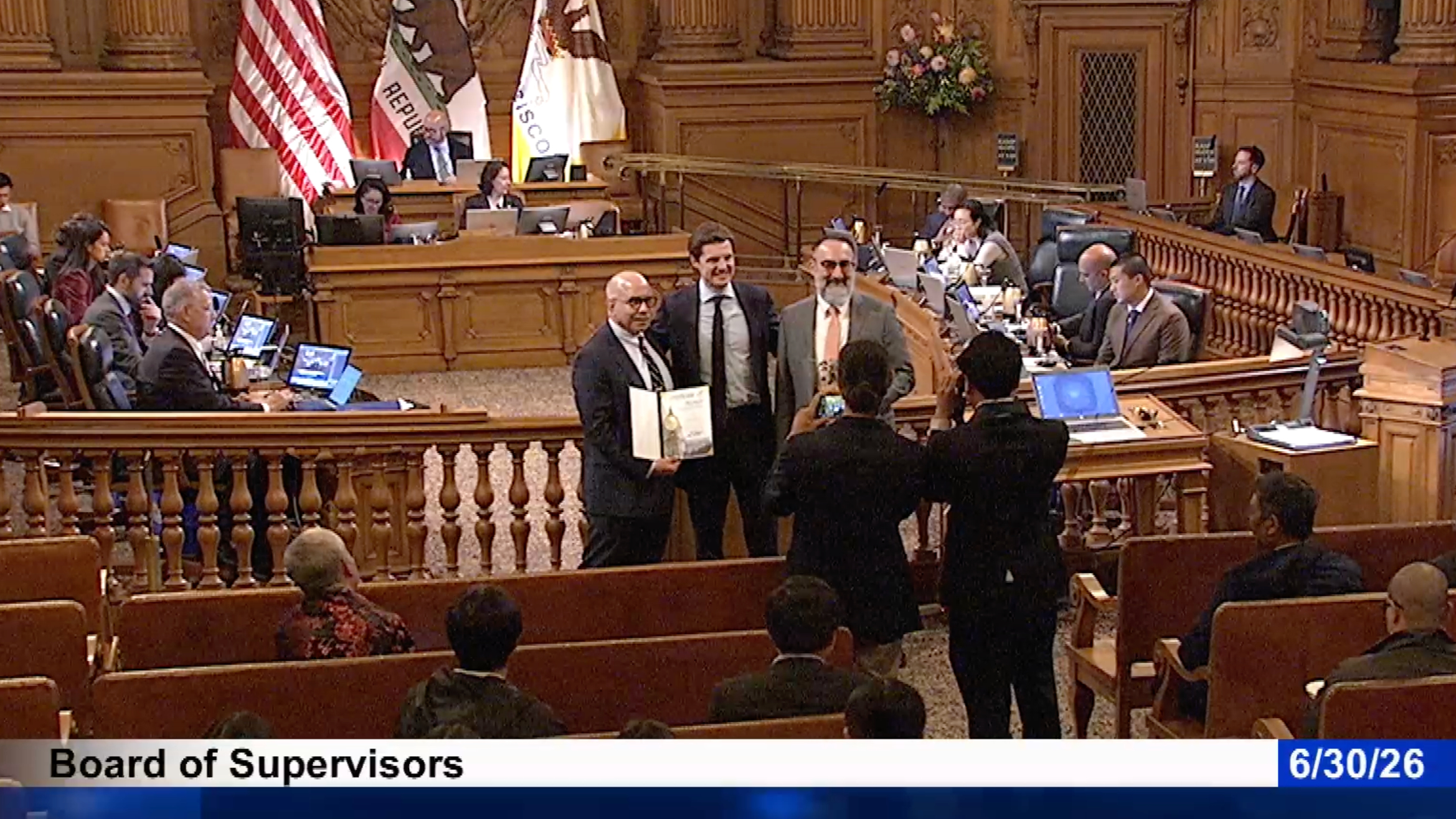
Board commended retiring City Hall Building Manager Rob Reiter (nearly 17 years, led LEED Platinum certification); Lloyd Haddad and Keith Wicker of Capricorn Framing and Walter Adams Framing for their 20th business anniversary and community philanthropy; outgoing Youth Commissioner Gabby Listana, who served six terms starting at age 12 and will attend Harvard this fall; and Vets Supporting and founder Jason Chitavong for PTSD Awareness Month.
An SEIU 1021 union steward raised concerns about mistreatment of frontline Department of Public Health staff and shared the story of a clinical social worker who died from a stress-related overdose.
Meeting adjourned in memory of Glorie Diao Delarey and Stanloss Chan.