
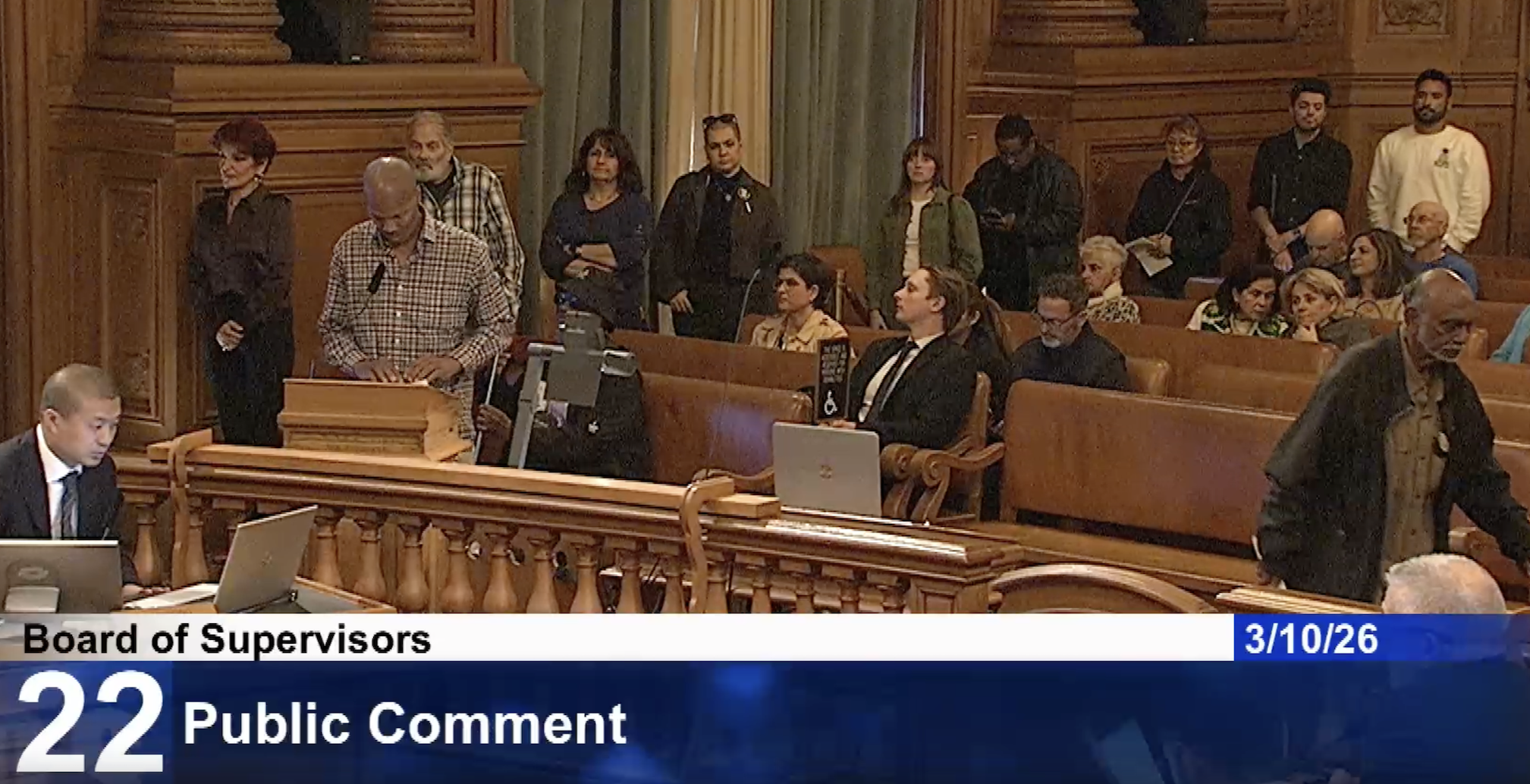
Board of Supervisors - Mar 10, 2026 - Regular Meeting

Board of Supervisors - Mar 10, 2026 - Regular Meeting

Board of SupervisorsSan FranciscoMarch 10, 2026

Sources:

Locunity is a independent informational service and is not an official government page for this commission.We use AI-assisted analysis and human editorial review to publish information.

Lurie and Mandelman Advance Three-Part Charter Overhaul for November Ballot

San Francisco's mayor and board president joined forces to unveil the most ambitious restructuring of city government in decades — centralizing contracting, curbing ballot measure sprawl, and giving the mayor power to hire and fire department heads. Separately, the Board delayed a police GPS tracking policy, launched an audit of the Sheriff's Office over a $19 million overtime overrun, and heard an avalanche of opposition to repealing the Prop I real estate transfer tax.

  • Mayor Daniel Lurie and Board of Supervisors President Rafael Mandelman introduce charter reform to centralize city contracting, limit ballot measures, and expand mayoral authority over department heads — with a fast-track to the November ballot

  • Supervisor Fielder orders audit of the Sheriff's Office over $19M overtime overrun, allegations of forced strip searches, and sanctuary policy concerns

  • Housing advocates flood public comment to oppose the BUILD Act and Prop I repeal, calling it a tax cut for billionaires during a $296M deficit — no one speaks in favor

  • Police GPS tracking policy delayed two weeks after supervisors raise Fourth Amendment and reliability concerns about StarChase vehicle-tagging technology

  • Board unanimously recognizes Iranian American Heritage Month with emotional testimony about belonging amid US military operations against Iran

  • Dorsey moves to block pension system's relocation from Civic Center to the Financial District, demanding alternatives


Charter Reform Heads for the Fast Track

Mayor Daniel Lurie appeared before the Board to pitch a three-part charter overhaul he developed with Board President Rafael Mandelman, setting up what could be the most consequential governance restructuring San Francisco has debated in years.

"You all know that our city charter is one of the longest in the country. It's bloated and it's broken," Mayor Lurie told supervisors.

Why it matters: San Francisco's charter is one of the longest in the country, and the reforms — if approved by voters in November — would shift significant power toward the mayor's office while streamlining a procurement system that city leaders say drives up costs and delays projects.

Where things stand: Lurie laid out three pillars:

  1. Contracting reform would centralize procurement under the city administrator with consistent citywide standards.

  2. Ballot measure reform would require a board majority to place measures on the ballot and eliminate the mayor's unilateral ballot placement power — Lurie noted San Francisco had 15 ballot measures in 2024 compared to Oakland's three and San Jose's one.

  3. Accountability reforms would allow the mayor to hire and remove department heads while ensuring commissioners answer to the authorities that appoint them.

The other side: Public commenter Patrick Monette-Shaw argued the fast-tracking of the process violates the 30-day rule for major policy, warning voters will reject the ballot measure if the process feels rushed. The Board adopted item 31 — a motion to pull the streamlining task force's final report from the Rules Committee to a committee of the whole hearing — as part of a block vote on items 23-32 (For: 11, Against: 0).

What's next: The legislation now moves to a committee of the whole hearing. The Board faces a July 24 ballot deadline to place a charter amendment before November voters.


Fielder Orders Sheriff's Audit Amid $19M Overtime Overrun

Supervisor Jackie Fielder announced she is requesting the Budget and Legislative Analyst complete a comprehensive audit of the Sheriff's Office, citing fiscal and civil rights concerns that she said demand urgent oversight.

Why it matters: The audit comes as San Francisco faces a $296 million budget deficit and the Public Health Department absorbs $40 million in cuts — creating a stark contrast with law enforcement spending that is running well over budget.

Where things stand: Fielder cited three areas of concern. The Sheriff's Department is projected to overrun its overtime budget by $19 million this fiscal year, even after accounting for savings from vacant positions and reduced capital spending. She also raised a series of troubling incidents: a BAAQMD settlement for pepper ball gas drifting onto Portola Elementary School during a training exercise, and Mission Local reporting allegations that deputies forced incarcerated women to undress during filmed searches. Additionally, Fielder questioned whether the department is honoring San Francisco's sanctuary city policies regarding ICE access to county jail detainees.

"This disparity [between the Sheriff Department and the Public Health Department] raises serious questions about our city's priorities and commitment to fiscal oversight.," Supervisor Fielder said.

Fielder emphasized the audit was not an indictment of the workforce but a fiscal oversight duty.

What's next: The Budget and Legislative Analyst will conduct the audit. No timeline was specified.


Housing Groups Rally Against Prop I Repeal

The most sustained public engagement of the meeting came during general public comment, where at least eight speakers from housing organizations, tenant coalitions, and resident groups urged the Board to reject the proposed BUILD Act and preserve the Prop I real estate transfer tax. No one spoke in favor.

The basics: Prop I, approved by 57.5% of voters in 2020, levies a transfer tax on properties sold for more than $10 million. The BUILD Act, attributed to Supervisor Bilal Mahmood and SF Mayor Daniel Lurie, would repeal it. The legislation was not voted on at this meeting.

Why it matters: Prop I has generated nearly half a billion dollars since 2020. Speakers said the revenue funded the nation's strongest COVID rent relief program — protecting 20,000 tenants from eviction — $40 million in land banking for over 550 affordable homes, and $64 million in housing acquisition. Repealing it would blow a further hole in a city already facing a $296 million deficit.

Where things stand: Kyle Smeallie of the San Francisco Community Land Trust noted that Prop I's first two years alone saw over $200 million allocated to affordable housing purposes. Charley Bodkin of the District Democratic Club and San Franciscans for Social Housing reminded supervisors that 11 then-sitting supervisors unanimously voted to dedicate Prop I funds to social housing, and pointed out that Donald Trump is a co-owner of 555 California Street — a property that could benefit from reduced transfer taxes. Destiny Santana, a District 5 resident, cited the $296 million city deficit and warned that eliminating Prop I revenue on top of the mayor's $400 million spending cut would devastate non-core programming. Meg Heisler of the SF Anti-Displacement Coalition noted 17,000 affordable units are ready to build but lack funding.

The multiple speakers framed the proposal as a tax cut that primarily benefits large commercial real estate investors. Reshav, a District 9 resident, noted that evictions are at a decade high and that 365 affordable units were lost from the Potrero Yard project due to lack of funding.

What's next: The BUILD Act has not yet been scheduled for a committee hearing or vote.


GPS Police Tracking Policy Delayed Amid Fourth Amendment Concerns

The Board unanimously continued the StarChase GPS vehicle-tracking surveillance policy to March 24, after Supervisor Shamann Walton and Supervisor Connie Chan raised unresolved questions about warrantless tracking, cost, and reliability.

The basics: StarChase is a GPS projectile launcher mounted on police vehicles. Officers fire a small tracker that attaches to a fleeing car, allowing them to track it remotely instead of engaging in a high-speed pursuit. The ordinance — which came to the full board without recommendation from the Rules Committee — would formally authorize the technology under San Francisco's surveillance policy framework.

Why it matters: SFPD reported 17 successful vehicle tags in 22 deployments during 2025 using six mounted units. Oakland, by contrast, required a warrant even after tagging a vehicle, effectively defeating the tool's purpose and resulting in only one successful tag in five years before abandoning the program.

Where things stand: Walton moved for the continuance:

"There are concerns about warrantless trackers, lack of data, cost concerns, reliability, and of course, always the protection of civil liberties," he said.

SFPD Government Affairs Manager Carl Nicita explained that under exigent circumstances, officers would tag and track without a warrant; otherwise a judicial warrant would be obtained.

"StarChase is a pursuit mitigation tool. It's not a pursuit enhancement tool. Its overall goal is to reduce dangerous high-speed pursuits within the city," Nicita said.

Board President Rafael Mandelman signaled personal support for the technology but granted the continuance as a collegial accommodation:

"I did support Prop E. I think San Francisco and Oakland can take different paths on public safety and in this case I think should."

Decisions: Motion to continue passed 11-0 (For: 11, Against: 0).

What's next: The Board will take up the StarChase policy again on March 24.


Dorsey Challenges Pension System's Move From Civic Center

During supervisor role call introductions, Supervisor Matt Dorsey announced legislation to require Board involvement when city agencies propose relocating away from the Civic Center area, after discovering the San Francisco Employees' Retirement System evaluated 19 Financial District office towers and only one Civic Center option for its planned move.

Why it matters: The fight signals a broader policy battle over whether city agencies should anchor the struggling Civic Center and Mid-Market corridors — neighborhoods that took an outsized hit during the pandemic — or seek more convenient locations elsewhere.

Where things stand: Dorsey called attention to the fact that only one option was in the Civic Center area and it was rejected, despite cost savings.

He described the move as "the exact opposite of what our city should be doing to reinvest and reinvigorate our adjacent neighborhoods with strategic investments of our city's own real estate assets."

Dorsey announced two actions: a legislative drafting request to amend the administrative code requiring early Board involvement when city real estate decisions depart from Civic Center area plan policies, and a letter requesting the City Administrator's Real Estate Division survey all alternatives within Mid-Market and Civic Center.


Iranian American Heritage Month

The Board unanimously adopted a resolution recognizing March 2026 as Iranian American Heritage Month, with all 11 supervisors co-sponsoring. Supervisor Matt Dorsey, the primary sponsor, acknowledged the painful moment for Iranian Americans given events abroad:

"In moments like these, it matters more than ever what this board does. It matters that San Francisco and San Franciscans are able to say unequivocally, you belong here."

San Francisco Arts Commissioner Mahsa Hakimi, an Iranian American community leader, provided emotional testimony calling the declaration "recognition and hope that we finally belong in the history of this city we proudly call home." Former Supervisor Ahsha Safaí returned to the chamber to support the resolution, connecting the pain of the Iranian community to the broader suffering of immigrants and noting it was Ramadan approaching Nowruz.

Decisions: Adopted unanimously (For: 11, Against: 0).


SFPUC Gas Easement Passes Over Climate Objection

The Board approved, 10-1, a permanent easement granting PG&E approximately 3,000 square feet on San Francisco Public Utilities Commission (SFPUC) property at 1800 Gerald Avenue to replace solids treatment facilities at the Southeast Water Pollution Control Plant. Supervisor Jackie Fielder cast the lone no vote.

Why it matters: The vote locks in additional natural gas infrastructure at the sewage plant, highlighting the tension between upgrading aging systems and meeting San Francisco's climate commitments.

Where things stand: SFPUC Government Affairs' Jeremy Spitz explained the agency moved away from a cogeneration process — which would have used biogas to generate electricity on-site — because of environmental justice impacts on the nearby community, making external natural gas the preferred alternative to heat larger digesters. Fielder said she understood the improvements support biogas technology but because the plant would require more natural gas to make the regenerative energy work, she could not support increasing natural gas supply given the city's climate goals.

Decisions: For: 10, Against: 1 (Fielder).


Minor Items

  • $65M SFMTA security contract extension: Board approved a one-year extension and $5.9 million increase for Allied Universal security services at transit facilities (For: 11, Against: 0).

  • $3.9M in lawsuit settlements: Seven settlements approved, including employment disputes, tax refunds, property damage, and a $30,450 BAAQMD citation for chemical agent discharge near Portola Elementary (For: 11, Against: 0).

  • Elena Rivkin appointed to Assessment Appeals Board No. 3, with residency requirement waived; term ending Sept. 7, 2026 (For: 11, Against: 0).

  • Vallejo Street unit merger appeal continued to April 7 to allow a DBI inspection at 524-526 Vallejo Street, where homeowners seek to legalize merging three dwelling units into one. Public commenter Jerry Dratler opposed the delay, warning the approval would set a precedent like the nearby $32M conversion of seven units at 104-114 Presidio Avenue (For: 11, Against: 0).

  • "James Richards Way" commemorative street name approved for Oakdale Avenue.

  • Women's History Month commendations honored six community leaders from Districts 2, 3, 4, 5, 10, and 11.

  • Four consent ordinances passed on final reading without objection.

  • Curbside EV charging legislation introduced by Board President Mandelman and the mayor, building on a Bernal Triangle pilot with two chargers.

  • State bill resolutions introduced by Supervisor Sauter: AB 2276 (speed-limiting devices for reckless drivers, citing three SF pedestrian fatalities the prior week) and SB 1218 (DMV registration holds for outstanding illegal dumping fines — only 40% of DPW fines collected in 2025).

  • SFPUC green infrastructure grant program extension introduced by Mandelman for five additional years of nature-based stormwater management projects.

  • Fillmore community center closure: Ace Washington, Fillmore Corridor Ambassador, urged the city to help reconstitute the board of directors of the Ella Hill Hutch Community Center to prevent the historic Black community hub from shutting down.