Board of Supervisors - Mar 17, 2026 - Regular Meeting

Board of Supervisors - Mar 17, 2026 - Regular Meeting

Board of SupervisorsSan FranciscoMarch 17, 2026

Sources:

Locunity is a independent informational service and is not an official government page for this commission.We use AI-assisted analysis and human editorial review to publish information.

Board Largely Rejects on Prop E Task Force's Sweeping Governance Overhaul

San Francisco's Board of Supervisors heard — and largely rejected — the Prop E Commission Streamlining Task Force's final report, which proposed slashing the city's 152 public meeting bodies nearly in half and expanding mayoral authority over department heads and commissioners. Over 30 public speakers, backed by a coalition of labor unions, civil rights groups and community advocates, turned out in near-unanimous opposition, while Board President Mandelman signaled the board would not advance the task force's charter amendment as written.

  • Board hears plan to cut SF's 152 commissions to 87; overwhelming public opposition stalls sweeping charter amendment

  • Supervisor Walton calls task force recommendations on police oversight "unjust, inequitable, and racist," introduces resolution to preserve Police Commission powers

  • Labor coalition — Unite Here Local 2, SEIU 1021, IBEW, NUHW — formally opposes streamlining recommendations as an executive power grab

  • Supervisor Chen blasts SFMTA for slashing Potrero Yard affordable housing from 465 to 100 units, calls it an 80% betrayal

  • Supervisors introduce new legislation on cannabis cafes, grocery store closures, and Eid holiday recognition

  • Twin Peaks Promenade clears final hurdle with unanimous street vacation vote


Screenshot 2026 03 19 at 6.11.58 AM

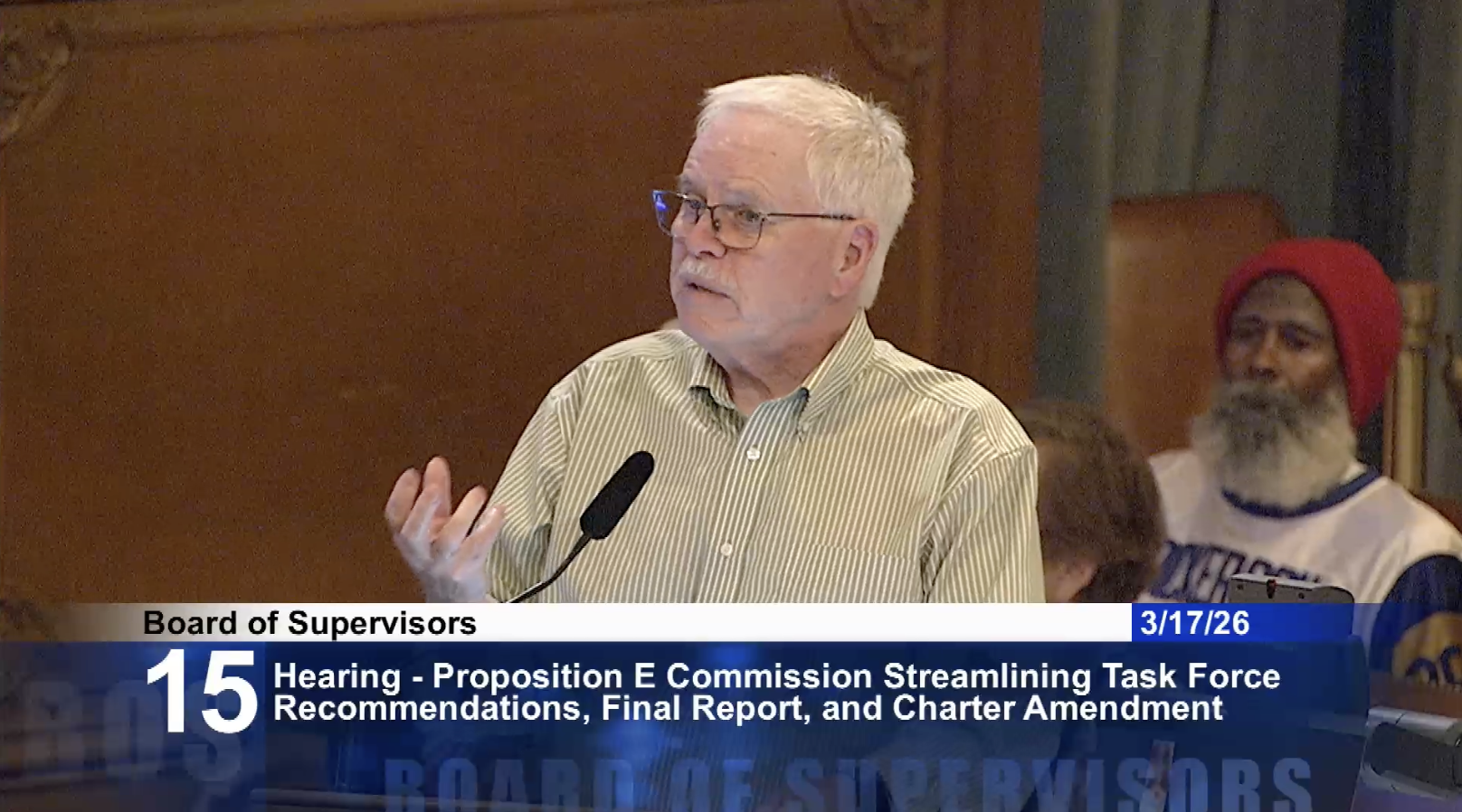
Prop E Task Force Meets a Wall of Opposition

The meeting's main event was a marathon committee-of-the-whole hearing on the Prop E Commission Streamlining Task Force's final report — a document that recommends cutting San Francisco's 152 public meeting bodies to 87, transferring roughly 20 commissions from the city charter to the administrative code, giving the mayor authority to hire and fire most department heads, making most commissioner appointments at-will rather than for-cause, imposing 12-year term limits, and adding three-year sunset dates to advisory bodies.

Why it matters: The board has roughly six weeks to decide which recommendations, if any, to include in a charter amendment for the November 2026 ballot. Whatever the supervisors forward could reshape San Francisco's governance structure for decades.

Where things stand: Task Force Chair Ed Harrington opened by conceding the panel went further than its mandate. "I also concede that what the task force did went much further than many of the advocates for Prop E had ever envisioned. And so I do understand the disconnect that's there," he said. Rachel Alonso of the City Administrator's Office walked the board through the detailed commission-by-commission analysis.

Board President Rafael Mandelman set the tone before the presentation even began, declaring it "highly unlikely" that any supervisor would introduce the task force's charter amendment or that the board would send it to voters as written. He noted the City Attorney's office was already drafting an alternative.

Screenshot 2026 03 19 at 6.21.14 AM

Police Oversight: The Live Wire

The task force's recommendation to strip the Police Commission of its independent disciplinary authority drew fire from across the political spectrum. Walton, who introduced a separate resolution to preserve the commission's powers, cited the years-long Department of Justice reform process that followed the deaths of Alex Nieto, Mario Woods and others. Under the current oversight structure, SFPD achieved "substantial compliance" with DOJ reforms in 2025, with use of force declining and officer-involved shootings cut in half.

"The streamlining task force proposal to change exactly the structure that made that possible is unjust, inequitable, and racist," Supervisor Walton said. "This decision to strip down the independent police oversight was made strictly by people in the majority."

Even the task force's own chair broke ranks on this point. "This was one of those that I did vote against," Task Force Chair Harrington told supervisors. "Not so much because I didn't think our process made more sense than the current one. But because we were the wrong people making the decision."

Supervisor Matt Dorsey called the police discipline proposal "a solution in search of a problem." Dorsey praised the task force's work overall but questioned whether police oversight changes were necessary given recent progress. He suggested the model applied to the Arts Commission — keeping the body in charter while moving operational duties to code — might be a template for other commissions.

Retired SFPD Capt. Paul Chignell of the San Francisco Police Officers Association also urged rejection, warning sole disciplinary power for the chief would be a "severe impediment to due process."

Screenshot 2026 03 19 at 6.24.47 AM

A Broad Coalition Says No

Public comment ran for hours, with speakers representing nearly every corner of the city's civic infrastructure lining up against the recommendations.

Margaret Brodkin, former head of the Department of Children, Youth, and Their Families and current Juvenile Probation Commission president, urged the board to keep children and youth commissions in the charter, calling San Francisco's model one that has been replicated nationally.

Laura Stein of the League of Women Voters called for retaining league seats on the Sunshine Task Force and Ballot Simplification Committee and protecting the independence of the Commission on the Status of Women and Ethics Commission. Flo Kelly and Jennifer Friedenbach of the Coalition on Homelessness opposed consolidating five homelessness-related committees into one advisory body, arguing it would destroy the Prop C accountability framework. Friedenbach warned that without the Shelter Monitoring Committee, standards of care are unenforceable.

Cynthia Gomez of Unite Here Local 2, speaking on behalf of multiple unions including NUHW and IBEW Locals 6 and 1245, opposed term limits, at-will commissioner removal and restrictions on ballot initiative placement, calling them anti-labor measures that would concentrate power in the executive branch. Michael Kyle of SEIU 1021 compared the commission streamlining effort to DOGE, framing it as an expansion of mayoral power.

Brandy Bowen-Bremond of Coleman Advocates and Brittni Chicuata, the Human Rights Commission director speaking in a personal capacity, added their voices — Chiquata recounting the HRC's founding in the 1964 civil rights movement and its ongoing role fighting source-of-income discrimination.

The Task Force's Core Philosophy

Harrington defended the panel's reasoning on mayoral authority, explaining "we did not believe that every other commission set up in the city was automatically set up to say no to the mayor, that there was a reason that the mayor was in charge of the city and elected." The task force's view was that at-will appointments and clearer lines of executive authority would improve accountability — a position few in the room shared.

Decisions: No action was taken. The hearing was informational only.

What's next: Mandelman closed by noting that even "the non-controversial elements" of the task force's recommendations "would be a big chunk of charter reform." He added: "We may do a little bit more than that. I don't think we're going to touch many of the live wires that folks have expressed the greatest concerns about." The board must introduce any charter amendment by approximately May to meet the November 2026 ballot deadline. The City Attorney's office is already drafting an alternative.

Screenshot 2026 03 19 at 6.11.12 AM

Chen Demands SFMTA Restore 365 Affordable Homes Cut From Potrero Yard

Supervisor Chyanne Chen introduced a resolution urging the SFMTA to honor its original commitment to deliver 465 units of affordable housing as part of the Potrero Yard modernization project at 17th and Bryant Streets.

Why it matters: The SFMTA Board of Directors approved a reduction to just 100 units — an 80% cut that eliminates 365 affordable homes from a public transit site shaped through more than 55 public meetings over eight years.

Where things stand: Chen called the decision a "tremendous, tremendous, tremendous policy failure," noting the SFMTA has identified 34 sites in its inventory for future joint development. The Potrero Yard project was meant to be the model for combining affordable housing with transit infrastructure. An 80% reduction undermines the city's housing element goals and risks eroding public trust in every future joint development proposal.

Separately, the board approved a $47.6M state grant under the Affordable Housing and Sustainable Communities (AHSC) program for 100% affordable housing and transit improvements at 1939 Market Street — a project that shows what these partnerships can deliver when commitments hold.

What's next: The resolution will move through committee. The contrast between the 1939 Market success and the Potrero Yard cuts is likely to become a flashpoint in ongoing debates over SFMTA's role as a housing partner.


Grocery Desert Grows as Supervisors Fight Lucky Closure

Supervisor Stephen Sherrill, joined by Supervisor Bilal Mahmood, introduced a resolution urging SaveMart Companies to reconsider closing the Lucky Supermarket at 1750 Fulton Street, scheduled for September 2026.

Why it matters: The store has been the critical grocery option for the Western Addition, Fillmore, Alamo Square and NoPa since the Fillmore Safeway closed in 2025. Its loss would leave seniors, families and transit-dependent residents without a nearby full-service grocery store.

Sherrill emphasized the store serves communities of color, seniors, students and working-class residents who lack reliable car access. He also called for a data-driven approach, noting: "We can't just force companies to stay open when they are losing money. That would be ignoring reality. So I'm committed to also doing the work to better understand exactly why, by data, and not just vibes, certain grocery stores are closing in certain neighborhoods across the city." (Lightly edited for clarity.)

Supervisor Mahmood said the closure "creates a serious gap in food access for seniors, families, and residents who rely on nearby grocery stores and public transit." Both supervisors acknowledged support from the mayor's office.

What's next: The resolution heads to committee. Sherrill's push for data-driven grocery closure analysis could set a citywide precedent for how San Francisco responds to the ongoing wave of neighborhood supermarket exits.


Cannabis Cafes Move Forward Under New Mandelman Ordinance

Board President Rafael Mandelman introduced an ordinance allowing cannabis businesses to prepare and serve food and non-alcoholic beverages for on-site consumption, implementing Assembly Member Matt Haney's AB 1775 at the local level.

"If we want to shrink that illicit market, I believe we should be doing what we reasonably can to support the legal cannabis industry," Board President Mandelman said. "Cannabis cafes are a real economic opportunity for these businesses to go from surviving to thriving."

The basics: Legal cannabis retailers face steep taxes and compete with a larger, untaxed illicit market. The ordinance amends the health, planning, police and business and tax codes. Mandelman credited Ben Van Houten of OEWD, Sarah Crowley in the City Attorney's Office and the San Francisco Cannabis Alliance for helping craft the legislation.

What's next: The ordinance moves to committee for hearing.


Twin Peaks Promenade Clears Final Hurdle

The board unanimously approved the street vacation and interdepartmental property transfer for the Twin Peaks Promenade Project, passing first reading 8-0 with no public comment.

Chris Towns of the Recreation and Park Department presented the project. The eastern half of the Twin Peaks Boulevard figure-eight roadway — permanently closed to vehicular traffic in 2020 — will be jurisdictionally transferred from Public Works to Recreation and Park. The promenade plan features a central asphalt pathway with an aggregate pathway along the hillside, flanked by native landscaping.

The board previously approved $4.25M in grant funding. Construction is slated to begin summer 2026, with the park opening to the public in early 2027.


Screenshot 2026 03 19 at 6.07.43 AM

Sunset Irish Cultural District Wins Board Support

Supervisor Alan Wong introduced and the board adopted a resolution expressing intent to establish the Sunset Irish Cultural District. The resolution received over 600 letters of community support in a single day.

"Irish immigrants were here from the very beginning, arriving in the 1840s and 1850s, many of them fleeing starvation and building life in a city that wasn't always welcoming," Supervisor Wong said. "By 1870, one in eight San Franciscans was Irish."

Wong emphasized that Irish cultural traditions — music, dance, language and sporting clubs — remain alive in the Sunset District. The designation would provide institutional support comparable to San Francisco's other cultural districts. Wong thanked the Irish United Cultural Center, the St. Patrick's Day Parade and the United Irish Societies of San Francisco.


Minor Items

  • SF General Hospital security contract extended through December 2026, increasing by $3.2M to $15.38M total for Allied Universal's unarmed guard services (Item 4).

  • $1.4M DHCS grant accepted for healthcare capacity expansion (Item 5).

  • $3M JPMorgan Chase grant accepted for the Stop Scams SF program (Item 7).

  • Immigration document protections ordinance passed first reading, requiring notaries to provide free or low-cost immigration legal services information (Item 8).

  • Police Commission statement of purpose adopted (Item 9).

  • Gunshot detection technology annual surveillance report approved (Item 10).

  • 2245 Post Street Special Use District established, first reading (Item 11).

  • Engine Company 33 firehouse at 117 Broad Street designated as a city landmark (Item 12).

  • 1270 Mission Street height limit raised from 120 to 200 feet under a new special use district, first reading (Item 16).

  • Sidewalk flower stand permit program updated, first reading (Item 17).

  • Downtown activation zones expanded to additional SoMa streets including Jesse Alley, Natoma and Yerba Buena Lane, first reading (Item 18).

  • Supervisor Mahmood introduced a resolution supporting AB 2017 by Assembly Member Matt Haney, which would recognize Eid al-Fitr and Eid al-Adha in California law, ensuring students and state employees can observe without penalty. Co-sponsored by Supervisor Chen.

  • Supervisor Mahmood introduced a resolution urging the Governor and Legislature to continue funding Market Match, which doubles CalFresh dollars for fruits and vegetables at farmers markets.

  • DBI Director Patrick O'Riordan honored upon retirement after 26 years. Under his leadership, median permit issuance times dropped more than 70% — from 272 days to under 80. David Kane was announced as his successor.

  • Public commenter Leah McGeever raised the case of a deaf child and his mother deported from the ICE office on Tehama Street, criticizing silence from the mayor and District 6 supervisor.

Board Largely Rejects on Prop E Task Force's Sweeping Governance Overhaul | Board of Supervisors | Locunity