
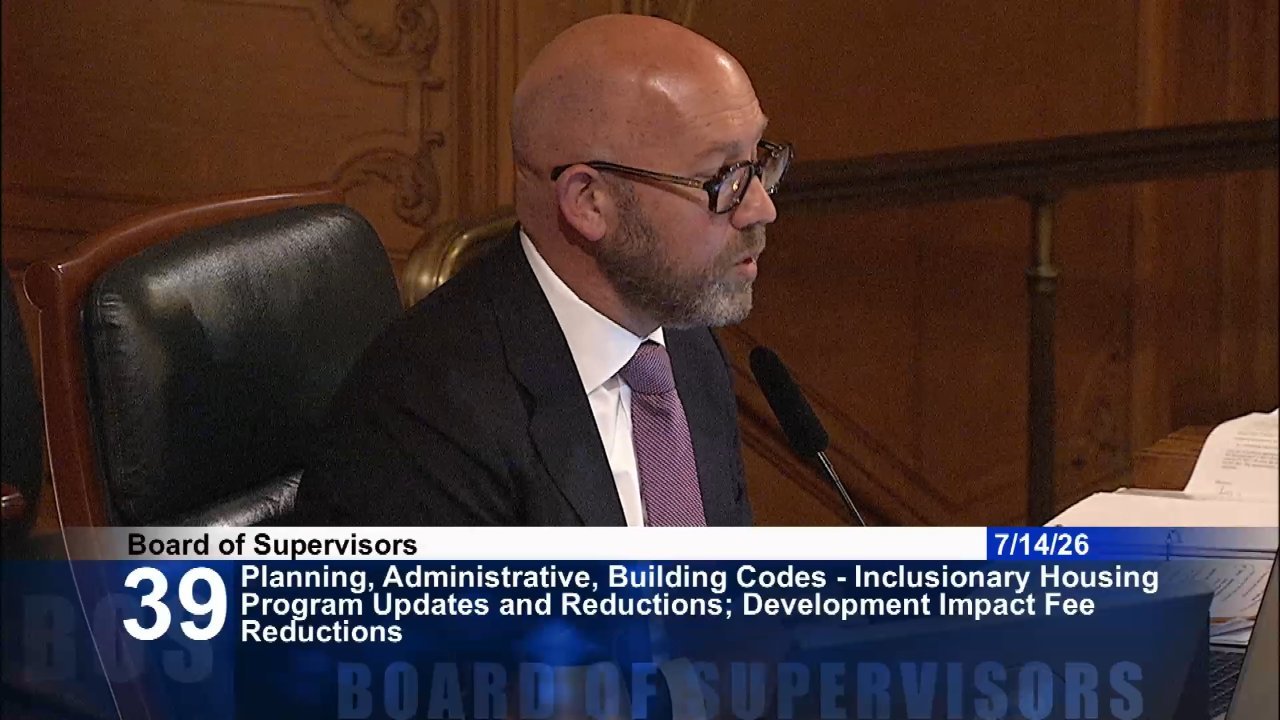
Board of Supervisors - Jul 14, 2026 - Regular Meeting
Board of Supervisors • San FranciscoJuly 14, 2026
Locunity is a independent informational service and is not an official government page for this commission.We use AI-assisted analysis and human editorial review to publish information.
Board Slashes Inclusionary Housing Fees, Passes Drug-Free Supportive Housing in Marathon Session
The San Francisco Board of Supervisors reshaped the city's housing and homelessness policy framework on July 14, cutting inclusionary housing requirements to their lowest level in years, advancing a permanent affordable housing funding source to the November ballot, and passing the city's first systematic drug-free supportive housing ordinance. Across nearly four hours of debate, familiar fault lines emerged — production versus affordability, individual choice versus systemic risk, efficiency versus oversight — with several items passing on narrow 7-4 and 6-5 votes that will define who builds what, where and for whom in San Francisco for years to come.
- Inclusionary housing fees drop from 17% to 5% citywide to restart stalled construction; a narrow 6-5 amendment carves out an 8% rate in the Mission
- Drug-free supportive housing ordinance passes 7-4 after two years of work by Supervisor Dorsey, creating new drug-prohibition requirements for city-funded PSH
- Housing Trust Fund charter amendment heads to November ballot unanimously, projecting $125 million annually for affordable housing
- AI-assisted code cleanup ordinance passes 7-4, eliminating ~140 city reporting requirements over sharp objections about process and surveillance oversight
- Commission restructuring charter amendment advances 9-2 to the November ballot, drawing criticism for concentrating power in the mayor's office
- Cannabis café permits approved 7-4, creating San Francisco's first on-premises consumption establishments
- FY2026-2028 budget introduced, closing a $642 million deficit with 50 new long-term SRO family subsidies added
Inclusionary Fees Slashed to Spur Construction
The basics: Inclusionary housing is the percentage of affordable units developers must include in new market-rate projects. San Francisco's current 17% on-site requirement has been so high that, according to the city's Technical Advisory Committee, no projects penciled out — meaning zero inclusionary fees were collected over the past three years. This ordinance drops the rate to 5% for projects of 25 or more units.
Why it matters: The city faces a paradox: requiring more affordable units per project yields nothing if nothing gets built. The Board's response was to slash the requirement while simultaneously placing a long-term Housing Trust Fund on the ballot — a strategy co-sponsor Supervisor Myrna Melgar framed as a package deal.
"What has happened if we look back at the last three years is that 0% of 0 is 0. In the past three years we have gotten 0 in inclusionary fees," said Supervisor Melgar.
Where things stand: The most contentious moment came when Supervisor Jackie Fielder introduced a floor amendment requiring an 8% on-site rate in the Mission Area Plan — 6% low income, 2% moderate — citing the neighborhood's unique displacement history.
"The Mission Area Plan is not a generic part of San Francisco. It is among the most studied, most contested and most intentionally planned areas in the city's recent history," Supervisor Fielder said.
Supervisor Bilal Mahmood supported the carve-out: "We as a board should respect supervisor prerogative and I trust her to know how to balance her shared priority policy goals with the feedback that she is getting from her constituents in the Mission."
The other side: Board President Rafael Mandelman opposed the amendment, arguing the TAC data doesn't support any rate above 5%.
"Since the tax analysis shows that the 5% does not create feasible projects, I'm not inclined to support a rate that is higher than that, even for a neighborhood that is very special and has a history of displacement," President Mandelman said.
Supervisor Shamann Walton objected to the entire premise, calling it contradictory to raise the Housing Trust Fund and cut inclusionary requirements at the same meeting. Supervisor Chyanne Chen voted against the final ordinance, arguing it forces a choice between production and affordability.
Decisions: The Fielder amendment passed 6-5 (For: Walton, Chan, Chen, Fielder, Mahmood, Melgar; Against: Sauter, Sherrill, Wong, Dorsey, Mandelman). After procedural confusion involving vote rescissions from Supervisor Chen and Supervisor Connie Chan, the full ordinance passed on first reading 9-2 (Walton and Chen voting no).
What's next: The ordinance requires a second reading before final passage.
Drug-Free Supportive Housing Clears Board After Two-Year Push
Why it matters: San Francisco currently has just one drug-free permanent supportive housing facility. Supervisor Matt Dorsey's ordinance creates the first citywide policy requiring new city-funded PSH buildings to prohibit illicit drug use on site — a voluntary option for residents who want to live in a drug-free environment. The policy does not apply to state-funded projects, existing buildings, or new construction already in the pipeline.
Where things stand: Supervisor Dorsey emphasized that the legislation is not sober housing — it permits alcohol, marijuana, and medically assisted treatment.
"This is not sober housing. It is not recovery housing. It does not prohibit alcohol or marijuana or medically assisted treatment," Supervisor Dorsey said.
He delivered an impassioned defense citing constituent Daniel McLennan, a former PSH resident and artist who testified in Sacramento in favor of reforming Housing First at the state level. Supervisor Dorsey pushed back forcefully against criticism of his use of the term "drug tolerant" to describe current PSH policy, citing California Welfare and Institutions Code 8255.
His eviction-avoidance amendment — adding language clarifying that the goal is to prevent evictions and returns to homelessness — passed 10-1, with only Supervisor Walton dissenting.
The other side: Supervisor Fielder introduced a competing amendment to remove shelter as a relocation option for residents who violate the drug-free policy, noting 762 PSH units currently sit vacant.
"Shelter is not housing. A person is not considered housed when they're in shelter. They're still considered homeless," Supervisor Fielder said.
That amendment failed 5-6 (For: Walton, Chan, Chen, Fielder, Melgar; Against: Sauter, Sherrill, Wong, Dorsey, Mahmood, Mandelman). Supervisor Chen and Supervisor Chan conditioned their overall support on the Fielder amendment and voted no on the final bill after it failed.
President Mandelman called the status quo in supportive housing untenable: "The status quo is insane. The status quo in which so many folks living in permanent supportive housing developments are consigned to deal with the most outrageous behavior from their neighbors."
Decisions: The ordinance passed on first reading 7-4 (For: Sauter, Sherrill, Wong, Dorsey, Mahmood, Mandelman, Melgar; Against: Walton, Chan, Chen, Fielder).
What's next: The ordinance requires a second reading before final passage.
Housing Trust Fund Expansion Heads to November Ballot
Why it matters: The charter amendment would expand and extend the Housing Trust Fund — which dedicates a share of property value growth to affordable housing — eventually reaching $125 million annually and extending it through 2058. Critically, the fund generates bondable revenue, meaning the city can borrow against stable future income to triple its affordable housing production capacity now.
Where things stand: Supervisor Melgar led the measure, which drew a broad coalition including the Council of Community Housing Organizations, Mission Economic Development Agency, Chinatown Community Development Center, Nonprofit Housing Association, Housing Accelerator Fund, Firefighters Local 798, and Building Trades. Supervisor Alan Wong co-sponsored, emphasizing the need to invest in a city where people of different incomes can build a life.
Supervisor Walton supported the measure but noted the tension with the inclusionary fee vote taken the same day: "I think it is arbitrary to extend the Housing Trust Fund and increase the Housing Trust Fund and at the very same meeting vote to decrease occlusionary housing."
Decisions: Passed unanimously, 11-0. The charter amendment will appear on the November 2026 ballot.
AI-Assisted Code Cleanup Passes Over Transparency Objections
The basics: The ordinance used a Stanford language model to identify 540 reporting requirements across city code, then proposes eliminating or modifying roughly 140 of them. About 380 reports remain untouched. Amendments addressed concerns from the small business community, restored domestic violence data reporting and women's representation reports from the Department on the Status of Women, and changed sexual harassment reporting from quarterly to semi-annual.
Why it matters: The ordinance reduces the Controller's annual surveillance technology audit from every year to once every five years — a change Supervisor Fielder called a threat to civil liberties.
"I have one major outstanding concern with this legislation, and that is the paring down of the Controller's annual surveillance technology audit from once a year to once every five years," Supervisor Fielder said.
President Mandelman defended the approach, explaining that AI was used to identify reports, not to write or analyze the legislation: "The way AI was used with this ordinance was that a Stanford Learned Language model was brought to bear to identify all of these reports. The ordinance was not written by AI."
The other side: Supervisor Walton sharply criticized the 350-page document for bypassing meaningful public engagement: "You should be proud to make so many changes without anyone knowing what's happening. This really should have been separated and taken up after recess with a public process."
Supervisor Melgar voted no on process grounds and delivered a pointed warning: "I just want to make a point in public to request to our city attorney, please do not ever do this again this way."
Decisions: Passed on first reading, 7-4 (Walton, Chan, Fielder, Melgar voting no).
Commission Restructuring Advances to Ballot
The Board voted 9-2 to place a charter amendment on the November 2026 ballot that would update departments, boards, commissions, and advisory bodies. Supervisor Fielder voted no, arguing the changes go far beyond voter intent in Proposition E (2024) by concentrating power in the mayor's office. Supervisor Chan also dissented, saying eliminating advisory bodies is not in the city's best interest.
What's next: Voters will decide in November 2026 whether to approve the restructuring.
BART Plaza Cleanup: Early Wins, but Service Offers Mostly Declined
During the Mayor's appearance before the Board, Mayor Daniel Lurie reported early results from a 90-day multi-agency effort at the 16th and 24th Street BART plazas.
"Routine patrol checks are up 56% at 16th Street and 36% at 24th Street with major increases in narcotics enforcement, moving violations and felony arrests," Mayor Lurie said.
The effort has produced 300 warnings and citations against illegal fencing, new lighting and cameras, ambassador deployment, and encampment reports down 8% at 16th Street and 30% at 24th Street. A dedicated Department of Public Health outreach team handles behavioral health and medical needs.
However, Mayor Lurie acknowledged conditions worsen at night and nearly three-quarters of service offers are declined. Supervisor Fielder, who requested the hearing, noted she continues to receive complaints and see problems firsthand.
Board Opposes Federal Closure of National Archives
The Board unanimously adopted a resolution urging the National Archives and Records Administration to halt the closure of its San Francisco facility in San Bruno.
Public commenter Julie Hsu of Save Our National Archives testified that the facility holds Chinese Exclusion Act documents, Japanese American relocation records, Port Chicago documents, and Angel Island immigration files. Public commenter Jenny Liu, a 25-year SONA advocate, emphasized the archives contain coaching documents with detailed village maps that are the only link to ancestral villages for many Chinese American families — records she described as irreplaceable and critical to family reunification research.
Decisions: Adopted 11-0 alongside a companion resolution supporting AB 1448, the California Coastal Sanctuary Act.
Minor Items
- Cannabis café permit ordinance finally passed 7-4 (Wong, Chan, Chen, Melgar voting no), creating a new Office of Cannabis–administered permit for on-premises cannabis consumption.
- Speed camera resolution adopted 10-1 (Walton no), affirming Board support for expanding the Speed Safety System pilot program on high-injury corridors.
- Grant acceptance threshold raised from $100,000 to $1 million without Board approval, passed on first reading.
- FY2026-2028 budget items introduced with Budget Chair Connie Chan presenting Board spending plan amendments. Eliza Pugh of the Mayor's Budget Office presented a $3.7 million technical adjustment for the Sheriff's Office. Supervisor Chen secured 50 new long-term housing subsidies for families in SRO units through the Our City, Our Home spending plan. All budget items continued to July 21.
- Ballot Simplification Council appointments: Betty Packard and Ruth Grace Wong confirmed, 11-0.
- Azalina Eusope reappointed to the Sanitation and Streets Commission, 11-0.
- Consent items approved 11-0: liquor establishment conditions, Harry Street waste bin, and Chestnut Street entertainment zone.
- Supervisor Walton introduced a Budget and Legislative Analyst request to analyze the fiscal impact of Mayor Lurie's charter reform ballot measures, calling the proposals a shift of "real power away from the Board of Supervisors, independent commissions and from the residents of San Francisco."