
Supervisors Advance Hotel Workers' Right to Sue Over Cleaning Rules
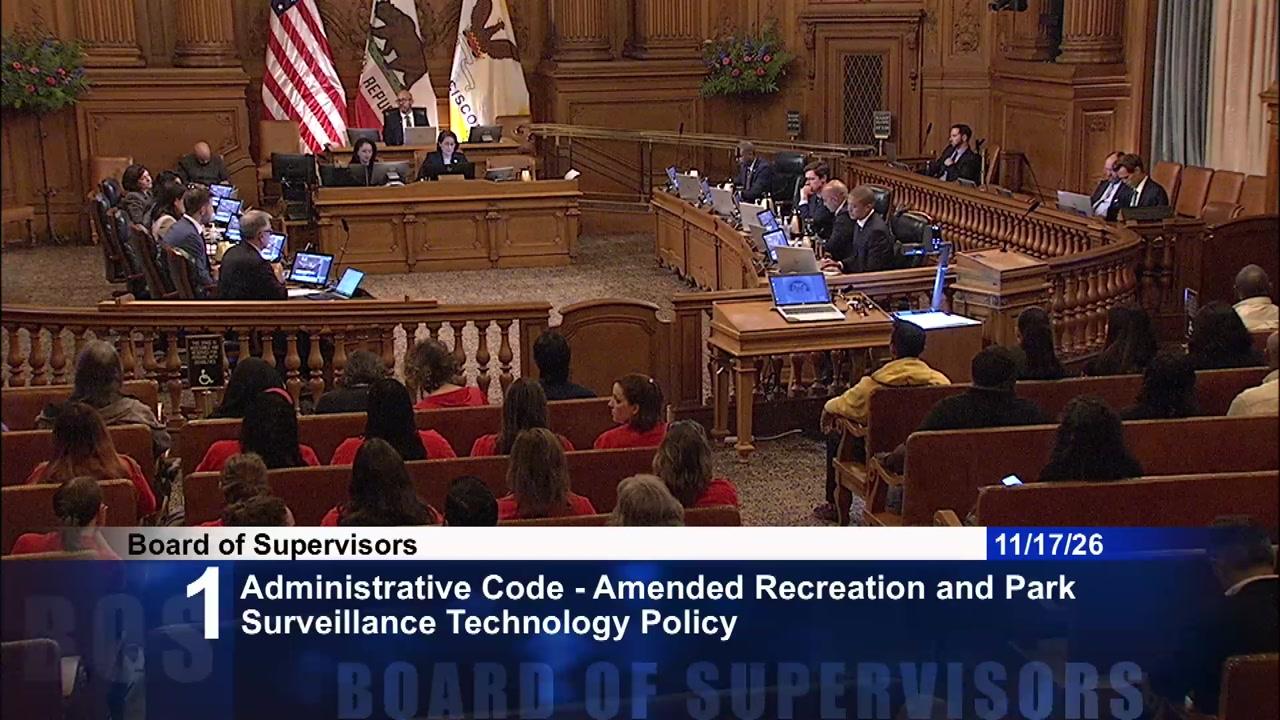
Board of Supervisors • San FranciscoNovember 17, 2026
Locunity is an independent informational service and is not an official government page for this commission. All information is sourced from public footage and an analysis of official agendas with the aid of responsible, fact-checked AI. to report an error or omission.
Hotel housekeepers and their unions moved a step closer to taking hotel operators to court over cleaning violations. At its Nov. 17, 2026, meeting, the San Francisco Board of Supervisors rejected a bid to send the measure back to committee and passed it on first reading, 9-2. The Board also extended its citywide data center pause, released $1.76M for immigrant legal defense, and heard residents call for a permanent ban on data centers and action against AI companies.
- Hotel cleaning lawsuit measure passes first reading 9-2 after a 2-8 failed referral to committee
- Data center moratorium extended 10 months and 15 days as residents push for a permanent ban
- $1.76M from the general reserve goes to immigration legal defense; four Immigrant Rights Commissioners appointed 11-0
- $6.5M Crankstart grant for PermitSF staffing, a 60-bed recovery program and a police sexual assault resolution, adopted 11-0, headline new business
- Rec and Park license plate readers approved 9-1 over objections to Golden Gate Park paid parking
Hotel Workers Gain a Path to Court
The basics: Item 36 amends the Health Code so tourist hotel employees, or the unions that represent them, can file civil suits over violations of the cleaning and disease-prevention standards in the Healthy Buildings Ordinance, which passed in 2020. This kind of enforcement tool is known as a "private right of action." Courts could impose civil penalties and equitable relief.
Why it matters: The measure shifts some enforcement from the city to workers themselves. The hospitality industry argues the underlying pandemic-era cleaning rules are outdated.
Where things stand: Chyanne Chen, Supervisor, District 11, presented the measure as a compliance tool. "My amendment to the Healthy Buildings Ordinance gives workers and worker representatives the right to private action as a means to ensure that hotel operators comply with cleaning standards," said Supervisor Chen. She called daily cleaning a baseline expectation and said room cleaners without union representation fear retaliation. She also said a duplicated file, a copy of the ordinance that can be amended separately, will add a Department of Public Health investigation step before any suit can proceed.
That pending amendment won over a skeptic. Matt Dorsey, Supervisor, District 6, said he is generally wary of private rights of action and pointed to other San Francisco laws that already include them. "I am satisfied that before this law will become operative, the ordinance will require a DPH finding of an actual violation for any such suit to proceed," said Supervisor Dorsey.
Shamann Walton, Supervisor, District 10, framed the measure as accountability for bad actors. "If you do not respect our laws, then there should be an enforcement mechanism and a consequence," said Supervisor Walton.
The other side: Danny Sauter, Supervisor, District 3, cited hotel-industry requests for a continuance. "I believe any conversation about strengthening enforcement of this legislation should be paired with improvements to the base cleaning requirements," said Supervisor Sauter.
Stephen Sherrill, Supervisor, District 2, opposes private rights of action generally and tried to slow the bill. "I'd like to make a motion to send this back to committee so that these amendments can be carefully considered, voted on, added, and then consider moving forward," said Supervisor Sherrill.
Decisions and stakeholder impacts: The referral failed (For: 2, Sherrill and Sauter; Against: 8; Absent: 1, Connie Chan). Walton then moved to close debate, seconded by Sherrill, and the motion passed. The Board held the final vote until Connie Chan, Supervisor, District 1, returned from jury duty.
The measure then passed first reading (For: 9, Walton, Wong, Chan, Chen, Dorsey, Fielder, Mahmood, Mandelman and Melgar; Against: 2, Sherrill and Sauter). Hotel workers and their unions gain a new enforcement lever. Hotel operators face potential litigation once DPH confirms a violation, under the amendment now being drafted.
What's next: The ordinance needs a second reading. The DPH-finding amendments are moving separately in the duplicated file.
Data Center Pause Extended as Critics Push for More
Why it matters: The extension keeps new data centers out of San Francisco while the city studies effects on electricity, water, air and noise. Planning said those effects carry significant uncertainty.
Where things stand: The Board adopted the Planning Department's report on the original 45-day moratorium. It then passed an urgency ordinance extending the pause by 10 months and 15 days under Government Code Section 65858, which requires nine votes. Both items passed "same house, same call," meaning the Board reused an earlier roll call. No separate tally was announced.
Walton said the Land Use and Transportation Committee backed the extension unanimously. He said the extension "will provide a time to determine what impacts data centers will have in our communities." He summarized the report's concerns about grid capacity, water and wastewater, air pollution from backup diesel generators, and noise. He also acknowledged that community members and labor had complained they were left out of the initial assessment, and he promised to include them going forward.
The other side: During general public comment, several residents called for a permanent citywide ban. They cited electricity and water use, rent and public opposition. Ishwar, a District 8 resident, said the Planning report "lacks direct input from communities." He also tied AI to housing costs and ICE's use of AI software.
Others went further. Guido Reichstatter, an organizer with Stop AI, announced a blockade of Anthropic and invited supervisors to join. "Why are you not taking action to shut down this continuing public nuisance caused by the creation of these uncontrollable, unpredictable AI systems which are already causing harm," he said. Another commenter, Wind Kaufman, quoted Anthropic's IPO filing on catastrophic and uninsurable AI risks.
Decisions and stakeholder impacts: The clerk interrupted some data center remarks because the items had already received public comment in committee. "The data center question has received public comment at the meeting yesterday," said Brad Rossi, Deputy City Attorney. Other comments about AI were allowed. Developers remain barred from building data centers citywide. Residents who want a permanent ban have about 10 months to make their case.
What's next: Planning's study continues during the extension, with the inclusion of community members and labor that Walton promised.
Immigrant Defense Funding and ICE Appeals
Where things stand: The Board appropriated about $1.76M from the general reserve to the Mayor's Office of Housing and Community Development for coordinated immigration legal defense and community response. The appropriation required eight votes under Charter Section 9.113(c) and passed same house, same call.
The Board also appointed four members to the Immigrant Rights Commission, 11-0: Jesse Ruiz Navarro, Cesar Alejandro Perez Monreño, Laura Padilla and Adubu Charore. The Board waived the residency requirement for Charore.
Why it matters: The money expands legal defense capacity as residents press the city on federal immigration enforcement.
The other side: Carolyn Reed, a public commenter, urged the Board, and Supervisor Bilal Mahmood in particular, to mobilize legal defense resources. She asked the Board to "pass a resolution calling for ICE to release USF nursing educator Dr. Anne Lawani," who she said had been moved to Louisiana. Dwight, a District 8 resident, asked why ICE and DHS vehicles are allowed to park at an SFMTA garage at Washington and Battery streets in a sanctuary city. Leah McGeever, another public commenter, also cited ICE vehicles at an SFMTA site. No Board response was recorded.
New Business: Permits, Recovery Beds, Police Reform
Where things stand: Sherrill introduced a resolution to accept and spend a $6.5M Crankstart Foundation grant. The grant would fund 13 new staff for three years to speed up PermitSF, with money released in stages as the work progresses. "San Francisco is the slowest permitting city in California," said Supervisor Sherrill.
Bilal Mahmood, Supervisor, District 5, introduced legislation "to authorize Casa Loma a 60-bed recovery housing program at 610 Fillmore Street in Alamo Square." The Salvation Army would operate the program as part of the One City Shelter Act approach.
Rafael Mandelman, Board President, called for a hearing on behavioral health placement capacity for people with severe mental illness. The hearing will cover Prop 1-funded locked subacute beds, community conservatorship and advocacy at the state level. It is headed to the Public Safety and Neighborhood Services Committee.
Decisions and stakeholder impacts: Myrna Melgar, Supervisor, District 7, introduced a resolution urging the Police Commission and Police Department to adopt seven recommendations on how they handle sexual assault cases. She cited data that 78% of rape cases fell into an inactive category in 2025. The Board adopted the resolution as item 45 without committee reference, 11-0. That route requires a unanimous vote.
What's next: The PermitSF grant and the Casa Loma legislation go through committee. Mandelman's hearing will be scheduled at Public Safety and Neighborhood Services.
Park License Plate Readers Clear, With One Dissent
The Board approved Rec and Park's amended surveillance policy for vehicle-mounted automatic license plate readers, 9-1 (Against: Wong; Absent: Chan). Alan Wong, Supervisor, District 4, pulled the item from the consent agenda. He said constituents are worried about the paid parking program scheduled for Golden Gate Park in January, and he called it too expansive. He said the license plate readers' efficiency goals were worthwhile, but added: "I'm not prepared to authorize additional enforcement capabilities for a program whose scope and impact I have serious reservations about," said Supervisor Wong.
The Airport's amended surveillance policy, which covers license plate readers, ground transportation and parking systems, passed first reading without objection.
- Transamerica Pyramid: The landmark ordinance for 600 Montgomery Street went back to the Land Use committee after Sauter said an ownership change requires minor changes.
- Port resilience: Port capital projects addressing flooding, sea level rise or seismic risk were exempted from financial feasibility studies, 11-0, on first reading.
- Routine measures: Consent items passed 10-0. The Board also gave final approval to home kitchen (MEHKO) permits 10-0, advanced an Ethics Commission disclaimer website rule, and named Anderson J.B. Williams Way and Jace Young Way.
- Commendations: Honorees included the Presidio Theater, Wu Yi Children's Services, the African American Construction Collective, the Asian Firefighter Association and Meredith Dodson of SF Parents.
- Labor voices: Vince Courtney of the San Francisco Labor Council urged support for SFHP Workers United. Pete Wilson, president of TWU Local 250A, warned against adding duties for health inspectors without adequate funding.
Looking ahead: The hotel cleaning ordinance returns for a second reading while DPH amendments take shape. SFHP Workers United supporters turn to the San Francisco Health Plan board meeting on Nov. 18.