
SFO Commission Locks $325.65M Cargo Price, Flags $77.8M Terminal Overrun
Airport Commission • San FranciscoNovember 3, 2026
Locunity is an independent informational service and is not an official government page for this commission. All information is sourced from public footage and an analysis of official agendas with the aid of responsible, fact-checked AI. to report an error or omission.
San Francisco's Airport Commission committed hundreds of millions of dollars to three major construction projects on Nov. 3, 2026, including a final price on what staff called the nation's first fully automated, multilevel airport cargo building. Every item passed 5-0, but staff disclosed a forecast $77.8M overrun on Terminal 3 West, and commissioners questioned a thin bidder pool and an untested consulting model before signing off.
- $325.65M guaranteed maximum price set for Cargo Building 626.1 with Clark Construction
- Terminal 3 West contract climbs to $2.1B, with a $77.8M overrun forecast and remaining work targeted for around 2030
- Commissioners press staff on whether procurement consultants deliver results before approving a first-of-its-kind RFQ
- $9.5M noise insulation contract awarded after only one proposal, raising questions about a shrinking market
- CLEAR lease awarded with a $5M annual floor, and an RFP opens for 12 terminal food leases with 16-year terms
- Identity Project tells commissioners to act on immigration enforcement data sharing, and the director says SFO shares no passenger data
Big Builds, Big Numbers: Three Capital Projects Advance
The basics: A guaranteed maximum price (GMP) caps what the airport pays a design-build contractor. Once it is set, the contractor generally absorbs the remaining cost risk.
Why it matters: The three approvals add roughly $390M in commitments across cargo, terminal and utility work, the backbone of SFO's capital program. One project is running over budget.
Where things stand: The largest item sets a final GMP of $325.65M with Clark Construction Group for Cargo Building 626.1, funded through Phase 1.5 of the airport's ASCEND program. Structural steel topping is complete, and substantial completion is expected in March 2028.
"Cargo 626 will be the first multilevel, fully automated cargo facility in an airport in the country," said Claudia Luquin, Director of Project Management.
Terminal 3 West is the pressure point. Phase C22 adds $43,377,910 to Turner Construction's contract, bringing the not-to-exceed amount to $2.1B. The phase covers design services and trade packages 43 and 44. Bids averaged about 2.5% above engineer estimates. Staff attributed the gap to abatement and unforeseen conditions, including existing utilities.
"We continue to forecast an impact of $77.8 million, which is about 2.8% over the contract budget," Luquin said.
Staff said they are pursuing mitigation, including possible scope deferment. The project is about 81% procured. Four gates are targeted to open in April 2028, and the remaining work is now targeted for around 2030.
The West Field Utilities and Paving Project got a $21.9M increase with Nibbi Bros. Associates, bringing that contract to about $144M. The phase covers approved change orders for contaminated soil disposal and extended management fees, plus an electrical substation and roadway improvements. Bids came within 5% of estimates, the project is forecast at $156M within budget, and substantial completion is expected in March 2027.
Decisions and stakeholder impacts: All three items passed 5-0 (For: 5, Mark Buell, Susan Leal, Jose Fuentes Almanza, Nancy Tung and Suzy Jones; Against: 0; Absent: 0). Commissioners asked no questions, and no one spoke during public comment. Local Business Enterprise (LBE) firms gain from the cargo project's subcontracting requirements of 20% for design and 14% for construction. Airport budgets and, ultimately, airlines and travelers bear the Terminal 3 West overrun if mitigation falls short.
What's next: Watch whether staff return with specific scope deferrals on Terminal 3 West.
Commissioners Ask: Does Procurement Advice Pay Off?
Why it matters: This item drew the meeting's longest policy exchange. It sets up a new consulting model the airport has not used before.
Where things stand: RFQ No. 50468 creates three prequalified pools of firms for strategic procurement advisory, organizational development and training services. The RFQ stays open for two years.
"Placement in a prequalified pool does not guarantee a contract award," said Ronda Chu, Chief Financial Officer. She added, "This is probably the first in procurement advisory services."
Staff said they were unaware of other city departments doing this and could not cite direct airport contracts.
The other side: One commissioner pushed for proof. "Are there other airports anywhere in the world that are doing this?" the commissioner asked, then followed up: "Do we know that these actually provide a benefit?"
Staff said other airports are pursuing procurement advisory work and benchmarking, and they offered to research the question and report back. The only evidence offered was informal feedback from peers. "They have had really good improvements in their procurement processes and staff knowledge through the assistance of advisory services," said Yen Pang, Director of Procurement Services.
Decisions and stakeholder impacts: The RFQ passed 5-0. Consulting firms gain a new entry point, but pool placement carries no guarantee of work.
What's next: "My understanding is you'll be back to the Commission when these pools are formed for approval," said Commission President Mark Buell. Staff also owe commissioners research on peer airports.
One Bidder for Noise Insulation Work
Why it matters: The Noise Insulation Program reduces aircraft noise for nearby communities, and federal grants can reimburse up to 80% of eligible costs. A one-bid market limits the airport's leverage on price and performance.
Where things stand: The Commission awarded a four-year, $9.5M project delivery contract to CSDA Design Group. A 5.12% small business participation goal applies.
"Despite extensive outreach, we only received one proposal in response to the request for proposals," said Luquin. Staff said interested firms declined to bid because of the expense and prior commitments to other airports.
The other side: "Are we seeing a trend in minimal bids being proposed?" a commissioner asked.
Luquin said the last procurement, about four years ago, was similar. She said staff spent six months on outreach trying to widen the pool. "There are not that many companies that will provide these services," she said.
Decisions and stakeholder impacts: The award passed 5-0. Residents in insulation-eligible neighborhoods get continuity, while competition for this niche work remains thin.
Revenue Moves: CLEAR Stays, Food Leases Open Up
Why it matters: Concession revenue helps fund airport operations. These two items cover a growing tech-enabled service and more than $70M in projected food and beverage sales.
Where things stand: Alclear, LLC, known as CLEAR, has operated at SFO for 14 years across six checkpoints. Staff said it is the only TSA-authorized company providing e-gates without TSA staffing. The new lease runs five years, with two 2-year options.
"Rent is the greater of a minimum annual guarantee of $5 million or 12.5% of gross sales up to $40 million, plus 15% of gross sales over $40 million," said Cheryl Brennan, Director of Revenue Development and Management.
Present sales are a little over $42M. When a commissioner asked whether the $5M floor should be higher, staff said percentage rent is expected to exceed it. "So I'm a member, so I'm helping to pay the airport," Buell remarked.
The Commission also launched an RFP for 13 locations, bundled into 12 leases, across Terminals 2 and 3. Changes include grab-and-go markets, broader permitted cuisines and two small business set-asides. "The term for these leases is 16 years," Brennan said, the longest yet for food and beverage.
A commissioner asked how the airport reaches diverse new operators. Staff cited neighborhood outreach, conferences, the Office of Small Business and wide publication of RFPs. Asked by Buell about Lark Creek, staff said all of the leases are expiring.
Decisions and stakeholder impacts: Both items passed 5-0. Incumbent operators face open competition, and small businesses get dedicated set-asides.
What's next: The agenda notes the CLEAR lease also requires Board of Supervisors approval.
Immigration Data Sharing Returns to the Podium
Why it matters: A civil liberties group says the airport is ignoring its concerns about federal immigration enforcement. Airport leadership disputes that SFO shares passenger data.
Where things stand: Edward Hasbrouck of the Identity Project asked commissioners to put the matter on their next agenda. He alleged that contract 50387, which provides facial recognition services to U.S. Customs and Border Protection (CBP), is illegal. He had tried to raise the issue earlier, during the Director's Report, and was redirected to general public comment.
"There has been no response, no engagement, and most importantly, no action whatsoever by airport staff on any of the specific requests for action which we made 2 months ago," Hasbrouck said. He closed with: "Please do your job."
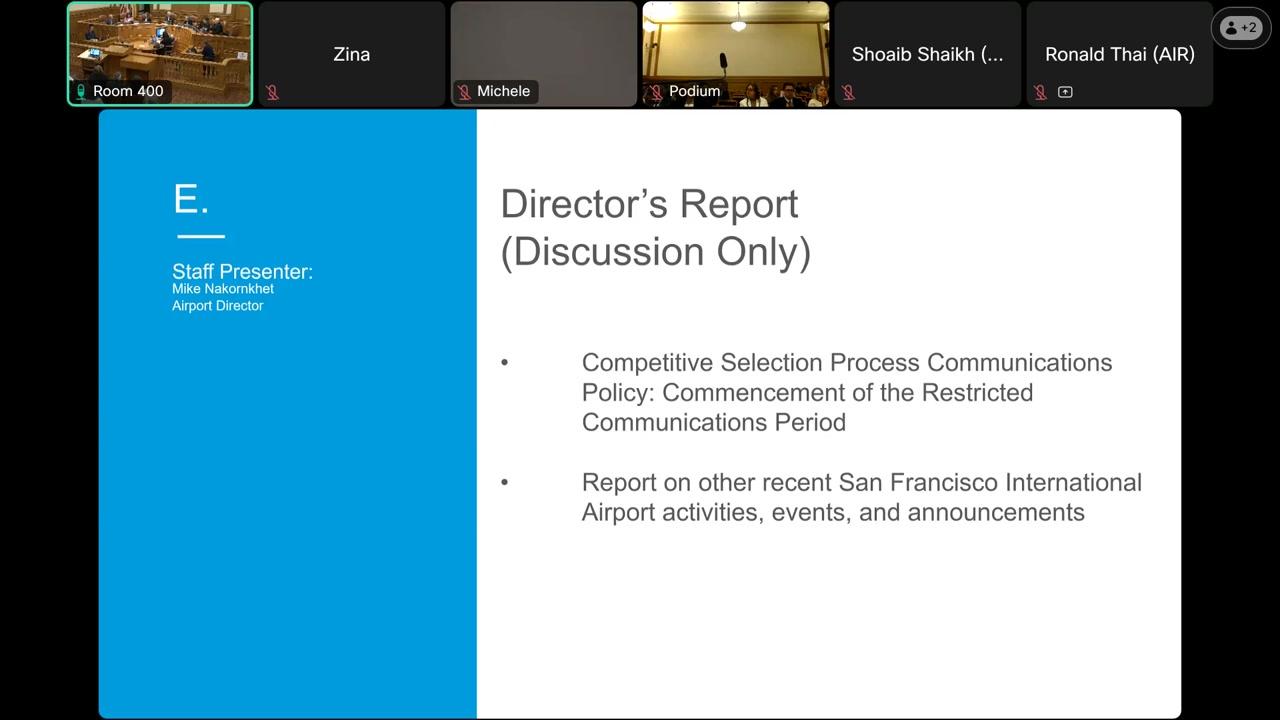
The other side: "I want to continue to stress that SFO is not involved in the sharing of passenger information for immigration enforcement purposes," said Airport Director Mike Nakornkhet. He said the airport replaced its signage with digital advisory signs, added multilingual QR-code materials, and trained staff and about 70 SFPD ambassadors.
What's next: Commissioners did not comment, take action or commit to placing the item on a future agenda.
Minor Items
- Retirements: The Commission unanimously honored Security Access Office staffers Zina Booker, Michele Parente and Marites Asido, who each served 10 to 12 years.
- Electrification bids: The Commission authorized bids for HVAC, heating electrification, roof and solar upgrades at cargo buildings 900 and 944 and the police training facility. Construction is estimated at $19.5M to $22.6M over 500 days, with a 20% LBE requirement.
- Consent calendar (5-0): Approved items include reissuing the identity management system RFP, raising five micro-LBE environmental contracts, extending shoreline protection review work, relocating the Tom Lantos plaque, and extending the Airport Butler concierge lease.
- Winter readiness: The director reported El Niño and king tide preparations, including added pumping and backup power, plus coordination with the Coast Guard on shoreline protection.
- Closed session: The Commission discussed a potential State of California hazardous waste claim and voted 5-0 not to disclose the discussion. Any settlement would need Board of Supervisors approval.
Looking Ahead
The Airport Commission next meets Nov. 17, 2026.