
BCDC Sends Berkeley Waterfront Paid Parking to Full Permit Hearing
Commission • San Francisco Bay Conservation and Development CommissionAugust 6, 2026
Locunity is an independent informational service and is not an official government page for this commission. All information is sourced from public footage and an analysis of official agendas with the aid of responsible, fact-checked AI. to report an error or omission.
Berkeley wanted to begin charging for parking at its waterfront through a quiet administrative sign-off. On Aug. 6, 2026, the San Francisco Bay Conservation and Development Commission voted 12-7 to reject that fast track and require a full major permit hearing. The rest of the agenda pointed to growing pressure on shoreline governance, from new sea level rise contracts to a federal review that could put agency funding at risk.
- Berkeley paid parking pilot pushed to major permit review, 12-7, after nine public speakers objected
- Consent calendar passes 18-0-1, approving SPUR and Arcadis contracts for sea level rise planning
- Speakers press for an environmental review of San Francisco Marina's Gas House Cove project before staff weighs in
- NOAA reopens its review of California's coastal program, with federal funds at stake and comments due Aug. 22
Berkeley's Parking Pilot Gets a Public Hearing
The basics: Under BCDC rules, a "minor repair or improvement" can be approved administratively by the executive director unless commissioners object. If commissioners object, the application becomes a major permit, which requires a public hearing and a staff report.
Where things stand: Berkeley proposed charging $1 per hour, $6 per day or $500 per year, from 9 a.m. to 5 p.m., at three waterfront lots. Staff conditioned the approval to "make that a limited-term 3-year pilot," said Principal Shoreline Development Analyst Lindsay Martin. Usage would be monitored, and Berkeley would have to return to BCDC to extend the pilot.
Deputy Director Christina Erickson of the City of Berkeley Parks, Recreation and Waterfront Department gave the waterfront's parking inventory as "2,200 total, 1,000 free, 270 proposed for paid parking." According to counsel, only about 53 of those spaces fall within BCDC's jurisdiction. Counsel said the legal test is whether the change in use has a significant adverse effect on existing public access.
Why it matters: This would be the first paid parking for the general public at the Berkeley waterfront. The debate centered on public access, the area's designation as a park priority use and equity. Berkeley's finances were not the deciding issue.
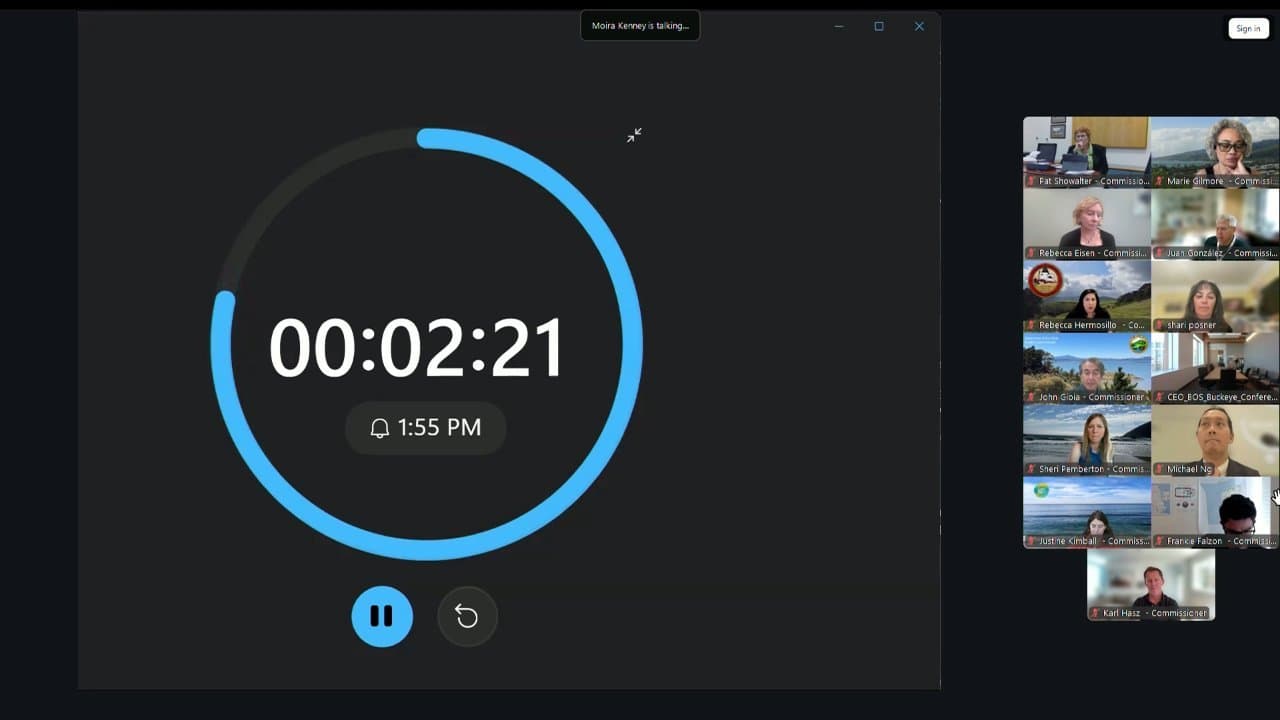
The other side: Nine public speakers urged the commission to require a major permit. Camille Antonori, co-founder of the Berkeley Waterfront Community Coalition, which has more than 130 members, said a Coastal Conservancy grant presumed free parking. She also argued the fees piecemeal parking rules from the not-yet-approved Pier Ferry project, a point echoed by Moira Kenny and Nancy Okada. Erin Diem, a former chair of Berkeley's parks commission, cited a parking study showing that lower-income visitors use the affected lots. Allison Granzella, a Cal Sailing Club volunteer, said the lots serve the only recreational docks. Paul Kamen warned that dragon boat paddlers and M Dock berthers would be displaced. Another former parks commission chair questioned Berkeley's projected $185,000 in first-year revenue.
The debate: Commissioner Nelson cited free public access parking, park priority use and equity. "Those three to me suggest that there's enough of a nexus that I think I will object and suggest that we should vote on this," Nelson said. Commissioner Gilmore argued the pilot condition "is acting more like the end result of a major permit than an administrative permit." Commissioner Gonzalez backed staff: "I like regulatory certainty. I accept staff's recommendation." Commission Chair R. Zachary Wasserman warned against letting public controversy over matters outside BCDC's jurisdiction elevate an administrative item. "I do not think that is the standard," he said.
Decisions and stakeholder impacts: Nelson's motion passed (For: 12, Against: 7, Abstain: 0; absences not reported). Commissioner Ahn, Commissioner Gunther, Commissioner Showalter, Vice Chair Rebecca Eisen and Wasserman were among the identified "yes" votes. Commissioner R. Sean Randolph voted no. Counsel advised federal commissioners not to vote. Wasserman stressed that the commission was "not deciding in any manner on the merits." Waterfront users and the coalition won a full public process. Berkeley now faces a slower, more conditioned path.
What's next: The application returns as a major permit with a public hearing. No date has been set.
Sea Level Rise Contracts Clear Consent
Where things stand: The commission approved the June 18 minutes and two contracts. A SPUR contract will study how to reduce governance barriers to effective, efficient and funded climate adaptation. An Arcadis contract will produce guidance on the economic analysis local governments need for subregional plans under SB 272. Dollar amounts were not given.
Commissioner Patricia Showalter moved approval. She warned that "it's outside of the scope of any kind of municipal agency to do the modeling that's needed to check that every restoration project that goes forward is going to have a net positive effect." Commissioner Andrew Gunther asked that Arcadis's work not rely on a "proprietary approach that can't be revisited 5 years, 10 years down the road." He also asked about groundwater rise. A staff member replied that the contract would sketch "the contours" of a possible regional analysis rather than perform one, and that deliverables would be shared.
Decisions and stakeholder impacts: The calendar passed by roll call (For: 18, Against: 0, Abstain: 1). Commissioner Eddie Ahn abstained. Earlier, an unidentified commissioner had asked to avoid voting on the Arcadis contract, and counsel advised them to simply not vote. Cities and counties drafting subregional plans are the main beneficiaries of the guidance.
Gas House Cove Project Draws Early Fire
Where things stand: Two speakers used general public comment to flag San Francisco Marina's Marina Improvement and Remediation Project at Gas House Cove. The project is expected before the full commission in October or November. "The Marina Improvement and Remediation Project is bad for water quality," said public commenter Dan Clark, citing a submitted water quality study and a contested dock design.
Why it matters: Maggie Hallahan, a commissioner on the California Boating and Waterways Commission and a member of the Harbor Safety Committee of San Francisco Bay, called the fuel dock vital for emergency response. She pointed to closures of other Bay fuel docks. "I'm asking BCDC, before this gets to staff recommendation, to ask for an EIR, which hasn't been done in 19 years on this project," she said. She asked that the cost be charged to SF Rec and Park.
What's next: The commission took no action.
Federal Review Puts Coastal Funding at Risk
Where things stand: NOAA has reopened its evaluation of the California Coastal Management Program after the Secretary of Commerce raised questions about the state's three coastal agencies. Wasserman said the agency has received about 9,000 letters. Wasserman and the executive director will testify in Santa Monica.
Why it matters: Wasserman said a negative NOAA finding would suspend federal funds to BCDC, the Coastal Commission and the Coastal Conservancy. He noted the Coastal Commission would be hit harder.
What's next: Planning Director Jessica Fain said NOAA will hold virtual meetings, and written comments are accepted through Aug. 22. A full report is expected at the Sept. 3 meeting.
- Sand mining ex parte ban: BCDC received three sand mining permit applications on Aug. 3. Commissioners are now barred from outside communications on them until the commission acts, which is expected by early next year.
- Sediment reuse hearing set: A Bay Plan amendment on reusing dredged and excavated sediment goes to public hearing Oct. 15. A vote is expected in late November or early December.
- SB 272 staffing: BCDC will have 14 permanent positions after converting four limited-term staff, with one hire remaining. The first peer learning session drew 44 jurisdictions.
- New San Francisco alternate: Madison Tam, legislative director for Supervisor Dorsey, joined as an alternate commissioner.
- Intern briefing: Four summer interns presented work on sand mining species mapping, tide gates and a permit compliance workshop. They recommended creating an alumni database.
Looking ahead: A briefing on BCDC jurisdictional determinations was postponed to a later date. The Bay Adapt summit is set for Nov. 9 at the Exploratorium, and the next peer learning gathering is Oct. 14.