Commission - Jun 04, 2026 - Meeting
Commission • San Francisco Bay Conservation and Development CommissionJune 4, 2026
Locunity is a independent informational service and is not an official government page for this commission.We use AI-assisted analysis and human editorial review to publish information.
BCDC Launches Landmark Sediment Reuse Overhaul as Federal Threats Loom
The San Francisco Bay Conservation and Development Commission kicked off its most ambitious policy revision in years — a plan to make beneficial reuse of dredged sediment the default over disposal — while its chair warned that the federal government is simultaneously auditing California's coastal agencies and destroying the ocean monitoring infrastructure they depend on.
- Commission launches first public workshop on Bay Plan Amendment 126, a policy overhaul to prioritize wetland restoration over sediment disposal
- Chair warns the Secretary of Commerce has ordered a NOAA audit of California coastal zone agencies including BCDC, citing offshore oil leasing and SpaceX as grievances
- Federal government dismantling $380 million in sea level monitoring buoys, threatening the data foundation for climate adaptation planning
- Permit program streamlined 16-0-1 ahead of new regulations taking effect July 1, eliminating two permits and 20 categories of minor activities from BCDC oversight
- Commissioner frames sediment work as generational, comparing it to building cathedrals and warning about presidential misinformation on sea level rise
Almost 700 Salesforce Towers of Sediment: BCDC Begins Rewriting the Rules
The commission devoted the bulk of its June 4 meeting to the first public workshop for Bay Plan Amendment 126, a policy proposal that would fundamentally change how dredged sediment and excavated soil are managed across the nine-county Bay Area. The amendment, formally initiated May 7, aims to shift the default from dumping material in the ocean or open bay to using it to rebuild the tidal wetlands that buffer communities against flooding and sea level rise.
The basics: San Francisco Bay has lost 90% of its tidal wetlands over 225 years. Scientists estimate those remaining wetlands and mudflats will need between 450 and 650 million metric tons of sediment to survive projected sea level rise of 1.5 to 3 feet by 2100. Current BCDC policies address only navigation dredging, leaving flood control channels, streams and upland soil outside the framework.
Why it matters: Between 2013 and 2024, the Bay Area averaged 41% beneficial reuse of dredged material — but hit 73% in 2023 when additional funding was available, demonstrating that the barrier is policy and money, not feasibility. Only two sites in the region currently accept material for restoration, a bottleneck the amendment seeks to break open.
"Scientists predict that our tidal wetlands and mudflats will need between 450 to 650 metric tons of sediment to survive sea level rise through 2100," said Rachel Cohen, BCDC coastal planner. "It's hard to visualize that number, so I like to say that it amounts to the volume of almost 700 Salesforce Towers worth of sediment."
Four Goals, One Shift
The amendment has four goals: acknowledge sediment as a critical public trust resource, make beneficial reuse BCDC's priority over disposal, expand Bay Plan dredging policies beyond navigation dredging to include flood control channels, streams and upland soil, and connect smaller dredging projects to local restoration efforts.
Six interactive poster stations guided commissioner and stakeholder engagement — three on specific policy proposals (prioritizing reuse over disposal, expanding policies to tidal channels and streams, and upland soil use) and three brainstorming stations (restoration incentives, action plan implementation and funding strategies).
A Generational Frame
Commissioner Dr. Andrew Gunther, chair of the Sediment and Beneficial Reuse Commissioner Working Group, delivered impassioned remarks casting the work in historical terms.
"Just like those who began the construction of the great cathedrals of Europe, today we lay the foundations to create a new kind of cathedral — a vital public work that will benefit the residents of the region," said Commissioner Gunther.
He also warned that federal misinformation is undermining science-based planning: "President Trump has belittled the risk of sea level rise several times in the last few years, claiming that the rise will only be a fraction of an inch over hundreds of years, when in fact we're measuring rise of a fraction of an inch every year."
Commissioner Gunther noted a shift in key partners, too. "At a recent BCDC hearing, the colonel of the district said that she sees sediment as a resource. My heart just went pitter pat," he said, describing the Army Corps leadership's evolving stance as a milestone.
Sludge, Timelines and Unanswered Questions
Commissioner Pat Eklund pushed staff to think bigger, drawing on her experience at the U.S. EPA. "I think that at some point BCDC should look at municipal sludge, because that is currently a disposal issue throughout the country, basically in California, other places as well," she said.
Commissioner Eklund also raised concerns about the pace of the process, questioning whether the proposed timeline gives commissioners enough time to review public input before voting. "It just seems like there should be another meeting of the commission before the vote," she said.
Cohen acknowledged the constraint on restoration capacity: "There are only two sites that are currently accepting material, and that's why we want to have that conversation around incentivizing new restoration sites, because we really need to bring more online in the region."
What's next: Staff outlined a tentative timeline: a preliminary staff recommendation mailed July 21, a 30-day public comment period, a public hearing at the Aug. 20 commission meeting, and a commission vote thereafter — though dates may shift based on feedback.
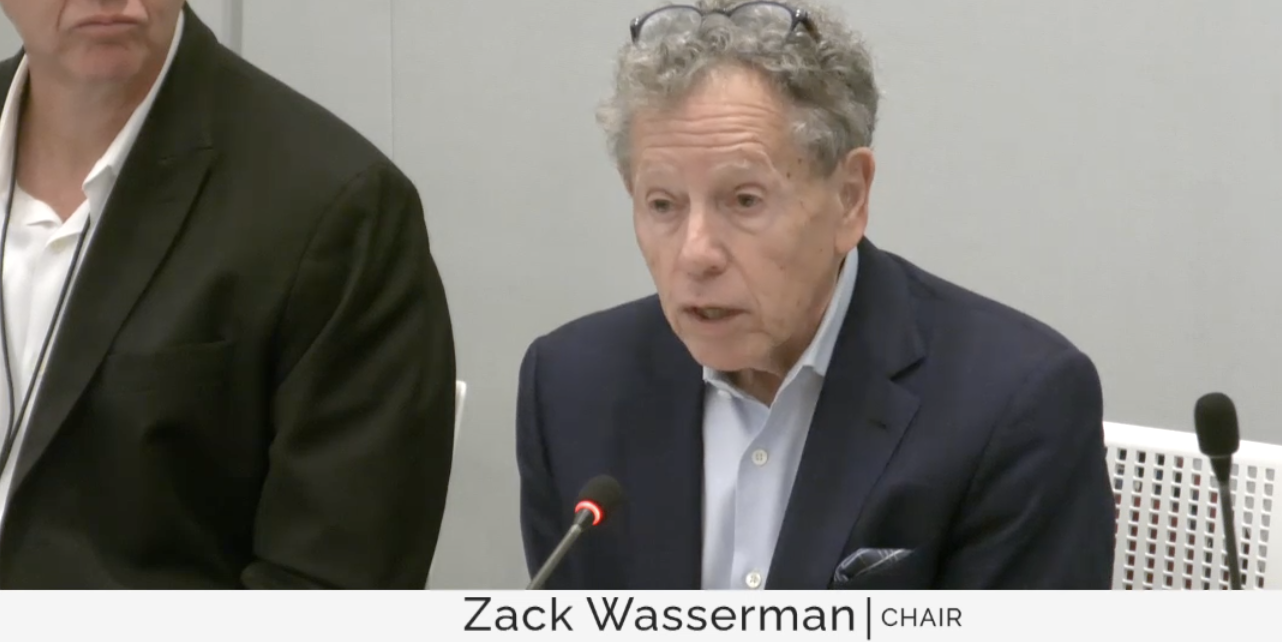
Chair R. Zachary Wasserman closed the workshop on a high note: "I think this is one of the most creative and productive workshops that we've held, and we've held a fair amount."
Federal Government Targets California Coastal Agencies, Destroys Monitoring Infrastructure
Chair R. Zachary Wasserman opened the meeting with a stark warning: the Secretary of Commerce has directed NOAA to conduct an audit and public hearing on the performance of California's coastal zone management agencies — BCDC, the California Coastal Commission and the California Conservancy.
Why it matters: The audit letter specifically criticizes the agencies for not incorporating economic consequences and federal executive orders into their actions, citing offshore oil leasing and SpaceX space exploration as examples. If the federal government were to strip California's Coastal Zone Management Act consistency authority, the state would lose a powerful tool for reviewing federal projects that affect the coast and bay.
"The Secretary of Commerce has directed NOAA to conduct an audit and public hearing on the performance of the California Coastal Management Zone agencies. That includes us, the Coastal Commission and the California Conservancy," Chair Wasserman said.
But the audit may not be the most damaging federal action. Wasserman reported that the administration is dismantling a major ocean monitoring program, destroying an estimated $380 million in sea buoys that measure sea levels and provide critical data for communities planning for rising water.
"They are also dismantling a major ocean monitoring effort. Destroying a something like $380 million investment in sea buoys that have been measuring sea levels, providing critical information for localities and agencies throughout the country to deal with rising sea level," he said.
BCDC staff is coordinating with the Coastal Commission, the Natural Resources Agency and the governor's office on a response.
Where things stand: Wasserman also noted that Tuesday's election results, in which tax and bond measures failed across California, underscore the challenge of funding climate adaptation. He warned that the region has become "spoiled" by the relative ease of passing such measures in recent years and needs to return to a model in which campaigns function as extended educational efforts. "I think we collectively have forgotten a lesson. If you go back 25 or 30 years in this state, up and down the state, it typically took two or three times to pass a school bond," he said.
Permit Streamlining Moves Forward
The commission approved the consent calendar 16-0-1 by roll call vote, adopting revisions to the Region Wide Permit program that align with new permitting regulations approved by the Office of Administrative Law and effective July 1.
Why it matters: Twenty categories of minor activities in the Shoreline Band will no longer require BCDC permits starting July 1. Two existing permits — Abbreviated Region Wide Permit 2 (minor residential work) and Region Wide Permit 5 (minor commercial and multi-unit work) — are being eliminated. The abbreviated and standard region wide permit programs are being consolidated into a single program with one application form.
BCDC staff member Tessa Filipchik presented the item, explaining that the changes are housekeeping to match already-approved regulatory amendments. A commissioner asked whether the scope was expanding; staff clarified that today's action is cleanup only, with future expansion planned to cover nature-based solutions and living shorelines.
Decisions: Passed 16-0-1. Commissioner Janoff abstained on the permits and application portion; the vote was initially announced as 17-0-0 but corrected on the record. Commissioner Patricia Showalter moved; Commissioner Dr. Andrew Gunther seconded.
Minor Items
- Enforcement milestone: The enforcement team, led by Isabel Chamberlain, issued BCDC's first permit for removal of sunken vessels in May and has fully integrated compliance tracking into Enforcement Committee meetings.
- Underwater lot sales: Acting Executive Director Greg Scharf reported that companies and brokers are selling underwater subtitle lots in the bay to buyers who may believe they can moor boats or build on them. BCDC is sending letters clarifying that its regulatory framework and the public trust doctrine severely constrain any development.
- Rising Sea Level Working Group recap: The morning session featured presentations from the California Coastal Commission on local coastal plan integration with SB 272, Northeastern University students on financing and governance mechanisms for sea level rise, and the Boston Green Ribbon Commission on community mobilization for climate adaptation.
- Administrative matters were listed without comment or questions.