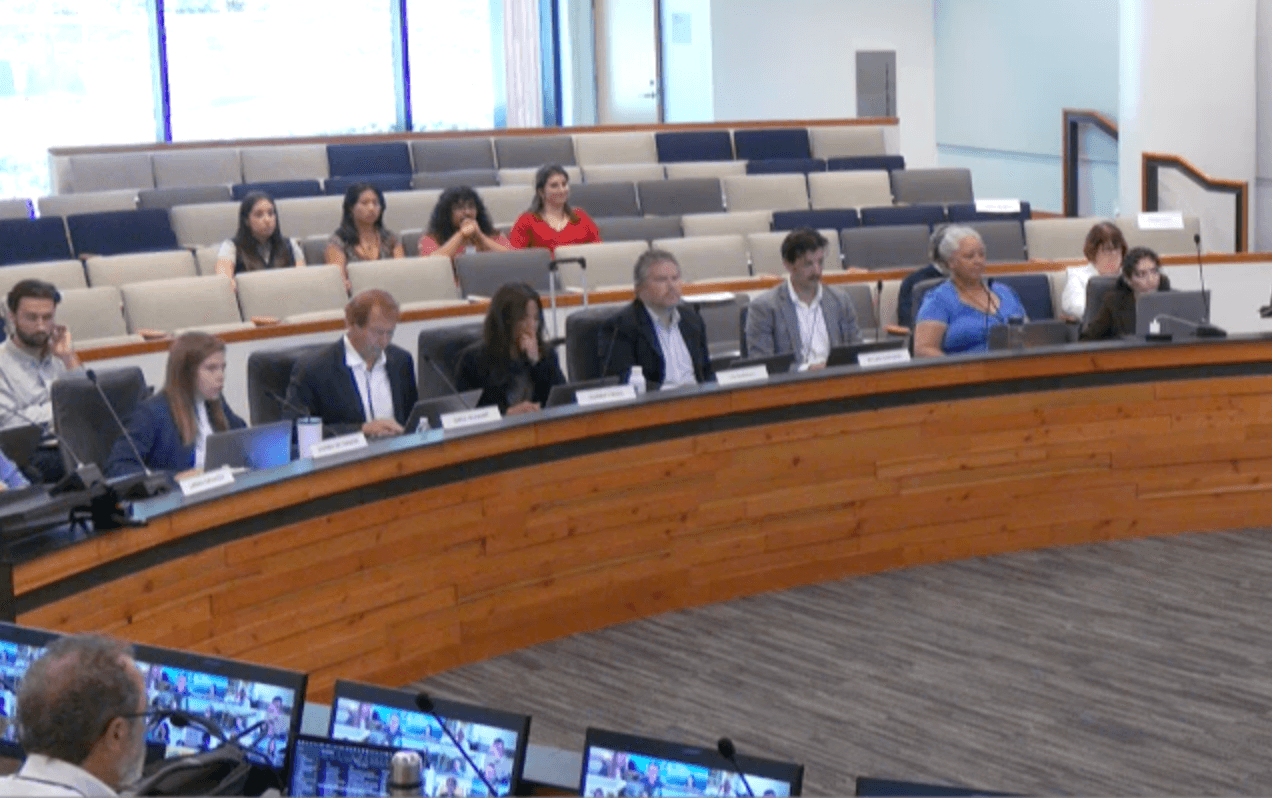
Commission - Jun 18, 2026 - Meeting
Commission • San Francisco Bay Conservation and Development CommissionJune 18, 2026
Locunity is an independent informational service and is not an official government page for this commission. All information is sourced from public footage and an analysis of official agendas with the aid of responsible, fact-checked AI. to report an error or omission.
Belmont Life Sciences Campus Wins Unanimous Approval With First-of-Its-Kind Climate Safeguards
The San Francisco Bay Conservation and Development Commission cleared a landmark shoreline development permit in Belmont, embedding novel sea level rise check-in requirements that could reshape how the agency handles long-timeline projects on a changing coastline. The June 18 meeting also surfaced a looming $2 million budget threat and a state bill that could dramatically expand the agency's permitting workload.
Belmont life sciences campus approved unanimously with unprecedented 5-year climate and species review conditions tied to a 10-year construction window
Legislature's budget zeroes out greenhouse gas funds, threatening $2 million in annual BCDC operations
Tribal consultation bill AB 2218 could require BCDC to consult on all 250 annual permits, drawing warnings from staff and commissioners about overload
$400K in contracts approved for permitting modernization and Bay Adapt regional climate adaptation strategy
Federal Ships for America Act could designate parts of San Francisco Bay as a maritime shipbuilding zone, overlapping BCDC jurisdiction
A New Model for Shoreline Development
The commission voted 15-0 to approve permit M1981.064.03 for 1 Shoreway Owner LLC to redevelop a 6.91-acre site at 1301 Shoreway Road in Belmont into two 7-8 story life sciences and R&D buildings, a 9-level parking garage, and expanded public access along Belmont Creek.
Why it matters: The permit establishes what commissioners and staff described as a first-of-its-kind framework: a 10-year construction commencement window with mandatory check-ins at the 5-year mark requiring the developer to demonstrate the project remains resilient to updated sea level rise projections and to reassess impacts on special-status species. If science or conditions have shifted, the permit conditions must be revisited before construction can proceed.
Where things stand: Staff analyst Lindsay Martien laid out the core innovation:
"If the project does not commence for five years, then prior to construction the permittee would be required to demonstrate that the project design is still projected to be resilient to sea level rise at 2050 and adaptable to 2100 based on updated guidance at that time."
The project's shoreline elevation will be raised to 12.5 feet NAVD88, designed to be resilient through mid-century and adaptable to end-of-century sea level rise scenarios. It will deliver 0.25 acres of net new dedicated public access organized around four themed nodes — fitness, birding, vegetation education, and an arrival area — along with a shared-use sports court open to the public outside business hours.
Groundwater, El Niño, and the Details
Commissioners probed several technical dimensions. Commissioner Pat Eklund pressed on whether groundwater rise should be explicitly named in the permit conditions:
"I just would feel a little bit more comfortable if in our condition it included groundwater."
Martien confirmed that BCDC's existing climate change policies already cover groundwater rise within its sea level rise risk assessment framework.
Staff member Ben Dorfman raised the question of upstream flood risk from extreme weather events, noting the site's exposure to watershed flows during a potential super El Niño — a risk distinct from sea level rise alone. Commissioner Marie Gilmore praised a new compliance table format included in the staff report, calling it a useful innovation for tracking permit conditions. Commissioner Juan González asked about the project's relationship to broader shoreline planning.
Applicant Rich Ying of Four Corners Properties and project architect Karen Kuklin of DGA presented the design, with landscape architect René Bihan of SWA Group detailing the public access program. The applicant accepted the final staff recommendation without objection. No public comments were received.
Decisions: The commission closed the public hearing and approved the permit unanimously (For: 15, Against: 0, Absent: 0). González moved to approve the final staff recommendation, seconded by Eklund.
What's next: The developer has 10 years to commence construction. If the project has not started within 5 years, the permittee must submit updated sea level rise and species assessments before breaking ground — a condition that will likely be watched closely as a potential template for other BCDC shoreline permits.
$2 Million Budget Threat Emerges
Executive Director Larry Goldzband warned commissioners that the state Legislature's adopted budget has eliminated greenhouse gas reduction fund spending across the Executive Branch baseline — a move that directly threatens roughly $2 million in annual BCDC funding.
Why it matters: GGRF dollars support core BCDC operations. Losing them would force the agency to find alternative revenue or scale back programs at a moment when it is simultaneously launching new shoreline adaptation initiatives and facing potential workload increases from pending legislation.
"You may have read that the Legislature's adopted budget has essentially zeroed out greenhouse gas reduction funds for the entirety of the Executive Branch's baseline spending," Goldzband said. "BCDC receives about $2 million annually of GGRF funding."
On the brighter side, Goldzband announced that BCDC has launched a Regional Shoreline Adaptation Plan Peer Learning Community to help local government staff develop shoreline resilience plans required under SB 272. Twelve Bay Area jurisdictions, including Tiburon, have now formally started the process. Staff member Ben Dorfman also briefed commissioners on the Bay Area Public Trust project — a joint effort with the State Lands Commission to create consistent guidelines for analyzing waterfront development on bay tidelands, with a draft report planned for January 2027 and a final report in April 2027.
Tribal Consultation Bill Could Reshape BCDC's Workload
Director of Legislative and External Affairs Rylan Gervase delivered a wide-ranging briefing on state and federal legislation, with the sharpest concern centered on AB 2218, a bill by Assemblymember Ash Kalra (AD 25) that would codify tribal consultation requirements for all state permits and regulatory changes.
Why it matters: If applied to BCDC, the bill could require the agency to conduct formal tribal consultation on all 250 of its annual permits — not just major projects — potentially adding weeks to each permitting timeline and straining both agency and tribal resources.
"Without much clear standards, guardrails or limits, there is a risk that this bill could expose BCDC and permit applicants to litigation," Gervase warned.
Chair R. Zachary Wasserman was blunt about the practical consequences:
"Think about the 250 permits that we do that have next to no effect on any tribes and require letters to all of them, most of which would probably be ignored. I think this is unintended."
Maritime Zones and Abandoned Vessels
On the federal front, Gervase flagged the Ships for America Act, which has drawn attention from California Forever advocates pushing to designate the Sacramento-San Joaquin Delta — including Suisun and San Pablo Bays — as a Maritime Prosperity Zone.
"The sponsors of the California Forever Project have been advocating the media for the designation of the California Delta as a Maritime Protection Zones, including the Suisun and San Pablo Bays, which would overlap with our jurisdiction," Gervase said.
He also highlighted the Abandoned Vessel Prevention Act (sponsored by Rep. Harder and Rep. Garamendi), which would hold vessel sellers liable for sunken boats 12 months after sale, and the Adapt Assets Act, which would authorize $10 billion for infrastructure protection including a long-term fix for State Route 37. Commissioner Pat Eklund asked about the likelihood of passage; Gervase said none of the bills are likely to advance independently but could be folded into omnibus legislation.
Golden Gate Fields and Budget Bright Spots
Gervase noted one significant positive in the governor's budget: $125 million earmarked to purchase Golden Gate Fields and convert it into a new shoreline park. Commissioner Arye Janoff expressed interest in the acquisition as a potential opportunity for beneficial sediment reuse. On the broader state budget, Gervase reported that AI-sector stock revenues had erased California's projected $25 billion deficit.
Sediment Reuse and Regional Resilience
Chair Zachary Wasserman opened the meeting with a recap of a public workshop held two weeks earlier on a possible Bay Plan amendment to increase beneficial reuse of sediment and soil for wetland restoration. He identified a key takeaway: the need to coordinate upland fill operations with water-related beneficial reuse, since both face the same stockpiling and transportation challenges.
Wasserman announced three fall conferences: the Restore America's Estuaries national meeting in September in San Francisco (BCDC is a major co-sponsor), the statewide California Resilience Forum in Stockton in October, and BCDC's third annual summit on Nov. 9 focused on making local government shorelines more resilient, with a particular emphasis on regionalism.
"In order to effectively address the problems that confront us, particularly with attitudes in Washington D.C. today, we need to be more united regionally, thinking more connected regionally and really thinking about how we fulfill our obligations as regional stewards," Wasserman said.
He also shared two positive national signals: the U.S. Senate rejected the administration's effort to dismantle ocean monitoring systems, and Gallup polling showing 44% of U.S. adults now worry a great deal about climate change, a significant increase. Executive Director Larry Goldzband added context, crediting mid-Atlantic and Gulf state senators for backing the ocean monitoring bill due to their dependence on NOAA coastal data.
Minor Items
Consent calendar approved 15-0, including June 4, 2026, meeting minutes, a $251,844 contract with Environmental Science Associates to modernize BCDC's programmatic permit program, and a contract of up to $150,000 with Catalyst for Bay Adapt regional climate adaptation strategy support. Staff noted a correction to the Bay Adapt contract staff report: Task 5 (server administration) was erroneously included and is not part of the agreement.
Four undergraduate interns introduced by Executive Director Goldzband, along with the hiring of Sam Stromberg, a former BCDC intern, for a shoreline access guide project.
Administrative matters were received without discussion or public comment.
Closed session on anticipated litigation: the commission took no action.
Agenda items on bridge safety from vessel strikes and a public access briefing were not reached before the commission entered closed session.
Meeting adjourned with Happy Juneteenth wishes from the chair.