
San Carlos Council Majority Backs Path to Gas Leaf Blower Ban
City Council • San CarlosNovember 10, 2026
Locunity is an independent informational service and is not an official government page for this commission. All information is sourced from public footage and an analysis of official agendas with the aid of responsible, fact-checked AI. to report an error or omission.
San Carlos is moving toward ending gas-powered leaf blower use. After a study session that drew eight public commenters on Nov. 9, 2026, four of five councilmembers signaled support for an ordinance. No vote was taken. Staff will return in early 2027 with a proposal that would make property owners responsible for violations, issue warnings before fines and expand rebates. Separately, county health officials heard councilmembers' frustration that the city has little visibility into tobacco retail enforcement.
- Council majority backs a gas leaf blower ban; staff to return early 2027
- Quiet San Carlos and residents push for a six-month transition, faster than the council's likely timeline
- Councilmember Neil Layton opposes the ban as proposed, citing enforceability with one code officer
- County tobacco enforcement briefing exposes gaps in information sharing with the city
- Community Foundation grants hit $160,000, and the foundation wants to revisit its city endowment agreement
Leaf Blower Ban Gains Four Votes in Principle
Why it matters: A ban would end the use of gas blowers that run on long daily hours. Costs would shift to landscapers and homeowners, and the city's thin code enforcement capacity would be tested.
The basics: State law AB 1346 bans the sale of new gas-powered small engines, but stores can sell legacy stock and the law does not ban operating the equipment. Local bans fill that gap.
Where things stand: Staff framed the stakes in health terms. "Operating a gas-powered leaf blower for 1 hour emits the same amount of pollution as driving a car for 1,100 miles," said Senior Management Analyst Akanksha Chopra, citing the California Air Resources Board. She said blowers run at 70 to 100 decibels. The city's rebate program has drawn 106 residential and four commercial applications.
Staff found that peer cities, including Menlo Park, Burlingame and Palo Alto, struggle to enforce their bans and rely mostly on education. "Staff's recommendation is to have the property owner be responsible for any violations," said Assistant Community Development Director Andrea Marticich. The rest of the staff outline:
- Roughly a year of outreach before enforcement
- Complaints filed through Inform San Carlos, with an address
- A warning for a first violation
- Expanded rebates
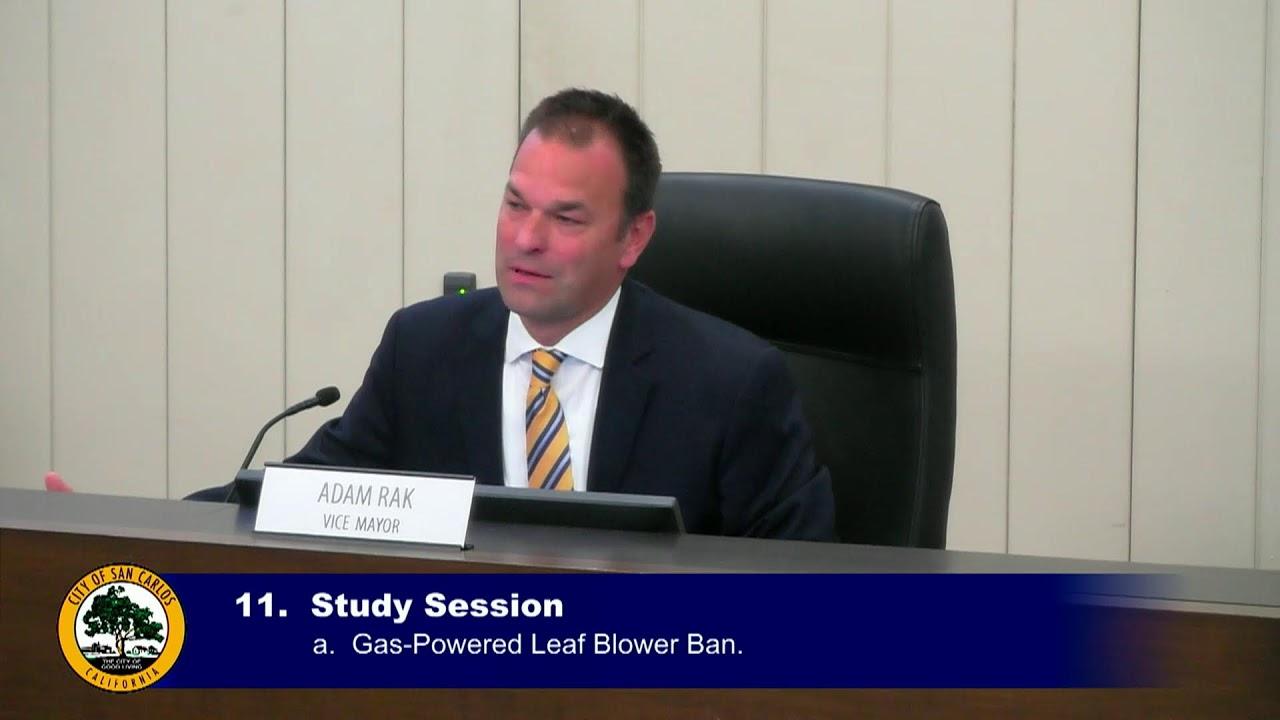
Councilmember John Dugan framed the ban as an extension of the city's climate and noise policies. "What we're talking about here tonight is implementation of existing policy," he said. Vice Mayor Adam Rak said he was "certainly happy to support moving forward with this." Councilmember Sara McDowell also backed the ban. She asked for a long runway and voiced concern for small, minority-owned landscaping businesses.
The other side: Councilmember Neil Layton questioned both the environmental benefit and the city's ability to enforce a ban. "From the environmental perspective, a ban would be a 0.5% reduction in emissions in our city," he said. He added, "A rule without a remedy is just a suggestion."
Code enforcement is handled by one contracted officer. City Manager Kathy Kleinbaum called that staffing lean and said it would need to be revisited.
Hours split: Rak wants changes. "I definitely want to change the leaf blower hours," he said, proposing to align them with construction hours. "I would not necessarily agree to a proposal of changing the hours," Layton said, citing the impact on residents. The majority favored leaving hours unchanged.
Decisions and stakeholder impacts: No vote was taken. Members gave direction that:
- Property owners would be the responsible party.
- Current fines of $100, $200 and $500 would be lowered, with amounts left to staff.
- Rebates would be expanded.
Dugan suggested up to $15,000 a year each for residents and landscapers and about $5,000 for property managers. Layton wanted landscapers who work in San Carlos to qualify and questioned business license requirements. Mayor Pranita Venkatesh looked to Westlight Energy for help with funding. "I would love them to do matching funds for us, and especially for batteries," she said.
Dugan floated an Oct. 1 start date, and McDowell agreed. A start date was not formally decided.
What's next: Staff will return in early 2027 with an ordinance.
Residents Organize for a Faster Ban
Why it matters: Supporters want a shorter timeline than staff proposed.
Where things stand: Josh Safran, leader of Quiet San Carlos, urged a six-month transition. He also asked for better rebates, bilingual outreach and warnings before citations, citing worker health and the city's noise policy. Emily Burt, who organized a petition with more than 1,200 supporters, noted that Burlingame needed only six months.
Julie Fellers also sought a ban within six months and asked that rebates be reserved for residents and small landscapers. She relayed landscapers' concerns about battery life, charging and cost.
Other residents described the impacts directly:
- Mark Forbes, a White Oaks resident, cited noise and fumes near a preschool.
- Laura Pfister, who is sensitive to noise, described daily disruption.
- Justin Hagler said low commercial rebate uptake shows incentives alone won't work.
Kathleen Goforth, a retired EPA scientist and UC Master Gardener, proposed:
- A cap of 65 decibels at 50 feet on all blowers
- Exterior outlets for charging
- Liability for both property owners and operators
Gerard Manning, a Burlingame resident, said that city's gentle, letter-based enforcement shifted most of his neighbors to electric. He also raised concerns about worker exposure and equity.
Council Presses County on Tobacco Enforcement
Why it matters: Councilmembers said they lack visibility into county inspections and violations at San Carlos tobacco shops.
The basics: The briefing followed the Sept. 28 introduction of a tobacco retailer permit ordinance. San Mateo County's 2023 ordinance includes:
- No new retailers within 1,000 feet of youth-serving sites
- No retailers within 500 feet of each other
- Bans on flavored products and electronic smoking devices
Where things stand: Waymond Wong, deputy director of consumer protection for San Mateo County Environmental Health Services, said the county inspects each site twice a year. Fines start at $500, rise to $1,000, then escalate to permit suspensions. "There's 10 permitted businesses in San Carlos with 40 inspections that have been performed," Wong said.
Wong also walked through a case involving unpermitted San Carlos retailers. The county pursued injunctions with:
- The California Department of Tax and Fee Administration
- The California Department of Public Health
- The Narcotics Task Force
- The property owner
The other side: Councilmembers pushed for more information. "I personally think that we should receive readouts of the inspections that you're doing," said McDowell. She also sought notice when the county denies a permit.
Layton probed whether fines work against fly-by-night businesses, and Dugan suggested dashboards. Wong acknowledged a gap: "We don't have that direct connection to provide that referral from environmental health or county towards the city."
Decisions and stakeholder impacts: No action was taken. Wong said he would work with the city manager to set up a contact for sharing information.
Lucy Lathu, assistant director of Dalama for Tongans, supported the ordinance on youth health and equity grounds. Tricia Barr, volunteer co-chair of the San Mateo County Tobacco Education Coalition, urged regular reporting on inspections, violations and youth-sale stings. She also asked councilmembers to encourage neighboring cities to adopt the county ordinance.
Community Foundation Eyes New Deal With City
Why it matters: The foundation has taken over the nonprofit grantmaking the city once handled. Its strategic review points to renegotiating its endowment agreement with San Carlos.
Where things stand: Linda Garvey, board president of the Community Foundation, said grants have grown from about $40,000 a year under city administration. "We gave out $160,000 to 21 nonprofits," she said. Other figures from her report:
- $200,000 in grants expected this year
- $1.25M distributed over six years
- An endowment of roughly $2.9M
- $40,000 raised at the first Celebrating San Carlos benefit
Dugan asked whether the investment strategy had changed. Garvey said it had not, that Wealth Architects remains retained and that the foundation has built a cushion.
What's next: A consultant-led strategic plan is due in mid-December.
Minor Items
- Consent calendar: Items A through F passed (For: 5, Against: 0, Absent: 0). Dugan, Layton, McDowell, Rak and Venkatesh all voted yes; the items were not described aloud.
- Library report: Library Manager Adrienne Gass reported 13,200 participants at 550 cultural programs and nearly 426,600 items circulated. She said she would provide an update on makerspace construction.
- Bookmobile: The county's new bookmobile visits the San Carlos Library parking lot Nov. 15–16.
- 700 block cost: Resident John Durkin asked for a public discussion in early 2027 of the Phase 1B cost, which he said reportedly doubled to $20M.
- Street dumping: Resident Fred Pisani said discarded furniture and trash pile up on corners and sometimes block sidewalks.
Looking Ahead
A Diwali event is set for Nov. 14 on Laurel Street. Venkatesh raised a possible e-bike item tied to AB 2595 and was told to give notice before it can be placed on an agenda.