
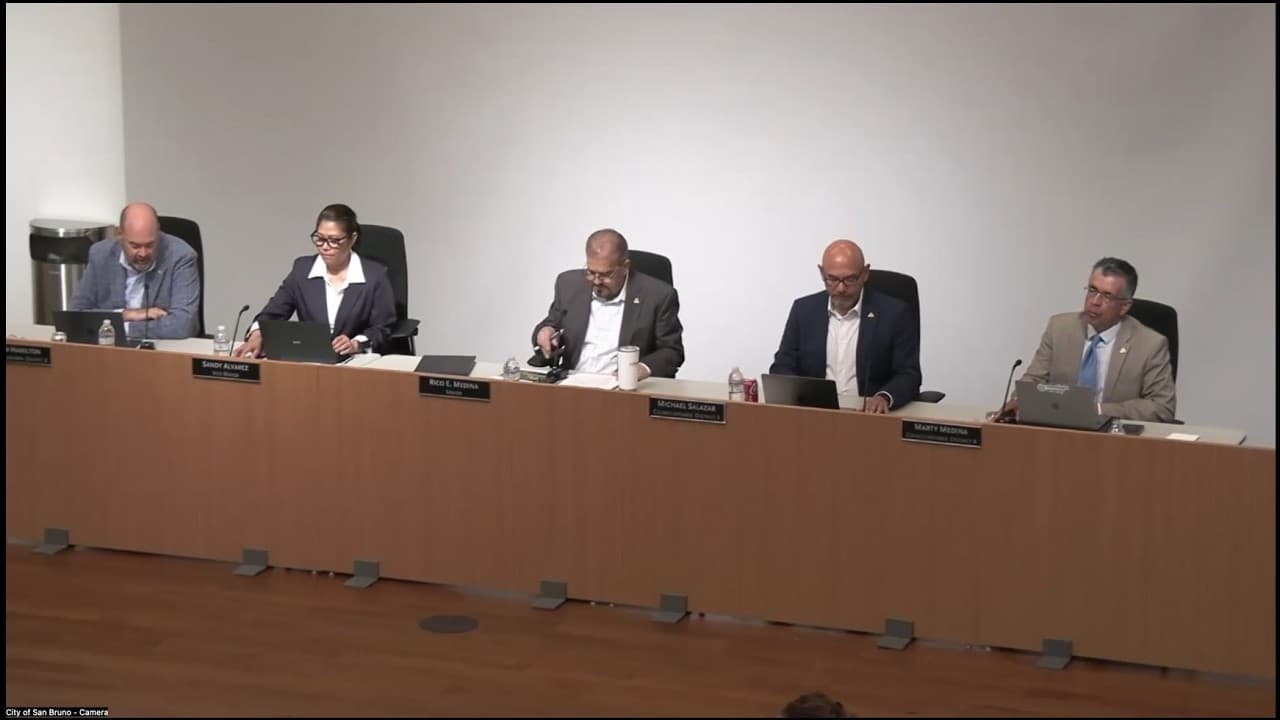
Council Balks at Halting Crestmoor Fields, Adopts Senior Lunch Fees 5-0
City Council • San BrunoOctober 19, 2026
Locunity is an independent informational service and is not an official government page for this commission. All information is sourced from public footage and an analysis of official agendas with the aid of responsible, fact-checked AI. to report an error or omission.
San Bruno's long-promised Crestmoor soccer fields survived a staff push for an indefinite hold, even as the numbers behind them grew harder to ignore. In a marathon study session with no vote, council members told staff to keep looking for partners and cheaper designs instead of stopping. Later in the meeting, the council voted 5-0 to end free senior lunches, a sign of how far budget pressure now reaches.
- Council rejects an indefinite halt to Crestmoor Fields despite a projected 10-year ownership cost of $12.5 million to $14 million
- Youth soccer families, coaches and children urge the city to build turf fields they say were promised
- Senior lunches move to required fees Dec. 1: $6 for residents, $4 for low-income residents and $12 for non-residents
- Planning Commission shrinks from seven to five members in an ordinance introduced 5-0
Crestmoor Fields: Too Costly to Build, Too Promised to Drop
The basics: Toll Brothers is dedicating 6.9 acres from the former Crestmoor High site, including 5.3 acres for fields. Phase 1 was funded with a $3.4M San Bruno Community Foundation grant, $3.2M in developer fee credits and nearly $2M more for lights, for about $8.5M available.
Why it matters: Construction is now expected to exceed $10M. Staff say the city already faces about $60M in deferred parks maintenance, and even the best-case fee model leaves a roughly $141,000 first-year gap.
Where things stand: Community Services Director Travis Carlin laid out the costs. Operations would run about $162,500 a year, and turf replacement would cost $2.3M, requiring a $234,000 annual reserve. Current per-player fees recover about 10% of costs. The best realistic case, at $80 an hour plus a $2M endowment, recovers about 65%. The 10-year subsidy would range from $1.8M to $3.3M.
Staff's alternatives were a public-private partnership, with the Olympic Club already sounded out; undeveloped open space at about $1M over 10 years; or a basic park at about $4M. Staff recommended spending none of the roughly $560,000 in fee credits slated for design. Stopping would not reduce the city's obligations, Carlin said: "Halting the fields project, therefore, does not free the site for other uses or relieve the city of its maintenance obligations."
The other side: Council members pushed back. "I cannot agree to halting the project indefinitely," said Councilmember Tom Hamilton, who proposed a defined period to explore a simple grass option, value engineering and continued talks with the Olympic Club. Councilmember Marty Medina said "halting it indefinitely, in my mind, for now is definitely not an option," and floated an ad hoc committee.
Councilmember Michael Salazar was the most skeptical. "It would be absolutely fantastic to see this thing done, but the numbers don't pan out," he said, and suggested improving Monteverde and Lions Field instead. Vice Mayor Sandy Alvarez asked for fee-trajectory scenarios and timelines compared with the Bel Air fields. Mayor Rico E. Medina said "nobody wants to halt it," but added that the money must come from somewhere.
Decisions and stakeholder impacts: No vote was taken. "What I'm hearing is do not stop the project," said City Manager Alex McIntyre, who summarized three tasks: approach the Olympic Club, the Community Foundation and player groups. Staff will also price reaching 60% design with grass-or-turf flexibility. Carlin cautioned that switching surfaces would push design back to about 15%, and that Toll Brothers may demobilize after finishing basin work.
What's next: Staff are expected to return, likely in the new year, with options for paying for the project. A field allocation policy is due by spring.
Soccer Families Make Their Case
Why it matters: Eleven speaker cards brought parents, coaches, club leaders and children to the podium. They said about 900 fall players and 500 spring players have no home field and are scattered across Monte Verde, John Muir and Parkside.
Where things stand: Several speakers framed the fields as part of the bargain that cleared the Toll Brothers development. "I think it would be a horrible disservice to that community for the city to not figure out how to do what was promised at that time," said public commenter Joan Skinner. Linda Mason, a former councilmember, said the deal called for developer-funded fields: "Please don't make this another broken promise."
Nazim Salem, president of Lowen Soccer Club, offered a cheaper path: "If it's going to cost this much for turf, what's wrong with grass?" He said clubs would help maintain it. Carlin replied that grass is less expensive upfront but costlier over time, and that it would cut playable hours to 1,200. Rich Fern called staff's three options nonviable, urged a sand-based field and noted that contractor pricing was not locked in. Carlin said sand fields would not eliminate city costs.
A parent questioned whether Crestmoor faced a tougher test than other facilities and asked what happens to the fee credits and foundation money. Salazar raised the same point from the dais: "Is soccer being held to the same standard?" Carlin answered that "youth sports are the highest subsidized program that we have in the city."
Decisions and stakeholder impacts: Alex G., an AYSO referee, said clubs gave up the site expecting a turf field within two to three years. Other speakers described soccer as a source of belonging. A father credited AYSO at Crestmoor with helping his family integrate, and a Lowen '83 co-registrar spoke about the fields' value for her neurodivergent son. Carlin added that the developer was never asked to fund the whole project.
Free Senior Lunches End as City Takes Over
Why it matters: The county grant that reimburses up to $198,491 a year ends Nov. 30. Staff project the new model will cut the general fund subsidy by at least $116,000 a year. "It has always been free. Not anymore," said Mayor Medina.
Where things stand: The program serves more than 100 meals a day, about 25,000 a year, and provides more than 3,000 rides. Fifty-one percent of meals go to non-residents, and funding now relies on voluntary contributions.
Under the new model, regular meals cost $6 for residents, $4 for low-income residents and $12 for non-residents. Party-day meals cost $12, $8 and $15. Rides cost $2 for eligible residents, and residents 60 and older get priority. Low-income eligibility could rely on existing assistance criteria or CalFresh enrollment. Senior Services Manager Meghan Rosin said "the actual cost of each meal is closer to nearly $28," compared with an $11.75 catered meal.
The other side: Two senior leaders supported the model but warned about the non-resident price. "I respectfully ask the council to consider a fee of $10 instead," said Joyce Sato, a member of the San Bruno Senior Advisory Board. Joanna Dunn, a San Bruno Senior Center board member, suggested about $8: "I don't want to lose the non-residents." Both urged more grant and sponsorship work.
Decisions and stakeholder impacts: Hamilton confirmed that the Senior Advisory Board backed the $12 fee. He moved approval, saying "we have to do what we have to do, what we can to preserve these programs for our residents." The resolution passed without amendment (For: 5, Against: 0, Absent: 0). Non-resident seniors absorb the biggest change. Staff assumed an initial 20% drop in participation.
What's next: Fees take effect Dec. 1, 2026. Staff will return with updated transportation fees after Salazar asked about them and will evaluate the program in spring 2027.
Planning Commission Cut to Five Seats
The council introduced an ordinance amending Chapter 2.08 to shrink the Planning Commission from seven members to five (For: 5, Against: 0, Absent: 0). The Planning Director told the council that "about 2/3 of the cities that have a planning commission operate with just 5 members," and noted that Burlingame cut to five in April 2026.
Decisions and stakeholder impacts: No commissioner is forced off. One did not reapply, so the reduction happens through attrition. Staff said a smaller quorum means fewer canceled meetings. No one spoke during public comment, and the council did not discuss the item.
What's next: Final adoption comes at a future meeting. The change takes effect 30 days after adoption, bringing the commission to five members by December.
Minor Items
- Consent calendar: Items 6A through 6G passed unanimously by voice vote without discussion.
- Countywide Transportation Plan: Patrick Ilster of the San Mateo County Transportation Authority previewed San Bruno's top projects, including Safe Routes to School and the SFO Bay Trail gap closure. Adoption is targeted for spring, and comments go through the city manager's office.
- Narita exchange: Students reported on the 2026 sister-city exchange, part of a partnership dating to 1989. The program continues in 2027.
- Red Ribbon Week: The mayor proclaimed Oct. 23-31, 2026, as Red Ribbon Week. Police Captain Jeremy Brandenburg stressed prevention education.
- Open comment: Skyline College President Dr. Nate Carter asked for support for community colleges. Skinner urged no votes on Proposition 45 and Measure S, arguing both weaken environmental protections.
Looking ahead: The mayor reported a $15,000 donation for an emergency management platform and flagged a possible El Niño window around Nov. 24. A storm-preparedness presentation is expected at the Oct. 27 meeting, and a councilmember urged residents to pick up sandbags. The meeting adjourned in memory of former Councilmember Beverly Bernard, who served from 1983 to 1995 and was honored for her recycling program.