
San Bruno Charts First Risk Policy as Council Adopts $124M Sewer Plan
City Council • San BrunoOctober 27, 2026
Locunity is an independent informational service and is not an official government page for this commission. All information is sourced from public footage and an analysis of official agendas with the aid of responsible, fact-checked AI. to report an error or omission.
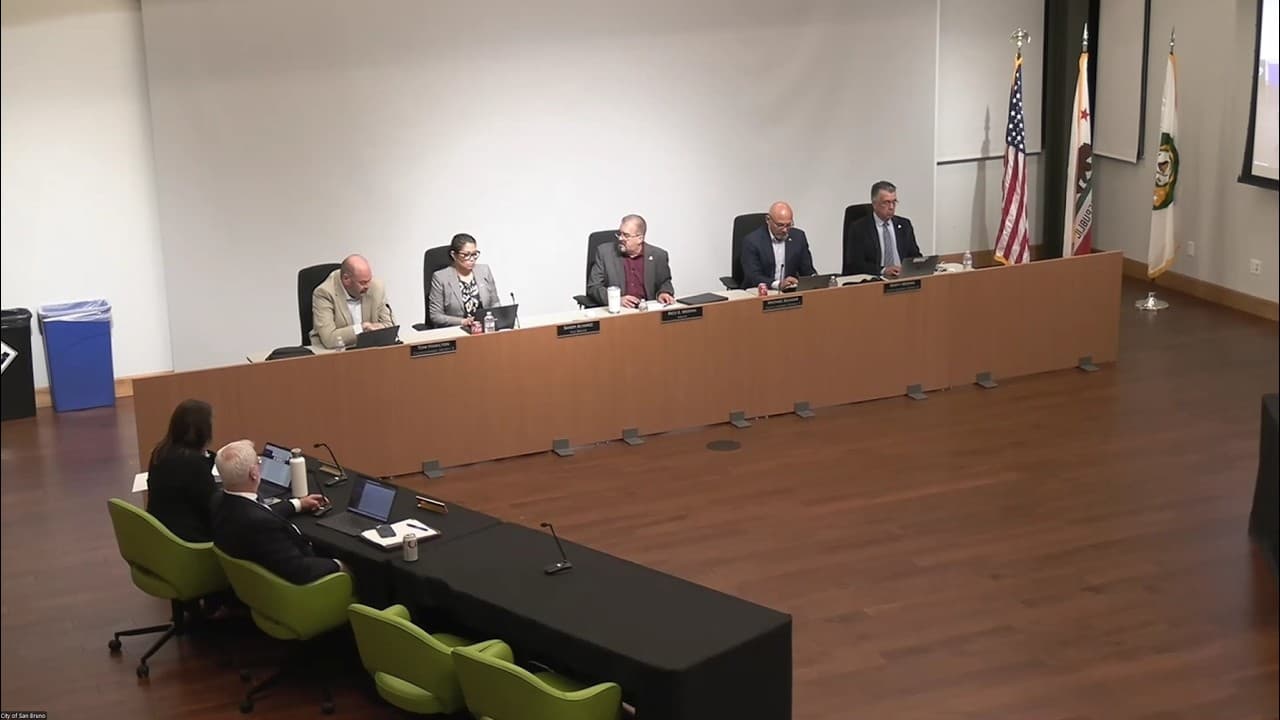
San Bruno is preparing to write down, for the first time, who carries the risk when residents rent the pool, run a sports league or volunteer for the city. On Oct. 27, the City Council gave staff informal consensus to turn a 12-principle framework into a formal policy. Council members then adopted a $124 million sewer master plan, rewrote their own procedures and heard preparations for forecasts of the strongest El Niño documented since 1950.
- Risk management framework advances: council backs 12 principles for insurance and risk transfer. The policy returns later.
- $124M sewer master plan adopted by unanimous voice vote. Rate talks are expected in late 2027 or early 2028.
- Council procedures overhauled: pre-agenda discussion allowed, out-of-scope items barred, email rule deferred.
- El Niño readiness: about 5,600 sandbags, a shelter plan and a draft emergency proclamation ahead of holiday king tides.
- $1.38M sidewalk contract heads to negotiation after Councilmember Marty Medina pressed for price review.
Who Pays When Things Go Wrong
The basics: San Bruno is insured through Plan JPA, a joint powers authority risk pool of 28 agencies that covers up to $30 million per claim. The city pays about $2.6 million in annual premiums and carries a $100,000 deductible. It also shifts risk to contractors and facility users through insurance and indemnification requirements, but the council has never adopted a policy governing how it does that.
Why it matters: Complaints about new insurance requirements for pool rentals, sports groups and volunteers prompted the study session. "This is the first time we've ever done a presentation of risk management in front of the council," said Alex McIntyre, City Manager, noting it was a first in his 30 years.
Where things stand: Staff proposed 12 principles in three categories: purpose, allocation and proportionality, and accountability. The principles would anchor a council policy, with administrative procedures to follow. Staff also asked which risk decisions the council wants to keep for itself. "Taxpayers and ratepayers bear the cost of any losses that are incurred," said Pegueros, Chief Financial Officer. McIntyre said the city manager would be the ultimate decision maker on risk under the proposed policy.
The other side: Council members were less worried about the framework than about how it lands on residents. Councilmember Marty Medina also pressed on timing and on how San Bruno compares with other cities. "How much is this going to cost our residents, and how do we inform them in a more timely manner?" said Marty Medina, Councilmember. Pegueros responded that the city could consider reimbursing groups for their insurance costs.
Michael Salazar, Councilmember, said strict application of the requirements to some groups "almost bordered on the ridiculous." Tom Hamilton, Councilmember, suggested a threshold tied to the city manager's spending authority. He also asked that Principle 6, on proportionality, say requirements "shouldn't create unnecessary financial or administrative barriers for residents and organizations who want to use city facilities." Salazar and the mayor stressed early communication and clarity about up-front costs. "I think it should be done administratively once the policy is set," said Rico E. Medina, Mayor.
Decisions and stakeholder impacts: No vote was taken. The council reached informal consensus to proceed. Youth and adult sports groups, volunteers and facility renters stand to gain earlier, clearer and more proportional requirements. City management would keep day-to-day control over risk decisions. The open question is how the policy balances protecting the city's $100,000 deductible against keeping public facilities accessible.
What's next: Staff will draft the policy and bring it back at a future meeting. Administrative procedures will follow.
Council Rewrites Its Own Rulebook
Why it matters: The update changes how items reach the agenda and what the council may take up. It also sets the stage for later rules on labor negotiations and council email.
Where things stand: Staff presented recommendations from an ad hoc subcommittee of Councilmembers Hamilton and Salazar. The policy changes:
- Clarify that the council may discuss an item before agendizing it.
- Prohibit agendizing matters outside the city's scope.
- Authorize staff to revise fireworks language following the Measure DD result.
- Consolidate sections of the document.
Other issues would be handled administratively rather than written into policy:
- City manager coordination on communications.
- No action on meeting transcripts, since YouTube transcripts already exist.
- A refresher training on censure procedures.
- Delegation of proclamation procedures to the mayor and city clerk.
Hamilton described a proclamation process in which drafts circulate in advance and members simply ask to pull an item or approve it.
The other side: Email remained unresolved. Councilmember Marty Medina asked who responds when residents email the full council. McIntyre proposed to "let the city manager's office act as the conductor." Mayor Medina reminded members to make clear when they are speaking for themselves.
Decisions and stakeholder impacts: Hamilton moved adoption with a carve-out. "We will at a future meeting bring back an amendment after we discuss the additional council communications topic," said Councilmember Hamilton. The motion passed by voice vote, and Mayor Medina declared it unanimous. Advocates who want the council to weigh in on issues beyond city scope now face a firmer barrier. Residents who email the full council will wait for a clear response protocol.
What's next: The council communications amendment and a labor-negotiation transparency policy will return later.
A $124M Road Map for Aging Pipes
The basics: The city's 2014 plan laid out a $150 million program, and most of it has been carried out. About $50 million has been invested, covering 10 miles of pipe and the rehabilitation of five of six pump stations. Crestwood Pump Station is next.
Where things stand: Consultant Woodard and Curran updated the plan with an expanded hydraulic model and new flow projections. The system carries 1.9 million gallons per day now, and growth is expected to add 1.3 million more. The consultant also used a risk-based condition assessment. The resulting 20-year capital program totals about $124 million:
- $15.2M for capacity.
- $9M for structural rehabilitation.
- $100M to replace old and substandard sewers.
"Tonight's action is to adopt the plan, not approve every project or set new rates," said Matt Lee, Public Works Director.
Council questions covered several areas:
- Recovering costs from developers through conditions of approval and capacity charges.
- Upgrading sewer laterals during home remodels.
- Inflow and infiltration, meaning stormwater and groundwater leaking into sewer pipes, including smoke testing and Measure Q storm drain work.
- Coordinating sewer work with paving.
Lee called the coordinated sewer, water and paving work east of El Camino Real a "once-in-a-generation kind of improvement."
Decisions and stakeholder impacts: The council adopted a resolution accepting the plan and finding it exempt from CEQA review. Councilmember Marty Medina seconded, and the motion passed by voice vote, which Mayor Medina declared unanimous. Adoption has no direct fiscal impact. Still, it sets the needs list that ratepayers will ultimately fund. Developers will face cost recovery through conditions and capacity charges.
What's next: A sewer rate discussion is expected in late 2027 or early 2028.
Sandbags, Shelters and the FEMA Paper Trail
Why it matters: Forecasts call for the strongest El Niño documented since 1950, plus king tides above 7 feet around Thanksgiving, Christmas and Martin Luther King Jr. Day. The city is still appealing about $1.8 million in federal assistance requests from 2023, the fire chief said. As a result, the readiness plan is built around the documentation FEMA requires.
Where things stand: The fire chief outlined the preparations:
- A full refresh of the emergency operations plan.
- Readiness of the emergency operations center.
- A Public Works pre-storm checklist.
- About 5,600 sandbags.
- A Community Emergency Response Team (CERT) refresher.
- A public information plan and an emergency status webpage.
- A procedure to open the Recreation and Aquatic Center as a shelter with the Red Cross.
- A draft local emergency proclamation.
The phased FEMA cost-recovery plan covers policies, baseline documentation, tracking and filing. It includes street sweeper video and drone surveys of slopes. Mayor Medina recalled past FEMA denials, including after the PG&E pipeline explosion. "FEMA, you can say, is not always everyone's friend in the sense of recuperating our money," said Mayor Medina.
Decisions and stakeholder impacts: No action was required. Councilmember Marty Medina flagged three neighborhood trouble spots:
- Sediment-clogged box culverts near Huntington and 1st Avenue.
- A debris-filled area at San Marco and Huntington.
- Branches tangled in communication lines.
The chief said staff would look into them. Hamilton asked to be included in public messaging.
What's next: FEMA training is set for late November, ahead of the storm season.
Sidewalk Contract Goes to the Bargaining Table
Where things stand: Item 6H, the on-call ClearPath sidewalk shaving contract, drew the only discussion on the consent calendar. Councilmember Marty Medina said the first bid process led to a request to modify insurance requirements. The rebid then drew no responsive bidder, and the staff report lacked unit prices. "I would prefer that it would come back to council for approval once the terms are negotiated," said Councilmember Marty Medina.
Lee said the municipal code allows negotiation when no responsive bids come in. He said staff expect to talk with about two bidders and will report back on prices. Staff said shaving is generally limited to 2-inch lifts. Dalia Manaois, Principal Engineer and CIP Manager, cited cost-recovery deadlines.
Decisions and stakeholder impacts: Salazar moved to approve the entire consent calendar. Councilmember Marty Medina seconded, saying he was satisfied with the spending limit. Mayor Medina declared the voice vote unanimous. The city manager may now negotiate a contract of up to roughly $1.38 million without a separate council vote, a departure from the council's usual practice of approving contract prices. The insurance snag in bidding echoes the risk policy debate earlier in the evening.
Minor Items
- Commission seats filled: The council reappointed incumbents and named Ross Pearson to the Culture and Arts Commission through 2030. It chose Camille Fox Lucero as Parks and Recreation youth representative, and two Revenue Measure Oversight seats will open.
- Complete Streets Committee: Chair Rhonda Collins said Walmart withdrew its Bike to Wherever Day sponsorship. Members asked for city funding for two stations, and the committee requested a council liaison.
- Seoul Kalbi fire code: Owner Carrie Laderan sought an interim plan while installing suppression systems on 11 hoods. Mayor Medina will relay her concerns to the fire marshal.
- ADU legalization: Resident Edward Cruz said he was told to prove his ADU predates 2020 through county assessor records, which he called a new burden under AB 2533.
- School funding: Dr. Edith Arias, Trustee, District 3, San Mateo County Office of Education, cited per-student funding gaps from $11,000 to over $35,000 and invited the city to partner on advocacy.
Looking Ahead
The mayor announced vote-center and drop-box locations for the Nov. 3 election. The council's next regular meeting is Nov. 10, 2026, at 7 p.m.