
Council Presses County on El Niño Readiness, Approves Fire, Capital Plans
Town Council • San AnselmoSeptember 22, 2026
Locunity is an independent informational service and is not an official government page for this commission. All information is sourced from public footage and an analysis of official agendas with the aid of responsible, fact-checked AI. to report an error or omission.
San Anselmo got a detailed look at Marin County's new emergency playbook Sept. 22, 2026. Councilmember Yoav Schlesinger said the playbook still left open whether the county is actually ready for this winter's El Niño storms. With Vice Mayor Chantel Walker absent, the Town Council then voted 4-0 to raise the town's share of regional fire costs and adopt its first rolling five-year capital plan. Meanwhile, a 50-year-old downtown cigar shop warned that next month's proposed tobacco ban could put it out of business.
- County emergency plan briefing leaves council asking about operational readiness before winter storms
- County preparedness package of roughly $3M heads to Marin supervisors
- Fire JPA amendment approved 4-0, setting San Anselmo's cost share at 41.99% and requiring three-person staffing at all stations
- $20M, 42-project capital plan adopted 4-0, with fund and unfunded-need forecasts promised next round
- Ludwig's seeks premium-cigar carve-out before the Oct. 13 tobacco ban discussion
County Pitches Its Plan; Council Asks If It's Ready
The basics: Steven Torrence, Director, Marin County Office of Emergency Management, presented the 2026 Operational Area Emergency Operations Plan. That is the county's framework for coordinating cities, towns and special districts during disasters. The briefing came a day after the governor declared a statewide emergency.
Why it matters: San Anselmo floods. Creekside businesses and residents want to know what the county will actually deploy when El Niño storms arrive, not just how alerts will reach them.
Where things stand: Torrence outlined upgrades to Alert Marin, including faster sign-up, bilingual alerts and flood-zone notifications. He also described new outreach aimed at 18- to 40-year-olds and a heavier focus on Nextdoor. San Anselmo has a 60.89% Alert Marin opt-in rate, which Torrence said is second-highest in the county. He described a countywide tabletop exercise on Nov. 18 with cities, towns and special districts. Because of FEMA delays, he said, residents should plan to be self-sufficient for 72 to 96 hours.
The other side: Schlesinger said the presentation clarified outreach but not operations, triggers or resource deployment.
"But I don't have a sense about the county's preparedness planning, capacity planning, resource allocation, anything like that in actual preparedness for this winter as opposed to any other winter," said Councilmember Yoav Schlesinger.
Torrence answered that a county package would go to the Board of Supervisors by the end of the month. "It's approaching upwards of $3 million of not only resources but staffing and support," said Torrence.
Business owners weigh in: Ludwig's representative Barbara asked about emergency declarations. She also asked whether grants exist for businesses that have hardened against floods, noting she had bought costly floodgates, and she suggested an Alert Marin sign-up contest. The Town Manager said the town and county can both declare emergencies, typically once one is occurring. "Both of us have the ability to declare an emergency, and we've done it many times," said the Town Manager.
Public commenter Belinda pressed on creek conditions. "As a person that has 2 businesses on the creek, I'm a little concerned about what's happening below," she said. Staff responded that most of San Anselmo Creek is privately owned. "We don't right now have any creek clearing opportunity or, I guess, programs," said the Town Manager.
Decisions and stakeholder impacts: The council took no vote on this informational item. Staff agreed to circulate a short report on the town's preparedness once the county package is finalized. Creekside property owners carry much of the clearing burden themselves, so the town's flood-season leverage runs mostly through alerts, declarations and county resources.
What's next: The county package goes to supervisors, followed by the Nov. 18 countywide exercise and the town's follow-up report.
First Rolling Capital Plan Clears, With Strings
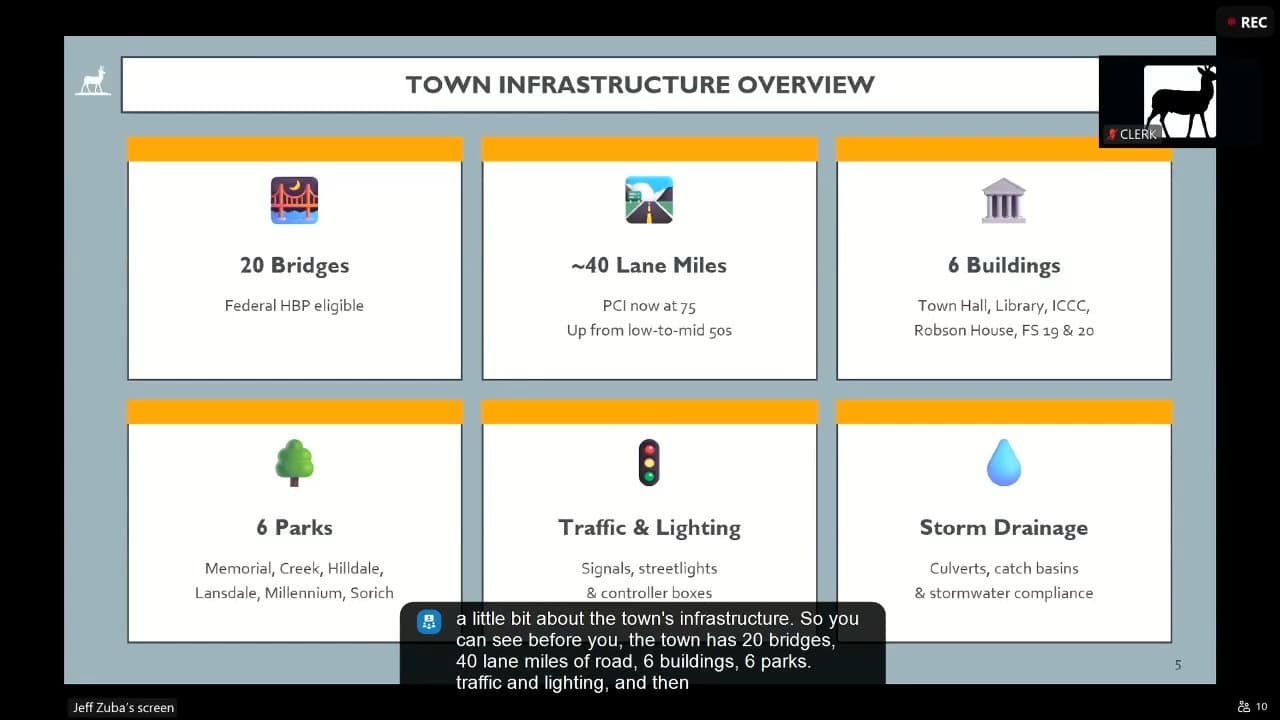
Why it matters: The fiscal year 2027–2031 Capital Improvement Plan, or CIP, sets San Anselmo's priorities for streets, safe routes and parks. The plan covers roughly $20M across 42 projects, funded largely by local Measure J and Measure AA dollars.
Where things stand: Finance Director Jeff Zuba presented the town's first rolling CIP, which will be updated each year rather than rewritten from scratch. The town's Infrastructure Finance and Management Committee (IFMC) reviewed it June 1. On July 20, the Planning Commission found it consistent with the general plan. About 54% of the plan goes to streets and 20% to active transportation. Highlights include a $900,000 Butterfield Road grant and a traffic signal at Sir Francis Drake Boulevard and Sunny Hills Drive.
"The CIP is a planning guide. It's not a fixed commitment," said Zuba.
The debate: Schlesinger asked about inflation, projected outcomes for the Pavement Condition Index (PCI, a 0–100 measure of road quality) and unfunded needs. "Can we see the 5-year fund balance forecast behind this?" he asked. He also sought rough cost ranges for projects that are funded only for design.
That design-only funding split the dais. Councilmember Eileen Burke cautioned against paying for designs that have no construction money behind them. "It seems that we ought to be focusing on what will get done, not what might," said Burke.
Councilmember Tarrell Kullaway defended design spending as a path to grants. "I think getting them shovel-ready is part of the idea in spending the money on design," said Kullaway. He also asked about construction funding for the Sir Francis Drake signal. He urged staff to measure road success by injury data for all road users, not by PCI alone.
Decisions and stakeholder impacts: The council approved the plan by voice vote (For: 4 — Burdo, Burke, Kullaway, Schlesinger; Against: 0; Absent: 1 — Walker). Staff agreed to add fund balance forecasts, unfunded-need estimates and design-only cost ranges in the next round. Cyclists, pedestrians and families on school routes gain from the active transportation share. Drivers on aging streets should watch flat paving budgets.
What's next: Resident Jorge Plata asked about the boarded-up park next to Creekside Pizza. Mayor Steve Burdo said the 60% design was approved and the full design will return in the coming months.
Fire Costs Shift on a 15-Year-Old Formula
The basics: San Anselmo, Fairfax, Ross and Sleepy Hollow share the Ross Valley Fire Department through a Joint Powers Agreement (JPA). A JPA is a contract that lets agencies jointly run a service. The council approved the JPA's Fourth Amendment.
Where things stand: Chief Mahoney of the Ross Valley Fire Department reviewed earlier amendments from 2010, 2012, 2014 and 2022. He said Ross has been credited $357,222 in savings after the Station 18 closure transitions. Under the new Section 8.1 shares, San Anselmo pays 41.99%, Fairfax 24.14%, Ross 20.61% and Sleepy Hollow 13.26%. "So they're going to go from 23.37% down to 20.61%," said Mahoney of Ross. Section 9.4 requires three-person staffing at all three stations, with a July 16, 2026, effective date.
The other side: Schlesinger asked how the percentages were derived. He learned they came from negotiations in 2010–2012, with no formal methodology. "It's been 15 years since those percentages have been revisited," said Schlesinger.
Burke, who reported that the fire board approved the amendment unanimously, agreed the cost factors should be reweighed periodically. "I think we do need to take a look at reallocating," said Burke.
Decisions and stakeholder impacts: The amendment passed by voice vote (For: 4; Against: 0; Absent: 1 — Walker). The vote authorizes the Mayor to execute the agreement. No one spoke during public comment. San Anselmo taxpayers carry the largest share, while Ross's share falls. Three-person staffing standardizes crew levels across stations.
What's next: Members signaled a future review of the allocation formula. No date was set.
Ludwig's Fights for a Cigar Carve-Out
Why it matters: The council is expected to consider a total tobacco sales ban on Oct. 13. A downtown family business says it may not survive the ban.
Where things stand: Ludwig's representative Barbara said the shop sells only premium, additive-free, hand-rolled cigars priced from $12 to $100. It sells no cigarettes, vapes or pouches, and it is approaching its 50th year. She cited a petition drive, argued that minors mostly obtain tobacco online and noted the financial strain of flood season.
"This isn't hyperbole. This is a real existential threat to our business," said Barbara. "Please allow room for a reasonable amendment that protects both youth health and our town's legacy small businesses."
Customer Philip Lederer, a San Rafael resident, said no one smokes in the store and no one under 21 can enter the cigar area. "The Nazari family has owned it for 50 years, but it is an institution," he said.
Decisions and stakeholder impacts: The council took no action. Burdo later noted that Ludwig's owner won Business Citizen of the Year at the Spirit of Marin Awards. The Oct. 13 debate pits youth-health goals against a legacy small business.
Minor Items
- Right-of-way vacations: In separate 4-0 votes, the council vacated a roughly 6-by-78-foot lane segment at 250 Redwood Road and a roughly 1,860-square-foot former roadway at 79 Sequoia Drive. The Sequoia vacation keeps a utility easement, and staff answered a neighbor's protest by noting the land was formerly roadway.
- Flock cameras: April Hughes read a Racial Equity Committee letter seeking termination dates, deactivation, a removal deadline and a map of every license-plate camera panel. Kullaway called the concerns valid and asked that the town's response be made public.
- Consent calendar: Items 11 through 18 passed 4-0 without discussion. A public commenter previewed the Oct. 2 Creek Park celebration.
- Zone 0 loans: A council report said Redwood Credit Union offered a 6.99% rate on short-term home-hardening loans, possibly dropping to 3.99%. The report also noted that state regulators paused Zone 0 rules.
- Creek Park design: Ross Asselstein urged a study of Option A with and without the low wall. He cited about 30 lost downtown parking spaces and raised the question of flood district refunds.
Looking Ahead
The tobacco ban comes to the council Oct. 13. The Ross Valley Fire Department holds a Station 20 open house Oct. 24. The countywide emergency tabletop exercise follows Nov. 18.