
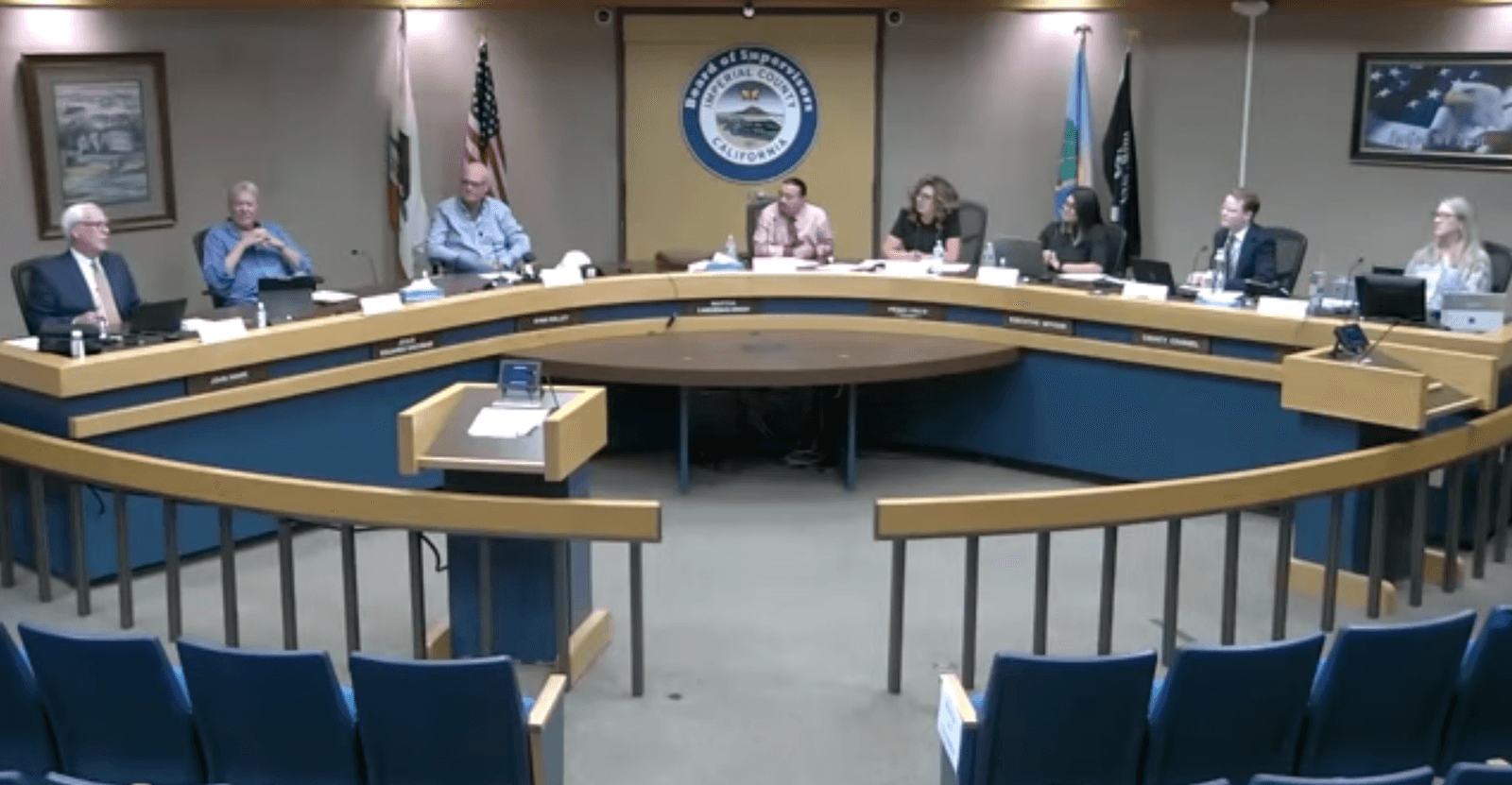
State Wants Salton Sea Authority's $200K Prop 68 Plan in Writing
Board of Directors • Salton Sea AuthoritySeptember 18, 2026
Locunity is an independent informational service and is not an official government page for this commission. All information is sourced from public footage and an analysis of official agendas with the aid of responsible, fact-checked AI. to report an error or omission.
How much detail does the state need before roughly $200,000 in Proposition 68 bond money flows to the Salton Sea Authority? That question took up the longest stretch of the board's Sept. 18, 2026, meeting, with state representative Joe Shea pressing for a written plan by November. Directors also heard a geothermal CEO and the board's own chair clash over a cultural-resource filing, and learned that a federal Colorado River review left the sea out entirely.
Prop 68 terms: State wants a written plan for about $200,000 by November
Geothermal clash: Controlled Thermal Resources seeks help; chair calls its letter vague
Sea left out: Federal Colorado River review skipped Salton Sea impacts; EPA letter drafted
$30M public-access money survives state budget despite a dropped earmark
$2.146M Corps request pending as Congress runs on a continuing resolution
Prop 68: How Much Paper Is Enough?
Why it matters: Bond rules and accountability scrutiny make flexible spending difficult. Whatever the Authority and the state agree on could become the template for future funding deals.
Where things stand: The Authority and the California Natural Resources Agency (CNRA) are negotiating how to use roughly $200,000 in Proposition 68 funds. Executive Director G. Patrick O'Dowd said about 40% would cover staff time — "That's about $80,000 a year, $20,000 a quarter" — with the rest funding outreach to be decided collaboratively. He said he was uncomfortable projecting those uses on paper.
The other side: Joe Shea, Assistant Secretary and ex officio board member representing the State of California, pushed back. "I'm just a hawk on putting it in writing," said Shea. He urged a written outline vetted by bond accountability staff and said the extra effort would pay off.
Project status: Shea also walked through the North Lake Wetlands project, which involves 109 parcels. Of those, 28 private parcels belong to 11 landowners who have been hard to reach, and the project needs a water agreement with the Coachella Valley Water District (CVWD). He pointed to Cane Spring as proof that faster delivery is possible: it went to contract in about two years. By contrast, scoping and contracting the earlier Species Conservation Habitat work took roughly a decade.
Board Chair Joseph Mirelez asked whether funds could be earmarked flexibly. Lisa Moore, the Authority's federal advocate, said the Authority's value in Congress, on appropriations and the Water Resources Development Act (WRDA), comes from being "an entity like the authority that represents the local folks."
Decisions and stakeholder impacts: The board took no vote. Authority staff stand to gain dedicated capacity funding if terms are settled. The 11 hard-to-reach North Lake landowners and CVWD remain critical to the project's path.
What's next: A written Prop 68 proposal is expected at the November meeting.
Geothermal Developer, Tribal Chair Spar Over Filing
Why it matters: A state commission is expected to take up a cultural-resource filing affecting a major geothermal project in late November. The Authority may need to decide its position before then.
Where things stand: Rod Colwell, CEO of Controlled Thermal Resources, told the board his company has invested over $300 million over about 15 years in its Hell's Kitchen geothermal development. He said the cultural-resource filing felt sprung on the company at the 11th hour. He also said the company wants to mitigate dust and offered to work with the Authority. Asked about his letter to the board, Colwell acknowledged the rush. "The letter was literally drafted on the plane on the way here," said Colwell.
The other side: Board Chair Mirelez, who also chairs the Torres Martinez Desert Cahuilla Indians, said "there's no specifics in this letter." He objected sharply to the letter's reference to "legitimate" resources. "Non-Native nations telling a Native nation what's legitimate to us, is a slap in the face," said Mirelez. He framed the tribal position as seeking mitigation, not delay. "We are not stallers of getting things accomplished," he said.
Decisions and stakeholder impacts: One director asked the board to take no action at this meeting but to meet before the state commission acts. "I would hope that before that time that this body is able to convene," the director said. O'Dowd will gather information. The dispute pits a heavily invested developer in the Lithium Valley region against tribal cultural-resource concerns, with the Authority's board sitting at the intersection of both.
What's next: Mirelez raised the possibility of an emergency meeting before Nov. 17, 2026.
Federal River Review Skipped the Sea
The basics: An environmental impact statement (EIS) is the federal analysis required under the National Environmental Policy Act (NEPA). The Quantification Settlement Agreement (QSA) governs Colorado River water transfers tied to the sea.
Why it matters: The federal review of post-2026 Colorado River operations excluded Salton Sea impacts. The Authority says no single agency is clearly responsible for assessing them.
Where things stand: O'Dowd said "the final EIS was issued and it excluded evaluating those impacts." He reported that a lawsuit has been filed in Nevada and that the Authority has sent a letter to the State Water Board. A draft EPA letter asks what the agency's finding that requirements were met actually means when no studies address the sea. Moore explained EPA's NEPA review role.
The other side: Shea said the Water Board oversees the state program under Division of Water Rights Order 2017-0134, separately from the QSA. He relayed that Water Board members "want a clearer nexus between the QSA efforts and our state program efforts." O'Dowd said that division of duties shows the problem: "There is no single person that you can say fix it."
Decisions and stakeholder impacts: Director John Aguilar of CVWD, Division 1, moved to receive and file the update. Supervisor Ryan E. Kelley, District 4, Imperial County, seconded. The motion passed on a voice vote, with the chair noting everyone was in favor. Staff had also sought authorization to send the EPA letter, but the recorded motion covered only receiving and filing. The letter puts federal agencies on notice that sea impacts remain unassessed.
Money Watch: $30M Survives, Corps Request Pending
Why it matters: Federal appropriations, a state public-access earmark and a CEQA ballot measure will shape Salton Sea project funding and timelines.
Federal: Moore said Congress is operating under a continuing resolution and Senate spending bills have not been released. Sens. Alex Padilla and Adam Schiff both requested the full "$2.146 million for the Corps to continue its work in FY27" on the Army Corps of Engineers feasibility study. The House side came up short. "We did request it of Congressman Ruiz, and he did not make the request on the House side," said Moore. She speculated that members trade off carrying requests. Separately, the Authority's WRDA language clarifying how federal-land benefits count in cost-benefit analysis was included in a bill reported out of the Senate Environment Committee.
State: Shea said the $30 million for public access projects lost its earmark through a drafting error. "The earmark didn't make it in, but the money did," said Shea. The funds remain in the budget bill junior, and the state will coordinate with the Wildlife Conservation Board. Cleanup legislation is expected. Glenn Farrell reported that AB 113 included about $2.7 billion in Proposition 4 appropriations, while Greenhouse Gas Reduction Fund auction revenue is projected lower.
Sacramento outlook: Nick Roma of Crew Strategies described the end of the two-year session, with about 900 bills on the governor's desk, and a gubernatorial race. "There's 14 ballot measures this year," said Roma, including Proposition 45, a CEQA reform proposed by the California Chamber of Commerce. He flagged "green tape" streamlining efforts that could speed restoration projects, though local governments have raised timeline concerns. He proposed a board visit to Sacramento in 2027.
What's next: A director asked the habitat contractor for local-hire numbers. The chair added local-hire data to the list for the next meeting.
Minor Items
Venue change: Directors moved the next meeting to the Torres Martinez Reservation to mark 150 years of the tribe's federal recognition. Supervisor Kelley moved and Supervisor Martha Singh, District 2, Imperial County, seconded; the motion carried by voice vote.
Desert Shores: The Authority will solicit every property owner of record, prioritizing 25 owners of multiple parcels, after the Bureau of Reclamation extended the grant two years past its prior March expiration. Public commenter Tom Sefton asked what happens if some owners can't be reached; O'Dowd said staff would work with state and federal partners on site-control options.
Framework of assurance: O'Dowd will return in November with an ad hoc committee implementation plan and a suite of funding options. He flagged SB 675, which reorganizes leadership of the Imperial County Air Pollution Control District.
Routine business: The agenda and consent calendar each passed on 4-0 roll calls (For: 4, Against: 0) among the directors called.
Looking ahead: November brings the Prop 68 written proposal, the ad hoc committee plan, funding options, local-hire data and a meeting on Torres Martinez land. A possible emergency session on the geothermal filing could come before Nov. 17, 2026.