
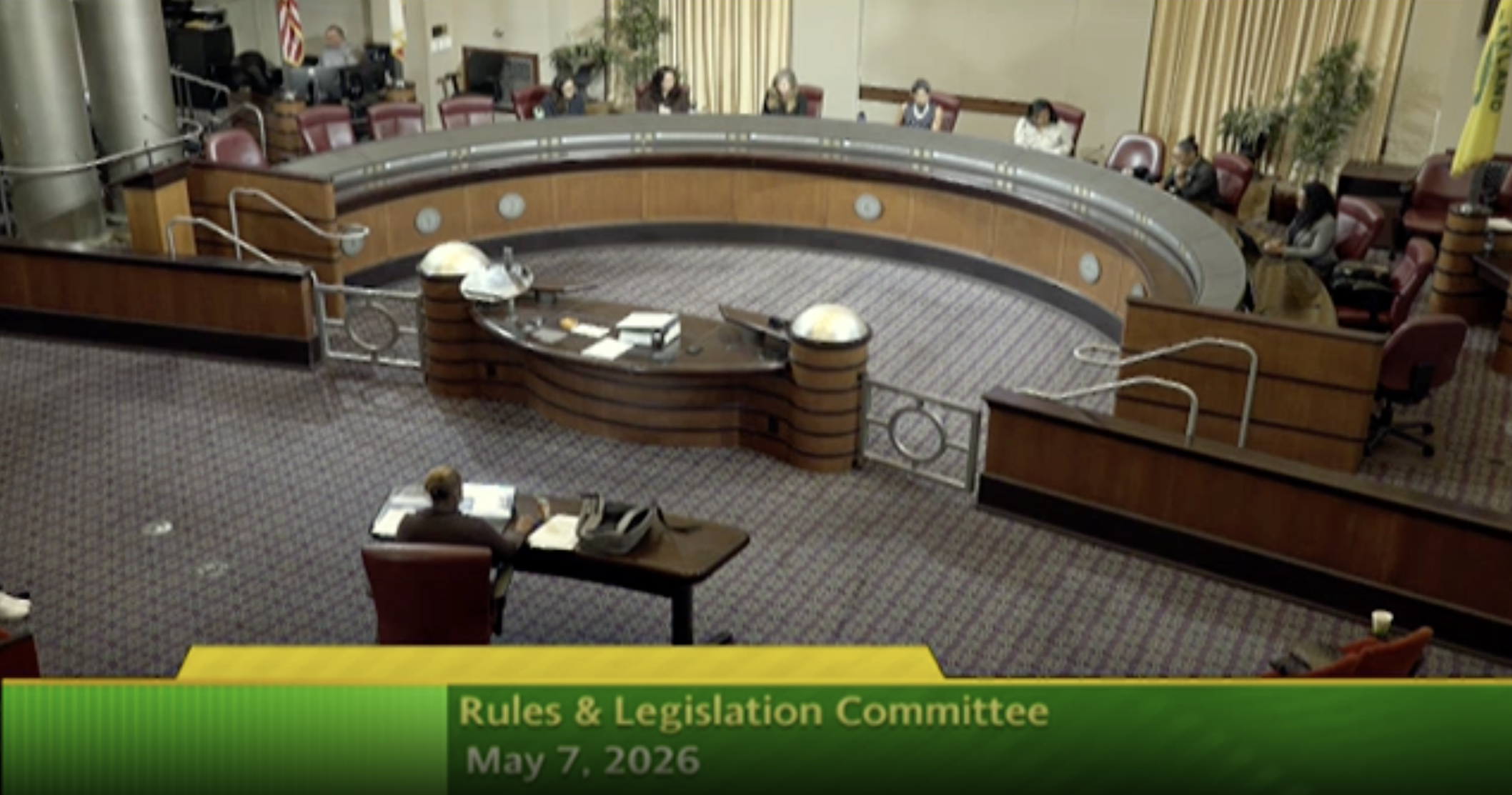
Rules & Legislation Committee - May 07, 2026 - Meeting

Rules & Legislation Committee - May 07, 2026 - Meeting

Rules & Legislation CommitteeOaklandMay 7, 2026

Sources:

Locunity is a independent informational service and is not an official government page for this commission.We use AI-assisted analysis and human editorial review to publish information.

Police Oversight Overhaul Shelved After Fierce Public Opposition

Oakland's Rules & Legislation Committee became a battleground over the future of civilian police oversight Wednesday, as a proposal to let council members directly appoint police commissioners and move the Inspector General under the city auditor drew overwhelming opposition before being tabled indefinitely. The committee also queued up a sweeping governance charter reform for the November 2026 ballot and scheduled a $45 million violence reduction plan for upcoming hearings — setting the stage for a consequential stretch of Oakland policy fights.

  • Proposal to restructure police commission tabled after public backlash from oversight advocates, the Inspector General, and former commissioners

  • Sweeping charter reform making the mayor CEO with veto power, full-time council, and subpoena authority headed to May 21 Rules hearing

  • $45M+ violence reduction plan scheduled for Public Safety Committee; council can approve or reject but cannot amend

  • Homelessness ballot measure with commercial real estate tax surcharge quietly withdrawn before debate

  • Meeting adjourned in memory of Wilson Riles Jr., former council member and police commissioner, whose legacy framed the oversight fight


Police Oversight Charter Amendment Dies on the Vine — for Now

The basics: Councilmember Ken Houston introduced a charter amendment proposing three changes to Oakland's nationally recognized police oversight structure: replacing the independent selection panel with direct council and mayoral appointments of police commissioners, moving the Inspector General from the police commission's authority to the city auditor's office, and streamlining the police chief hiring process to match how other department heads are appointed.

Why it matters: Oakland voters created the police commission by approving Measure LL in 2016 with more than 80% support, then strengthened it with Measure S1 in 2020. The commission is widely considered one of the strongest civilian oversight bodies in the country — governing a department still under federal oversight after decades of misconduct scandals. Restructuring it would fundamentally alter the independence mechanisms voters put in place.

Where things stand: Houston's staff presented a slide deck arguing that elected officials are more accountable than appointed commissioners, that the Inspector General faces an employment conflict when critiquing the body that can fire them, and that the city has suffered excessive police chief turnover — 11 chiefs in 13 years. Houston cited polling he said showed 80% public support for the changes.

Councilmember Carroll Fife dismantled the proposal point by point. She questioned whether eliminating alternate commissioners would create quorum problems, whether council appointments actually strengthen accountability or simply rearrange power, and whether moving the Inspector General contradicts the city auditor's own recommendations. She also challenged the polling data directly:

"The push poll that was released to get information about what the voters actually want was just that — it was a push poll with fallacious results, and we cannot start on a basis of fallacy," said Fife.

On the Inspector General transfer, Fife pressed:

"I want to understand why are we proposing to move against what the elected city auditor recommends for independence?"

The other side: The Inspector General himself appeared to oppose the proposal. Zurvohn Maloof, Inspector General, warned the committee that the transfer would violate professional standards:

"Under government auditing standards, an auditor cannot independently audit an office whose leadership that they select — it compromised both the appearance and the reality of impartiality."

Public comment ran overwhelmingly against the proposal. Millie Cleveland of the Coalition for Police Accountability challenged the committee directly:

"Before you declare there is a problem with the charter, you first must make sure you're implementing it as it's written. Then you can identify if there are problems."

Pamela Drake of the Wellstone Democratic Renewal Club and Progressive Working Group drew a parallel to the Trump administration's removal of federal inspectors general:

"We have the most innovative, independent, most community-minded oversight body in the country, and that is over our most expensive, most inefficient department, which has the ability to be the most lethal."

Cathy Leonard called the Inspector General transfer "nothing but a ploy to get rid of the OIG's office." Lorelei Bosserman accused Houston and Council President Kevin Jenkins of doing the police union's bidding. Jose Antoine Dorado, a former police commissioner, connected the fight to the legacy of Wilson Riles Jr. and the OPD scandals that led voters to create the commission in the first place.

Only one speaker, David McGinnis, offered qualified support for governance reform generally, citing concerns about volunteer commissioners lacking public safety experience and slow consultant hiring — though he stopped short of endorsing the specific proposal.

Decisions: Houston acknowledged the political reality before the vote:

"I'm watching. I don't believe I have the votes here because of certain political reasons. I like to put this on the pending list..."

Fife closed with an extended history of OPD scandals dating to 2004, arguing the city's improving safety record is a product of oversight, not an argument against it:

"Just because we've had 11 chiefs in 13 years does not mean it's the fault of oversight. And in fact, I would argue that a lot of the changes that have occurred into Oakland becoming safer is because of oversight, not in spite of it."

The motion to move the item to the Rules pending list with no specific return date passed 3-0 (Approve: Brown, Fife, Ramachandran; Abstain: Jenkins).

What's next: Houston signaled the fight may shift to a citizen ballot initiative through signature gathering. But the proposal faces a potential collision with a separate comprehensive charter reform measure (Item 3.9) also headed to the November 2026 ballot.


Major Charter Overhaul Advances Toward November 2026 Ballot

Why it matters: A comprehensive charter amendment that would fundamentally restructure Oakland's governance was scheduled for a May 21 Rules Committee hearing. The measure would make the mayor the city's chief executive officer, empower the council to confirm department head appointments for Finance, Human Services, Public Works, and Transportation, and create an independent Budget and Legislative Analysis Office.

Where things stand: Additional provisions include granting the council subpoena power, creating a mayoral veto with line-item budget authority and council override, requiring full-time council service with no outside employment, directing the Public Ethics Commission to align salaries, and mandating publication of ordinances within 15 days of passage.

What's next: The charter amendment text has not yet been released publicly. If both this measure and any police commission restructuring proposal reach the November 2026 ballot, whichever receives more votes would prevail where they conflict — a dynamic that could force voters to weigh competing visions for Oakland's governance in a single election.


$45 Million Violence Reduction Plan Heads to Committee — but Council Cannot Change It

The basics: The committee scheduled adoption of the 2025–2030 Community Violence Reduction Plan, required by Measure NN, for the May 26 Public Safety Committee. The plan guides more than $45 million per year in public safety spending.

Why it matters: Council can approve or reject the plan but cannot amend it — concentrating power in the Oakland Public Safety and Services Oversight Commission (OPSPOC) and potentially bypassing normal budget deliberation for major spending decisions.

Where things stand: Public commenter Rajni Mandal, a District 4 resident, warned the plan is still being revised. She said commissioners at a recent meeting stated the draft would undergo further changes based on community feedback and city attorney discussions.

"This plan will guide more than $45 million per year in public safety spending, and council can approve or reject it but cannot amend it," she said.

Mandal urged the council to ensure it stays focused on high-level strategy and avoids expanding OPSPOC's role into areas already overseen by existing bodies, including OPD, federal NSA compliance, and the police commission.

What's next: The plan goes before the Public Safety Committee on May 26. Given the council's inability to modify its contents, the committee hearing represents the primary opportunity for elected officials to raise concerns before an up-or-down vote.


CIPRA Accountability Report Flagged as Milestone After Years of Gaps

Public commenter Rajni Mandal also flagged the upcoming Community Police Review Agency (CIPRA) report on the May 12 Public Safety Committee agenda as significant — calling it the first time CIPRA is presenting to council under the municipal code after years of inconsistent reporting, a gap identified by the city auditor. She cited a memo from Councilmember Charlene Wang laying out ordinance-required metrics including completed investigations, sustained findings, missed deadlines, and mediation outcomes. CIPRA Director Lawson has acknowledged the agency is still building reporting infrastructure and has lacked written operating procedures for a significant period. Police commissioners themselves have expressed difficulty interpreting CIPRA data.


Homelessness Ballot Measure Quietly Withdrawn

Councilmember Charlene Wang's SAFER Act — which would have placed a commercial real estate transfer tax surcharge on the November 2026 ballot to fund interim shelter, transitional housing, and encampment response — was withdrawn before the committee could take it up. The measure proposed an eight-year surcharge: 25% on commercial real estate transfers over $2 million to $5 million, 5% for $5 million to $10 million, and 1% above $10 million. After initial scheduling confusion between May 14 and May 21, Wang's staff pulled the item entirely. No substantive debate occurred, and no timeline for reintroduction was given.


In Memoriam: Wilson Riles Jr.

The meeting was adjourned in the name of Wilson Riles Jr., a former Oakland council member and police commissioner who passed away recently. Chair Janani Ramachandran said she had authored his letter of recommendation for the police commission and praised his commitment to good governance:

"At the end of the day, what struck me the most was the importance of good governance."

Councilmember Carroll Fife called him "a radical revolutionary for justice" and connected his legacy directly to the evening's oversight debate. Jose Antoine Dorado, a former police commissioner, and multiple public speakers also paid tribute.


Minor Items

  • $300,000 Caltrans youth cleanup grant received an urgency finding and was fast-tracked to the May 12 Public Works and Transportation Committee; state deadline has already begun, and delay risked forfeiting the funds.

  • Gary Payton Way: A resolution to commemoratively rename a section of 40th Avenue after NBA legend Gary Payton was scheduled for the May 19 Council consent calendar. Public commenter Cathy Leonard urged the city to also give him a key to the city.

  • Outfront digital advertising signs agreement removed from the Community and Economic Development pending list, effectively killing a proposal for up to five new digital billboards that would have generated more than $2.3 million in city revenue.

  • April 23, 2026, meeting minutes approved 3-0.

  • Pending list of outstanding committee items approved 3-0.

  • 24 total items were scheduled across various council committees, with title changes applied to Items 3.8 and 3.15.

  • All votes passed 3-0 with Council President Kevin Jenkins absent/excused.