
$30 Minimum Wage Initiative Heads to Oakland Council Dec. 1
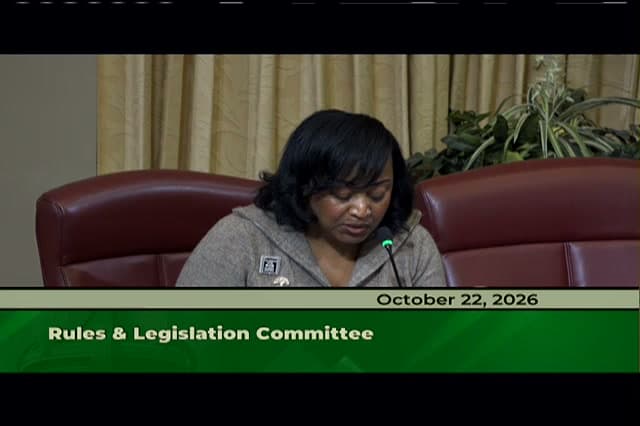
Rules & Legislation Committee • OaklandOctober 22, 2026
Locunity is an independent informational service and is not an official government page for this commission. All information is sourced from public footage and an analysis of official agendas with the aid of responsible, fact-checked AI. to report an error or omission.
Oakland’s citizen-backed push for a $30 minimum wage by 2037 cleared its last procedural gate Oct. 22. The Rules & Legislation Committee voted 4-0 to send the Oakland Living Wage For All Act of 2026 directly to the full City Council. Under state election law, the Council must now adopt it, send it to voters or order an impact study. The committee also put an extension of the city’s data center moratorium on a fast track for a Nov. 10 public hearing.
- $30 minimum wage initiative scheduled for Dec. 1 Council vote on three legally mandated options
- One Fair Wage presses Council to adopt the measure and avoid a ballot fight
- Data center moratorium extension of 10 months, 15 days set for Nov. 10 special hearing
Living Wage Initiative Skips Committee, Lands at Council
The basics: The Oakland Living Wage For All Act of 2026 is a citizen initiative that would raise Oakland’s minimum wage to $30 by July 1, 2037. Its petition signatures have been certified. That triggers California Elections Code Section 9215, which limits how a city council can respond.
Why it matters: The Council cannot amend or ignore a certified initiative. It has three choices, and each sets a different path for Oakland’s lowest-paid workers and the businesses that employ them.
Where things stand: The clerk read the three options into the record:
- Option A: Adopt the ordinance without alteration
- Option B: Submit it to voters Nov. 7, 2028, or at a special election
- Option C: Order an Elections Code Section 9212 impact report within 30 days
A special election under Option B would fall 88 to 103 days after the Council calls it. Under the committee’s Rule 24, the item bypasses policy committee review and goes to the Dec. 1, 2026, Council agenda as a non-consent item. That means it will be heard and voted on individually rather than bundled with routine business. The clerk explained that because the Council must pick one of the three options regardless, there is no reason to route the item through committee first.
The committee did not debate the measure’s merits. Its only action was scheduling.
Organized labor voice: Both public speakers on the item came from One Fair Wage, the coalition behind the initiative. They thanked members for following the law and asked them to engage directly with the campaign.
Tonisha Scott, a member and leader of One Fair Wage, described a low-wage District 3 colleague who could not attend because she had to work. Scott asked members to meet with the coalition.
“Workers in the City of Oakland deserve a living wage,” said Scott.
Orahi Umoni, also of One Fair Wage, said the coalition includes small businesses and workers without union representation. Umoni urged members to meet with all stakeholders, including people who disagree, and to make “a decision based on empirical data.” Umoni said the coalition hopes the Council will act on the ordinance itself.
“So that we can avoid the ballot box and we can avoid a crunch that could be upcoming,” said Umoni.
The other side: No opponents spoke, and no committee member weighed in on the policy. Umoni’s call to meet with critics suggests the coalition expects resistance before Dec. 1. Option C, the impact report, is the procedural tool most often available to a council that wants more data before committing.
Decisions and stakeholder impacts: The committee approved scheduling on a 4-0 vote (For: Councilmember At Large Rowena Brown, Councilmember Carroll Fife, Councilmember Janani Ramachandran, Council President Kevin Jenkins; Against: 0; Absent: 0).
If the Council adopts the measure, low-wage workers would gain a set path to $30 without a campaign. Employers would face that same schedule with no chance for a public vote. A ballot referral would push the decision to November 2028 unless the Council calls a special election. A 9212 report would delay the choice by about 30 days and produce an analysis that both sides could use.
What’s next: The full Council takes up the measure at its Dec. 1, 2026, meeting. Supporting documents include the certification resolution, Option A, Option B and Option C.
Data Center Pause Faces State-Mandated Deadline
The basics: On Oct. 6, the Council adopted Interim Emergency Ordinance No. 13899 C.M.S., a temporary pause on data center approvals. California Government Code Section 65858 requires the Council to hear a written report on the moratorium within 35 days of adoption. The Council must hold that hearing to keep the option of extending the pause.
Why it matters: The clock is set by state law. If the Council misses the deadline, it loses the ability to extend the moratorium, and data center applications would no longer be on hold.
Where things stand: The committee scheduled two items for a Nov. 10, 2026, special Council public hearing:
- A resolution adopting the Section 65858 written report, with California Environmental Quality Act (CEQA) findings
- An interim emergency ordinance under City Charter Section 213 extending the moratorium by 10 months and 15 days
Like the wage initiative, these items bypassed committee under Rule 24 because of the state deadline. No speakers addressed the moratorium, and members did not discuss it.
Decisions and stakeholder impacts: The items passed with the wage initiative as a single motion, 4-0, with the same roll call. Data center developers face a longer hold on approvals if the extension passes. Residents and advocates who are tracking the issue now have a fixed date to be heard.
What’s next: The public hearing is Nov. 10. Documents include the written report resolution and the extension ordinance.
Minor Items
- Public Safety item delayed: Michael Ford of the Department of Transportation asked to move item 3 from the Oct. 27 Public Safety Committee agenda to Nov. 17. Ford said Public Safety Chair Wong supported the change by email. The committee approved the amended agendas 4-0.
- October minutes approved: The Oct. 8 minutes passed 3-0, with Fife excused.
- Pending list unchanged: The rules pending list passed as is, 3-0, with Fife excused. Fife joined before the votes on items 3 and 4.
Looking Ahead
The Nov. 3 committee meetings are canceled for Election Day. A draft agenda for the Nov. 5 Rules meeting is pending. Key dates are the Nov. 10 data center hearing, the Nov. 17 Public Safety Committee meeting and the Dec. 1 Council vote on the $30 wage initiative.