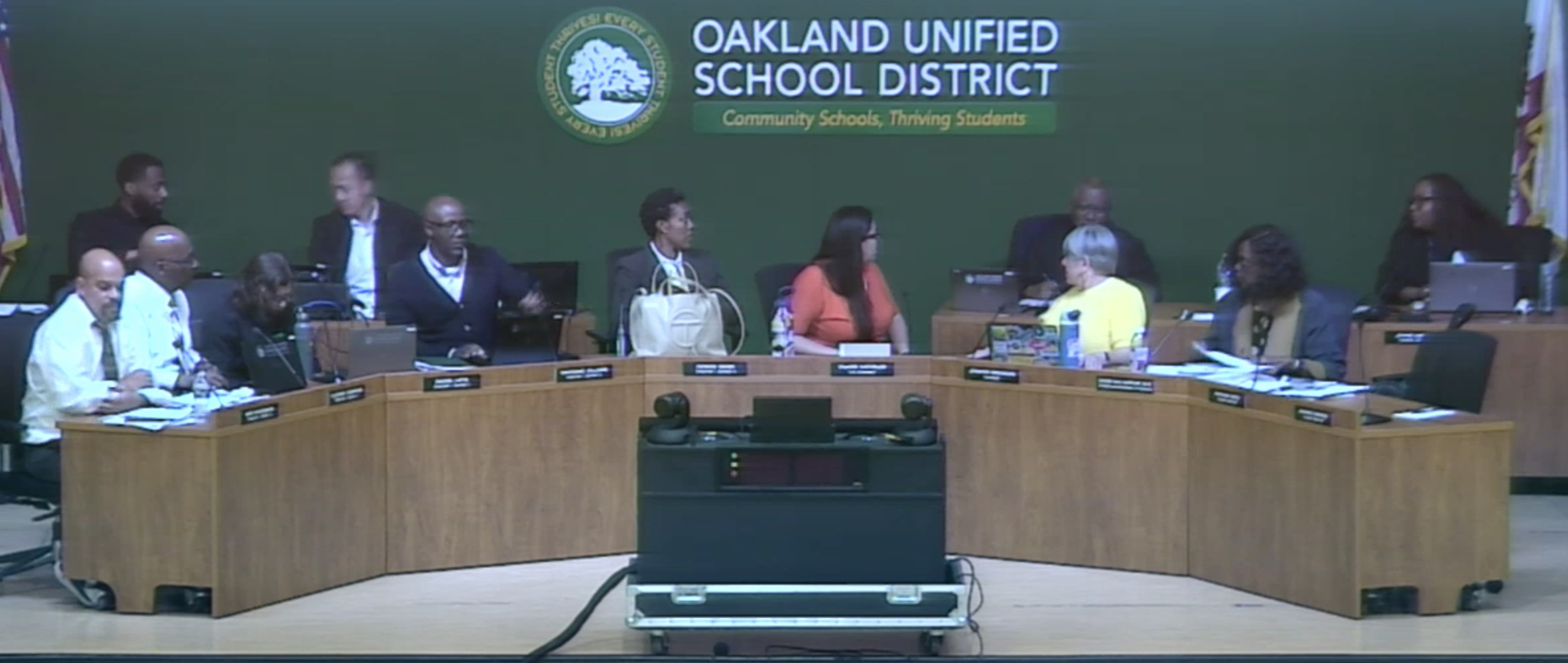
Rules & Legislation Committee - Mar 26, 2026 - Meeting
Rules & Legislation Committee • OaklandMarch 26, 2026
Locunity is a independent informational service and is not an official government page for this commission.We use AI-assisted analysis and human editorial review to publish information.
Charter Reform Battle Lines Drawn as Oakland Public Overwhelmingly Rejects Strong Mayor Plan
The Oakland Rules & Legislation Committee on March 26 became the stage for one of the most consequential governance debates the city has seen in years, as roughly 20 public speakers lined up to reject the mayor's charter reform working group recommendation for a strong mayor system — advocating instead for a council-manager model they call the "third option." The committee also routed dozens of policy items to upcoming hearings, including deferrals of the sideshow ordinance and an OPD surveillance tool, while a controversial rent control package was quietly pulled from committee.
- Charter reform showdown: Public overwhelmingly backs council-manager "third option" over working group's strong mayor recommendation, with labor leaders and former Mayor Libby Schaff among the few dissenters
- Sideshow ordinance and OPD surveillance policy both shelved to pending lists with no date, at the administration's request
- Rent Adjustment Ordinance amendments withdrawn from CED committee after drawing 22 speakers — no new hearing date set
- Illegal dumping crackdown advances: Penalty increases, a state bill, and a surveillance pilot head to the April 14 Council meeting
- Encampment abatement policy fast-tracked to the April 14 Council agenda at District 7's push
Oakland's Governance Future: Strong Mayor vs. the "Third Option"
The charter reform informational report consumed roughly 75 minutes of committee time — dwarfing every other item — and drew the sharpest public participation of the meeting. At its core: How should Oakland distribute power among its mayor, council, and city administration?
The basics: Oakland currently operates under what both sides agree is a dysfunctional "blended model" — a hybrid that captures the weaknesses of both council-manager and strong mayor systems without the strengths of either. The Mayor's Charter Reform Working Group, co-facilitated by SPUR and the League of Women Voters, recommended that Oakland adopt a strong mayor system with a mayoral veto, a strengthened city council with its own legislative and budget analyst office, and a return to an odd-numbered council. The group cited Oakland's fiscal distress, racial and geographic inequities, and the need for decisive leadership.
Why it matters: Whichever governance model Oakland ultimately chooses will restructure the balance of power between the mayor, council, and city administration for decades — and the question will likely go before voters as a ballot measure.
The Public Pushback
Of approximately 20 speakers who addressed the committee, the vast majority rejected the strong mayor recommendation. Instead, they championed a "third option": a council-manager system with an empowered mayor who holds veto power, sits on the council, and works alongside a professional city manager.
"97% of California cities have rejected the strong mayor system. With the exception of San Francisco, which is both a city and a county, every single city in the Bay Area, large and small, has rejected the strong mayor model," said Stephen Falk, co-founder of the Oakland Charter Reform Project. "No California city has transitioned to a strong mayor system in the last 20 years."
Pat Martel, ICMA West Coast Regional Director, made the professional case for the third option: "This option creates clear lines of responsibility and accountability. Elected officials set policy and a professionally trained manager is accountable to the mayor and city council for execution."
Mike Volk, speaking for Neighbors for Progressive Action and its 500-plus members, noted that only four large California cities use a strong mayor model and that 83% of surveyed residents wanted the council to have leverage to get things done. Charlie Long, a four-time city manager and 21-year Oakland resident who said he has invested $100 million in downtown Oakland, called the city's current organization "broken with siloed departments" — but opposed strong mayor as creating yet another broken system. Elizabeth Silver, a retired city attorney with 37 years of experience, emphasized the importance of professional management for implementing the budget.
Mark Sawicki, a former Oakland economic development director with 23 years in local government, said he found the working group's case for strong mayor unconvincing, arguing that a council-manager system distributes power and ensures district representatives have equal standing.
Labor and Schaff Push Back on the Pushback
The minority who favored strong mayor brought institutional weight of their own.
"Everyone is in charge, which means no one is in charge," said Keith Brown, executive secretary of the Alameda Labor Council. "We must establish clear lines of responsibility. We must ensure that the structure of our government can deliver for our community and for better use of limited resources."
Richard Fuentes, AFSCME Council 57 leader and working group member, framed the debate in equity terms: "A third option that has no input from working people, from black people, from brown people. Let's be clear. A third option is a privileged option. Working people don't have time to come today at 10:30 in the morning to provide their perspective."
Former Mayor Libby Schaff, who served 24 years at City Hall, drew on her experience under Jerry Brown's strong mayor structure: "I am probably the only person alive who was an East Oakland council staffer under Jerry Brown's strong mayor form of government. I was a council member of District 4 and I of course was the mayor for eight years." Schaff dismissed the third option as just another hybrid: "Everyone agrees that a hybrid system is fuzzy and does not serve anyone. Option three is just another hybrid proposal." She cited three polls showing 61–64% voter support for strong mayor.
Ahmed Ali Bab, a working group member and District 6 resident, echoed the accountability argument, saying the current system spreads responsibility too broadly.
Process Questions Surface
Ralph Kantz, former chair of the Public Ethics Commission, raised a procedural challenge that could shadow the entire effort: "Section 601 of the Charter requires an advisory group be created by resolution of the City Council. That didn't happen in this case. In addition, what that does is meant there was no public meetings of this working group for the public to observe the process." Kantz alleged the working group violated both the charter and the Brown Act.
Where Council Members Stand
Councilmember Rowena Brown (At-Large) came out publicly for the third option and against eliminating the at-large council seat. "I also would note that during the working group's process and when they met with me, I offered multiple recommendations of how I thought that we can improve the City of Oakland's government structure. And I did not see a single one of my recommendations make it to the recommendations," she said.
Councilmember Janani Ramachandran (District 4) remained noncommittal: "I have said at least 17 times in the past month when I'm in people's living rooms in my district, when I'm on their street corners, when I'm in the business districts that I am in an information gathering stage."
Decisions: The item was received and filed on a 3-0 vote (Councilmember Carroll Fife, District 3, excused). Council President Kevin Jenkins (District 6) committed to additional public hearings, including an evening full council meeting, and noted the ballot measure timeline is tight: "I'll make sure that I work with city attorney's office to send out a timeline for in which things need to get on the ballot. We need to hear them at two regularly scheduled meetings and that timeline is tight."
What's next: The charter reform discussion will move to a regularly scheduled evening council meeting. Council must hear the item at two regularly scheduled meetings before any ballot measure advances.
Sideshow Ordinance, Rent Control Amendments Stall Out
The committee processed 38 sub-items under its omnibus scheduling agenda, but the headline moves were what didn't advance.
Why it matters: Routing decisions at Rules & Legislation determine when — and whether — controversial policies reach final votes. Two high-profile items hit the brakes, while an illegal dumping package gained momentum.
Where things stand: The Oakland Sideshow Ordinance and the OPD Automatic Resource Locator (ARL) policy were both moved to the Public Safety Committee pending list with no specific date, at the administration's request. The Rent Adjustment Ordinance amendments — which would have eliminated tenant petition deadlines, required owner evidence for appeals, and increased damages remedies — were withdrawn from the CED committee and placed on its pending list with no date specific, after drawing 22 speakers at the March 24 CED committee hearing.
Decisions: The full scheduling item passed 3-0 as amended (Fife excused).
What's next: None of the three deferred items have a new hearing date. The sideshow ordinance and ARL policy await administration readiness; the rent control amendments remain in limbo after intense community opposition.
Illegal Dumping Enforcement Package Heads to Council
Three related measures designed to attack illegal dumping from multiple angles all advanced to the April 14 Council meeting.
Why it matters: The package combines local ordinance changes, state legislative advocacy, and new surveillance technology to address one of Oakland's most persistent quality-of-life complaints.
Where things stand: An ordinance strengthening illegal dumping enforcement would increase penalties and target waste transport without license plates, adding daily civil penalties up to $1,000 for harmful waste. A companion resolution supports SB 1218 (Arreguín), a state bill that would link illegal dumping fines to vehicle registration. And a pilot program with Aerbits Inc. would deploy surveillance technology to detect and report dumping.
What's next: All three items are scheduled for the April 14 special Council meeting.
Police Oversight Gaps Tied to Charter Reform
Public commenter Rajni Mondal, a District 4 resident, drew a through line across several agenda items — the city auditor's police oversight audit, the OPD Automatic Resource Locator policy, and OPD federal task force reports — arguing they all reveal the same governance problem: unclear scope, expanding authority, and stalled decisions across the Police Commission, CPRA, and Inspector General.
"Before adding resources, I would urge council to consider a combined structural and performance review so we are not reinforcing a system that lacks clear lines of responsibility," Mondal said. During open forum, she added that "a significant number of the city attorney public opinions, actually one in four in recent years, have focused exclusively on these oversight agencies. That suggests ongoing uncertainty about scope and authority, not just capacity."
Millie Cleveland, a District 4 resident, called for OPD overtime to be scheduled as a public safety agenda item, noting that decades of city auditor recommendations on the issue have been ignored.
Minor Items
- Committee minutes from Feb. 26, March 5, and March 12 approved 3-0 (Fife excused).
- Pending lists updated: Encampment abatement policy scheduled for the April 14 Council meeting at 9:30 a.m. at District 7's request; April 21 Finance Committee moved to a 9 a.m. special meeting.
- Salary ordinance amendments advanced to Council, with the Parking Administrator portion withdrawn; Constitutional Policing Administrator and Assistant Director of Human Services exemptions proceeding.
- Floodplain management ordinance public hearing moved to the May 5 Council meeting.
- Hoover Library property purchase at 3105 San Pablo Ave. forwarded to April 14 Council.
- Surveillance technology policies — including Cellebrite, GPS tracker, and LETS throw phone items — forwarded to April 14 Council.