Rules & Legislation Committee - Jun 18, 2026 - Meeting

Rules & Legislation Committee - Jun 18, 2026 - Meeting

Rules & Legislation CommitteeOaklandJune 18, 2026

Sources:

Locunity is a independent informational service and is not an official government page for this commission.We use AI-assisted analysis and human editorial review to publish information.

Foreclosure Tax Ballot Measure Stalls as Sweeps Funding Sparks Backlash

Oakland's Rules and Legislation Committee continued a November 2026 ballot measure that would close a real property transfer tax loophole on foreclosure transactions after public commenters clashed over whether the revenue should fund encampment closures. The committee also fast-tracked a $200 million bond sale to meet a CalPERS pension deadline and loaded up a July 7 Council session that Chair Kevin Jenkins acknowledged is going to be "pretty impacted."

  • Foreclosure transfer tax ballot measure continued to June 25 after public comment divided over encampment sweep funding and non-binding revenue promises

  • $200M tax and revenue anticipation notes sale bypasses committee, heading straight to July 7 Council to meet CalPERS July 31 pension prepayment deadline

  • General plan land use framework scheduled for July 7 public hearing, a major milestone for Oakland's zoning future

  • Residents challenge police commission chair reappointment, citing six police chiefs in five years and unresolved civilian oversight failures

  • Nuisance penalty ordinance raising fines to $10,000/day amended to require public hearing


Foreclosure Tax Loophole: Revenue Yes, Sweeps No

The committee's most substantive debate centered on Item S6 — a proposed November 2026 ballot measure that would amend Oakland Municipal Code Chapter 4.20 to close an exemption that currently shields foreclosure transactions from the city's real property transfer tax. A companion advisory measure would direct increased revenue toward interim shelter, transitional housing, encampment closure operations, addiction treatment, and job readiness programs.

The basics: When financial institutions like BlackRock acquire properties through foreclosure, they currently pay no real property transfer tax on those transactions. The staff report estimates closing that loophole could generate $400,000 to $1 million annually. The item had been previously continued with amendments adding exemptions for natural persons, family trusts with four or fewer residential units, and financial hardship cases. Councilmember Charlene Wang's office requested another week to continue refining the language.

Why it matters: The measure tests whether Oakland can thread a political needle — taxing institutional investors on distressed-property acquisitions while satisfying advocates who want shelter funding but reject encampment sweeps, and fiscal watchdogs who doubt the council will honor non-binding spending commitments.

Where things stand: Three public commenters laid bare the fault lines. Stacy supported closing the loophole but drew a sharp line at encampment operations:

"We should definitely raise revenue by closing the real estate transfer tax loophole that benefits financial institutions like BlackRock. But we should not tie service delivery to the use of cops and bulldozers to destroy communities."

She challenged the reliability of the recent point-in-time count showing a decline in homelessness, arguing sweeps simply displaced people beyond reach of counters:

"With sweeping, just like when you sweep in your house, if you're not careful, dust and debris goes into the small corners. So people have been swept into the far corners and underneath the bed, so to speak."

The other side: Kevin Daly raised a structural concern about the measure's advisory spending language. Because revenue flows to the general fund, there is no binding requirement for the council to spend it as directed.

"The council has a history of granting exemptions to requirements for other resolutions — sugar-free beverage tax or requirement to fund police," he said. "Having a suggestion in the resolution is a bad idea because there's no longer trust that the council will insist that the money be spent as suggested."

He also warned that stacking multiple tax measures on the November ballot could undermine the transit tax.

Derek Barnes, CEO of East Bay Rental Housing Association (EBRHA), commended the conversation but urged the committee to think bigger than revenue generation, pushing instead for neighborhood recovery and community ownership.

"Imagine using the funds to help Oakland residents, community cooperatives and small housing providers acquire and rehabilitate foreclosed small unit properties," he said, proposing "coupling tax policy with rehabilitation incentives, revolving loan funds, and community ownership opportunities that keep wealth and investment local."

Decisions: The committee voted 3-0 (For: Brown, Fife, Jenkins; Against: none; Absent: Ramachandran) to continue the item to the June 25 Rules and Legislation Committee meeting. The City Attorney's office confirmed there are no timeline concerns with the one-week delay.

What's next: The measure returns June 25, where the council must resolve whether to strip or soften the encampment closure language and whether the advisory spending framework is credible enough to survive public scrutiny on a crowded November ballot.


$200M Bond Sale Fast-Tracked to Meet Pension Deadline

Dawn Granados, from the Treasury Bureau of the Finance Department, requested that a resolution authorizing borrowing of up to $200 million through tax and revenue anticipation notes for fiscal year 2026-27 skip committee review entirely and go directly to the July 7 City Council meeting via Rule 24.

Why it matters: The preliminary official statement — the disclosure document for potential investors — is subject to federal securities laws requiring current material facts. Bypassing committee gives the financing team more time to incorporate the most up-to-date information before the print deadline.

"By bypassing committee, we will allow the financing team including city staff to incorporate the most current information in preliminary official statement before the print deadline for the July 7th City Council meeting," said Granados. "Also, this will allow the notes to close and meet CalPERS' deadline of July 31 for the prepayment of the unfunded actuarial liability."

What's next: The $200M resolution goes to the July 7 Council, where it must clear in time for the notes to close before CalPERS' July 31 pension prepayment window.


Police Commission Leadership Draws Persistent Criticism

Across multiple agenda items and open forum, residents mounted a sustained challenge to the pending reappointment of police commission chair Ricardo Garcia Acosta, raising questions about civilian oversight readiness as Oakland works toward exiting more than two decades of federal oversight.

Why it matters: The commission's leadership and CIPRA's capacity to independently investigate police misconduct are central to whether Oakland can credibly exit federal monitoring. Critics argue the current structure has failed to deliver on that promise.

Where things stand: Rajni Mandal, a District 4 resident, appeared during three separate items to argue the commission has failed to provide meaningful oversight.

"A vote for the current chair is a vote to continue that approach," he said. "I encourage council to evaluate candidates based not only on what they promise, but on their actual record of leadership, judgment and performance."

He pointed to persistent deficiencies in CIPRA:

"nearly 10 years after CIPRA was created, audits and independent reviews continue to identify many of the same deficiencies in lack of policies, training and reporting systems."

During open forum, he highlighted a hiring paradox — CIPRA struggles to fill investigator positions because it historically relied on attorney investigators but can no longer recruit attorneys at current salaries, yet the posted roles don't require law degrees. He characterized this as a governance failure, not a budget shortfall.

A public commenter Tuan, who said he attended the police commission selection panel, also opposed Acosta's reappointment:

"Under his tenure, we had six police chiefs in five years. We need stability."

He cited Acosta's conduct at a federal court hearing where the chair sought the same oversight power as the federal monitor, and advocated for retired Judge Grillo as an alternative who could provide balanced leadership.

What's next: The police commission chair reappointment remains on the committee's outstanding items schedule.


General Plan Land Use Framework Gets Its Hearing

Laura Kaminski, strategic planning manager for the Planning and Building Department, requested that the general plan update phase 2 draft land use framework move from the Rules pending list to the July 7 Council meeting as a public hearing.

Why it matters: The land use framework shapes future zoning and development capacity across Oakland — determining where housing, commercial activity, and community resources can grow. A public hearing is a key milestone that opens the process to formal community input.

Chair Kevin Jenkins acknowledged the crowded July 7 docket:

"July 7th is going to be pretty impacted."

What's next: The draft land use framework goes before the full Council on July 7 as a public hearing.


Nuisance Penalties Head to Public Hearing

Item 3.9, sponsored by Councilmember Zac Unger, would amend Oakland Municipal Code 1.08 to raise maximum civil penalties for nuisance violations: up to $1,000 for a first violation, $2,500 per day for subsequent violations, and $10,000 per day for unabated nuisances on real property. Matthew Mossman from Councilmember Unger's office presented the item.

The committee determined it needed a public hearing designation, scheduling it for the July 14 CED Committee with a public hearing on July 21.


Minor Items

  • June 4 draft minutes approved, 3-0 (Ramachandran absent).

  • Delinquent business taxes, property transfer taxes, and trash fee assessments (Items 3.1–3.3) all scheduled for July 7 Council public hearings via Rule 24, enabling the city to record liens and collect through the county tax collector.

  • AB 2720 support resolution (Item 3.4) backing state legislation requiring law enforcement agencies with more than 25 officers to designate human trafficking victim support coordinators; heads to July 7 Council on consent.

  • AC Transit Fruitvale Avenue cooperation agreement for transit signal priority technology scheduled for July 14 Public Works and Transportation Committee.

  • ~$7M in fleet collision repair contracts with four vendors scheduled for July 14 Public Works and Transportation Committee.

  • $365,000 energy assessment contract for municipal buildings scheduled for July 14 Public Works and Transportation Committee.

  • Chapter 8 tax sale authorization removing city liens on tax-defaulted properties to enable affordable housing development scheduled for July 14 CED Committee.

  • $100,000 grant for minority contractor mentor-protégé program with NAMC-NorCal scheduled for July 14 Life Enrichment Committee.

  • Biannual OPD Part II crime data report scheduled for Oct. 27 Public Safety Committee.

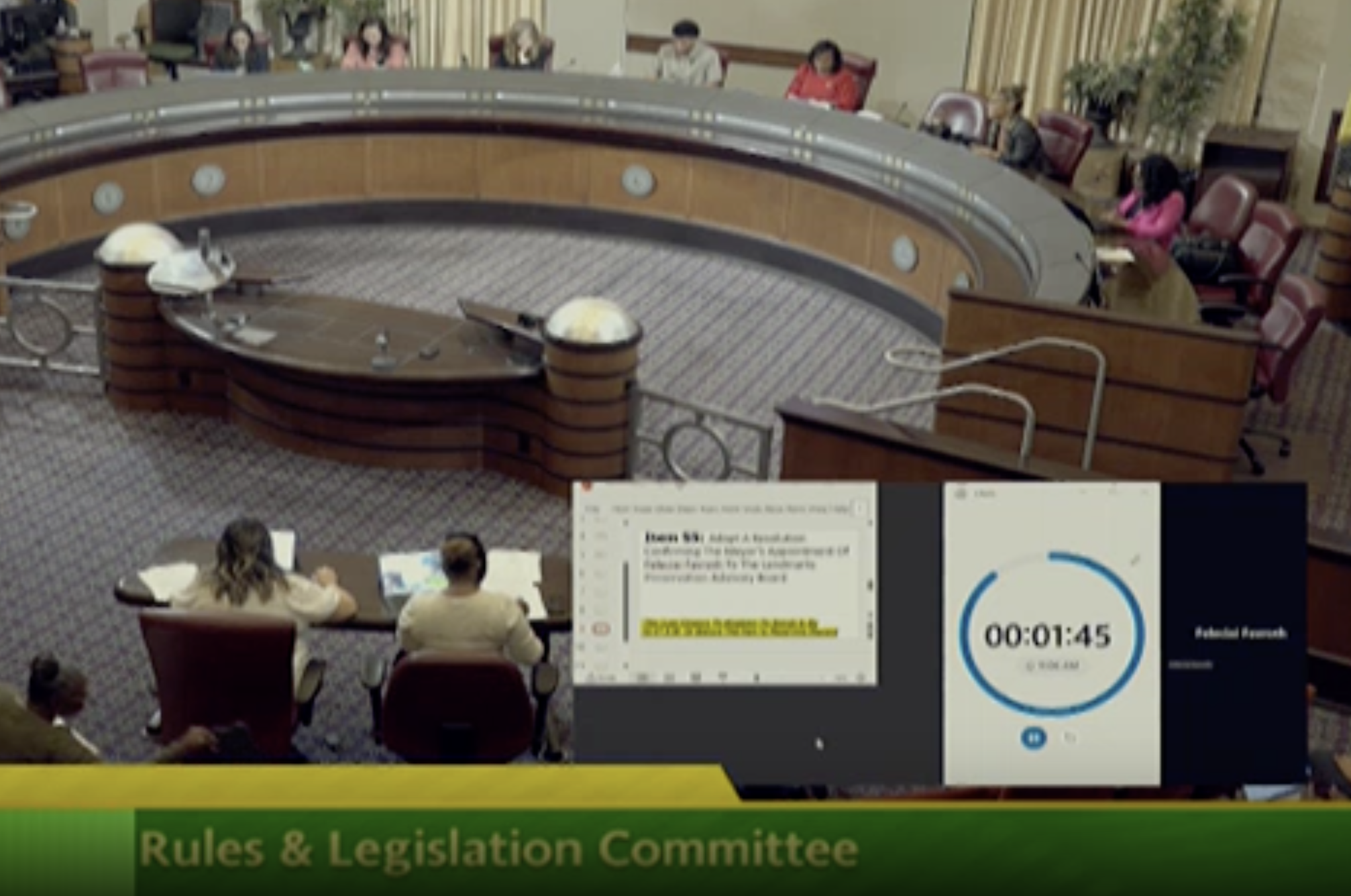
  • Feleciai Favroth confirmed to the Landmarks Preservation Advisory Board via urgency finding to maintain quorum; forwarded to July 7 Council on consent. Councilmember Brown called her "an amazing community advocate in this space."

Foreclosure Tax Ballot Measure Stalls as Sweeps Funding Sparks Backlash | Rules & Legislation Committee | Locunity